Refine search
Actions for selected content:
212758 results in Engineering
9 - Mobile Molecular Communication
-
- Book:
- Molecular Communication
- Published online:
- 12 December 2024
- Print publication:
- 19 December 2024, pp 160-179
-
- Chapter
- Export citation
1 - Introduction
-
- Book:
- Molecular Communication
- Published online:
- 12 December 2024
- Print publication:
- 19 December 2024, pp 1-21
-
- Chapter
- Export citation
Index
-
- Book:
- Wind Turbines
- Published online:
- 24 January 2025
- Print publication:
- 19 December 2024, pp 429-434
-
- Chapter
- Export citation
14 - Large-Scale Structure Formation of Bio-nanomachines
-
- Book:
- Molecular Communication
- Published online:
- 12 December 2024
- Print publication:
- 19 December 2024, pp 253-269
-
- Chapter
- Export citation
Allowed LS Coupling Terms for Equivalent d2 Electrons
-
- Book:
- Fundamentals of Laser Spectroscopy for Atoms and Diatomic Molecules
- Published online:
- 12 December 2024
- Print publication:
- 19 December 2024, pp 371-375
-
- Chapter
- Export citation
Contents
-
- Book:
- Fundamentals of Laser Spectroscopy for Atoms and Diatomic Molecules
- Published online:
- 12 December 2024
- Print publication:
- 19 December 2024, pp vii-viii
-
- Chapter
- Export citation
3D-printed wideband reflectarray antennas with mechanical beam-steering – CORRIGENDUM
-
- Journal:
- International Journal of Microwave and Wireless Technologies / Volume 16 / Issue 7 / September 2024
- Published online by Cambridge University Press:
- 19 December 2024, p. 1260
-
- Article
-
- You have access
- HTML
- Export citation
Contents
-
- Book:
- Molecular Communication
- Published online:
- 12 December 2024
- Print publication:
- 19 December 2024, pp v-xii
-
- Chapter
- Export citation
A compact self-quintuplexing antenna by HM-SIW cavity
-
- Journal:
- International Journal of Microwave and Wireless Technologies / Volume 16 / Issue 9 / November 2024
- Published online by Cambridge University Press:
- 18 December 2024, pp. 1561-1569
-
- Article
- Export citation
Frederick W. Lanchester and Aerodynamics: why an automotive engineer wrote a book for aerodynamic education
-
- Journal:
- The Aeronautical Journal / Volume 129 / Issue 1331 / January 2025
- Published online by Cambridge University Press:
- 18 December 2024, pp. 1-41
-
- Article
- Export citation
Pulse splitting technique for low sidelobe time-modulated antenna array synthesis with harmonic suppression
-
- Journal:
- International Journal of Microwave and Wireless Technologies / Volume 16 / Issue 7 / September 2024
- Published online by Cambridge University Press:
- 18 December 2024, pp. 1155-1161
-
- Article
- Export citation
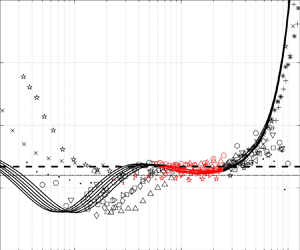
The vertical-velocity skewness in the inertial sublayer of turbulent wall flows
-
- Journal:
- Journal of Fluid Mechanics / Volume 1001 / 25 December 2024
- Published online by Cambridge University Press:
- 18 December 2024, R1
-
- Article
-
- You have access
- Open access
- HTML
- Export citation
-
Empirical evidence is provided that within the inertial sublayer (i.e. logarithmic region) of adiabatic turbulent flows over smooth walls, the skewness of the vertical-velocity component $S_w$ displays universal behaviour, being a positive constant and constrained within the range $S_w \approx 0.1\unicode{x2013}0.16$, regardless of flow configuration and Reynolds number. A theoretical model is then proposed to explain this behaviour, including the observed range of variations of $S_w$. The proposed model clarifies why $S_w$ cannot be predicted from down-gradient closure approximations routinely employed in large-scale meteorological and climate models. The proposed model also offers an alternative and implementable approach for such large-scale models.


120 GHz MIMO FMCW radar chipset in a SiGe bipolar technology
-
- Journal:
- International Journal of Microwave and Wireless Technologies / Volume 17 / Issue 2 / March 2025
- Published online by Cambridge University Press:
- 16 December 2024, pp. 164-176
-
- Article
-
- You have access
- Open access
- HTML
- Export citation
Frictional effects on shear-induced diffusion in suspensions of non-Brownian particles
-
- Journal:
- Journal of Fluid Mechanics / Volume 1001 / 25 December 2024
- Published online by Cambridge University Press:
- 16 December 2024, A42
-
- Article
-
- You have access
- Open access
- HTML
- Export citation
Reasoning about physical processes in buildings through component stereotypes
- Part of
-
- Journal:
- Data-Centric Engineering / Volume 5 / 2024
- Published online by Cambridge University Press:
- 16 December 2024, e40
-
- Article
-
- You have access
- Open access
- HTML
- Export citation
Identifying internal and external shoulder rotation using a kirigami-based shoulder patch
-
- Journal:
- Wearable Technologies / Volume 5 / 2024
- Published online by Cambridge University Press:
- 16 December 2024, e23
-
- Article
-
- You have access
- Open access
- HTML
- Export citation
Reinforcement learning-adaptive fault-tolerant IGC method for a class of aircraft with non-affine characteristics and multiple uncertainties – CORRIGENDUM
-
- Journal:
- The Aeronautical Journal , First View
- Published online by Cambridge University Press:
- 16 December 2024, p. 1
-
- Article
-
- You have access
- HTML
- Export citation
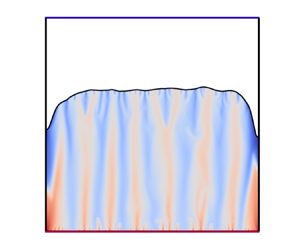
Vibration-induced morphological evolution of a melting solid under microgravity
-
- Journal:
- Journal of Fluid Mechanics / Volume 1001 / 25 December 2024
- Published online by Cambridge University Press:
- 16 December 2024, A43
-
- Article
- Export citation
-
We study the melting process of a solid under microgravity, driven solely by lateral vibrations that are perpendicular to the applied temperature gradient due to the absence of gravity-induced convection. Using direct numerical simulations with the phase-field method, we examine two-dimensional vibration-induced melting in a square cavity over four orders of magnitude of vibrational Rayleigh numbers, $10^5\le Ra_{{vib}}\le 10^9$. Our results show that as melting progresses, the flow structure transitions from a periodic-circulation regime with diffusion-dominated heat transfer to a columnar regime with vibroconvection. The mean height of the liquid–solid interface follows a power-law dependency with time, $\bar {\xi } \sim \tilde t^{1/(2-2\alpha )}$, where $\alpha = 0$ in the periodic-circulation regime and $\alpha = 1/2$ in the columnar regime. We further observe that within the columnar regime, the morphological evolution of the liquid–solid interface is influenced by the interaction of columnar thermal plumes in the central regions and the peripheral flow near the sidewalls. Specifically, we offer a comprehensive analysis of the plume merging behaviour, which is governed by the aspect ratio ( $\bar {\xi }$) of the liquid layer and the intensity of vibration, quantified by the effective vibrational Rayleigh number $Ra_{vib}^{eff}$. We identify the relationship between the number of columnar plumes $K_m$ and $Ra_{vib}^{eff}$, finding that $K_m \sim \bar {\xi }^{-1} (Ra_{vib}^{eff})^{\gamma }$ with the fitting scaling exponent $\gamma = 0.150 \pm 0.025$. We subsequently quantify the characteristics of the interface roughness amplitude evolution in microgravity vibroconvection. Our results indicate that the roughness amplitude exhibits a power-law dependence on the mean height of the liquid layer. Drawing from the Stefan boundary condition, we theoretically deduce this dependence under the assumption of a non-uniform heat flux distribution at the interface, where the theory is corroborated by our numerical simulations.


A multi-layer Kriging surrogate model for the reliability analysis of variable stator vanes in aero engines
-
- Journal:
- The Aeronautical Journal / Volume 129 / Issue 1331 / January 2025
- Published online by Cambridge University Press:
- 16 December 2024, pp. 123-143
-
- Article
- Export citation
-
The variable stator vanes (VSV) are a set of typical spatial linkage mechanisms widely used in the variable cycle engine compressor. Various factors influence the angle adjustment precision of the VSV, leading to the failure of the mechanism. The reliability analysis of VSV is a complex task due to the involvement of multiple components, high dimensionality input and computational inefficiency. Considering the hierarchical characteristics of VSV structure, we propose a novel multi-layer Kriging surrogate (MLKG) for the reliability analysis of VSV. The MLKG combines multiple Kriging surrogate models arranged in a hierarchical structure. By breaking the problem down into more minor problems, MLKG works by presenting each small problem as a Kriging model and reducing the input dimension of the sub-layer Kriging model. In this way, the MLKG can capture the complex interactions between the inputs and outputs of the problem while maintaining a high degree of accuracy and efficiency. This study proves the error propagation process of MLKG. To evaluate MLKG’s accuracy, we test it on two typical high-dimensional non-linearity functions (Rosenbrock and Michalewicz function). We compared MLKG with some contemporary KG surrogate modeling techniques using mean squared error (MSE) and R square ( ${R^2}$). Results show that MLKG achieves an excellent level of accuracy for reliability analysis in high-dimensional problems with a small number of sample points.

Small aircraft flight trajectory optimisation using a multidisciplinary approach
-
- Journal:
- The Aeronautical Journal / Volume 129 / Issue 1333 / March 2025
- Published online by Cambridge University Press:
- 16 December 2024, pp. 671-689
-
- Article
- Export citation
