Refine search
Actions for selected content:
212937 results in Engineering
3 - Classical Nucleation Theory
-
- Book:
- Nucleation of Particles from the Gas Phase
- Published online:
- 30 May 2024
- Print publication:
- 06 June 2024, pp 32-93
-
- Chapter
- Export citation
Foreword
-
-
- Book:
- Who's Doing What?
- Published by:
- ISEAS–Yusof Ishak Institute
- Published online:
- 05 July 2025
- Print publication:
- 06 June 2024, pp v-vi
-
- Chapter
- Export citation
Who’s Doing What? A Closer Look at Methane Climate Impact and Commitments in Southeast Asia’s Energy Sector
-
-
- Book:
- Who's Doing What?
- Published by:
- ISEAS–Yusof Ishak Institute
- Published online:
- 05 July 2025
- Print publication:
- 06 June 2024, pp 1-39
-
- Chapter
- Export citation
Copyright page
-
- Book:
- Nucleation of Particles from the Gas Phase
- Published online:
- 30 May 2024
- Print publication:
- 06 June 2024, pp iv-iv
-
- Chapter
- Export citation

Modern Robotics
- Mechanics, Planning, and Control
-
- Published online:
- 04 June 2024
- Print publication:
- 25 May 2017
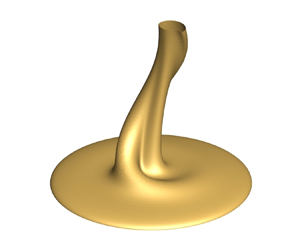
Critical transitions on a route to chaos of natural convection on a heated horizontal circular surface
-
- Journal:
- Journal of Fluid Mechanics / Volume 988 / 10 June 2024
- Published online by Cambridge University Press:
- 04 June 2024, A38
-
- Article
- Export citation
-
The transition route and bifurcations of the buoyant flows developing on a heated horizontal circular surface are elaborated using direct numerical simulations and direct stability analysis. A series of bifurcations, as a function of Rayleigh numbers ( $Ra$) ranging from $10^6$ to $6.0\times 10^7$, are found on the route to chaos of the flows at $Pr=7$. When $Ra<1.0\times 10^3$, the buoyant flows above the heated horizontal surface are dominated by conduction, because of which the distinct thermal boundary layer and plume are not present. At $Ra=1.1\times 10^6$, a Hopf bifurcation occurs, resulting in the flow transition from a steady state to a periodic puffing state. As $Ra$ increases further, the flow enters a periodic rotating state at $Ra=1.9\times 10^6$, which is a unique state that was rarely discussed in the literature. These critical transitions, leaving from a steady state and subsequently entering a series of periodic states (puffing, rotating, flapping and period-doubling) and finally leading to chaos, are diagnosed using two-dimensional Fourier transforms. Moreover, direct stability analysis is conducted by introducing random numerical perturbations into the boundary condition of the surface heating. We find that when the state of a flow is in the vicinity of critical values (e.g. $Ra=2.0\times 10^6$), the flow is conditionally unstable to perturbations, and it can bifurcate from the rotating state to the flapping state in advance. However, for relatively stable flow states, such as at $Ra=1.5\times 10^6$, the flow remains in its periodic puffing state even though it is being perturbed.


New design of materials, order and thicknesses of an aircraft windshield behaviour layers to increase its resistance against repeated bird impacts
-
- Journal:
- The Aeronautical Journal / Volume 128 / Issue 1328 / October 2024
- Published online by Cambridge University Press:
- 04 June 2024, pp. 2235-2260
-
- Article
- Export citation
Bimodal microstructural characterization of Si powder using X-ray diffraction: the role of peak shape
-
- Journal:
- Powder Diffraction / Volume 39 / Issue 3 / September 2024
- Published online by Cambridge University Press:
- 04 June 2024, pp. 119-131
-
- Article
- Export citation
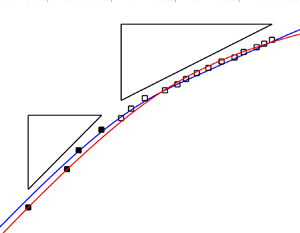
Capillary rise in partially saturated rigid porous media
-
- Journal:
- Journal of Fluid Mechanics / Volume 988 / 10 June 2024
- Published online by Cambridge University Press:
- 04 June 2024, A36
-
- Article
-
- You have access
- Open access
- HTML
- Export citation
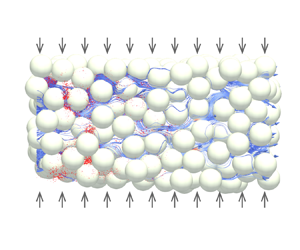
Non-monotonic effect of compaction on longitudinal dispersion coefficient of porous media
-
- Journal:
- Journal of Fluid Mechanics / Volume 988 / 10 June 2024
- Published online by Cambridge University Press:
- 04 June 2024, R2
-
- Article
- Export citation
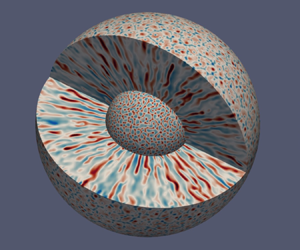
Fingering convection in a spherical shell
-
- Journal:
- Journal of Fluid Mechanics / Volume 988 / 10 June 2024
- Published online by Cambridge University Press:
- 04 June 2024, A18
-
- Article
- Export citation
-
We use $123$ three-dimensional direct numerical simulations to study fingering convection in non-rotating spherical shells. We investigate the scaling behaviour of the flow length scale, the non-dimensional heat and compositional fluxes $Nu$ and $Sh$ and the mean convective velocity over the fingering convection instability domain defined by $1 \leq R_\rho < Le$, $R_\rho$ being the ratio of density perturbations of thermal and compositional origins and $Le$ the Lewis number. We show that the chemical boundary layers are marginally unstable and adhere to the laminar Prandtl–Blasius model, hence explaining the asymmetry between the inner and outer spherical shell boundary layers. We develop scaling laws for two asymptotic regimes close to the two edges of the instability domain, namely $R_\rho \lesssim Le$ and $R_\rho \gtrsim 1$. For the former, we develop novel power laws of a small parameter $\epsilon$ measuring the distance to onset, which differ from theoretical laws published to date in Cartesian geometry. For the latter, we find that the Sherwood number $Sh$ gradually approaches a scaling $Sh\sim Ra_\xi ^{1/3}$ when $Ra_\xi \gg 1$; and that the Péclet number accordingly follows $Pe \sim Ra_\xi ^{2/3} |Ra_T|^{-1/4}$, $Ra_T$ and $Ra_{\xi}$ being the thermal and chemical Rayleigh numbers. When the Reynolds number exceeds a few tens, we report on a secondary instability which takes the form of large-scale toroidal jets which span the entire spherical domain. Jets distort the fingers, resulting in Reynolds stress correlations, which in turn feed the jet growth until saturation. This nonlinear phenomenon can yield relaxation oscillation cycles.


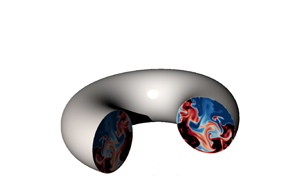
A critical transition of two-dimensional flow in toroidal geometry
-
- Journal:
- Journal of Fluid Mechanics / Volume 988 / 10 June 2024
- Published online by Cambridge University Press:
- 04 June 2024, A33
-
- Article
-
- You have access
- Open access
- HTML
- Export citation
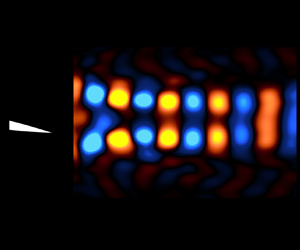
Connections between propulsive efficiency and wake structure via modal decomposition
-
- Journal:
- Journal of Fluid Mechanics / Volume 988 / 10 June 2024
- Published online by Cambridge University Press:
- 04 June 2024, A35
-
- Article
-
- You have access
- Open access
- HTML
- Export citation
-
We present experiments on oscillating hydrofoils undergoing combined heaving and pitching motions, paying particular attention to connections between propulsive efficiency and coherent wake features extracted using modal analysis. Time-averaged forces and particle image velocimetry measurements of the flow field downstream of the foil are presented for a Reynolds number of $Re=11\times 10^3$ and Strouhal numbers in the range $St=0.16\unicode{x2013}0.35$. These conditions produce 2S and 2P wake patterns, as well as a near-momentumless wake structure. A triple decomposition using the optimized dynamic mode decomposition method is employed to identify dominant modal components (or coherent structures) in the wake. These structures can be connected to wake instabilities predicted using spatial stability analyses. Examining the modal components of the wake provides insightful explanations into the transition from drag to thrust production, and conditions that lead to peak propulsive efficiency. In particular, we find modes that correspond to the primary vortex development in the wakes. Other modal components capture elements of bluff body shedding at Strouhal numbers below the optimum for peak propulsive efficiency and characteristics of separation for Strouhal numbers higher than the optimum.
Advancing digital healthcare engineering for aging ships and offshore structures: an in-depth review and feasibility analysis
- Part of
-
- Journal:
- Data-Centric Engineering / Volume 5 / 2024
- Published online by Cambridge University Press:
- 03 June 2024, e18
-
- Article
-
- You have access
- Open access
- HTML
- Export citation
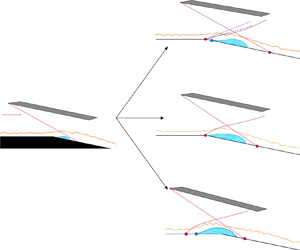
On incident shock wave/boundary layer interactions under the influence of expansion corner
-
- Journal:
- Journal of Fluid Mechanics / Volume 988 / 10 June 2024
- Published online by Cambridge University Press:
- 03 June 2024, A28
-
- Article
- Export citation
Simulation of particle-laden flows and erosion in an axial fan stage considering the relative position of the blades
- Part of
-
- Journal:
- The Aeronautical Journal / Volume 128 / Issue 1325 / July 2024
- Published online by Cambridge University Press:
- 03 June 2024, pp. 1379-1416
-
- Article
-
- You have access
- Open access
- HTML
- Export citation
-
Axial fans are vital accessories in aircraft ventilation systems, but, they may experience erosion from particulate flows, causing a decline in effectiveness over time. This study investigated the trajectories of two types of sand particles and erosion in an axial fan stage, considering the relative position of the blades facing the inlet guide vanes.
The movement of particles was simulated using an in-house code that implements a Lagrangian approach along with a stochastic particle-eddy interaction model. The flow field was solved separately and the flow data was transferred to the particle trajectory code. The finite element method allowed for the tracking of particles through the computational cells and accurate determination of their impact positions. A semi-empirical erosion correlation was used to evaluate the local erosion rates, mass removal, and geometry deterioration.
As a result, the rotor exhibits a high frequency of impacts and significant erosion on the leading edge of the blade, extending to the upper corner of the pressure side and blade tip, as well as the front of the suction side. In the inlet guide vane, the erosion is spread out along the entire pressure side but at lower erosion rates compared to the rotor blade. The erosion patterns obtained at different pitch-wise positions were cumulated to get better representation of erosion patterns. After being exposed to MIL-E5007E sand (0–1000 $\unicode{x03BC}$m) at the highest concentration for 10 hours, the blade experienced a reduction of a 0.29% in mass, a 0.45% decrease in tip chord, and a 0.23% increase in tip clearance. On the other hand, AC-coarse sand (0–200 μm) resulted in a 0.23% decrease in blade mass, a 0.4% reduction in tip chord, and a 0.16% increase in tip clearance.
The data that is available can be used to monitor the lifespan of axial fans of similar design and select appropriate coatings to protect against erosion.

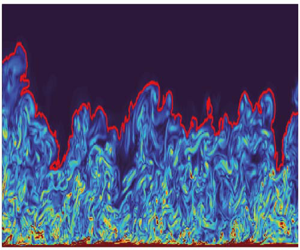
Investigations on the turbulent ${\boldsymbol{/}}$non-turbulent interface in supersonic compressible plate turbulent boundary layer
-
- Journal:
- Journal of Fluid Mechanics / Volume 988 / 10 June 2024
- Published online by Cambridge University Press:
- 03 June 2024, A30
-
- Article
- Export citation
-
The turbulent boundary layer (TBL) is a widely existing flow phenomenon in nature and engineering applications. Its strong mixing effect can achieve more sufficient material mixing, heat transport, etc. The understanding of the entrainment process and mechanism of irrotational fluids entering the turbulent region can be promoted by studying the geometric and dynamic characteristics of turbulent ${/}$non-turbulent interfaces (TNTI). In compressible flow, it is unclear whether the properties of TNTI will change and whether the entrainment will show different features due to the influence of compressibility. Based on the direct numerical simulation results of supersonic compressible plate TBLs with Mach number of 2.9, the geometric and dynamic characteristics of TNTI are investigated in this paper. The interface is identified by the enstrophy method, and the height, thickness, fractal dimension, enstrophy transportation and entrainment characteristics of the interface are investigated. It is found that for the enstrophy transportation in a TBL, the contribution of compressibility-related terms accounts for approximately 13.4 % of the total enstrophy transportation, which tends to transfer the enstrophy of turbulence near the interface to both directions vertical to the interface. This promotes the expansion of the turbulent region towards the non-turbulent region, and the mean height, thickness and entrainment velocity are increased by approximately 3.7 %, 7.0 % and 8.5 %, respectively, while the fractal dimension is basically unaffected. Different from the incompressible flow, the contribution of the compressibility-related terms to the entrainment velocity is independent of the local curvature, and the intense entrainment process is more likely to occur on a highly curved concave surface.


Hypersonic turbulent boundary layer over the windward side of a lifting body
-
- Journal:
- Journal of Fluid Mechanics / Volume 988 / 10 June 2024
- Published online by Cambridge University Press:
- 03 June 2024, A29
-
- Article
- Export citation
-
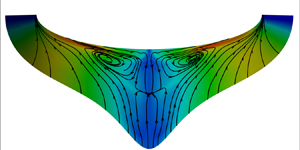
In the present study, we performed direct numerical simulations for a hypersonic turbulent boundary layer over the windward side of a lifting body, the HyTRV model, at Mach number $6$ and attack angle 2 $^{\circ }$ to investigate the global and local turbulent features, and evaluate its difference from canonical turbulent boundary layers. By scrutinizing the instantaneous and averaged flow fields, we found that the transverse curvature on the windward side of the HyTRV model induces the transverse opposing pressure gradients that push the flow on both sides towards the windward symmetry plane, yielding significant effects of the azimuthal inhomogeneity and large-scale cross-stream circulations, moderate and azimuthal independent influences of adverse pressure gradient, and negligible impact of the mean flow three-dimensionality. Further inspecting the local turbulent statistics, we identified that the mean and fluctuating velocity become increasingly similar to the highly decelerated turbulent boundary layers over flat plates in that the mean velocity deficit is enhanced, and the outer layer Reynolds stresses are amplified as it approaches the windward symmetry plane, and prove to be self-similar under the scaling of Wei & Knopp (J. Fluid Mech., vol. 958, 2023, A9) for adverse-pressure-gradient turbulent boundary layers. Conditionally averaged Reynolds stresses based on strong sweeping and ejection events demonstrated that the Kelvin–Helmholtz instability of the strong embedded shear layer induced by the large-scale cross-stream circulations is responsible for the turbulence amplification in the outer layer. The strong Reynolds analogy that relates the mean velocity and temperature was refined to incorporate the non-canonical effects, showing considerable improvements in the accuracy of such a formula. On the other hand, the temperature fluctuations are still transported passively, as indicated by their resemblance to the velocity. The conclusions obtained in the present study provide potentially profitable information for turbulent modelling modification for the accurate predictions of skin friction and wall heat transfer.


Diagnosing the fast-heating process of the double-cone ignition scheme with X-ray spectroscopy
-
- Journal:
- High Power Laser Science and Engineering / Volume 12 / 2024
- Published online by Cambridge University Press:
- 03 June 2024, e50
-
- Article
-
- You have access
- Open access
- HTML
- Export citation
The influence of space environmental factors on the laser-induced damage thresholds in optical components
-
- Journal:
- High Power Laser Science and Engineering / Volume 12 / 2024
- Published online by Cambridge University Press:
- 03 June 2024, e47
-
- Article
-
- You have access
- Open access
- HTML
- Export citation
