Refine search
Actions for selected content:
212927 results in Engineering
Rheological measurements and transition to turbulence for moderate Reynolds number inertial suspensions
-
- Journal:
- Journal of Fluid Mechanics / Volume 988 / 10 June 2024
- Published online by Cambridge University Press:
- 31 May 2024, A19
-
- Article
- Export citation
-
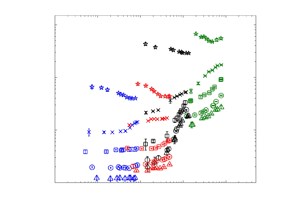
Particulate flows at moderate particle Reynolds numbers are important in critical engineering and geological applications. This experimental study explores neutrally buoyant suspensions in an outer-rotating coaxial rheometer for solid fractions, $\phi$, from 0.1 to 0.5, and particle Reynolds number, $Re$, from 0.5 to 800, covering laminar, transitional and turbulent regimes; $Re$ is defined in terms of the square of the particle diameter and the shear rate. For $0.1 < \phi < 0.4$ and $0.5 < Re <10$, the direct torque measurements normalised by the laminar flow torque, $M/M_{lam}$, are independent of $Re$, but depend on $\phi$. For the same range of $\phi$ and for $10< Re<100$, the normalised torques depend on both $\phi$ and $Re$, and show an increasing dependence on $Re$. As $Re$ increases, the flow transitions to turbulence. Small particles delay the turbulent transition for $\phi \leqslant 0.3$, while large particles augment the transition. A modified Reynolds number, $Re^\prime$, that depends linearly on the particle diameter and the maximum velocity, $U_{o}$, is introduced for both laminar and turbulent flows and shows a better correlation of the results as compared with $Re$. For $\phi = 50\,\%$, the normalised torque minus the torque at zero rotational speed is nearly independent of $Re^\prime$. Rheological models based on $Re^\prime$ and the Krieger–Dougherty relative viscosity are proposed in the laminar regime for $10< Re^\prime <500$; in the turbulent regime, a correlation is proposed in terms of $Re^\prime$ and $\phi$ for $1000< Re^\prime < 6000$.


Finite-size inertial spherical particles in turbulence
-
- Journal:
- Journal of Fluid Mechanics / Volume 988 / 10 June 2024
- Published online by Cambridge University Press:
- 31 May 2024, A17
-
- Article
-
- You have access
- Open access
- HTML
- Export citation
-
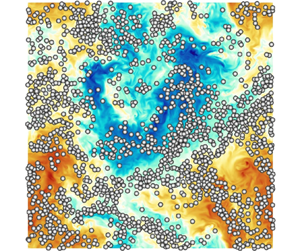
We investigate by direct numerical simulations the fluid–solid interaction of non-dilute suspensions of spherical particles moving in triperiodic turbulence, at the relatively large Reynolds number of $Re_\lambda \approx 400$. The solid-to-fluid density ratio is varied between $1.3$ and $100$, the particle diameter $D$ is in the range $16 \le D/\eta \le 123$ ( $\eta$ is the Kolmogorov scale) and the volume fraction of the suspension is $0.079$. Turbulence is sustained using the Arnold–Beltrami–Childress cellular-flow forcing. The influence of the solid phase on the largest and energetic scales of the flow changes with the size and density of the particles. Light and large particles modulate all scales in an isotropic way, while heavier and smaller particles modulate the largest scales of the flow towards an anisotropic state. Smaller scales are isotropic and homogeneous for all cases. The mechanism driving the energy transfer across scales changes with the size and the density of the particles. For large and light particles the energy transfer is only marginally influenced by the fluid–solid interaction. For small and heavy particles, instead, the classical energy cascade is subdominant at all scales, and the energy transfer is essentially driven by the fluid–solid coupling. The influence of the solid phase on the flow intermittency is also discussed. Besides, the collective motion of the particles and their preferential location in relation to properties of the carrier flow are analysed. The solid phase exhibits moderate clustering; for large particles the level of clustering decreases with their density, while for small particles it is maximum for intermediate values.


Experimental study of a single bubble's motion in a liquid metal under a horizontal magnetic field
-
- Journal:
- Journal of Fluid Mechanics / Volume 988 / 10 June 2024
- Published online by Cambridge University Press:
- 31 May 2024, A21
-
- Article
- Export citation
-
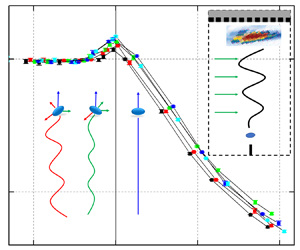
An ultrasonic phased array system is introduced to study the three-dimensional (3-D) movement of a single bubble in a GaInSn alloy under a transverse magnetic field (MF), which is verified by bubble experiments in water. The 3-D motion trajectories of individual bubbles in the GaInSn are obtained under a horizontal MF. As the MF becomes stronger, the bubble successively oscillates in random directions (R mode), a direction perpendicular to the MF (V mode), a direction parallel to the MF (P mode) and finally it rises straight (S mode). The significant anisotropy of the oscillation directions at a moderate MF intensity may be due to the anisotropy of the vortex structure around the bubble. Furthermore, the oscillation amplitude gradually declines with increasing MF intensity until the bubble trajectory finally becomes a straight line. Our measurements allow us to specify the characteristic regions for the observed bubble modes in the $N-Eo-Re$ parameter space (N is the magnetic interaction parameter, Eo is the Eötvös number and Re is the Reynolds number). In addition, more detailed characteristics of bubble terminal velocity are revealed, showing that the bubble velocities are closely related to the motion modes. The increase in bubble velocity at a moderate MF intensity is caused by the weakening oscillation. At a high strength, the MF monotonically suppresses the rise velocity of the bubble with a fixed scaling law.
Two-dimensional turbulence above topography: condensation transition and selection of minimum enstrophy solutions
-
- Journal:
- Journal of Fluid Mechanics / Volume 988 / 10 June 2024
- Published online by Cambridge University Press:
- 31 May 2024, A13
-
- Article
-
- You have access
- Open access
- HTML
- Export citation
Fluctuation covariance-based study of roll-streak dynamics in Poiseuille flow turbulence
-
- Journal:
- Journal of Fluid Mechanics / Volume 988 / 10 June 2024
- Published online by Cambridge University Press:
- 31 May 2024, A14
-
- Article
-
- You have access
- Open access
- HTML
- Export citation
-
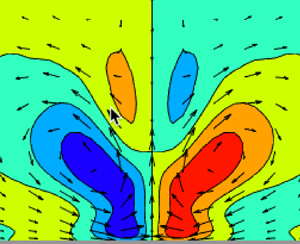
Although the roll-streak (R-S) is fundamentally involved in the dynamics of wall turbulence, the physical mechanism responsible for its formation and maintenance remains controversial. In this work we investigate the dynamics maintaining the R-S in turbulent Poiseuille flow at $R=1650$. Spanwise collocation is used to remove spanwise displacement of the streaks and associated flow components, which isolates the streamwise-mean flow R-S component and the second-order statistics of the streamwise-varying fluctuations that are collocated with the R-S. This partition of the dynamics into streamwise-mean and fluctuation components facilitates exploiting insights gained from the analytic characterization of turbulence in the second-order statistical state dynamics (SSD), referred to as S3T, and its closely associated restricted nonlinear dynamics (RNL) approximation. Symmetry of the statistics about the streak centreline permits separation of the fluctuations into sinuous and varicose components. The Reynolds stress forcing induced by the sinuous and varicose fluctuations acting on the R-S is shown to reinforce low- and high-speed streaks, respectively. This targeted reinforcement of streaks by the Reynolds stresses occurs continuously as the fluctuation field is strained by the streamwise-mean streak and not intermittently as would be associated with streak-breakdown events. The Reynolds stresses maintaining the streamwise-mean roll arise primarily from the dominant proper orthogonal decomposition (POD) modes of the fluctuations, which can be identified with the time average structure of optimal perturbations growing on the streak. These results are consistent with a universal process of R-S growth and maintenance in turbulent shear flow arising from roll forcing generated by straining turbulent fluctuations, which was identified using the S3T SSD.

Flow of an Oldroyd-B fluid in a slowly varying contraction: theoretical results for arbitrary values of Deborah number in the ultra-dilute limit
-
- Journal:
- Journal of Fluid Mechanics / Volume 988 / 10 June 2024
- Published online by Cambridge University Press:
- 31 May 2024, A10
-
- Article
-
- You have access
- Open access
- HTML
- Export citation
-
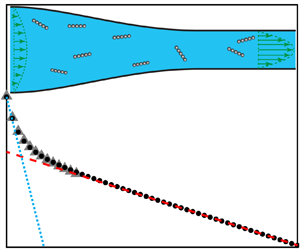
Pressure-driven flows of viscoelastic fluids in narrow non-uniform geometries are common in physiological flows and various industrial applications. For such flows, one of the main interests is understanding the relationship between the flow rate $q$ and the pressure drop $\Delta p$, which, to date, is studied primarily using numerical simulations. We analyse the flow of the Oldroyd-B fluid in slowly varying arbitrarily shaped, contracting channels and present a theoretical framework for calculating the $q-\Delta p$ relation. We apply lubrication theory and consider the ultra-dilute limit, in which the velocity profile remains parabolic and Newtonian, resulting in a one-way coupling between the velocity and polymer conformation tensor. This one-way coupling enables us to derive closed-form expressions for the conformation tensor and the flow rate–pressure drop relation for arbitrary values of the Deborah number ( $De$). Furthermore, we provide analytical expressions for the conformation tensor and the $q-\Delta p$ relation in the high-Deborah-number limit, complementing our previous low-Deborah-number lubrication analysis. We reveal that the pressure drop in the contraction monotonically decreases with $De$, having linear scaling at high Deborah numbers, and identify the physical mechanisms governing the pressure drop reduction. We further elucidate the spatial relaxation of elastic stresses and pressure gradient in the exit channel following the contraction and show that the downstream distance required for such relaxation scales linearly with $De$.
$De$.


Influence of vibrational non-equilibrium on the dynamics of velocity gradients in compressible flows
-
- Journal:
- Journal of Fluid Mechanics / Volume 988 / 10 June 2024
- Published online by Cambridge University Press:
- 31 May 2024, A24
-
- Article
-
- You have access
- Open access
- HTML
- Export citation
The effect of intermittency in wave forcing on the quasi-biennial oscillation
-
- Journal:
- Journal of Fluid Mechanics / Volume 988 / 10 June 2024
- Published online by Cambridge University Press:
- 31 May 2024, A16
-
- Article
-
- You have access
- Open access
- HTML
- Export citation
-
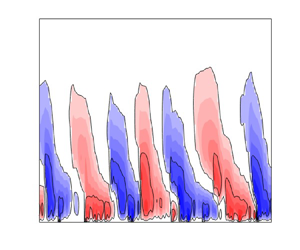
The Holton–Lindzen–Plumb (HLP) model of the quasi-biennial oscillation (QBO) is investigated in order to assess the impact of introducing intermittency in the wave forcing. Intermittency is introduced to HLP by allowing the amplitude of the waves which force the QBO to evolve according to a stationary random process, driven by a stochastic differential equation (SDE) with an associated time scale $\tau$. Provided that $\tau$ is much shorter than the QBO period, it is shown that the impact on the QBO of the intermittent forcing is captured by a single intermittency parameter $\lambda$, and the value of $\lambda$ is proportional to $\tau$ and otherwise depends upon the details of the SDE. Numerical simulations, using a family of mean-reverting Ornstein–Uhlenbeck processes as the choice of SDE, show that the effect of increasing the intermittency parameter is invariably to decrease the QBO amplitude and increase its period. Changes to the QBO amplitude and period are indeed found to collapse onto a single curve controlled by $\lambda$, as predicted by the theory, provided that $\tau$ is small enough for the approximations used to be valid. The extension to broadband forcing is discussed in the context of stochastic gravity wave parameterisation, with the eventual goal of developing a representation of source intermittency in the most general situation with close fidelity to the physics.


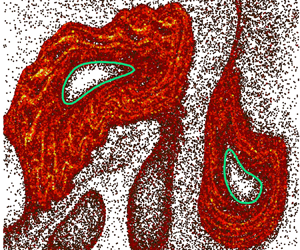
Enhancing transport barriers with swimming micro-organisms in chaotic flows
-
- Journal:
- Journal of Fluid Mechanics / Volume 988 / 10 June 2024
- Published online by Cambridge University Press:
- 31 May 2024, A25
-
- Article
-
- You have access
- Open access
- HTML
- Export citation

Spreading dynamics of droplets impacting on oscillating hydrophobic substrates
-
- Journal:
- Journal of Fluid Mechanics / Volume 988 / 10 June 2024
- Published online by Cambridge University Press:
- 31 May 2024, A15
-
- Article
-
- You have access
- Open access
- HTML
- Export citation
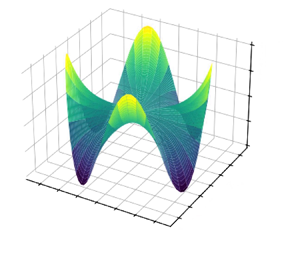
Standing waves, localised near the shoreline of a water basin, and asymptotic quasimodes
-
- Journal:
- Journal of Fluid Mechanics / Volume 988 / 10 June 2024
- Published online by Cambridge University Press:
- 31 May 2024, A22
-
- Article
- Export citation

Nucleation of Particles from the Gas Phase
-
- Published online:
- 30 May 2024
- Print publication:
- 06 June 2024
References
-
- Book:
- Introduction to Marine Dynamics
- Published online:
- 31 October 2024
- Print publication:
- 30 May 2024, pp 288-294
-
- Chapter
- Export citation
On the effects of struts diameter and shape on the European Space Agency deep space antenna directivity and first side lobe
-
- Journal:
- International Journal of Microwave and Wireless Technologies / Volume 16 / Issue 5 / June 2024
- Published online by Cambridge University Press:
- 30 May 2024, pp. 852-861
-
- Article
-
- You have access
- Open access
- HTML
- Export citation
Static and dynamic characteristics of supersonic cruise missile with damaged wing
-
- Journal:
- The Aeronautical Journal / Volume 128 / Issue 1329 / November 2024
- Published online by Cambridge University Press:
- 30 May 2024, pp. 2634-2655
-
- Article
- Export citation
-
Accurately evaluating the aerodynamic performance of the missile with damaged structures is very important for the subsequent flight control strategy. At present, few researchers have studied the aerodynamic characteristics of damaged supersonic cruise missiles. Based on CFD (computational fluid dynamics) solutions and the dynamic derivative identification method, the differences in static and dynamic characteristics between the damaged and undamaged models are compared. The results indicate that when the extent of damage increases, the change rate of drag coefficient at larger AoA (angle-of-attack) is greater than that at the smaller AoA. On the contrary, the change rate of lift coefficient at larger AoA is smaller than that at smaller AoA. Meanwhile, the absolute value of the static pitch moment decreases, but the absolute value of the roll moment increases. Damage causes a change in the absolute values of the pitch and roll dynamic derivatives, and the dynamic derivatives do not vary monotonically with the increase of AoA. The turning point occurs at about $\alpha$ = 5°. The areas of the hysteresis loops of the pitch-roll coupling moment increase, which makes the dynamic coupling characteristic between the pitch and roll directions increase. Finally, the maximum allowable damage extent of the missile wing that can achieve static trim is obtained and validated by controlling the deflection of the four rudders.

Chapter 1 - Preliminaries
- from Part I - Frequency Domain Dynamics
-
- Book:
- Introduction to Marine Dynamics
- Published online:
- 31 October 2024
- Print publication:
- 30 May 2024, pp 3-20
-
- Chapter
- Export citation
Contents
-
- Book:
- Introduction to Marine Dynamics
- Published online:
- 31 October 2024
- Print publication:
- 30 May 2024, pp v-viii
-
- Chapter
- Export citation
A broadband metasurface antenna with multimode resonance
-
- Journal:
- International Journal of Microwave and Wireless Technologies / Volume 16 / Issue 6 / July 2024
- Published online by Cambridge University Press:
- 30 May 2024, pp. 1001-1008
-
- Article
- Export citation
Preface
-
- Book:
- Introduction to Marine Dynamics
- Published online:
- 31 October 2024
- Print publication:
- 30 May 2024, pp ix-x
-
- Chapter
- Export citation
Chapter 8 - Seakeeping
- from Part II - Stochastic Marine Dynamics
-
- Book:
- Introduction to Marine Dynamics
- Published online:
- 31 October 2024
- Print publication:
- 30 May 2024, pp 232-287
-
- Chapter
- Export citation
