Refine search
Actions for selected content:
212937 results in Engineering
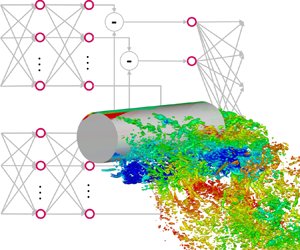
Large eddy simulation of flow over a circular cylinder with a neural-network-based subgrid-scale model
-
- Journal:
- Journal of Fluid Mechanics / Volume 984 / 10 April 2024
- Published online by Cambridge University Press:
- 27 March 2024, A6
-
- Article
-
- You have access
- Open access
- HTML
- Export citation
-
A neural-network-based large eddy simulation is performed for flow over a circular cylinder. To predict the subgrid-scale (SGS) stresses, we train two fully connected neural network (FCNN) architectures with and without fusing information from two separate single-frame networks (FU and nFU, respectively), where the input variable is either the strain rate (SR) or the velocity gradient (VG). As the input variables, only the grid-filtered variables are considered for the SGS models of G-SR and G-VG, and both the grid- and test-filtered variables are considered for the SGS models of T-SR and T-VG. The training data are the filtered direct numerical simulation (fDNS) data at $Re_d=3900$ based on the free-stream velocity and cylinder diameter. Using the same grid resolution as that of the training data, the performances of G-SR and G-VG (grid-filtered inputs) and T-SR-FU and T-VG-FU (grid- and test-filtered inputs with fusion) are better than those of the dynamic Smagorinsky model and T-SR-nFU and T-VG-nFU (grid- and test-filtered inputs without fusion). These FCNN-based SGS models are applied to untrained flows having different grid resolutions from that of training data. Although the performances of G-SR and G-VG are degraded, T-SR-FU and T-VG-FU still provide good performances. Finally, T-SR-FU and T-VG-FU trained at $Re_d = 3900$ are applied to higher-Reynolds-number flows ( $Re_d = 5000$ and 10 000) and their results are also in good agreements with those of fDNS and previous experiment, indicating that adding the test-filtered variables and fusion increases the prediction capability even for untrained Reynolds number flows.


GoldDigger and Checkers, computational developments in cryo-scanning transmission electron tomography to improve the quality of reconstructed volumes
-
- Journal:
- Biological Imaging / Volume 4 / 2024
- Published online by Cambridge University Press:
- 27 March 2024, e6
-
- Article
-
- You have access
- Open access
- HTML
- Export citation
FLM volume 983 Cover and Front matter
-
- Journal:
- Journal of Fluid Mechanics / Volume 983 / 25 March 2024
- Published online by Cambridge University Press:
- 27 March 2024, p. f1
-
- Article
-
- You have access
- Export citation
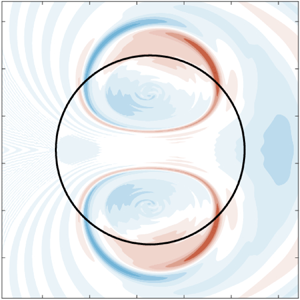
On the linear stability of the Lamb–Chaplygin dipole
-
- Journal:
- Journal of Fluid Mechanics / Volume 984 / 10 April 2024
- Published online by Cambridge University Press:
- 27 March 2024, A7
-
- Article
-
- You have access
- Open access
- HTML
- Export citation
Controlling roll-yaw coupling with aileron and twist design
-
- Journal:
- The Aeronautical Journal / Volume 128 / Issue 1327 / September 2024
- Published online by Cambridge University Press:
- 27 March 2024, pp. 1961-1973
-
- Article
-
- You have access
- Open access
- HTML
- Export citation
Concept of operations for the Neptune system mission Arcanum – CORRIGENDUM
-
- Journal:
- The Aeronautical Journal , First View
- Published online by Cambridge University Press:
- 27 March 2024, p. 1
-
- Article
-
- You have access
- Open access
- HTML
- Export citation
A digital twin for ship structures—R&D project in Japan
- Part of
-
- Journal:
- Data-Centric Engineering / Volume 5 / 2024
- Published online by Cambridge University Press:
- 27 March 2024, e7
-
- Article
-
- You have access
- Open access
- HTML
- Export citation
A spectrum of physics-informed Gaussian processes for regression in engineering
- Part of
-
- Journal:
- Data-Centric Engineering / Volume 5 / 2024
- Published online by Cambridge University Press:
- 27 March 2024, e8
-
- Article
-
- You have access
- Open access
- HTML
- Export citation
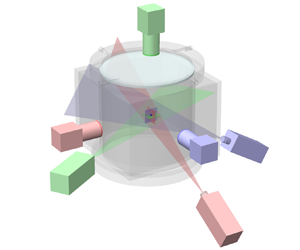
Experimental measurement of spatio-temporally resolved energy dissipation rate in turbulent Rayleigh–Bénard convection
-
- Journal:
- Journal of Fluid Mechanics / Volume 984 / 10 April 2024
- Published online by Cambridge University Press:
- 27 March 2024, A8
-
- Article
- Export citation
-
We report a home-built velocity-gradient-tensor-resolved particle image velocimetry (VGTR-PIV) system which spatio-temporally resolves all components of the velocity gradient tensor. This technique is applied to the paradigmatic turbulent Rayleigh–Bénard convection system in a cylindrical cell at three representative positions, i.e. centre, side and bottom regions. The VGTR-PIV system allows us to directly measure, for the first time, the spatio-temporally resolved energy dissipation rate and enstrophy in turbulent thermal convection. In the experiment, the Rayleigh number $Ra$ varied in the range $2 \times 10^8 \leqslant Ra \leqslant 8 \times 10^9$ and the Prandtl number $Pr$ was fixed at $Pr = 4.34$. Compared with the fully resolved energy dissipation rate $\varepsilon$, the pseudo-dissipation provides the best estimate within $3\,\%$, the planar (two-dimensional) surrogate has a larger relative error and the one-dimensional surrogate leads to the largest error. The power-law scalings of the time-averaged energy dissipation rate with the Rayleigh number follow $\langle \varepsilon _c \rangle _t / (\nu ^3 H^{-4}) = 9.86 \times 10^{-6} Ra^{1.54 \pm 0.02}$, $\langle \varepsilon _s \rangle _t / (\nu ^3 H^{-4}) = 9.26 \times 10^{-3} Ra^{1.25 \pm 0.02}$ and $\langle \varepsilon _b \rangle _t / (\nu ^3 H^{-4}) = 2.70 \times 10^{-2} Ra^{1.23 \pm 0.02}$ in the centre, side and bottom regions, respectively where $\nu$ is dynamic viscosity and $H$ is cell height. These scaling relations, along with our earlier measured time-averaged energy dissipation rate at the bottom wall surface $\langle \varepsilon _w \rangle _t / (\nu ^3 H^{-4}) = 9.65 \times 10^{-2} Ra^{1.25 \pm 0.02}$ (J. Fluid Mech., vol. 947, 2022, A15), provide important constraints against which theoretical models may be tested. For the centre and side locations in the convection cell, the probability density functions (p.d.f.s) of the energy dissipation rate and enstrophy both follow a stretched exponential distribution. For the bottom region, the p.d.f.s of dissipation and enstrophy exhibit a stretched exponential distribution outside the viscous boundary layer and an exponential distribution inside the viscous boundary layer. It is also found that extreme events with high dissipation are the most intermittent in the side region, whereas the bottom region is less intermittent than the cell centre.



Trending Islam
- Cases from Southeast Asia
-
- Published by:
- ISEAS–Yusof Ishak Institute
- Published online:
- 26 March 2024
- Print publication:
- 21 September 2023

Hawker Hunter
- The Story of a Thoroughbred
-
- Published by:
- Amsterdam University Press
- Published online:
- 26 March 2024
- Print publication:
- 25 August 2012
-
- Book
- Export citation

Global Methane Pledge
- A Review of Data, Policy and Transparency in Reducing Methane Emissions in Malaysia
-
- Published by:
- ISEAS–Yusof Ishak Institute
- Published online:
- 26 March 2024
- Print publication:
- 19 September 2023

Martin Mariner
-
- Published by:
- Amsterdam University Press
- Published online:
- 26 March 2024
- Print publication:
- 01 May 2012
-
- Book
- Export citation

English Electric Canberra
-
- Published by:
- Amsterdam University Press
- Published online:
- 26 March 2024
- Print publication:
- 01 August 2014
-
- Book
- Export citation

Warplane 07
- Weis WM.21 Sólyom
-
- Published by:
- Amsterdam University Press
- Published online:
- 26 March 2024
-
- Book
- Export citation

Warplane 04
- Brewster Buffalo
-
- Published by:
- Amsterdam University Press
- Published online:
- 26 March 2024
-
- Book
- Export citation

Warplane 05
- Fokker C.X
-
- Published by:
- Amsterdam University Press
- Published online:
- 26 March 2024
-
- Book
- Export citation
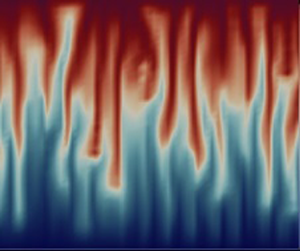
Effect of gravity settling on the onset of thermal convection in a nanofluid-saturated porous medium layer
-
- Journal:
- Journal of Fluid Mechanics / Volume 984 / 10 April 2024
- Published online by Cambridge University Press:
- 26 March 2024, A5
-
- Article
- Export citation
-
The onset of convection in a horizontal porous medium layer saturated with a nanofluid and heated from below is investigated via linear stability analysis and numerical simulation. The Darcy–Buongiorno model is used to describe the convective transport behaviour of the nanofluid and the settling effect of nanoparticles due to gravity is considered in addition to thermophoresis and Brownian diffusion. The linear stability analysis shows that the gravity settling is a substantial stabilizing mechanism restraining the destabilizing factors such as thermal buoyancy and thermophoresis. The stability threshold is determined by the relative strength of thermophoresis to gravity settling. It is found that the system is destabilized when the thermophoretic mobility prevails. As the nanoparticle size increases, the gravity settling effect is promoted and makes the system more stable. In particular, the onset of instability is dominated by the oscillatory mode once the nanoparticle concentration is in a stably stratified profile across the porous layer. When the Rayleigh–Darcy number $Ra_D$ exceeds the critical value, the spectrum of the growth rates of the unstable modes rises with increasing $Ra_D$ and $Rn$ (i.e. the concentration Rayleigh number), and eventually the unstable modes in the high-wavenumber region exhibit the same instability. The evolution of the convection is further examined by numerical simulation. The results verify the stability characteristics predicted by linear stability analysis. Moreover, the pattern of fingering convection of the nanofluid concentration is observed once the nanofluid concentration is unstably stratified and the density difference across the porous layer is large enough.


Introduction
-
- Book:
- Warplane 07
- Published by:
- Amsterdam University Press
- Published online:
- 26 March 2024, pp 2-48
-
- Chapter
- Export citation
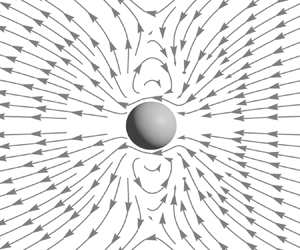
The propulsion direction of nanoparticles trapped in an acoustic field
-
- Journal:
- Journal of Fluid Mechanics / Volume 984 / 10 April 2024
- Published online by Cambridge University Press:
- 26 March 2024, R1
-
- Article
-
- You have access
- Open access
- HTML
- Export citation
