Refine search
Actions for selected content:
212971 results in Engineering
References
-
- Book:
- Pyromania
- Published by:
- Agenda Publishing
- Published online:
- 19 December 2024
- Print publication:
- 23 November 2023, pp 129-136
-
- Chapter
- Export citation
3 - Rethinking firepower and geopolitics
-
- Book:
- Pyromania
- Published by:
- Agenda Publishing
- Published online:
- 19 December 2024
- Print publication:
- 23 November 2023, pp 51-82
-
- Chapter
- Export citation
Index
-
- Book:
- Pyromania
- Published by:
- Agenda Publishing
- Published online:
- 19 December 2024
- Print publication:
- 23 November 2023, pp 137-140
-
- Chapter
- Export citation
1 - The problem of firepower
-
- Book:
- Pyromania
- Published by:
- Agenda Publishing
- Published online:
- 19 December 2024
- Print publication:
- 23 November 2023, pp 11-24
-
- Chapter
- Export citation
Acknowledgements
-
- Book:
- Pyromania
- Published by:
- Agenda Publishing
- Published online:
- 19 December 2024
- Print publication:
- 23 November 2023, pp ix-x
-
- Chapter
- Export citation
2 - Fire history and the making of the modern world
-
- Book:
- Pyromania
- Published by:
- Agenda Publishing
- Published online:
- 19 December 2024
- Print publication:
- 23 November 2023, pp 25-50
-
- Chapter
- Export citation
Anthropocene timeline
-
- Book:
- Pyromania
- Published by:
- Agenda Publishing
- Published online:
- 19 December 2024
- Print publication:
- 23 November 2023, pp 125-128
-
- Chapter
- Export citation
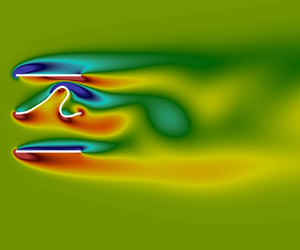
Wall-bounded periodic snap-through and contact of a buckled sheet
-
- Journal:
- Journal of Fluid Mechanics / Volume 976 / 10 December 2023
- Published online by Cambridge University Press:
- 23 November 2023, A1
-
- Article
-
- You have access
- Open access
- HTML
- Export citation
Conclusion: join the fire department!
-
- Book:
- Pyromania
- Published by:
- Agenda Publishing
- Published online:
- 19 December 2024
- Print publication:
- 23 November 2023, pp 121-124
-
- Chapter
- Export citation
Contents
-
- Book:
- Pyromania
- Published by:
- Agenda Publishing
- Published online:
- 19 December 2024
- Print publication:
- 23 November 2023, pp v-vi
-
- Chapter
- Export citation
Frontmatter
-
- Book:
- Pyromania
- Published by:
- Agenda Publishing
- Published online:
- 19 December 2024
- Print publication:
- 23 November 2023, pp i-iv
-
- Chapter
- Export citation
X-ray powder diffraction data for three new compounds obtained as a result of CO2 capture
-
- Journal:
- Powder Diffraction / Volume 38 / Issue 4 / December 2023
- Published online by Cambridge University Press:
- 23 November 2023, pp. 253-258
-
- Article
- Export citation
-
The field of research related to CO2 capture is significant and really attractive for sustainable green chemistry. Focusing attention on this topic in our research led to obtaining new compounds based on diamines. As a result of the syntheses carried out using aqueous solutions of diamines exposed to the slow action of carbon dioxide from the air, three new monocarbamates were obtained. X-ray powder diffraction data for the obtained compounds: 12-propCO2 (C4H10N2O2) [a = 9.3033(7), b = 9.2485(7), c = 7.4735(7) Å, β = 111.214(7)°, V = 599.46 Å3, Z = 4, space group Ia]; 13-propCO2 (C4H10N2O2) [a = 5.0065(10), b = 12.2093(23), c = 4.9006(10) Å, β = 96.457(18)°, V = 297.65 Å3, Z = 2, space group P21]; and 13-dytekCO2 (C6H14N2O2) [a = 28.374(3), c = 5.1726(9) Å, V = 3606.53 Å3, Z = 18, space group $R\bar{3}$] are reported in this paper.

Bespoke stability analysis tool in next-generation computational fluid dynamics solver
-
- Journal:
- The Aeronautical Journal / Volume 128 / Issue 1324 / June 2024
- Published online by Cambridge University Press:
- 23 November 2023, pp. 1164-1182
-
- Article
-
- You have access
- Open access
- HTML
- Export citation
Dedication
-
- Book:
- Pyromania
- Published by:
- Agenda Publishing
- Published online:
- 19 December 2024
- Print publication:
- 23 November 2023, pp vii-viii
-
- Chapter
- Export citation
Introduction: a world on fire
-
- Book:
- Pyromania
- Published by:
- Agenda Publishing
- Published online:
- 19 December 2024
- Print publication:
- 23 November 2023, pp 1-10
-
- Chapter
- Export citation
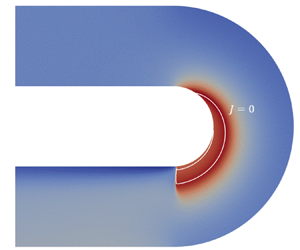
Ideal and non-ideal planar compressible fluid flows in radial equilibrium
-
- Journal:
- Journal of Fluid Mechanics / Volume 975 / 25 November 2023
- Published online by Cambridge University Press:
- 22 November 2023, A43
-
- Article
- Export citation
-
Two-dimensional compressible flows in radial equilibrium are investigated in the ideal dilute-gas regime and the non-ideal single-phase regime close to the liquid–vapour saturation curve and the critical point. Radial equilibrium flows along constant-curvature streamlines are considered. All properties are therefore independent of the tangential streamwise coordinate. A differential relation for the Mach number dependency on the radius is derived for both ideal and non-ideal conditions. For ideal flows, the differential relation is integrated analytically. Assuming a constant specific heat ratio $\gamma$, the Mach number is a monotonically decreasing function of the radius of curvature for ideal flows, with $\gamma$ being the only fluid-dependent parameter. In non-ideal conditions, the Mach number profile also depends on the total thermodynamic conditions of the fluid. For high molecular complexity fluids, such as toluene or hexamethyldisiloxane, a non-monotone Mach number profile is admissible in single-phase supersonic conditions. For Bethe–Zel'dovich–Thompson fluids, non-monotone behaviour is observed in subsonic conditions. Numerical simulations of subsonic and supersonic turning flows are carried out using the streamline curvature method and the computational fluid dynamics software SU2, respectively, both confirming the flow evolution from uniform flow conditions to the radial equilibrium profile predicted by the theory.


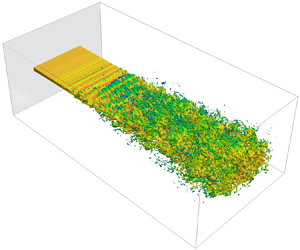
Breakup of planar liquid sheets injected at high speed in a quiescent gas environment
-
- Journal:
- Journal of Fluid Mechanics / Volume 975 / 25 November 2023
- Published online by Cambridge University Press:
- 22 November 2023, A38
-
- Article
-
- You have access
- Open access
- HTML
- Export citation
-
Using a combination of mean flow spatial linear stability and two-dimensional volume-of-fluid (VoF) simulations, the physics governing the instability of high-speed liquid sheets being injected into a quiescent gas environment is studied. It is found that the gas shear layer thickness $\delta _G$ plays an influential role, where for values $\delta _G/H\lesssim 1/8$, the growth of sinuous and varicose modes is nearly indistinguishable. Here, $H$ is the liquid sheet thickness. With larger values of $\delta _G/H$, a second peak develops in the lower wavenumber region of the dispersion relation, and becomes increasingly dominant. This second peak corresponds to a large-scale sinuous mode, and its critical wavelength $\lambda _{crit,sinuous}$ is found to scale as $\lambda _{crit,sinuous}/H = 14.26 (\delta _G/H)^{0.766}$. This scaling behaviour collapses onto a single curve for various combinations of the liquid-based Reynolds ( $Re_L$) and Weber ( $We_L$) numbers, provided that $\delta _G/H > O({10^{-1}})$. For the varicose modes, the shape of the dispersion relation does not change with variations in $\delta _G/H$, and the liquid shear layer thickness has an almost negligible influence on the growth of instabilities. Two-dimensional VoF simulations are employed to examine the validity of the linear stability assumptions. These simulations also show that the dominant sinuous mode remains active as the process transitions into the nonlinear regime, and that this mode is ultimately responsible for fragmenting the sheet. Based on an energy budget analysis, the most influential contributors to the growth of the sinuous mode are the gas Reynolds shear stress and the lateral working of pressure on the gas side.


Dynamic separation on an accelerating prolate spheroid
-
- Journal:
- Journal of Fluid Mechanics / Volume 975 / 25 November 2023
- Published online by Cambridge University Press:
- 22 November 2023, A51
-
- Article
-
- You have access
- Open access
- HTML
- Export citation
-
Time-varying flow separation on an accelerating prolate spheroid has been studied at various angles of incidence. Instantaneous pressure and scanning stereoscopic particle image velocimetry were used to shed light on the evolution of cross-flow structures for the Reynolds number ( $Re$) range of $1.0\times 10^6\leq Re \leq 1.5\times 10^6$. The movement of separation lines is examined for various model accelerations to investigate on the interplay between acceleration and flow separation. The results demonstrate that for axial accelerations, the streamwise pressure distribution in the rear part of the prolate spheroid switches from an adverse to a favourable pressure gradient. At the same time, the circumferential adverse pressure gradient present during steady motion vanishes during said accelerations. In contrast, both streamwise and circumferential adverse pressure gradients strengthen when the model is axially decelerated. These dynamic pressure distributions influence the location of the separation line, which in turn moves closer to the model meridian during accelerations while moving outwards during decelerations. The streamwise vorticity distribution and the streamwise circulation both show how the separation-line position impacts the vortex formation. A high-vorticity region near the model surface is established during acceleration. In contrast, a decelerating model leads to transport of high-vorticity fluid into the outer area of the cross-flow separation. We further assess the memory effects following the near-impulsive velocity changes. The cross-flow retains the memory of moving separation lines shortly after the acceleration. However, the separation recovers quickly to a steady state.

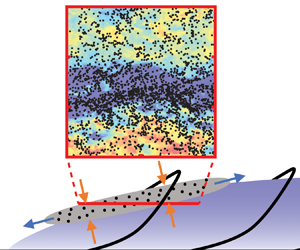
Dynamics and scaling of particle streaks in high-Reynolds-number turbulent boundary layers
-
- Journal:
- Journal of Fluid Mechanics / Volume 975 / 25 November 2023
- Published online by Cambridge University Press:
- 22 November 2023, A47
-
- Article
-
- You have access
- Open access
- HTML
- Export citation
-
Inertial particles in wall-bounded turbulence are known to form streaks, but experimental evidence and predictive understanding of this phenomenon is lacking, especially in regimes relevant to atmospheric flows. We carry out wind tunnel measurements to investigate this process, characterizing the transport of microscopic particles suspended in turbulent boundary layers. The friction Reynolds number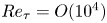 $Re_\tau = {O}(10^4)$ allows for significant scale separation and the emergence of large-scale motions, while the range of viscous Stokes number $St^+=18$–870 is relevant to the transport of dust and fine sand in the atmospheric surface layer. We perform simultaneous imaging of both carrier and dispersed phases along wall-parallel planes in the logarithmic layer, demonstrating that streamwise particle streaks largely overlap with large-scale low-speed flow regions. The fluid–particle slip velocity indicates that with increasing inertia, the particle streaks outlive the low-speed fluid streaks. Moreover, two-point statistics show that the width of the particle streaks increases linearly with Stokes number, bounded by the size of the coherent flow structures. Finally, the particle-sampled flow topology suggests that particle streaks reside between the legs of hairpin packets. From these observations, we infer a conceptual view of the formation of particle streaks in the frame of the attached eddy model. A scaling for the particle streaks’ width is derived as a function of $Re_\tau$ and $St^+$, which reproduces the measured trends and predicts widths ${O}(0.1)$ m in the atmospheric surface layer, comparable to aeolian streamers observed in the field.


Accurate determination of stability characteristics of spatially modulated shear layers
-
- Journal:
- Journal of Fluid Mechanics / Volume 975 / 25 November 2023
- Published online by Cambridge University Press:
- 22 November 2023, A50
-
- Article
-
- You have access
- Open access
- HTML
- Export citation
