Refine search
Actions for selected content:
212971 results in Engineering

On vortex-sheet evolution beyond singularity formation
-
- Journal:
- Journal of Fluid Mechanics / Volume 976 / 10 December 2023
- Published online by Cambridge University Press:
- 30 November 2023, A17
-
- Article
- Export citation
-
We consider the evolution of a spatially periodic, perturbed vortex sheet for small times after the formation of a curvature singularity at time $t=t_c$ as demonstrated by Moore (Proc. R. Soc. Lond. A, vol. 365, issue 1720, 1979, pp. 105–119). The Moore analysis is extended to provide the small-amplitude, full-sheet structure at $t=t_c$ for a general single-mode initial condition in terms of polylogarithmic functions, from which its asymptotic form near the singular point is determined. This defines an intermediate evolution problem for which the leading-order, and most singular, approximation is solved as a Taylor-series expansion in $\tau = t-t_c$, where coefficients are calculated by repeated differentiation of the defining Birkhoff–Rott (BR) equation. The first few terms are in good agreement with numerical calculation based on the full-sheet solution. The series is summed, providing an analytic continuation which shows sheet rupture at circulation $\varGamma =0^+$, $\tau >0^+$, but with non-physical features owing to the absence of end-tip sheet roll up. This is corrected by constructing an inner solution with $\varGamma < \tau$, as a perturbed similarity form with small parameter $\tau ^{1/2}$. Numerical solutions of both the inner, nonlinear zeroth-order and first-order linear BR equations are obtained whose outer limits match the intermediate solution. The composite solution shows sheet tearing at $\tau =0^+$ into two separate, rolled up algebraic spirals near the central singular point. Branch separation distance scales as $\tau$ with a non-local, $\tau ^{3/2}$ correction. Properties of the intermediate and inner solutions are discussed.


Acknowledgments
-
- Book:
- Introductory Quantum Optics
- Published online:
- 14 December 2023
- Print publication:
- 30 November 2023, pp xv-xvi
-
- Chapter
- Export citation
Compact size antenna for skin implantable medical devices
-
- Journal:
- International Journal of Microwave and Wireless Technologies / Volume 16 / Issue 2 / March 2024
- Published online by Cambridge University Press:
- 30 November 2023, pp. 217-226
-
- Article
- Export citation
Compact ACS-fed MIMO antenna with dual-band notch characteristics for UWB applications
-
- Journal:
- International Journal of Microwave and Wireless Technologies / Volume 16 / Issue 3 / April 2024
- Published online by Cambridge University Press:
- 30 November 2023, pp. 478-486
-
- Article
- Export citation
Reviews
-
- Book:
- Introductory Quantum Optics
- Published online:
- 14 December 2023
- Print publication:
- 30 November 2023, pp ii-ii
-
- Chapter
- Export citation
Appendices
-
- Book:
- Introductory Quantum Optics
- Published online:
- 14 December 2023
- Print publication:
- 30 November 2023, pp 386-407
-
- Chapter
- Export citation
6 - Beam Splitters and Interferometers
-
- Book:
- Introductory Quantum Optics
- Published online:
- 14 December 2023
- Print publication:
- 30 November 2023, pp 155-190
-
- Chapter
- Export citation
Brief Contents
-
- Book:
- Introductory Quantum Optics
- Published online:
- 14 December 2023
- Print publication:
- 30 November 2023, pp vii-viii
-
- Chapter
- Export citation
Shaping the future of tunneling with data and emerging technologies
-
- Journal:
- Data-Centric Engineering / Volume 4 / 2023
- Published online by Cambridge University Press:
- 29 November 2023, e29
-
- Article
-
- You have access
- Open access
- HTML
- Export citation
Aircraft fleet availability optimisation: a reinforcement learning approach
- Part of
-
- Journal:
- The Aeronautical Journal / Volume 127 / Issue 1318 / December 2023
- Published online by Cambridge University Press:
- 29 November 2023, pp. 2204-2218
-
- Article
- Export citation
Thermal management system design for a series hybrid-electric propulsion architecture
- Part of
-
- Journal:
- The Aeronautical Journal / Volume 128 / Issue 1325 / July 2024
- Published online by Cambridge University Press:
- 29 November 2023, pp. 1532-1555
-
- Article
-
- You have access
- Open access
- HTML
- Export citation
Development of a design space for dissimilar materials joining in aerospace applications
-
- Journal:
- The Aeronautical Journal / Volume 128 / Issue 1324 / June 2024
- Published online by Cambridge University Press:
- 29 November 2023, pp. 1284-1301
-
- Article
-
- You have access
- Open access
- HTML
- Export citation
Digital generation of super-Gaussian perfect vortex beams via wavefront shaping with globally adaptive feedback
-
- Journal:
- High Power Laser Science and Engineering / Volume 12 / 2024
- Published online by Cambridge University Press:
- 29 November 2023, e5
-
- Article
-
- You have access
- Open access
- HTML
- Export citation
Analysis of mid-spatial frequency wavefront distortions from a liquid-cooled flash-lamp pumped Nd:phosphate laser amplifier
-
- Journal:
- High Power Laser Science and Engineering / Volume 12 / 2024
- Published online by Cambridge University Press:
- 29 November 2023, e3
-
- Article
-
- You have access
- Open access
- HTML
- Export citation
Synchronized off-harmonic probe laser with highly variable pulse duration for laser–plasma interaction experiments
-
- Journal:
- High Power Laser Science and Engineering / Volume 12 / 2024
- Published online by Cambridge University Press:
- 29 November 2023, e10
-
- Article
-
- You have access
- Open access
- HTML
- Export citation
Scaling relations in quasi-static magnetoconvection with a strong vertical magnetic field
-
- Journal:
- Journal of Fluid Mechanics / Volume 976 / 10 December 2023
- Published online by Cambridge University Press:
- 28 November 2023, A4
-
- Article
-
- You have access
- Open access
- HTML
- Export citation
-
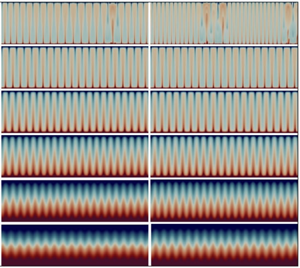
The scaling law for the horizontal length scale $\ell$ relative to the domain height $L$, originating from the linear theory of quasi-static magnetoconvection, $\ell /L \sim Q^{-1/6}$, has been verified through two-dimensional (2-D) direct numerical simulation (DNS), particularly at high values of the Chandrasekhar number ( $Q$). This relationship remains valid within a specific flow regime characterized by columnar structures aligned with the magnetic field. Expanding upon the $Q$-dependence of the horizontal length scale, we have derived scaling laws for the Nusselt number ( $Nu$) and the Reynolds number ( $Re$) as functions of the driving forces (Rayleigh number ( $Ra$) and $Q$) in quasi-static magnetoconvection influenced by a strong magnetic field. These scaling relations, $Nu \sim Ra/Q$ and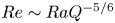 $Re \sim Ra Q^{-5/6}$, have been successfully validated using 2-D DNS data spanning a wide range of five decades in $Q$, ranging from $10^5$ to $10^9$. The successful validation of the relations at large $Q$ values, combined with our theoretical analysis of dissipation rates and the incorporation of the horizontal length scale's influence on scaling behaviour, presents a valid approach for deriving scaling laws under various conditions.


A weakly nonlinear amplitude equation approach to the bypass transition in the two-dimensional Lamb–Oseen vortex
-
- Journal:
- Journal of Fluid Mechanics / Volume 976 / 10 December 2023
- Published online by Cambridge University Press:
- 28 November 2023, A10
-
- Article
-
- You have access
- Open access
- HTML
- Export citation
The effect of turbulent motions on particle spatial distribution in high-Reynolds-number particle-laden flows
-
- Journal:
- Journal of Fluid Mechanics / Volume 976 / 10 December 2023
- Published online by Cambridge University Press:
- 28 November 2023, A14
-
- Article
- Export citation
MRF volume 15 issue 9 Cover and Front matter
-
- Journal:
- International Journal of Microwave and Wireless Technologies / Volume 15 / Issue 9 / November 2023
- Published online by Cambridge University Press:
- 28 November 2023, pp. f1-f2
-
- Article
-
- You have access
- Export citation

Energy harvesting using an inverted piezohydroelastic flag with resistor–inductor–capacitor circuit
-
- Journal:
- Journal of Fluid Mechanics / Volume 975 / 25 November 2023
- Published online by Cambridge University Press:
- 28 November 2023, A49
-
- Article
-
- You have access
- Open access
- HTML
- Export citation
