Refine search
Actions for selected content:
212971 results in Engineering
A novel PIN diode-based frequency reconfigurable patch antenna with switching between the mid-5G and high-5G frequency band
-
- Journal:
- International Journal of Microwave and Wireless Technologies / Volume 16 / Issue 4 / May 2024
- Published online by Cambridge University Press:
- 07 December 2023, pp. 595-604
-
- Article
- Export citation
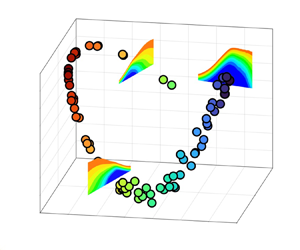
A data-driven analysis of short and long laminar separation bubbles
-
- Journal:
- Journal of Fluid Mechanics / Volume 976 / 10 December 2023
- Published online by Cambridge University Press:
- 07 December 2023, R3
-
- Article
-
- You have access
- Open access
- HTML
- Export citation
A low-profile wideband circularly polarized metasurface antenna based on characteristic mode analysis
-
- Journal:
- International Journal of Microwave and Wireless Technologies / Volume 16 / Issue 2 / March 2024
- Published online by Cambridge University Press:
- 07 December 2023, pp. 244-251
-
- Article
- Export citation

An analytical model of momentum availability for predicting large wind farm power
-
- Journal:
- Journal of Fluid Mechanics / Volume 976 / 10 December 2023
- Published online by Cambridge University Press:
- 06 December 2023, A24
-
- Article
-
- You have access
- Open access
- HTML
- Export citation
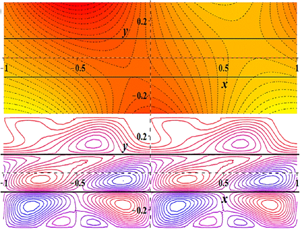
Wavy Marangoni effect and strategic slip-pattern-driven species transport in micro-confined sandwiched liquid films
-
- Journal:
- Journal of Fluid Mechanics / Volume 976 / 10 December 2023
- Published online by Cambridge University Press:
- 06 December 2023, A26
-
- Article
- Export citation

Two-dimensional Janus drops in shear: deformation, rotation and their coupling
-
- Journal:
- Journal of Fluid Mechanics / Volume 976 / 10 December 2023
- Published online by Cambridge University Press:
- 06 December 2023, A29
-
- Article
- Export citation
-
In this work, the dynamics of two-dimensional rotating Janus drops in shear flow is studied numerically using a ternary-fluid diffuse interface method. The rotation of Janus drops is found to be closely related to their deformation. A new deformation parameter $D$ is proposed to assess the significance of the drop deformation. According to the maximum value of $D$ (
$D$ ( $D_{max}$), the deformation of rotating Janus drops can be classified into linear deformation ( $D_{max}\le 0.2$) and nonlinear deformation ( $D_{max}> 0.2$). In particular, $D_{max}$ in the former depends linearly on the Reynolds and capillary numbers, which can be interpreted by a mass–spring model. Furthermore, the rotation period $t_R$ of a Janus drop is found to be more sensitive to the drop deformation than to the aspect ratio of the drop at equilibrium. By introducing a corrected shear rate and an aspect ratio of drop deformation, a rotation model for Janus drops is established based on Jeffery's theory for rigid particles, and it agrees well with our numerical results.


Theoretical analysis of frequency modulation-to-amplitude modulation on the final optics and target of the SG II-Up laser facility
-
- Journal:
- High Power Laser Science and Engineering / Volume 12 / 2024
- Published online by Cambridge University Press:
- 06 December 2023, e9
-
- Article
-
- You have access
- Open access
- HTML
- Export citation

Boundary mixing. Part 1. Transport of buoyancy and passive tracer
-
- Journal:
- Journal of Fluid Mechanics / Volume 976 / 10 December 2023
- Published online by Cambridge University Press:
- 06 December 2023, A23
-
- Article
-
- You have access
- Open access
- HTML
- Export citation
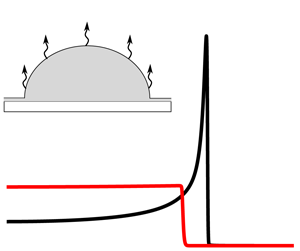
Comparison of one-sided and diffusion-limited evaporation models for thin liquid droplets
-
- Journal:
- Journal of Fluid Mechanics / Volume 976 / 10 December 2023
- Published online by Cambridge University Press:
- 06 December 2023, A25
-
- Article
-
- You have access
- Open access
- HTML
- Export citation
A compact and fully integrated $\text{0.48}\,\text{THz}$ FMCW radar transceiver combined with a dielectric lens
-
- Journal:
- International Journal of Microwave and Wireless Technologies / Volume 16 / Issue 5 / June 2024
- Published online by Cambridge University Press:
- 06 December 2023, pp. 738-749
-
- Article
-
- You have access
- Open access
- HTML
- Export citation
-
Electronic measurement systems in the THz frequency range are often bulky and expensive devices. While some compact single-chip systems operating in the high millimeter-wave frequency range have recently been published, compact measurement systems in the low THz frequency range are still rare. The emergence of new silicon-germanium (SiGe) semiconductor technologies allow the integration of system components, like oscillators, frequency multipliers, frequency dividers, and antennas, operating in the low THz frequency range, into a compact monolithic microwave integrated circuits (MMIC), which contains most components to implement a low-cost and compact frequency-modulated continuous-wave-radar transceiver. This article presents a single transceiver solution containing all necessary components. It introduces a $0.48\,\mathrm{THz}$ radar transceiver MMIC with a tuning range of $43\,\mathrm{GHz}$ and an output power of up to $-9.4\,\mathrm{dBm}$ in the SG13G3 $130\,\mathrm{nm}$ SiGe technology by IHP. The MMIC is complemented by a dielectric lens antenna design consisting of polytetrafluoroethylene, providing up to $39.3\,\mathrm d\mathrm B\mathrm i$ of directivity and half-power beam widths of 0.95∘ in transmit and receive direction. The suppression of clutter from unwanted targets deviating from antenna boresight more than 6∘ is higher than $24.6\,\mathrm d \mathrm B$ in E- and H-Plane.

Turbulent energy transfers in physical and scale spaces at dissipative length scales
-
- Journal:
- Journal of Fluid Mechanics / Volume 976 / 10 December 2023
- Published online by Cambridge University Press:
- 06 December 2023, A27
-
- Article
- Export citation
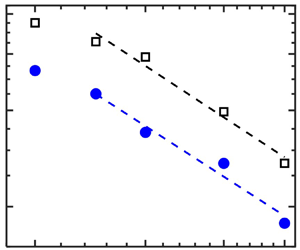
Transition to turbulence in viscoelastic channel flow of dilute polymer solutions
-
- Journal:
- Journal of Fluid Mechanics / Volume 976 / 10 December 2023
- Published online by Cambridge University Press:
- 06 December 2023, A28
-
- Article
-
- You have access
- Open access
- HTML
- Export citation
-
The transition to turbulence in a plane Poiseuille flow of dilute polymer solutions is studied by direct numerical simulations of a finitely extensible nonlinear elastic fluid with the Peterlin closure. The range of Reynolds number ( $Re$)
$Re$)  $2000 \le Re \le 5000$ is studied but with the same level of elasticity in viscoelastic flows. The evolution of a finite-amplitude perturbation and its effects on the transition dynamics are investigated. A viscoelastic flow begins transition at an earlier time than its Newtonian counterparts, but the transition time appears to be insensitive to polymer concentration in the dilute and semi-dilute regimes studied. Increasing polymer concentration, however, decreases the maximum attainable energy growth during the transition process. The critical or minimum perturbation amplitude required to trigger transition is computed. Interestingly, both Newtonian and viscoelastic flows follow almost the same power-law scaling of $Re^\gamma$ with the critical exponent $\gamma \approx -1.25$, which is in close agreement with previous studies. However, a shift downward is observed for viscoelastic flow, suggesting that smaller perturbation amplitudes are required for the transition. A mechanism of the early transition is investigated by the evolution of wall-normal and spanwise velocity fluctuations and flow structure. The early growth of these fluctuations and the formation of quasi-streamwise vortices around low-speed streaks are promoted by polymers, hence causing an early transition. These vortical structures are found to support the critical exponent $\gamma \approx -1.25$. Once the transition process is completed, polymers play a role in dampening the wall-normal and spanwise velocity fluctuations and vortices to attain a drag-reduced state in viscoelastic turbulent flows.


IJMWT special issue on the 2022 French Microwave Days
-
- Journal:
- International Journal of Microwave and Wireless Technologies / Volume 15 / Issue 10 / December 2023
- Published online by Cambridge University Press:
- 04 December 2023, pp. 1633-1634
-
- Article
-
- You have access
- HTML
- Export citation
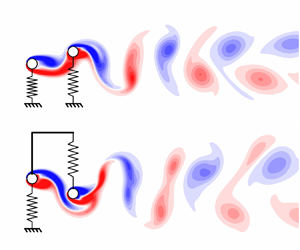
Flow-induced vibrations of elastically coupled tandem cylinders
-
- Journal:
- Journal of Fluid Mechanics / Volume 976 / 10 December 2023
- Published online by Cambridge University Press:
- 04 December 2023, A22
-
- Article
-
- You have access
- Open access
- HTML
- Export citation
-
We numerically study the transverse flow-induced vibration (FIV) of elastically coupled tandem cylinders at Reynolds number $100$, using an in-house immersed boundary method-based solver in two-dimensional coordinates. While several previous studies considered tandem cylinders coupled through flow between them, a hitherto unexplored elastic coupling with fluid flow between them significantly influences FIV. We consider a wide range of gap ratio, reduced velocity, an equal mass ratio of both cylinders and zero damping. A systematic comparison between the classic elastically mounted tandem cylinders and elastically coupled cylinders is presented. The latter configuration exhibits two vibration modes, in-phase and out-of-phase, with corresponding natural frequencies approaching the Strouhal frequency of the system. We quantify variation of the following output variables with reduced velocity and gap ratios: cylinders’ displacement; fluid forces; amplitude spectral density of displacement and force signals; phase characteristics; energy harvesting potential; and discuss the wake characteristics using flow separation, pressure distribution, gap flow quantification, and dynamic mode decomposition characterization. The FIV response is classified into several regimes: initial desynchronization with and without gap vortices; final desynchronization; mixed mode; initial branch; lock-in; upper and lower branch; wake-induced vibration; galloping. We draw upon similarities of computed FIV characteristics with those of an isolated cylinder, in which the lower branch exhibits larger a amplitude than the upper branch. The elastically coupled cylinders show a galloping response similar to an isolated D-section cylinder. By invoking the elastic coupling, we demonstrate FIV suppression and augmentation for in-phase and out-of-phase systems. Our calculations show larger energy harvesting potential at reduced cost for elastically coupled cylinders.

Predictive methods for initiation of delamination and intra-laminar damage in carbon fibre reinforced polymer laminates subject to impact
-
- Journal:
- The Aeronautical Journal / Volume 128 / Issue 1323 / May 2024
- Published online by Cambridge University Press:
- 04 December 2023, pp. 846-874
-
- Article
-
- You have access
- Open access
- HTML
- Export citation

Integrated Circuit Fabrication
- Science and Technology
-
- Published online:
- 01 December 2023
- Print publication:
- 16 November 2023
-
- Textbook
- Export citation

Interfacial flow around a pusher bacterium
-
- Journal:
- Journal of Fluid Mechanics / Volume 976 / 10 December 2023
- Published online by Cambridge University Press:
- 30 November 2023, A18
-
- Article
-
- You have access
- Open access
- HTML
- Export citation
Appendix D - Nonlinear Optics and Spontaneous Parametric Down-Conversion
-
- Book:
- Introductory Quantum Optics
- Published online:
- 14 December 2023
- Print publication:
- 30 November 2023, pp 406-407
-
- Chapter
- Export citation
2 - Field Quantization
-
- Book:
- Introductory Quantum Optics
- Published online:
- 14 December 2023
- Print publication:
- 30 November 2023, pp 11-49
-
- Chapter
- Export citation
4 - Emission and Absorption of Radiation by Atoms
-
- Book:
- Introductory Quantum Optics
- Published online:
- 14 December 2023
- Print publication:
- 30 November 2023, pp 89-133
-
- Chapter
- Export citation
