Refine search
Actions for selected content:
212971 results in Engineering
Stratified inclined duct: two-layer hydraulics and instabilities
-
- Journal:
- Journal of Fluid Mechanics / Volume 977 / 25 December 2023
- Published online by Cambridge University Press:
- 19 December 2023, A25
-
- Article
-
- You have access
- Open access
- HTML
- Export citation
A data-driven method for modelling dissipation rates in stratified turbulence
- Part of
-
- Journal:
- Journal of Fluid Mechanics / Volume 977 / 25 December 2023
- Published online by Cambridge University Press:
- 19 December 2023, A37
-
- Article
-
- You have access
- Open access
- HTML
- Export citation
-
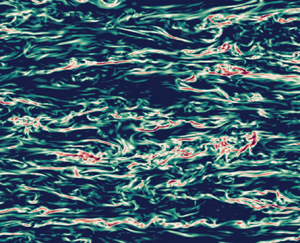
We present a deep probabilistic convolutional neural network (PCNN) model for predicting local values of small-scale mixing properties in stratified turbulent flows, namely the dissipation rates of turbulent kinetic energy and density variance, $\varepsilon$ and $\chi$. Inputs to the PCNN are vertical columns of velocity and density gradients, motivated by data typically available from microstructure profilers in the ocean. The architecture is designed to enable the model to capture several characteristic features of stratified turbulence, in particular the dependence of small-scale isotropy on the buoyancy Reynolds number $Re_b:=\varepsilon /(\nu N^2)$, where $\nu$ is the kinematic viscosity and $N$ is the background buoyancy frequency, the correlation between suitably locally averaged density gradients and turbulence intensity and the importance of capturing the tails of the probability distribution functions of values of dissipation. Empirically modified versions of commonly used isotropic models for $\varepsilon$ and $\chi$ that depend only on vertical derivatives of density and velocity are proposed based on the asymptotic regimes $Re_b\ll 1$ and $Re_b\gg 1$, and serve as an instructive benchmark for comparison with the data-driven approach. When trained and tested on a simulation of stratified decaying turbulence which accesses a range of turbulent regimes (associated with differing values of $Re_b$), the PCNN outperforms assumptions of isotropy significantly as $Re_b$ decreases, and additionally demonstrates improvements over the fitted empirical models. A differential sensitivity analysis of the PCNN facilitates a comparison with the theoretical models and provides a physical interpretation of the features enabling it to make improved predictions.


Inertial migration of a sphere in plane Couette flow
-
- Journal:
- Journal of Fluid Mechanics / Volume 977 / 25 December 2023
- Published online by Cambridge University Press:
- 19 December 2023, A33
-
- Article
- Export citation
-
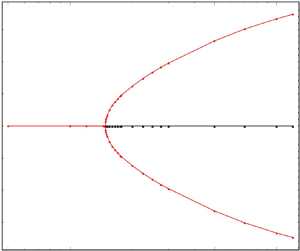
We study the inertial migration of a torque-free neutrally buoyant sphere in wall-bounded plane Couette flow over a wide range of channel Reynolds numbers $Re_c$ in the limit of small particle Reynolds number ( $Re_p\ll 1$) and confinement ratio ( $\lambda \ll 1$). Here, $Re_c = V_{wall}H/\nu$, where $H$ denotes the separation between the channel walls, $V_\text {wall}$ denotes the speed of the moving wall, and $\nu$ is the kinematic viscosity of the Newtonian suspending fluid. Also, $\lambda = a/H$, where $a$ is the sphere radius, with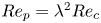 $Re_p=\lambda ^2 Re_c$. The channel centreline is found to be the only (stable) equilibrium below a critical $Re_c$ ( $\approx 148$), consistent with the predictions of earlier small- $Re_c$ analyses. A supercritical pitchfork bifurcation at the critical $Re_c$ creates a pair of stable off-centre equilibria, located symmetrically with respect to the centreline, with the original centreline equilibrium becoming unstable simultaneously. The new equilibria migrate wall-ward with increasing $Re_c$. In contrast to the inference based on recent computations, the aforementioned bifurcation occurs for arbitrarily small $Re_p$ provided that $\lambda$ is sufficiently small. An analogous bifurcation occurs in the two-dimensional scenario, that is, for a circular cylinder suspended freely in plane Couette flow, with the critical $Re_c$ being approximately $110$.


Penetrative and Marangoni convection in a fluid film over a phase boundary
-
- Journal:
- Journal of Fluid Mechanics / Volume 977 / 25 December 2023
- Published online by Cambridge University Press:
- 19 December 2023, A34
-
- Article
-
- You have access
- Open access
- HTML
- Export citation
-
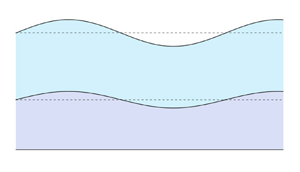
We study the effects of buoyancy, surface-tension gradients and phase boundary on the stability of a layer of water that is confined between air at the top and a layer of ice at the bottom. The temperature of the overlying air and flux condition at the free surface of the water layer are such that the layer is susceptible to both thermal and thermocapillary instabilities. We perform a linear stability analysis to identify these modes of instability and investigate the effects of the phase boundary on them. We find that with increasing thickness of the ice layer, the critical Rayleigh and Marangoni numbers for the instabilities are found to first decrease and then asymptote to constant values for ice thicknesses much larger than the thickness of the water layer. In the case of thermocapillary instability, we find that the thickness of the ice layer has negligible influence on the stability threshold for dimensionless wavenumber $k \gg 1$, and that the presence of an unstably stratified liquid layer significantly alters the stability threshold for $k = O (1)$. Furthermore, the inclusion of Marangoni stresses reduces the stability threshold of the thermal instability.


Rheology of dense suspensions of ideally conductive particles in an electric field
-
- Journal:
- Journal of Fluid Mechanics / Volume 977 / 25 December 2023
- Published online by Cambridge University Press:
- 19 December 2023, A35
-
- Article
-
- You have access
- Open access
- HTML
- Export citation
-
The rheological behaviour of dense suspensions of ideally conductive particles in the presence of both electric field and shear flow is studied using large-scale numerical simulations. Under the action of an electric field, these particles are known to undergo dipolophoresis (DIP), which is the combination of two nonlinear electrokinetic phenomena: induced-charge electrophoresis (ICEP) and dielectrophoresis (DEP). For ideally conductive particles, ICEP is predominant over DEP, resulting in transient pairing dynamics. The shear viscosity and first and second normal stress differences $N_1$ and $N_2$ of such suspensions are examined over a range of volume fractions $15\,\% \leq \phi \leq 50\,\%$ as a function of Mason number $Mn$, which measures the relative importance of viscous shear stress over electrokinetic-driven stress. For $Mn < 1$ or low shear rates, the DIP is shown to dominate the dynamics, resulting in a relatively low-viscosity state. The positive $N_1$ and negative $N_2$ are observed at $\phi < 30\,\%$, which is similar to Brownian suspensions, while their signs are reversed at $\phi \ge 30\,\%$. For $Mn \ge 1$, the shear thickening starts to arise at $\phi \ge 30\,\%$, and an almost five-fold increase in viscosity occurs at $\phi = 50\,\%$. Both $N_1$ and $N_2$ are negative for $Mn \gg 1$ at all volume fractions considered. We illuminate the transition in rheological behaviours from DIP to shear dominance around $Mn = 1$ in connection to suspension microstructure and dynamics. Lastly, our findings reveal the potential use of nonlinear electrokinetics as a means of active rheology control for such suspensions.


Analytic solution for pulse wave propagation in flexible tubes with application to a patient-specific arterial tree
-
- Journal:
- Journal of Fluid Mechanics / Volume 977 / 25 December 2023
- Published online by Cambridge University Press:
- 19 December 2023, A36
-
- Article
- Export citation
-
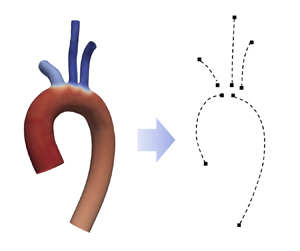
In this paper, we present an analytic solution for pulse wave propagation in a flexible arterial model with tapering, physiological boundary conditions and variable wall properties (wall elasticity and thickness). The change of wall properties follows a profile that is proportional to $r^\alpha$, where $r$ represents the lumen radius and $\alpha$ is a material coefficient. The cross-sectionally averaged velocity and pressure are obtained by solving a hyperbolic system derived from the mass and momentum conservations, and they are expressed in Bessel functions of order $(4-\alpha )/(3-\alpha )$ and $1/(3-\alpha )$, respectively. The solution is successfully validated by comparing it with numerical results from three-dimensional (3-D) fluid–structure interaction simulations. Subsequently, the solution is employed to study pulse wave propagation in an arterial model, revealing that the wall properties and the physiological outlet boundary conditions, such as the resistor–capacitor–resistor (RCR) model, play a crucial role in characterizing the input impedance and reflection coefficient. At low-frequency range, the input impedance is found to be insensitive to the wall properties and is primarily determined by the RCR parameters. At high-frequency range, the input impedance oscillates around the local characteristic impedance, and the oscillation amplitude varies non-monotonically with $\alpha$. Expressions for the input impedance at both low-frequency and high-frequency limits are presented. This analytic solution is also successfully applied to model flow inside a patient-specific arterial tree, with the maximum relative errors in pressure and flow rate never exceeding $1.6\,\%$ and $9.0\,\%$ when compared with results from 3-D numerical simulations.


Distortions in focusing laser pulses due to spatio-temporal couplings: an analytic description
-
- Journal:
- High Power Laser Science and Engineering / Volume 12 / 2024
- Published online by Cambridge University Press:
- 18 December 2023, e25
-
- Article
-
- You have access
- Open access
- HTML
- Export citation
Motion of a disk embedded in a nearly inviscid Langmuir film. Part 1. Translation
-
- Journal:
- Journal of Fluid Mechanics / Volume 977 / 25 December 2023
- Published online by Cambridge University Press:
- 18 December 2023, A30
-
- Article
-
- You have access
- Open access
- HTML
- Export citation
-
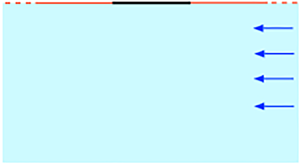
The motion of a disk in a Langmuir film bounding a liquid substrate is a classical hydrodynamic problem, dating back to Saffman (J. Fluid Mech., vol. 73, 1976, p. 593) who focused upon the singular problem of translation at large Boussinesq number, ${\textit {Bq}}\gg 1$. A semianalytic solution of the dual integral equations governing the flow at arbitrary ${\textit {Bq}}$ was devised by Hughes et al. (J. Fluid Mech., vol. 110, 1981, p. 349). When degenerated to the inviscid-film limit ${\textit {Bq}}\to 0$, it produces the value $8$ for the dimensionless translational drag, which is $50\,\%$ larger than the classical $16/3$-value corresponding to a free surface. While that enhancement has been attributed to surface incompressibility, the mathematical reasoning underlying the anomaly has never been fully elucidated. Here we address the inviscid limit ${\textit {Bq}}\to 0$ from the outset, revealing a singular mechanism where half of the drag is contributed by the surface pressure. We proceed beyond that limit, considering a nearly inviscid film. A naïve attempt to calculate the drag correction using the reciprocal theorem fails due to an edge singularity of the leading-order flow. We identify the formation of a boundary layer about the edge of the disk, where the flow is primarily in the azimuthal direction with surface and substrate stresses being asymptotically comparable. Utilising the reciprocal theorem in a fluid domain tailored to the asymptotic topology of the problem produces the drag correction $(8\,{\textit {Bq}}/{\rm \pi} ) [ \ln (2/{\textit {Bq}}) + \gamma _E+1]$, $\gamma _E$ being the Euler–Mascheroni constant.


Direct numerical simulation of flow in open rectangular ducts
-
- Journal:
- Journal of Fluid Mechanics / Volume 977 / 25 December 2023
- Published online by Cambridge University Press:
- 18 December 2023, A32
-
- Article
-
- You have access
- Open access
- HTML
- Export citation
-
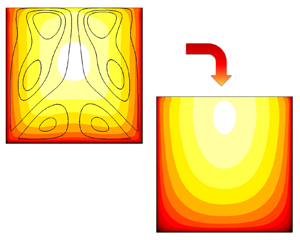
We study turbulent flow in open channels with a free surface and rectangular cross-section, for various Reynolds numbers and duct aspect ratios. Direct numerical simulations are used to obtain accurate characterization of the secondary motions, which are found to be more intense than in closed ducts, and to scale with the bulk, rather than with the friction velocity. A notable feature of open-duct flows is the presence of a velocity dip, namely the peak velocity is achieved at some depth underneath the free surface. We find that the depth of the velocity peak increases with the Reynolds number, and correspondingly the flow becomes more symmetric with respect to the horizontal midplane. This is also confirmed from the change of the topology of the secondary motions, which exhibit a strong corner circulation at the free-surface/wall corners at low Reynolds number, which, however, weakens at higher $Re$. The structure of the mean velocity field is such that the log law applies with good approximation in the direction normal to the nearest wall, which allows us to explain why predictive friction formulae based on the hydraulic diameter concept are successful. Additional analysis shows that the secondary motions account for a large fraction of the frictional drag (up to $15$ %).


Insights into the flame transitions and flame stabilization mechanisms in a freely falling burning droplet encountering a co-flow
-
- Journal:
- Journal of Fluid Mechanics / Volume 977 / 25 December 2023
- Published online by Cambridge University Press:
- 18 December 2023, A29
-
- Article
- Export citation
Path curvature enhances the flow-induced vibrations of a cylinder without structural restoring force
-
- Journal:
- Journal of Fluid Mechanics / Volume 977 / 25 December 2023
- Published online by Cambridge University Press:
- 18 December 2023, A31
-
- Article
-
- You have access
- Open access
- HTML
- Export citation
-
A cylinder immersed in a current and free to translate along a circular arc is considered to investigate the impact of path curvature on the flow-induced vibrations (FIV) occurring without structural restoring force. Path curvature magnitude ( $\kappa$, inverse of path radius non-dimensionalized by the body diameter $D$) is varied from $0$ (transverse rectilinear path) to $20$, over a wide range of values of the structure to displaced fluid mass ratio, $m^\star \in [0.05,10]$. The exploration is carried out numerically at subcritical and postcritical values of the Reynolds number ( $Re$, based on $D$ and the inflow velocity), i.e. below and above the critical value $47$ for the onset of flow unsteadiness when the body is fixed, up to $100$. Path curvature triggers a desynchronized regime of the flow–body system in addition to the synchronized regime typical of vortex-induced vibrations, and alters the composition of fluid forcing. The most prominent effect uncovered here is, however, a global enhancement of FIV, with three principal results: (i) vibrations and flow unsteadiness are found to arise at lower subcritical $Re$ along a curved path, down to $19.5$ versus $31$ for $\kappa =0$; (ii) the $m^\star$ range where substantial responses develop is considerably extended and encompasses the entire interval under study, which contrasts with the narrow band of low $m^\star$ identified for $\kappa =0$; (iii) the vibrations are amplified, $+45\,\%$ relative to the peak amplitude measured along a rectilinear path at $Re =100$.


Boundary layer transition due to distributed roughness: effect of roughness spacing
-
- Journal:
- Journal of Fluid Mechanics / Volume 977 / 25 December 2023
- Published online by Cambridge University Press:
- 18 December 2023, A27
-
- Article
-
- You have access
- Open access
- HTML
- Export citation
-
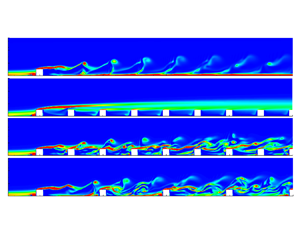
The influence of roughness spacing on boundary layer transition over distributed roughness elements is studied using direct numerical simulation and global stability analysis, and compared with isolated roughness elements at the same Reynolds number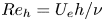 $Re_h=U_eh/\nu$ ( $U_e$ is the boundary layer edge velocity, h is roughness height and $\nu$ is the kinetic viscosity of the fluid). Small spanwise spacing ( $\lambda _z=2.5h$) inhibits the formation of counter-rotating vortex pairs (CVP) and, as a result, hairpin vortices are not generated and the downstream shear layer is steady. For $\lambda _z=5h$, the CVP and hairpin vortices are induced by the first row of roughness, perturbing the downstream shear layer and causing transition. The temporal periodicity of the primary hairpin vortices appears to be independent of the streamwise spacing. Distributed roughness leads to a lower critical roughness Reynolds number for instability to occur and a more significant breakdown of the boundary layer compared with isolated roughness. When the streamwise spacing is $\lambda _x=5h$, the high-momentum fluid barely moves downward into the cavities and the wake flow has little impact on the following roughness elements. The leading unstable varicose mode is associated with the central low-speed streaks along the aligned roughness elements, and its frequency is close to the shedding frequency of hairpin vortices in the isolated case. For larger streamwise spacing ( $\lambda _x=10h$), two distinct modes are obtained from global stability analysis. The first mode shows varicose symmetry, corresponding to the primary hairpin vortex shedding induced by the first-row roughness. The high-speed streaks formed in the longitudinal grooves are also found to be unstable and interact with the varicose mode. The second mode is a sinuous mode with lower frequency, induced as the wake flow of the first-row roughness runs into the second row. It extracts most energy from the spanwise shear between the high- and low-speed streaks.


Lubrication dynamics of a settling plate
-
- Journal:
- Journal of Fluid Mechanics / Volume 977 / 25 December 2023
- Published online by Cambridge University Press:
- 18 December 2023, A28
-
- Article
-
- You have access
- Open access
- HTML
- Export citation
-
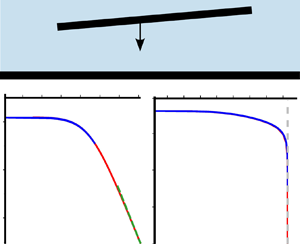
If a flat, horizontal, plate settles onto a flat surface, it is known that the gap $h$ decreases with time $t$ as a power law: $h\sim t^{-1/2}$. We consider what happens if the plate is not initially horizontal, and/or the centre of mass is not symmetrically positioned: does one edge contact the surface in finite time, or does the plate approach the horizontal without making contact? The dynamics of this system is analysed and shown to be remarkably complex. We find that, depending upon the initial position of the plate and the position of the centre of force, the plate might either make contact in finite time or settle progressively without ever making contact. Our results show an excellent agreement between analytical exact solutions, asymptotic solutions and numerical studies of the lubrication equations.


Flow charts as a method to transfer self-sealing from plant models into programmable materials and related challenges
-
- Journal:
- Programmable Materials / Volume 1 / 2023
- Published online by Cambridge University Press:
- 18 December 2023, e12
-
- Article
-
- You have access
- Open access
- HTML
- Export citation

Interaction between forced and natural convection in a thin cylindrical fluid layer at low Prandtl number
-
- Journal:
- Journal of Fluid Mechanics / Volume 977 / 25 December 2023
- Published online by Cambridge University Press:
- 18 December 2023, A26
-
- Article
- Export citation
The study of shadowing effect for LTE and 5G networks in suburban environment
-
- Journal:
- International Journal of Microwave and Wireless Technologies / Volume 16 / Issue 2 / March 2024
- Published online by Cambridge University Press:
- 15 December 2023, pp. 339-347
-
- Article
- Export citation

Droplet jumping by modulated electrowetting
-
- Journal:
- Journal of Fluid Mechanics / Volume 977 / 25 December 2023
- Published online by Cambridge University Press:
- 15 December 2023, A24
-
- Article
-
- You have access
- Open access
- HTML
- Export citation
High-repetition-rate and high-power efficient picosecond thin-disk regenerative amplifier
-
- Journal:
- High Power Laser Science and Engineering / Volume 12 / 2024
- Published online by Cambridge University Press:
- 15 December 2023, e14
-
- Article
-
- You have access
- Open access
- HTML
- Export citation
Shallow current of viscous fluid flowing between diverging or converging walls
-
- Journal:
- Journal of Fluid Mechanics / Volume 977 / 25 December 2023
- Published online by Cambridge University Press:
- 15 December 2023, A23
-
- Article
-
- You have access
- Open access
- HTML
- Export citation
-
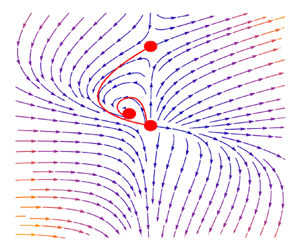
We investigate the shallow flow of viscous fluid into and out of a channel whose gap width increases as a power law ( $x^n$), where $x$ is the downstream axis. The fluid flows slowly, while injected at a rate in the form of $t^\alpha$, where $t$ is time and $\alpha$ is a constant. The invading fluid has a higher viscosity than the ambient fluid, thus avoiding Saffman–Taylor instability. Similarity solutions of the first kind for the outflow problem are found using approximations of lubrication theory. Zheng et al. (J. Fluid Mech., vol. 747, 2014, pp. 218–246) studied the deep-channel case and found divergent behaviour of the similarity variable as $n\rightarrow 1$ and $n\rightarrow 3$, when fluid flows into and out of the channel, respectively. No divergence is found in the shallow case presented here up to the breakdown of the geometric assumption. The characteristic equilibration time for the numerically simulated constant-volume flow to converge to the similarity solution is calculated assuming an inverse dependence on the ratio disagreement between the current front using the method of lines. An inverse power dependence between equilibration time and ratio disagreement is found for channels of different powers. A similarity solution of the second kind for the inflow problem is found using the phase-plane formalism and the bisection method. An exponential decay relationship is found between $n$ and the degree $\delta$ of the similarity variable $xt^{-\delta }$, which does not show any divergent behaviour for large $n$. An asymptotic behaviour is found for $\delta$ that approaches $1/2$ for $n\gg 1$.



Introductory Quantum Optics
-
- Published online:
- 14 December 2023
- Print publication:
- 30 November 2023
-
- Textbook
- Export citation
