Refine search
Actions for selected content:
212971 results in Engineering
Wind tunnel test of full-scale wing-propeller system of a eVTOL aircraft
-
- Journal:
- The Aeronautical Journal / Volume 128 / Issue 1324 / June 2024
- Published online by Cambridge University Press:
- 12 December 2023, pp. 1204-1218
-
- Article
- Export citation
Kinks on elliptical convergent shock waves in hypersonic flow
-
- Journal:
- Journal of Fluid Mechanics / Volume 977 / 25 December 2023
- Published online by Cambridge University Press:
- 12 December 2023, A12
-
- Article
- Export citation
-
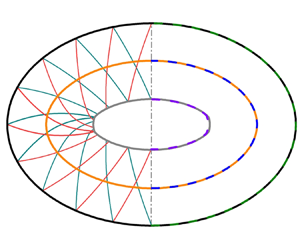
Kinks commonly appear on the convergent shock surface when an internal conical flow deviates from the axisymmetric state. In this paper, the formation mechanisms of kinks on internal conical shocks (ICSs) generated by elliptical ring wedges with typical entry aspect ratios ( $AR{\rm s}$) in a Mach 6 flow are revealed using a theoretical method, in which the spatial evolution of the three-dimensional elliptical ICS is converted into a temporal evolution of a two-dimensional elliptical moving shock (EMS) using the hypersonic equivalence principle. To simultaneously track the shock front of the EMS and the disturbances propagating along it, a front-disturbance tracking method (FDTM) based on geometrical shock dynamics is proposed. It is found that the shock–compression disturbances from the same family initially near the major axis catch up with the disturbance initially emitted from the major axis to form kinks on the EMS. The equivalent kink formation positions predicted by the FDTM always lag behind the real kink formation positions on the elliptical ICS because the applicability of the hypersonic equivalence principle decays as the shock strengthens along the incoming flow direction. The accuracy of the equivalent kink formation positions predicted by the FDTM gradually declines with the reduction in $AR$, but it can be significantly improved for all $AR{\rm s}$ after a modification of the equivalent relationship using the shock angle in the major plane of the elliptical ICS, which provides a new way to solve the kinks on the elliptical ICS.


Modulation of coaxial cone-jet instability in active co-flow focusing
-
- Journal:
- Journal of Fluid Mechanics / Volume 977 / 25 December 2023
- Published online by Cambridge University Press:
- 12 December 2023, A14
-
- Article
- Export citation
Non-local eddy diffusivity model based on turbulent energy density in scale space
-
- Journal:
- Journal of Fluid Mechanics / Volume 977 / 25 December 2023
- Published online by Cambridge University Press:
- 12 December 2023, A11
-
- Article
-
- You have access
- Open access
- HTML
- Export citation
The ‘−1’ decay law for some small-scale quantities at large Péclet numbers and fixed Reynolds numbers
-
- Journal:
- Journal of Fluid Mechanics / Volume 977 / 25 December 2023
- Published online by Cambridge University Press:
- 12 December 2023, A15
-
- Article
- Export citation
-
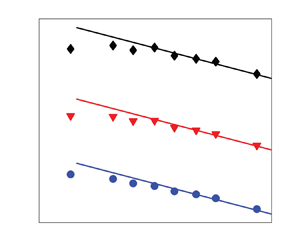
The effect of a uniform mean scalar gradient on the small scales of a passive scalar field in statistically stationary homogeneous isotropic turbulence is investigated through the transport equation for the scalar fluctuation. After some manipulation of the equation, it is shown that the effect can be recast in the form $S_\theta ^* {{Pe^{-1}_{\lambda _\theta }}}$ ( $S_\theta ^*$ is the non-dimensional scalar gradient, ${{Pe_{\lambda _\theta }}}$ is the turbulent Péclet number). This effect gradually disappears as ${{Pe_{\lambda _\theta }}}$ becomes sufficiently large, implying a gradual approach towards local isotropy of the passive scalar. It is further argued that, for a given $S_\theta ^*$, the normalized odd moments of the scalar derivative tend towards isotropy as ${{Pe^{-1}_{\lambda _\theta }}}$. This is supported by direct numerical simulations data for the normalized odd moments of the scalar derivative at large Péclet numbers. Further, the present derivation leads to the same prediction ( ${\sim }Sc^{-0.45}$ where Sc is the Schmidt number) as Buaria et al. (Phys. Rev. Lett., vol. 126, no. 3, 2021a, p. 034504) and complements the derivation by the latter authors, which is based on dimensional arguments and the introduction of a new diffusive length scale.


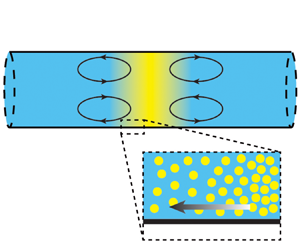
Diffusioosmotic dispersion of solute in a long narrow channel
-
- Journal:
- Journal of Fluid Mechanics / Volume 977 / 25 December 2023
- Published online by Cambridge University Press:
- 12 December 2023, A5
-
- Article
-
- You have access
- Open access
- HTML
- Export citation
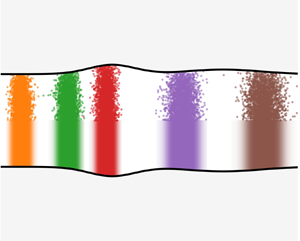
Taylor dispersion in arbitrarily shaped axisymmetric channels
- Part of
-
- Journal:
- Journal of Fluid Mechanics / Volume 976 / 10 December 2023
- Published online by Cambridge University Press:
- 12 December 2023, A30
-
- Article
-
- You have access
- Open access
- HTML
- Export citation
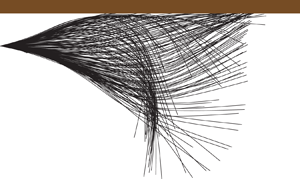
Gravity-coupled flutter and contact of a flag near a wall
-
- Journal:
- Journal of Fluid Mechanics / Volume 977 / 25 December 2023
- Published online by Cambridge University Press:
- 11 December 2023, A2
-
- Article
-
- You have access
- Open access
- HTML
- Export citation
Robust adaptive beamforming via residual convolutional neural network
-
- Journal:
- International Journal of Microwave and Wireless Technologies / Volume 16 / Issue 6 / July 2024
- Published online by Cambridge University Press:
- 11 December 2023, pp. 1024-1032
-
- Article
- Export citation
An efficient linear and elliptical antenna array design using sail fish optimization
-
- Journal:
- International Journal of Microwave and Wireless Technologies / Volume 16 / Issue 3 / April 2024
- Published online by Cambridge University Press:
- 11 December 2023, pp. 440-453
-
- Article
- Export citation
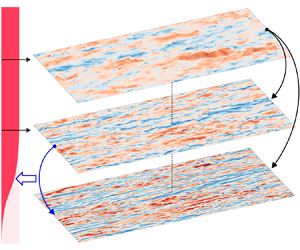
A resolvent-based prediction framework for incompressible turbulent channel flow with limited measurements
-
- Journal:
- Journal of Fluid Mechanics / Volume 976 / 10 December 2023
- Published online by Cambridge University Press:
- 11 December 2023, A31
-
- Article
-
- You have access
- Open access
- HTML
- Export citation
-
A new resolvent-based method is developed to predict the space–time properties of the flow field. To overcome the deterioration of the prediction accuracy with increasing distance between the measurements and predictions in the resolvent-based estimation (RBE), the newly proposed method utilizes the RBE to estimate the relative energy distribution near the wall rather than the absolute energy directly estimated from the measurements. Using this extra information from RBE, the new method modifies the energy distribution of the spatially uniform and uncorrelated forcing that drives the flow system by minimizing the norm of the cross-spectral density tensor of the error matrix in the near-wall region in comparison with the RBE-estimated one, and therefore it is named as the resolvent-informed white-noise-based estimation (RWE) method. For validation, three time-resolved direct numerical simulation (DNS) datasets with the friction Reynolds numbers $Re_\tau = 180$, 550 and 950 are generated, with various locations of measurements ranging from the near-wall region ( $y^+ = 40$) to the upper bound of the logarithmic region ( $y/h \approx 0.2$, where h is the half-channel height) for the predictions. Besides the RWE, three existing methods, i.e. the RBE, the $\lambda$-model and the white-noise-based estimation (WBE), are also included for the validation. The performance of the RBE and scale-dependent model ( $\lambda$-model) in predicting the energy spectra shows a strong dependence on the measurement locations. The newly proposed RWE shows a low sensitivity on $Re_{\tau }$ and the measurement locations, which may range from the near-wall region to the upper bound of the logarithmic region, and has a high accuracy in predicting the energy spectra. The RWE also performs well in predicting the space–time properties in terms of the correlation magnitude and the convection velocity. We further utilize the new method to reconstruct the instantaneous large-scale structures with measurements from the logarithmic region. Both the RWE and RBE perform well in estimating the instantaneous large-scale structure, and the RWE has smaller errors in the estimations near the wall. The structural inclination angles around $15^\circ$ are predicted by the RWE and WBE, which generally recover the DNS results.


Adrenal ablation as a treatment for hypertension: analyzing the dielectric properties of adrenal glands for microwave ablation technologies
-
- Journal:
- International Journal of Microwave and Wireless Technologies / Volume 16 / Issue 2 / March 2024
- Published online by Cambridge University Press:
- 11 December 2023, pp. 177-188
-
- Article
-
- You have access
- Open access
- HTML
- Export citation
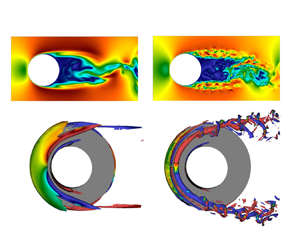
The flow around a stepped cylinder with turbulent wake and stable shear layer
-
- Journal:
- Journal of Fluid Mechanics / Volume 977 / 25 December 2023
- Published online by Cambridge University Press:
- 11 December 2023, A3
-
- Article
-
- You have access
- Open access
- HTML
- Export citation
-
The turbulent external flow around a three-dimensional stepped cylinder is studied by means of direct numerical simulations with the adaptive mesh refinement technique. We give a broad perspective of the flow regimes from laminar to turbulent wake at $Re_D=5000$, which is the highest ever considered for this flow case. In particular, we focus on the intermediate Reynolds number $Re_D=1000$ that reveals a turbulent wake coupled with a stable cylinder shear layer (subcritical regime). This flow shows a junction dynamics similar to the laminar $Re_D=150$, where no hairpin vortex appears around the edges, and just two horseshoe vortices are visible. A new stable vortex in the form of a ring, which coils around the rear area, is also identified. In the turbulent wake, the presence of three wake cells is pointed out: the large and small cylinder cells together with the modulation region. However, the modulation dynamics varies between the subcritical and turbulent regimes. A time-averaged, three-dimensional set of statistics is computed, and spatially coherent structures are extracted via proper orthogonal decomposition (POD). The POD identifies the (long-debated) connection between the N-cell and the downwash behind the junction. Furthermore, as the Reynolds number increases, the downwash phenomenon becomes less prominent. Eventually, a reduced-order reconstruction with the most energetically relevant modes is defined to explain the wake vortex interactions. This also serves as a valuable starting point for simulating the stepped cylinder wake behaviour within complex frameworks, e.g. fluid–structure interaction.


Dual-band transmissive linear to circular polarization converter with angular-stable and orthogonal polarizations
-
- Journal:
- International Journal of Microwave and Wireless Technologies / Volume 16 / Issue 3 / April 2024
- Published online by Cambridge University Press:
- 11 December 2023, pp. 515-523
-
- Article
- Export citation
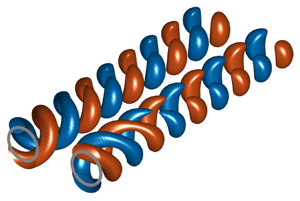
On the preferred flapping motion of round twin jets
-
- Journal:
- Journal of Fluid Mechanics / Volume 977 / 25 December 2023
- Published online by Cambridge University Press:
- 11 December 2023, A4
-
- Article
-
- You have access
- Open access
- HTML
- Export citation
-
Linear stability theory (LST) is often used to model the large-scale flow structures in the turbulent mixing region and near pressure field of high-speed jets. For perfectly expanded single round jets, these models predict the dominance of azimuthal wavenumbers $m=0$ and $m = 1$ helical modes for the lower frequency range, in agreement with empirical data. When LST is applied to twin-jet systems, four solution families appear following the odd/even behaviour of the pressure field about the symmetry planes. The interaction between the unsteady pressure fields of the two jets also results in their coupling. The individual modes of the different solution families no longer correspond to helical motions, but to flapping oscillations of the jet plumes. In the limit of large jet separations, when the jet coupling vanishes, the eigenvalues corresponding to the $m=1$ mode in each family are identical, and a linear combination of them recovers the helical motion. Conversely, as the jet separation decreases, the eigenvalues for the $m=1$ modes of each family diverge, thus favouring a particular flapping oscillation over the others and preventing the appearance of helical motions. The dominant mode of oscillation for a given jet Mach number $M_j$ and temperature ratio $T_R$ depends on the Strouhal number $St$ and jet separation $s$. Increasing both $M_j$ and $T_R$ independently is found to augment the jet coupling and modify the $(St,s)$ map of the preferred oscillation mode. Present results predict the preference of two modes when the jet interaction is relevant, namely varicose and especially sinuous flapping oscillations on the nozzles’ plane.


Magnetic-electric dipole circularly polarized antenna with unidirectional radiation pattern with improved characteristics
-
- Journal:
- International Journal of Microwave and Wireless Technologies / Volume 16 / Issue 2 / March 2024
- Published online by Cambridge University Press:
- 11 December 2023, pp. 276-283
-
- Article
- Export citation
Reconfigurable MIMO antenna: previous advancements and the potential for future wireless communication
-
- Journal:
- International Journal of Microwave and Wireless Technologies / Volume 16 / Issue 3 / April 2024
- Published online by Cambridge University Press:
- 11 December 2023, pp. 524-534
-
- Article
- Export citation
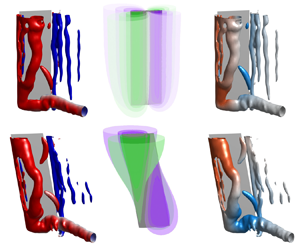
Flow-induced oscillations of pitching swept wings: stability boundary, vortex dynamics and force partitioning
-
- Journal:
- Journal of Fluid Mechanics / Volume 977 / 25 December 2023
- Published online by Cambridge University Press:
- 11 December 2023, A1
-
- Article
-
- You have access
- Open access
- HTML
- Export citation
-
We study experimentally the aeroelastic instability boundaries and three-dimensional vortex dynamics of pitching swept wings, with the sweep angle ranging from 0 $^\circ$ to 25 $^\circ$. The structural dynamics of the wings are simulated using a cyber-physical control system. With a constant flow speed, a prescribed high inertia and a small structural damping, we show that the system undergoes a subcritical Hopf bifurcation to large-amplitude limit-cycle oscillations (LCOs) for all the sweep angles. The onset of LCOs depends largely on the static characteristics of the wing. The saddle-node point is found to change non-monotonically with the sweep angle, which we attribute to the non-monotonic power transfer between the ambient fluid and the elastic mount. An optimal sweep angle is observed to enhance the power extraction performance and thus promote LCOs and destabilize the aeroelastic system. The frequency response of the system reveals a structural-hydrodynamic oscillation mode for wings with relatively high sweep angles. Force, moment and three-dimensional flow structures measured using multi-layer stereoscopic particle image velocimetry are analysed to explain the differences in power extraction for different swept wings. Finally, we employ a physics-based force and moment partitioning method to correlate quantitatively the three-dimensional vortex dynamics with the resultant unsteady aerodynamic moment.


Cylindrical conformation and miniaturization of cavity-backed magnetoelectric antenna with an outer Γ-shaped probe
-
- Journal:
- International Journal of Microwave and Wireless Technologies / Volume 16 / Issue 2 / March 2024
- Published online by Cambridge University Press:
- 07 December 2023, pp. 348-356
-
- Article
- Export citation

Flow topology in the gap and wake of convex curved tandem cylinders
-
- Journal:
- Journal of Fluid Mechanics / Volume 976 / 10 December 2023
- Published online by Cambridge University Press:
- 07 December 2023, A32
-
- Article
-
- You have access
- Open access
- HTML
- Export citation
