Refine search
Actions for selected content:
212971 results in Engineering
An improved wide-lane ambiguity resolution method for kinematic smartphone positioning
-
- Journal:
- The Journal of Navigation / Volume 77 / Issue 1 / January 2024
- Published online by Cambridge University Press:
- 13 May 2024, pp. 1-17
- Print publication:
- January 2024
-
- Article
- Export citation
A simple method for pulse contrast enhancement via self-focusing
-
- Journal:
- High Power Laser Science and Engineering / Volume 12 / 2024
- Published online by Cambridge University Press:
- 29 December 2023, e18
-
- Article
-
- You have access
- Open access
- HTML
- Export citation
-
Here we report on a simple-to-implement and cost-effective approach for laser pulse contrast enhancement, based on the ${\chi}^{(3)}$ nonlinear self-focusing effect. An intentionally induced and gently controlled self-focusing in a thin glass transforms the time-dependent intensity into variation in beam divergence. Followed by a spatial discriminating filter, only the strongly focused fraction traverses the setup, at the expense of efficiency. A numerical model, accounting for the pulse and material parameters via a Gaussian ABCD matrix, provides an estimate for the instantaneous beam waist and transmission efficiency, which enables us to evaluate the resulting contrast enhancement. The estimated contrast enhancement spans between 0.5 and 2.5 orders of magnitude, in conjunction with approximately 25%–90% estimated efficiency, depending on the pulse parameters. In a preliminary experiment we demonstrated the effect with 10s-μJ sub GW regime with approximately 40 $\%$ efficiency and a contrast improvement of more than or equal to 20 dB.


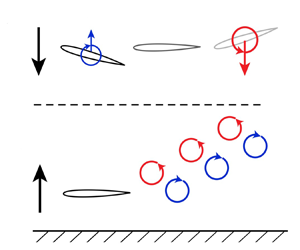
Revealing the mechanism and scaling laws behind equilibrium altitudes of near-ground pitching hydrofoils
-
- Journal:
- Journal of Fluid Mechanics / Volume 978 / 10 January 2024
- Published online by Cambridge University Press:
- 28 December 2023, A5
-
- Article
- Export citation
-
A classic lift decomposition (Von Kármán & Sears, J. Aeronaut. Sci., vol. 5, 1938, pp. 379–390) is conducted on potential flow simulations of a near-ground pitching hydrofoil. It is discovered that previously observed stable and unstable equilibrium altitudes are generated by a balance between positive wake-induced lift and negative quasi-steady lift while the added mass lift does not play a role. Using both simulations and experiments, detailed analyses of each lift component's near-ground behaviour provide further physical insights. When applied to three-dimensional pitching hydrofoils the lift decomposition reveals that the disappearance of equilibrium altitudes for ${A{\kern-4pt}R}\ {\rm (aspect\ ratio)} <1.5$ occurs due to the magnitude of the quasi-steady lift outweighing the magnitude of the wake-induced lift at all ground distances. Scaling laws for the quasi-steady lift, wake-induced lift and the stable equilibrium altitude are discovered. A simple scaling law for the lift of a steady foil in ground effect is derived. This scaling shows that both circulation enhancement and the velocity induced at a foil's leading edge by the bound vortex of its ground image foil are the essential physics to understand steady ground effect. The scaling laws for unsteady pitching foils can predict the equilibrium altitude to within $20\,\%$ of its value when $St\ {\rm (Strouhal\ number)} < 0.45$. For $St \ge 0.45$ there is a wake instability effect, not accounted for in the scaling relations, that significantly alters the wake-induced lift. These results not only provide key physical insights and scaling laws for steady and unsteady ground effects, but also for two schooling hydrofoils in a side-by-side formation with an out-of-phase synchronization.


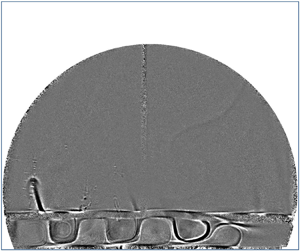
Heat transport and flow structure in thermal convection with two liquid layers
-
- Journal:
- Journal of Fluid Mechanics / Volume 978 / 10 January 2024
- Published online by Cambridge University Press:
- 27 December 2023, A4
-
- Article
- Export citation
-
We report an experimental investigation of the heat transport and flow field in a rectangular Rayleigh–Bénard convection (RBC) cell with two immiscible fluids: silicone oil and glycerol. The global heat transport of the system is divided into three ranges corresponding to the different flow structures formed in the glycerol layer. In range I, the glycerol layer is dominated by conduction, and no plume is formed over the interface. In range II, cellular rolls are formed in the glycerol layer and the horizontal motion of rolls causes an oscillation of temperature in the interface. In range III, the cellular pattern is time-independent, and the interface forms a group of wavelets with wave numbers consistent with the mode of the cellular pattern. In lower-thin glycerol, the Nusselt (Nu) grows from conduction to convection through an oscillating subcritical bifurcation at critical Rayleigh number $Ra_c$. The value of $Ra_c$ in the present work is smaller than the theoretical prediction of both-rigid boundaries and greater than the prediction of one-rigid and one-free boundaries. In the upper-thick silicone oil layer, $Nu$ increases with increasing $Ra$, but it is smaller than that of traditional RBC. For the silicone oil layer in two-layer RBC, the hot plumes emitting over the liquid–liquid interface showed different shape and different velocity from cold plumes emitting from the top rigid plate. This implies that the velocity boundary condition strongly influences the flow structure in turbulent convection.


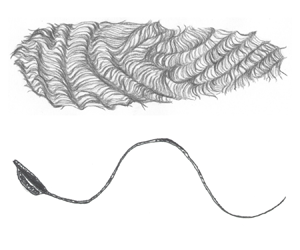
Eukaryotic swimming cells are shaped by hydrodynamic constraints
-
- Journal:
- Journal of Fluid Mechanics / Volume 978 / 10 January 2024
- Published online by Cambridge University Press:
- 27 December 2023, R1
-
- Article
- Export citation
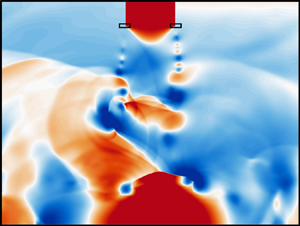
A data-driven approach to guide supersonic impinging jet control
-
- Journal:
- Journal of Fluid Mechanics / Volume 978 / 10 January 2024
- Published online by Cambridge University Press:
- 27 December 2023, R2
-
- Article
- Export citation

On local isotropy and scale dependence of pair dispersion in turbulent canopy flows
-
- Journal:
- Journal of Fluid Mechanics / Volume 978 / 10 January 2024
- Published online by Cambridge University Press:
- 27 December 2023, A3
-
- Article
-
- You have access
- Open access
- HTML
- Export citation
-
Canopy flows in the atmospheric surface layer play important economic and ecological roles, governing the dispersion of passive scalars in the environment. The interaction of high-velocity fluid and large-scale surface-mounted obstacles in canopy flows produces drag and causes intense, inhomogeneous and anisotropic turbulence. In this work, we focus on the turbulent dispersion of passive scalars by studying the ‘pair dispersion’ – a statistical measure of relative motion between particles. We analyse the results of a three-dimensional particle tracking velocimetry experiment in a wind-tunnel canopy flow, focusing on small scales. We confirm the existence of local isotropy of pair dispersion at scales smaller than a characteristic shear length scale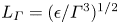 $L_\varGamma =(\epsilon /\varGamma ^3)^{1/2}$, where $\epsilon$ and $\varGamma$ are the mean dissipation rate and shear rate, respectively. Furthermore, we show that pair dispersion in this locally isotropic regime is a scale-dependent super-diffusive process, similar to what occurs in homogeneous isotropic turbulent flows. In addition, we measure the pair relative velocity correlation function, showing that its de-correlation occurs in the locally isotropic regime, and discuss the implications of this observation for modelling pair dispersion. Thus, our study extends the fundamental understanding of turbulent pair dispersion to the anisotropic inhomogeneous turbulent canopy flow, bringing valuable information for modelling scalar dispersion in the atmospheric surface layer.


The role of viscoplastic drop shape in impact
-
- Journal:
- Journal of Fluid Mechanics / Volume 978 / 10 January 2024
- Published online by Cambridge University Press:
- 27 December 2023, A1
-
- Article
- Export citation
Imbibition and collapse between swelling fibres
-
- Journal:
- Journal of Fluid Mechanics / Volume 978 / 10 January 2024
- Published online by Cambridge University Press:
- 27 December 2023, A2
-
- Article
- Export citation
A revised gap-averaged Floquet analysis of Faraday waves in Hele-Shaw cells
-
- Journal:
- Journal of Fluid Mechanics / Volume 977 / 25 December 2023
- Published online by Cambridge University Press:
- 27 December 2023, A45
-
- Article
-
- You have access
- Open access
- HTML
- Export citation
Inertial range scaling of inhomogeneous turbulence
- Part of
-
- Journal:
- Journal of Fluid Mechanics / Volume 978 / 10 January 2024
- Published online by Cambridge University Press:
- 27 December 2023, A9
-
- Article
-
- You have access
- HTML
- Export citation
-
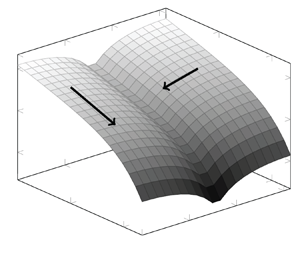
We investigate how inhomogeneity influences the $k^{-5/3}$ inertial range scaling of turbulent kinetic energy spectra (with $k$ the wavenumber). For weak statistical inhomogeneity, the energy spectrum can be described as an equilibrium spectrum plus a perturbation. Theoretical arguments suggest that this latter contribution scales as $k^{-7/3}$. This prediction is assessed using direct numerical simulations of three-dimensional Kolmogorov flow.


Granular dilatancy and non-local fluidity of partially molten rock
-
- Journal:
- Journal of Fluid Mechanics / Volume 978 / 10 January 2024
- Published online by Cambridge University Press:
- 27 December 2023, A7
-
- Article
-
- You have access
- Open access
- HTML
- Export citation
Self-propulsion of an elliptical phoretic disk emitting solute uniformly – CORRIGENDUM
-
- Journal:
- Journal of Fluid Mechanics / Volume 977 / 25 December 2023
- Published online by Cambridge University Press:
- 27 December 2023, E1
-
- Article
-
- You have access
- Open access
- HTML
- Export citation
Vorticity dynamics in transcritical liquid jet breakup
-
- Journal:
- Journal of Fluid Mechanics / Volume 978 / 10 January 2024
- Published online by Cambridge University Press:
- 27 December 2023, A6
-
- Article
-
- You have access
- Open access
- HTML
- Export citation
-
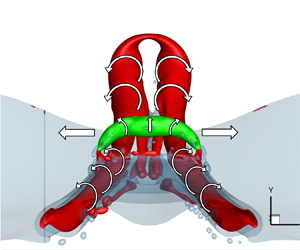
A transcritical domain with a sharp two-phase interface may exist during the early times of liquid hydrocarbon fuel injection at supercritical pressure. Thus, two-phase dynamics are sustained before substantial heating of the liquid and drive the early three-dimensional deformation and atomisation. A recent study of a transcritical liquid jet showed distinct deformation features caused by interface thermodynamics, low surface tension and intraphase diffusive mixing. In the present work, the compressible vortex identification method $\lambda _\rho$ is used to study the vortex dynamics in a cool liquid n-decane transcritical jet surrounded by a hotter oxygen gaseous stream at supercritical pressures. The relationship between vortical structures and the liquid surface evolution is detailed, along with the vorticity generation mechanisms, including variable-density effects. The roles of hairpin and roller vortices in the early deformation of lobes, the layering and tearing of liquid sheets and the formation of fuel-rich gaseous blobs are analysed. At these high pressures, enhanced intraphase mixing and ambient gas dissolution affect the local liquid structures (i.e. lobes). Thus, liquid breakup differs from classical sub-critical atomisation. Near the interface, liquid density and viscosity drop by up to 10 % and 70 %, respectively, and the liquid is more easily affected by the vortical motion (e.g. liquid sheets wrap around vortices). Despite the variable density, compressible vorticity generation terms are smaller than the vortex stretching and tilting. Layering traps and aligns the vortices along the streamwise direction while mitigating the generation of new rollers.

Dynamics of the interaction of a pair of thin evaporating droplets on compliant substrates
-
- Journal:
- Journal of Fluid Mechanics / Volume 978 / 10 January 2024
- Published online by Cambridge University Press:
- 27 December 2023, A8
-
- Article
-
- You have access
- Open access
- HTML
- Export citation
Extensional flow of a compressible viscous fluid
-
- Journal:
- Journal of Fluid Mechanics / Volume 977 / 25 December 2023
- Published online by Cambridge University Press:
- 22 December 2023, A43
-
- Article
-
- You have access
- Open access
- HTML
- Export citation
Generation of millijoule-level sub-5 fs violet laser pulses
- Part of
-
- Journal:
- High Power Laser Science and Engineering / Volume 12 / 2024
- Published online by Cambridge University Press:
- 22 December 2023, e16
-
- Article
-
- You have access
- Open access
- HTML
- Export citation
Energy and dissipation spectra of waves propagating in the inner surf zone
-
- Journal:
- Journal of Fluid Mechanics / Volume 977 / 25 December 2023
- Published online by Cambridge University Press:
- 22 December 2023, A48
-
- Article
-
- You have access
- Open access
- HTML
- Export citation
-
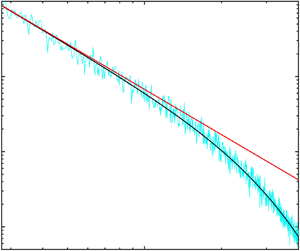
The spectral behaviour of random sawtooth waves propagating in the inner surf zone is investigated in this study. We show that the elevation energy spectrum exhibits a universal shape with an $\omega ^{-2}$ tendency in the inertial subrange and an exponential decay in the diffusive subrange ( $\omega$ being the angular frequency). A theoretical spectrum is derived based on the similarities between sawtooth waves in the inner surf zone and Burgers wave solutions. Very good agreement is shown between this theoretical spectrum and laboratory experiments covering a large range of incident random wave conditions. Additionally, an equation describing the universal shape of the dissipation spectrum is derived. It highlights that the dissipation spectrum is nearly constant in the inertial subrange, consistent with prior laboratory observations. The findings presented in this study can be useful to improve broken wave dissipation parametrizations in stochastic spectral wave models.


Velocity and temperature scalings leading to compressible laws of the wall
-
- Journal:
- Journal of Fluid Mechanics / Volume 977 / 25 December 2023
- Published online by Cambridge University Press:
- 22 December 2023, A49
-
- Article
- Export citation
In situ resistivity measurement of metal surfaces to track down dislocations caused by high field conditioning
-
- Journal:
- International Journal of Microwave and Wireless Technologies / Volume 16 / Issue 10 / December 2024
- Published online by Cambridge University Press:
- 22 December 2023, pp. 1632-1640
-
- Article
-
- You have access
- Open access
- HTML
- Export citation
