Refine search
Actions for selected content:
212966 results in Engineering
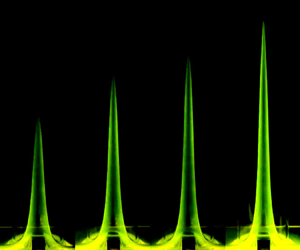
Capillary rise in sharp corners: not quite universal
-
- Journal:
- Journal of Fluid Mechanics / Volume 978 / 10 January 2024
- Published online by Cambridge University Press:
- 05 January 2024, A26
-
- Article
-
- You have access
- Open access
- HTML
- Export citation
-
We study the capillary rise of viscous liquids into sharp corners formed by two surfaces whose geometry is described by power laws $h_i(x) = c_i x^n$, $i = 1,2$, where $c_2 > c_1$ for $n \geq 1$. Prior investigations of capillary rise in sharp corners have shown that the meniscus altitude increases with time as $t^{1/3}$, a result that is universal, i.e. applies to all corner geometries. The universality of the phenomenon of capillary rise in sharp corners is revisited in this work through the analysis of a partial differential equation for the evolution of a liquid column rising into power-law-shaped corners, which is derived using lubrication theory. Despite the lack of geometric similarity of the liquid column cross-section for $n>1$, there exist a scaling and a similarity transformation that are independent of $c_i$ and $n$, which gives rise to the universal $t^{1/3}$ power law for capillary rise. However, the prefactor, which corresponds to the tip altitude of the self-similar solution, is a function of $n$, and it is shown to be bounded and monotonically decreasing as $n\to \infty$. Accordingly, the profile of the interface radius as a function of altitude is also independent of $c_i$ and exhibits slight variations with $n$. Theoretical results are compared against experimental measurements of the time evolution of the tip altitude and of profiles of the interface radius as a function of altitude.


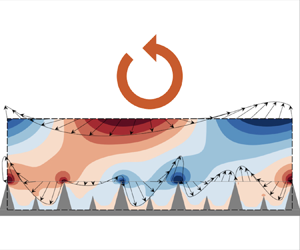
A viscous vortex model for predicting the drag reduction of riblet surfaces
-
- Journal:
- Journal of Fluid Mechanics / Volume 978 / 10 January 2024
- Published online by Cambridge University Press:
- 05 January 2024, A18
-
- Article
-
- You have access
- Open access
- HTML
- Export citation
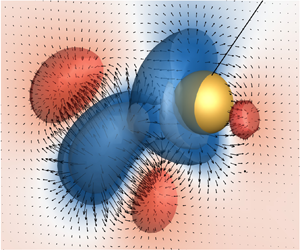
Dynamics of heavy subaqueous spherical pendulums
-
- Journal:
- Journal of Fluid Mechanics / Volume 978 / 10 January 2024
- Published online by Cambridge University Press:
- 05 January 2024, A19
-
- Article
-
- You have access
- Open access
- HTML
- Export citation
-
We present a systematic study to investigate the fluid–structure interaction (FSI) of subaqueous spherical pendulums with several solid-to-fluid mass ratios $m^*\in [1.14, 14.95]$ and corresponding Reynolds numbers of up to $\textit {Re}\sim 10^4$. A digital object tracking (DOT) method was employed to track the oscillating pendulum spheres whereas the time-resolved 3-D particle tracking velocimetry (tr-3D-PTV) was used to measure the flow field around the spheres. The data obtained from the coupling of the two measuring techniques provide novel insights into the dynamics of pendulum sphere oscillations, instantaneous pressure fluctuations related to vortex shedding around the spheres and the way they are influenced by the vortex and wake interactions. Namely, we show that during the downward motion of the pendulum spheres, vortex rings are shed off the spheres which, in turn, induce short-lived propulsion and, subsequently, distinct deceleration. Further, we used the measured data to improve an existing basic model of pendulum motion, which has significant discrepancies for the period and peak amplitude predictions. We did this by incorporating a vortex-induced drag term and a wake interaction term into the equation. Finally, the improved equations are shown to be capable of predicting the subaqueous pendulum dynamics with high accuracy, for the investigated range of $m^*$. The study thus extends the current understanding of basic fluid dynamic mechanisms such as added mass, nonlinear drag, vortex and pressure dynamics.


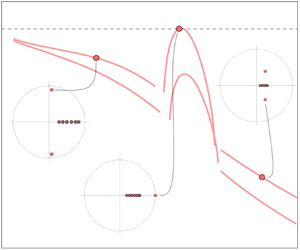
Floquet stability analysis of a two-layer oscillatory flow near a flexible wall
-
- Journal:
- Journal of Fluid Mechanics / Volume 978 / 10 January 2024
- Published online by Cambridge University Press:
- 05 January 2024, A24
-
- Article
-
- You have access
- Open access
- HTML
- Export citation
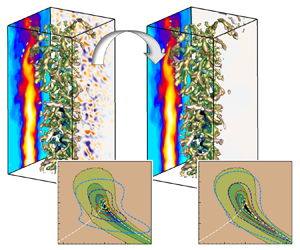
Four-dimensional variational data assimilation of a turbulent jet for super-temporal-resolution reconstruction
-
- Journal:
- Journal of Fluid Mechanics / Volume 978 / 10 January 2024
- Published online by Cambridge University Press:
- 05 January 2024, A14
-
- Article
- Export citation
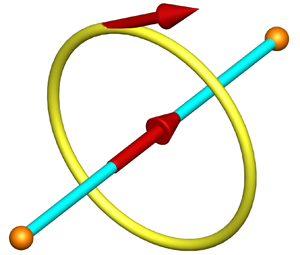
An alternative to the Navier–Stokes equation based on the conservation of acceleration
-
- Journal:
- Journal of Fluid Mechanics / Volume 978 / 10 January 2024
- Published online by Cambridge University Press:
- 05 January 2024, A21
-
- Article
-
- You have access
- Open access
- HTML
- Export citation

Total and static temperature statistics in compressible turbulent plane channel flow
-
- Journal:
- Journal of Fluid Mechanics / Volume 978 / 10 January 2024
- Published online by Cambridge University Press:
- 05 January 2024, A25
-
- Article
-
- You have access
- Open access
- HTML
- Export citation
-
The paper studies the statistics of total and static temperature (total $h_t$ and static $h$ enthalpy) in compressible turbulent plane channel flow using direct numerical simulations (DNS) data covering the range of centreline Mach numbers $0.3\lessapprox \bar {M}_{{{CL}}_x} \lessapprox 2.5$ and Huang–Coleman–Bradshaw friction Reynolds numbers $100\lessapprox Re_{\tau ^\star }\lessapprox 1000$. For this class of very-cold-wall flows, the DNS data for correlation coefficients and joint probability density functions (p.d.f.s) show that $h_t'$ is invariably very strongly correlated with the streamwise velocity fluctuation $u'$, in contrast to static temperature (static enthalpy $h'$) whose correlation with $u'$ weakens rapidly with increasing wall distance. We study various correlations and joint p.d.f.s of $h_t'$ and $h'$ in relation to the fluctuating velocity field, including the turbulent Prandtl number $Pr_{{T}}$, and discuss the predictions of Reynolds analogy. The scaling of the mean enthalpy and the fluctuating enthalpy variance and fluxes with respect to inner and outer velocity scales is investigated. The complex behaviour and scaling of different terms in the transport equations for the enthalpy variance and fluxes are discussed.


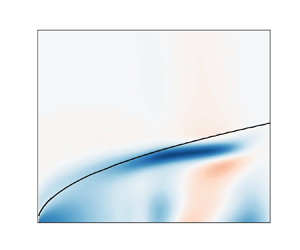
Adjoint-based linear sensitivity of a supersonic boundary layer to steady wall blowing–suction/heating–cooling
-
- Journal:
- Journal of Fluid Mechanics / Volume 978 / 10 January 2024
- Published online by Cambridge University Press:
- 05 January 2024, A16
-
- Article
- Export citation
-
For a Mach $4.5$ flat-plate adiabatic boundary layer, we study the sensitivity of the first, second Mack modes and streaks to steady wall-normal blowing/suction and wall heat flux. The global instabilities are characterised in frequency space with resolvent gains and their gradients with respect to wall-boundary conditions are derived through a Lagrangian-based method. The implementation is performed in the open-source high-order finite-volume code BROADCAST and algorithmic differentiation is used to access the high-order state derivatives of the discretised governing equations. For the second Mack mode, the resolvent optimal gain decreases when suction is applied upstream of Fedorov's mode $S$/mode $F$ synchronisation point, leading to stabilisation, and the converse when applied downstream. The largest suction gradient is in the region of branch I of mode $S$ neutral curve. For heat-flux control, strong heating at the leading edge stabilises both the first and second Mack modes, the former being more sensitive to wall-temperature control. Streaks are less sensitive to any boundary control in comparison with the Mack modes. Eventually, we show that an optimal actuator consisting of a single steady heating strip located close to the leading edge manages to damp the linear growth of all three instability mechanisms.


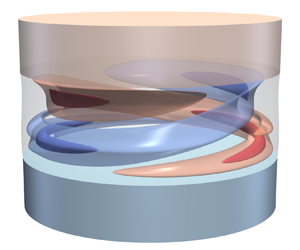
Flow instability in high-Prandtl-number liquid bridges with fully temperature-dependent thermophysical properties
-
- Journal:
- Journal of Fluid Mechanics / Volume 978 / 10 January 2024
- Published online by Cambridge University Press:
- 05 January 2024, A17
-
- Article
-
- You have access
- Open access
- HTML
- Export citation
-
The axisymmetric steady two-phase flow of a differentially heated thermocapillary liquid bridge in air and its linear stability is investigated numerically, taking into account dynamic interfacial deformations in the basic flow. Since most experiments require a high temperature difference to drive the flow into the three-dimensional regime, the temperature dependence of the material properties must be taken into account. Three different models are investigated for a high-Prandtl-number thermocapillary liquid bridge with nominal Prandtl number ${\textit {Pr}}=28.8$: the Oberbeck–Boussinesq (OB) approximation, a linear temperature dependence of all material properties and a full nonlinear temperature dependence of all material properties. For all models, critical Reynolds numbers are computed as functions of the volume of the liquid bridge, its aspect ratio, its dimensional size and as a function of the strength of a forced axial flow in the ambient air. Under most circumstances the OB approximation overpredicts and the linear model underpredicts the critical Reynolds number, compared with the model based on the full temperature dependence of the material properties. Among the main influence factors are the proper selection of the reference temperature and, at larger temperature differences, the temperature dependence of the viscosity of the liquid.

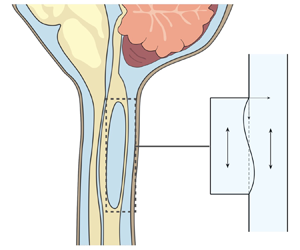
An analytic model for the flow induced in syringomyelia cavities
-
- Journal:
- Journal of Fluid Mechanics / Volume 978 / 10 January 2024
- Published online by Cambridge University Press:
- 05 January 2024, A22
-
- Article
-
- You have access
- Open access
- HTML
- Export citation

Resilience Engineering for Power and Communications Systems
- Networked Infrastructure in Extreme Events
-
- Published online:
- 04 January 2024
- Print publication:
- 18 January 2024

Magnetic Communications
- Theory and Techniques
-
- Published online:
- 04 January 2024
- Print publication:
- 18 January 2024
Acknowledgments
-
- Book:
- Field Theory of Multiscale Plasticity
- Published online:
- 14 December 2023
- Print publication:
- 04 January 2024, pp xviii-xx
-
- Chapter
- Export citation
Author Index
-
- Book:
- Field Theory of Multiscale Plasticity
- Published online:
- 14 December 2023
- Print publication:
- 04 January 2024, pp 833-834
-
- Chapter
- Export citation
12 - Scale C
- from Part III - Applications I
-
- Book:
- Field Theory of Multiscale Plasticity
- Published online:
- 14 December 2023
- Print publication:
- 04 January 2024, pp 604-678
-
- Chapter
- Export citation
Preface
-
- Book:
- Field Theory of Multiscale Plasticity
- Published online:
- 14 December 2023
- Print publication:
- 04 January 2024, pp xv-xvii
-
- Chapter
- Export citation
Subject Index
-
- Book:
- Field Theory of Multiscale Plasticity
- Published online:
- 14 December 2023
- Print publication:
- 04 January 2024, pp 835-839
-
- Chapter
- Export citation
7 - Gauge Field Theory of Dislocations and Defects
- from Part II - Theoretical Backgrounds
-
- Book:
- Field Theory of Multiscale Plasticity
- Published online:
- 14 December 2023
- Print publication:
- 04 January 2024, pp 371-415
-
- Chapter
- Export citation
Part I - Fundamentals
-
- Book:
- Field Theory of Multiscale Plasticity
- Published online:
- 14 December 2023
- Print publication:
- 04 January 2024, pp 1-264
-
- Chapter
- Export citation
13 - Cooperation of Multiple Inhomogeneous Fields
- from Part IV - Applications II
-
- Book:
- Field Theory of Multiscale Plasticity
- Published online:
- 14 December 2023
- Print publication:
- 04 January 2024, pp 681-747
-
- Chapter
- Export citation
