To save content items to your account,
please confirm that you agree to abide by our usage policies.
If this is the first time you use this feature, you will be asked to authorise Cambridge Core to connect with your account.
Find out more about saving content to .
To save content items to your Kindle, first ensure no-reply@cambridge.org
is added to your Approved Personal Document E-mail List under your Personal Document Settings
on the Manage Your Content and Devices page of your Amazon account. Then enter the ‘name’ part
of your Kindle email address below.
Find out more about saving to your Kindle.
Note you can select to save to either the @free.kindle.com or @kindle.com variations.
‘@free.kindle.com’ emails are free but can only be saved to your device when it is connected to wi-fi.
‘@kindle.com’ emails can be delivered even when you are not connected to wi-fi, but note that service fees apply.
The charismatic renewal in the early 1960s was a significant development in global Christianity, creating theological and pastoral debates and disagreements with both local and international dimensions. This article sets the controversy between the leading Anglicans John Stott and Michael Harper within the wider cultural context that impacted the initial rise of the charismatic movement, and its subsequent growing global acceptance. The Stott-Harper debates contributed notably to the long-term domestication of the charismatic movement within an established Church, keeping most charismatic Anglicans within the Evangelical tradition. Conservative Evangelicals were enabled to adjust constructively to the growing ‘charismatisation’ of global Evangelicalism.
Scholars of late antique liturgy usually find the origins of baptismal imagery in the Bible and the daily life of early Christians. This article reveals that some metaphors, such as the ‘furnace’ image, may also come from pre-Christian literature. In ancient Greek and Mesopotamian sources, the female uterus is compared to a furnace. This article argues that, based on its use in pre-Christian literature, the furnace image might also be considered feminine. This image describes a broader range of activities in baptism than that ascribed to female agency until now and seems more empowering for today's women.
This article argues that we must look beyond Paolo Sarpi's infamous history of the Council of Trent to understand the culture of reading about the council in early modern Italy. We unearth prohibited works that garnered more attention from Rome than Sarpi's, and we show that these were widely read in multiple formats across Italy from the late sixteenth through the eighteenth century. By recovering this history, we can see Sarpi's magnum opus in a new light: as one of many works that sought to make sense of the council, working within and around serious constraints.
Identity in nineteenth-century British imperial port cities throughout East and Southeast Asia was imprecise and fluid, shifting according to socio-political, cultural, and racial exigencies. Such port cities have historically been understood as contact zones, nodes within or on the edge of imperial networks, or else as “in-between spaces,” “bridges” between the maritime world of commerce and migration and the coastal hinterlands, across which goods, ideas, and people flowed.1 In line with recent scholastic shifts, the papers collected here revisit these paradigms by examining semi-colonial and colonial port cities connected to the British Empire through the experiences of understudied communities living and working far from their purported homelands.2 Building upon scholarly shifts away from analyses of East-meets-West encounters and towards explorations of the “multidirectionality” of interactions in colonial port cities, the case studies in this issue are grounded in the lived realities of distinct populations and their particular interactions with other port-city communities and (semi)colonial authorities.3 The transient, mobile, and interconnected nature of these colonial and semi-colonial littoral spaces allowed engagement and encounter to erode not just geopolitical borders through the forging of expansive and wide-reaching networks, but also the boundaries that governed the positionality of various ethnic and national communities.4
Preserved within the corpus of the East Roman polemicist Peter the Sicilian, several unassuming statements subtly contradict the historical consensus that the Paulicians espoused absolute dualism. According to their own testimony, rather than literally upholding two gods, as their Roman adversaries alleged, the Paulicians worshipped the heavenly Father but contended that the devil was merely a false god to whom the Romans were subject. This article therefore contributes to a broader critique of several received truths: that the Paulicians were absolute dualists, or dualists more generally, and that their thought informed that of later dualist groups.
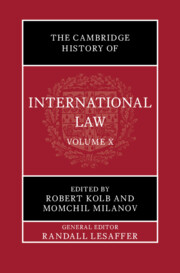
Volume X of The Cambridge History of International Law offers a comprehensive and critical discussion of the history of international law in the interwar period to date. Bringing together scholars across various disciplines, the volume aims to go beyond the well-established cliché of the failure of the League of Nations and discusses the huge impact this period had on the post-WWII international legal order. It focuses on the League of Nations as an important milestone to be studied, analysed, and understood in its own right. Using a global perspective, the volume sheds light on the different branches of international law in this dynamic period, during which the discipline underwent a qualitative leap.
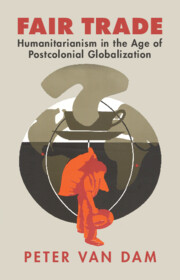
The fair trade movement has been one of the most enduring and successful civic initiatives to come out of the 1960s. In the first transnational history of the movement, Peter van Dam charts its ascendance and highlights how activists attempted to transform the global market in the aftermath of decolonization. Through original archival research into the trade of handicrafts, sugar, paper, coffee and clothes, van Dam demonstrates how the everyday, material aspects of fair trade activism connected the international politics of decolonization with the daily realities of people across the globe. He explores the different scales at which activists operated and the instruments they employed in the pursuit of more equitable economic relations between the global South and North. Through careful analysis of a now ubiquitous global movement, van Dam provides a vital new lens through which to view the history of humanitarianism in the age of postcolonial globalization.
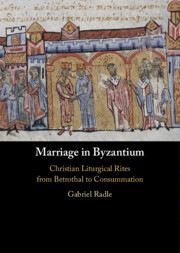
Across cultures, weddings have historically represented some of the most important and extravagant celebrations. This is the first comprehensive study of marriage rituals in the Eastern Mediterranean world of Byzantine Christianity. Using a large corpus of unedited liturgical manuscripts as well as other evidence from jewelry and law to visual representations and theological treatises, Gabriel Radle reconstructs the ceremonies used by the Byzantines to formalize the marriage process, from betrothal to rites of consummation. He showcases the meanings behind rituals of kinship formation and sexual relations and explores how the practice of Byzantine Christianity crossed fluid borders between the church and the domestic sphere. The book situates the development of Byzantine Christian marriage traditions alongside those of other religious communities and, in placing liturgical manuscripts at the heart of this study, paves new methodological paths for the use of ritual sources in the writing of Byzantine history.
Today, we perceive Gothic cathedrals as light-filled forms representing the sacred. The colored light projected from brightly-colored stained glass windows onto the walls and floors of these buildings suggests the presence of divinity. Suger (1081-1151CE), the abbot of the monastery of Saint-Denis, is credited with originating Gothic architecture. However, focus on form and structure has elided attention to the material out of which medieval churches were made. When Suger describes the early church he was replacing, he says that the gold and gems it contained beamed outwardly with a gleaming light that filled the eye. When he restored his church and filled it with the shining souls of his ecclesia, he repeated God's divine act of creation. His restored church imitated the precious stones that could be shaped and polished to reveal divine light. By crafting stone, Suger fulfilled the divine plan to make heaven on earth.
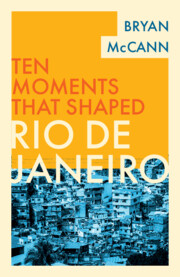
What do nineteenth-century fiction, early twentieth-century popular music, 1930s soccer, 1950s film comedy, 1960s experimental art and 1970s soap operas have in common with one another? Each reveal the deep patterns structuring social and cultural life in Rio de Janeiro. Bringing a fresh perspective to one of the most visited cities in South America, Bryan McCann explores each manifestation in turn, mining their depths and drawing connections between artistic movements and political and economic transitions. The book explores the centrality of slavery to every aspect of life in nineteenth century Rio and its long legacy through to the current day, illuminating both the city's grinding inequality and violence, as well as its triumphant cultural expressions. Rio de Janeiro is a unique and fascinating city, and through ten pivotal moments, McCann reveals its boundless creativity and contradictions, and shows how it has been continually remade by newcomers, strivers, and tricksters.
This article examines Conor Cruise O’Brien’s ideas about historical objectivity and the craft of the historian. Drawing on a mix of published material and unpublished manuscript sources, it charts the evolution of the thinking of a key Irish public intellectual about how historians should write history and how their work should relate to their contemporary world. It identifies several unacknowledged intellectual debts O’Brien owed to influential twentieth-century thinkers — namely, the philosophers Michael Oakeshott and Maurice Merleau-Ponty and the sociologist C. Wright Mills. The article challenges the claim that O’Brien’s view of historiography underwent significant changes in response to the outbreak of violence in Northern Ireland during the late 1960s. On the contrary, it is argued that O’Brien’s thinking on these themes remained fundamentally unchanged from the mid 1950s until the end of his long career as a public intellectual.
In conventional writing on the Indonesian National Revolution, perjuangan (struggle) is often counterpoised against diplomacy. But seen from another angle, both activities served each other. For Tan Malaka and his supporters, guerrilla warfare was a subset of the broader political and ideological campaign. It connoted a particular form of struggle exercised through political coalition building and through the exercise of mass campaigns, rallies or other mass actions joined by left-wing and religious groups supporting laskar, or militias, who took their struggle to the streets, the countryside or even the mountain slopes. From 1945 to 1949, practically no one on the Left in Indonesia knew anything about guerrilla warfare contained within communist theories of revolutionary takeover, much less had any deep experience of them (and that included the group around Musso). The exception was Tan Malaka, who set out his own blueprint for a revolutionary takeover of Java in his 1925 publication, and which he further refined in some of his prison writings.
This chapter is divided into two sections. The first sets out the details of Tan Malaka's Persatuan Perjuangan, or Struggle Front, following his first open political plays in the young Republic. The second goes on to detail the emergence of the Gerakan Revolusi Rakyat (GRR), a grand Tan Malaka coalition linking political parties with sections of the TNI, and even with radical Islamists, that came together in the wake of the crackdown on the PKI. In the Dutch estimation, the GRR emerged to become the most potent threat to peace on their terms.