To save content items to your account,
please confirm that you agree to abide by our usage policies.
If this is the first time you use this feature, you will be asked to authorise Cambridge Core to connect with your account.
Find out more about saving content to .
To save content items to your Kindle, first ensure no-reply@cambridge.org
is added to your Approved Personal Document E-mail List under your Personal Document Settings
on the Manage Your Content and Devices page of your Amazon account. Then enter the ‘name’ part
of your Kindle email address below.
Find out more about saving to your Kindle.
Note you can select to save to either the @free.kindle.com or @kindle.com variations.
‘@free.kindle.com’ emails are free but can only be saved to your device when it is connected to wi-fi.
‘@kindle.com’ emails can be delivered even when you are not connected to wi-fi, but note that service fees apply.
This paper constructs the intellectual histories of learned societies in Ghana to illuminate African agency in pursuing knowledge production and dissemination. Academics and politicians founded some of Africa’s first scientific societies in Ghana. Previous scholarship on scientific research and higher education in Africa has overlooked the role of disciplines-based learned societies and national academies. This paper contributes to that literature using a historical comparative approach to construct the histories of learned societies that emerged during the colonial and postcolonial periods to understand how such scientific associations contributed to research productivity. I advance two arguments based on case studies of three scientific societies. First, there is linearity in the evolution of learned societies. Second, the institutionalization of scientific communities along interdisciplinary and transdisciplinary lines provided flexibility and enabled learned associations to contribute relevant knowledge to the “developmental state” that the political leaders were constructing.
From 1942 to 1945, the Indian National Army (INA) and its civilian wing, the Indian Independence League (IIL), operated in Japanese-occupied Asia to prepare for wars against Britain. Led by first Rash Behari Bose and then Subhas Chandra Bose, the INA recruited members from diverse Indian communities in Asia. This article examines the spiritual training that the INA launched in Malaya in 1943 to unite Indians outside the subcontinent. Through twenty-three lectures, the spiritual training taught a strand of Indian nationalism by creating a historical narrative, which helped reproduce the Indian National Congress’s vision for India. Contrasting with existing literature that attributes the lectures solely to Chandra Bose, this article traces the lectures to the works of Behari Bose, Mohandas Gandhi, and Jawaharlal Nehru. It further argues that Behari Bose’s leadership of the IIL and the INA and the spread of Nehru’s political ideas in Malaya shaped the lectures. Accordingly, the article restores the importance of the lesser-known Behari Bose in the INA and the Indian independence struggle. More broadly, it demonstrates the relationship between violent and non-violent movements, and questions the historical memory about the anti-colonialists who worked with the Axis powers.
Though historians have often traced the evolution of LGBT ‘communities’ in the United States, they have left the genealogy of queer ideas of ‘community’ underexamined. This article begins to address this lacuna by charting the bifurcated early history of these ideas in the nation’s ‘gay capital’, San Francisco. It identifies homophile activist José Sarria’s 1961 campaign for San Francisco city supervisor as the event that introduced the notion of a ‘gay community’ to lasting effect into local homophile organizing. Sarria’s camp mobilized the idea as a resistance tool for the fight against state repression. In the following years, the concept established itself across local homophile activism. Simultaneously with the rise of ‘gay community’, some homophile leaders also developed coalitional visions of ‘community’. These were inspired by Black freedom organizing and prioritized building community with other marginalized groups. Only a mid-1960s struggle over the orientation of the country’s first homophile community centre led to a lasting sidelining of this coalitional tradition. The reconstruction of this bipartite history challenges enduring myths of a monolithically conservative homophile movement, and helps explain the subsequent success of a homonormative gay politics in the late 1960s and 1970s.
In the early modern period, both legal and illegal maritime predation was a common occurrence, but the expansion of European maritime empires exacerbated existing and created new problems of piracy across the globe. This collection of original case studies addresses these early modern problems in three sections: first, states' attempts to exercise jurisdiction over seafarers and their actions; second, the multiple predatory marine practices considered 'piracy'; and finally, the many representations made about piracy by states or the seafarers themselves. Across nine chapters covering regions including southeast Asia, the Atlantic archipelago, the North African states, and the Caribbean Sea, the complexities of defining and criminalizing maritime predation is explored, raising questions surrounding subjecthood, interpolity law, and the impacts of colonization on the legal and social construction of ocean, port, and coastal spaces. Seeking the meanings and motivations behind piracy, this book reveals that while European states attempted to fashion piracy into a global and homogenous phenomenon, it was largely a local and often idiosyncratic issue.
What happens when we take the big picture to its spatial zenith and examine histories of science from the vantage point of outer space? The answer is somewhat messy. The satellite era launched alongside Sputnik 1 in 1957 facilitated the extension of scientific order and control through technologies of planetary surveillance. Yet regimes of disorder and fragmentation that emerged through entanglements of anthropogenic and more-than-human natural forces at the planetary periphery prompt a reconsideration of the limits of that control. Enrolling the methodologies of envirotech and discard studies scholarship invites a generatively messy, vertical and extra-planetary view of scientific practices and politics from the ground up and back again, and a glimpse at the historiographical possibilities that emerge from an embrace of systemic disorder.
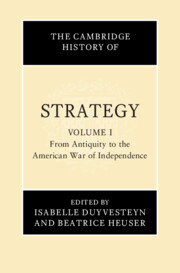
Volume I of The Cambridge History of Strategy offers a history of the practice of strategy from the beginning of recorded history, to the late eighteenth century, from all parts of the world. Drawing on material evidence covering two and a half millennia, an international team of leading scholars in each subject examines how strategy was formulated and applied and with what tools, from ancient Greece and China to the Ottoman and Mughal Empires and the American Revolutionary War. They explore key themes from decision-makers and strategy-making processes, causes of wars and war aims and tools of strategy in war and peace, to configurations of armed forces and distinctive and shared ways of war across civilisations and periods. A comparative conclusion examines how the linking of political goals with military means took place in different parts of the world over the course of history, asking whether strategic practice has universal features.
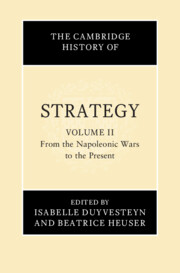
Volume II of The Cambridge History of Strategy focuses on the practice of strategy from 1800 to the present day. A team of eminent scholars examine how leaders of states, empires and non-state groups (such as guerrilla forces, rebel groups and terrorists) have attempted to practise strategy in the modern period. With a focus on the actual 'doing' of strategy, the volume aims to understand real-world experiences when ideas about conflict are carried out against a responding and proactive opponent. The case studies and material presented in the volume form an invitation to rethink dominant perspectives in the field of strategic studies. As the case studies demonstrate, strategy is most often not a stylised, premeditated and wilful phenomenon. Rather, it is a product of circumstance and opportunity, both structural and agential, leading to a view of strategy as an ad hoc, if not chaotic, enterprise.
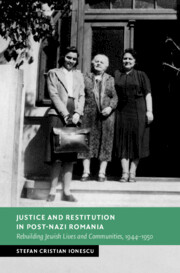
On 23rd August 1944, following the collapse of the pro-Nazi dictatorship of Ion Antonescu, Romania changed sides and abandoned the Axis to join the Allies. Justice and Restitution in Post-Nazi Romania explores the hopes, struggles and disappointments of Jewish communities in Romania seeking to rebuild their lives after the Holocaust. Focusing on the efforts of survivors to recuperate rights and property, Stefan Cristian Ionescu demonstrates how the early transitional government enabled short term restitution. However, from 1948, the consolidated communist regime implemented nationalizations which dispossessed many citizens. Jewish communities were disproportionality affected, and real estate and many businesses were lost once again. Drawing on archival sources from government documentation to diaries and newspaper reports, this study explores both the early success and later reversal of restitution policies. In doing so, it sheds light on the postwar treatment of Romanian Jewish survivors, and the reasons so many survivors emigrated from Romania.
This Element analyses the autobiographies of historians from a global perspective and looks at all eras, from antiquity to the present day. It includes twenty autobiographies: Caesar's and Lucian of Samosata's memories in antiquity; an autobiography of a medieval king such as Peter IV of Aragon; Vico's, Gibbon's and Adams' intellectual self-accounting in modernity; autobiographical revelations and social activism of twentieth century women historians such as Carolyn Steedman, Jill Conway and Gerda Lerner; classical Chinese and Islamic traditions through the autobiographies of Sima Quian and Ibn Khaldun; the perplexities inherent in the modernisation of Japan (Fukuzawa Yukichi), China (Gu Jiegang), India (Nirad Chaudhuri) and Egypt (Taha Hussein); postmodernists such as Rosenstone; and traumatic postcolonial experiences in Africa (Bethwell Ogot), Latin America (Carlos Eire) and Southeast Asia (Wang Gungwu). This Element proposes a literary and historical approach to these autobiographies, emphasising its historiographical dimension and value.
This Element examines the sociopolitical hierarchy of England in the tenth and eleventh centuries, focusing upon the plasticity of the boundary between the ranks of ceorl and thegn. Offering a nuanced analysis of terms such as ceorl and thegn in both earlymedieval texts and modern scholarship, the Element highlights the mechanisms that allowed these non-institutional signifiers to hold such socialweight while conferring few tangible benefits. To better describe the relative social positions, the author argues that a compound method is preferable, supporting this proposal via a thorough deconstruction of writings by Archbishop Wulfstan II of York − responsible for many of scholars' ideas about rank in the period − and the examination of sources that evidence a blurring of 'middling' social boundaries across the two centuries under discussion. Together, these strands of interrogation allow for a fuller understanding of how status was constructed in earlymedieval England.
In 1989, British Petroleum (BP) made the largest onshore investment in the company’s 72-year history in Scotland by expanding its Grangemouth petrochemical complex. Construction and operation were promised to generate between 1,200 and 1,500 jobs, but upon the project’s completion, over 1,000 industrial jobs were lost in the town, and employment never increased. This research explains this outcome by embedding it within a history of post-World War II deindustrialization and engaging with E.P. Thompson’s moral economy and the concept of “noxious deindustrialization”: expanding environmentally destructive capacity and shrinking industrial employment. It illuminates what the buildup and later transgression of moral economy promises looked like for a town experiencing rapid but fragile expansion on the back of petrochemicals, a modern, highly toxic, and land-intensive industry. Using oral history and archive study, the research establishes the presence of noxiousness in Grangemouth from the mid-twentieth century onward. Between 1951 and 1970, industrialization, urban expansion, and paternalistic corporate practices shaped customary notions that embedded the petrochemical sector into the community, justifying concerns about pollution, smells, and the industry’s intensive requirements on land. Between 1970 and 1989, the moral economy was transgressed as the planning system was dismantled and BP’s welfarist responsibility to Grangemouth lessened under economic liberalization. Amid growing environmental concerns globally, noxiousness became intolerable. Noxious deindustrialization accelerated with changes in energy prices, consolidation of private power, and discovery of North Sea oil, leading to company restructuring and job cuts in BP Chemicals. Consequently, the link between employment, population growth, and economic security broke down.