To save content items to your account,
please confirm that you agree to abide by our usage policies.
If this is the first time you use this feature, you will be asked to authorise Cambridge Core to connect with your account.
Find out more about saving content to .
To save content items to your Kindle, first ensure no-reply@cambridge.org
is added to your Approved Personal Document E-mail List under your Personal Document Settings
on the Manage Your Content and Devices page of your Amazon account. Then enter the ‘name’ part
of your Kindle email address below.
Find out more about saving to your Kindle.
Note you can select to save to either the @free.kindle.com or @kindle.com variations.
‘@free.kindle.com’ emails are free but can only be saved to your device when it is connected to wi-fi.
‘@kindle.com’ emails can be delivered even when you are not connected to wi-fi, but note that service fees apply.
People with severe mental illness (SMI), including schizophrenia and related psychoses and bipolar disorder, are at greater risk for obesity compared with people without mental illness. An altered resting metabolic rate (RMR) may be a key driving factor; however, published studies have not been systematically reviewed. This systematic review and meta-analysis aimed to determine whether the RMR of people with SMI assessed by indirect calorimetry differs from (i) controls, (ii) predictive equations and (iii) after administration of antipsychotic medications. Five databases were searched from database inception to March 2022. Thirteen studies providing nineteen relevant datasets were included. Study quality was mixed (62 % considered low quality). In the primary analysis, RMR in people with SMI did not differ from matched controls (n 2, standardised mean difference (SMD) = 0·58, 95 % CI −1·01, 2·16, P = 0·48, I2 = 92 %). Most predictive equations overestimated RMR. The Mifflin–St. Jeor equation appeared to be most accurate (n 5, SMD = −0·29, 95 % CI −0·73, 0·14, P = 0·19, I2 = 85 %). There were no significant changes in RMR after antipsychotic administration (n 4, SMD = 0·17, 95 % CI −0·21, 0·55, P = 0·38, I2 = 0 %). There is little evidence to suggest there is a difference in RMR between people with SMI and people without when matched for age, sex, BMI and body mass, or that commencement of antipsychotic medication alters RMR.
Despite over a decade of both quantitative and qualitative studies, food insecurity among US college/university students remains a pervasive problem within higher education. The purpose of this perspective piece was to highlight research gaps in the area of college food insecurity and provide rationale for the research community to focus on these gaps going forward. A group of food insecurity researchers from a variety of higher education institutions across the United States identified five thematic areas of research gaps: screening and estimates of food insecurity; longitudinal changes in food insecurity; impact of food insecurity on broader health and academic outcomes; evaluation of impact, sustainability and cost effectiveness of existing programmes and initiatives; and state and federal policies and programmes. Within these thematic areas, nineteen specific research gaps were identified that have limited or no peer-reviewed, published research. These research gaps result in a limited understanding of the magnitude, severity and persistence of college food insecurity, the negative short- and long-term impacts of food insecurity on health, academic performance and overall college experience, and effective solutions and policies to prevent or meaningfully address food insecurity among college students. Research in these identified priority areas may help accelerate action and interdisciplinary collaboration to alleviate food insecurity among college students and play a critical role in informing the development or refinement of programmes and services that better support college student food security needs.
Despite evidence for favourable health outcomes associated with plant-based diets, a database containing the plant and animal content of all foods eaten is required to undertake a reliable assessment of plant-based diets within a population. This study aimed to expand an existing Australian food database to include the plant and animal content of all whole foods, beverages, multi-ingredient products and mixed dishes. Twenty-three plant- and animal-based food group classifications were first defined. The food servings per 100 g of each product were then systematically calculated using either a recipe-based approach, a food label-based approach, estimates based on similar products or online recipes. Overall, 4687 (83·5 %) foods and beverages were identified as plant or plant-containing products, and 3701 (65·9 %) were animal or animal-containing products. Results highlighted the versatility of plant and animal ingredients as they were found in various foods across many food categories, including savoury and sweet foods, as well as discretionary and core foods. For example, over 97 % of animal fat-containing foods were found in major food groups outside the AUSNUT 2011–2013 ‘fats and oils’ group. Surprisingly, fruits, nuts and seeds were present in a greater percentage of discretionary products than in core foods and beverages. This article describes a systematic approach that is suitable for the development of other novel food databases. This database allows more accurate quantitative estimates of plant and animal intakes, which is significant for future epidemiological and clinical research aiming to investigate plant-based diets and their related health outcomes.
The coronavirus disease 2019 (COVID-19) has led to the implementation of restrictions to reduce transmission worldwide. The restrictions and measures have affected the psychological health and eating habits. The objective of the present study was to evaluate dietary habits, lifestyle changes, adherence to the Mediterranean diet (MD) and fear of COVID-19 in Turkey during the pandemic. A cross-sectional online survey of socio-demographic characteristics, anthropometric measurements, nutrition, physical activity and lifestyle habits was used for data collection. The fear of COVID-19 levels of the participants was determined by the fear of COVID-19 scale (FCV-19S). The Mediterranean Diet Adherence Screener (MEDAS) was used to evaluate participants’ adherence to the MD. The differences between the FCV-19S and MEDAS according to gender were compared. Eight hundred and twenty subjects (76⋅6 % women and 28⋅4 % men) were evaluated within the study. The mean of MEDAS (ranged between 0 and 12) was 6⋅4 ± 2⋅1, and almost half of the participants moderately adhered to the MD. The mean of FCV-19S (ranged between 7 and 33) was 16⋅8 ± 5⋅7, while women's FCV-19S and MEDAS were significantly higher than men's (P < 0⋅001). The consumption of sweetened cereals, grains, pasta, homemade bread and pastries of the respondents with high FCV-19S were higher than in those with low FCV-19S. High FCV-19S was also characterized by decreased take-away food and fast food consumption in approximately 40 % of the respondents (P < 0⋅01). Similarly, women's fast food and take-away food consumption decreased more than men's (P < 0⋅05). In conclusion, the respondents’ food consumption and eating habits varied according to the fear of COVID-19.
We sought to examine the effects of daily consumption of macadamia nuts on body weight and composition, plasma lipids and glycaemic parameters in a free-living environment in overweight and obese adults at elevated cardiometabolic risk. Utilising a randomised cross-over design, thirty-five adults with abdominal obesity consumed their usual diet plus macadamia nuts (~15 % of daily calories) for 8 weeks (intervention) and their usual diet without nuts for 8 weeks (control), with a 2-week washout. Body composition was determined by bioelectrical impedance; dietary intake was assessed with 24-h dietary recalls. Consumption of macadamia nuts led to increased total fat and MUFA intake while SFA intake was unaltered. With mixed model regression analysis, no significant changes in mean weight, BMI, waist circumference, percent body fat or glycaemic parameters, and non-significant reductions in plasma total cholesterol of 2⋅1 % (−4⋅3 mg/dl; 95 % CI −14⋅8, 6⋅1) and low-density lipoprotein (LDL-C) of 4 % (−4⋅7 mg/dl; 95 % CI −14⋅3, 4⋅8) were observed. Cholesterol-lowering effects were modified by adiposity: greater lipid lowering occurred in those with overweight v. obesity, and in those with less than the median percent body fat. Daily consumption of macadamia nuts does not lead to gains in weight or body fat under free-living conditions in overweight or obese adults; non-significant cholesterol lowering occurred without altering saturated fat intake of similar magnitude to cholesterol lowering seen with other nuts.
Quality of Recovery-15 (QoR-15) has received attention as a postoperative patient-reported outcome measure. Preoperative nutritional status has negative effects on postoperative outcomes; however, these associations have not yet been investigated. We included inpatients aged ≥ 65 years who underwent elective abdominal cancer surgery under general anaesthesia between 1 June 2021 and 7 April 2022 at our hospital. Preoperative nutritional status was assessed using the Mini Nutritional Assessment Short-Form (MNA-SF), and patients with an MNA-SF score ≤ 11 were categorised into the poor nutritional group. The outcomes in this study were the QoR-15 scores at 2 d, 4 d and 7 d after surgery, which were compared between groups by unpaired t test. Multiple regression analysis was applied to assess the effects of poor preoperative nutritional status on the QoR-15 score on postoperative day 2 (POD 2). Of the 230 included patients, 33·9 % (78/230) were categorised into the poor nutritional status group. The mean QoR-15 value was significantly lower in the poor nutritional group than in the normal nutritional group at all postoperative time points (POD 2:117 v. 99, P = 0·002; POD 4:124 v. 113, P < 0·001; POD 7:133 v. 115, P < 0·001). Multiple analyses showed that poor preoperative nutritional status was associated with the QoR-15 score on POD 2 (adjusted partial regression coefficient, −7·8; 95 % CI −14·9, −0·72). We conclude that patients with a poor preoperative nutritional status were more likely to have a lower QoR-15 score after abdominal cancer surgery.
With the recent growing interest in improving fruit and vegetable intake for better health and limited research resources in many settings, simple-to-administer and low-priced indicators are essential tools for monitoring fruit and vegetable intake at the population level. A potential candidate indicator is the fruit and vegetable component of the Global Dietary Recommendation score (FV-GDR) based on data collected using the Diet Quality Questionnaire (DQQ). We investigated the relative validity of FV-GDR collected with the DQQ to measure fruit and vegetable intake by comparison with a 24-h recall (24hR) as a reference collected from 620 Vietnamese and 630 Nigerian adults in 2021. We found proportional differences in the prevalence of intake of vitamin A-rich vegetables, other vegetables and other fruits in Vietnam and all vegetable food groups in Nigeria. In both countries, we found a small difference in the total FV-GDR from DQQ compared with the 24hR, and the percentage of agreement between the two methods was quite high for the majority of the food groups. The FV-GDR calculated from the DQQ correlated with the actual intake, although less strongly than the FV-GDR from 24hR. The DQQ is a promising low-burden, low-cost and simple tool to calculate FV-GDR and to monitor fruit and vegetable consumption at the population level. This provides the possibility of evaluating an important aspect of diet quality in low-resource settings.
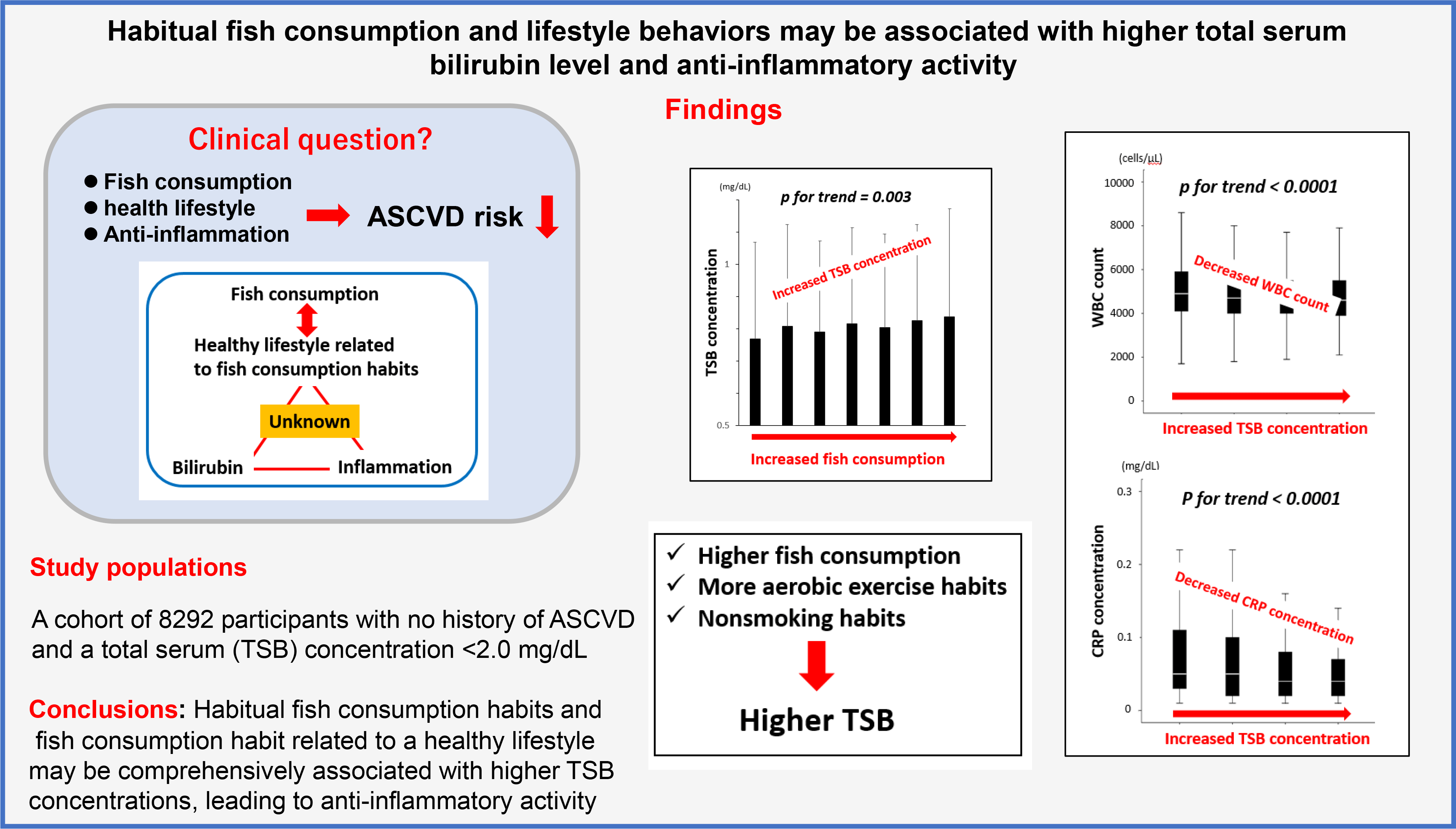
Habitual fish consumption and a healthy lifestyle are associated with lower atherosclerotic CVD (ASCVD) risk. Mildly elevated bilirubin, an end product of Hb metabolism, may be associated with anti-inflammatory effects, suppressing ASCVD risk. No data exist on the relationship between fish consumption, total serum bilirubin (TSB) and inflammation in clinical settings. We conducted a cross-sectional study between April 2019 and March 2020 in a cohort of 8292 participants (average age, 46·7 (sd 12·9) years and 58·9 % men) with no history of ASCVD and TSB concentrations < 2·0 mg/dl. Multiple stepwise regression analysis showed Hb concentrations were a solid positive determinant of TSB concentrations (β = 0·302, P< 0·0001). Fish consumption (β = 0·025, P= 0·019) and aerobic exercise (β = 0·021, P= 0·043) were statistically weak but significantly positive determinants of TSB concentrations. Cigarette smoking negatively affected TSB concentrations (β = −0·104, P< 0·0001). Moreover, with increasing fish consumption, the proportion of participants with a habit of cigarette smoking decreased, and that of participants who engaged in aerobic exercises increased (P< 0·0001 for both). Furthermore, as TSB concentrations increased, the leukocyte counts and C-reactive protein concentrations decreased (P< 0·0001 for both). In conclusion, despite the lesser relevance given to TSB concentrations than Hb concentrations, higher fish consumption and healthier lifestyle behaviours related to fish consumption habits may be additively or synergistically associated with higher TSB concentrations and anti-inflammatory activity, leading to attenuated ASCVD risk. Further investigations are needed to clarify the causal relationships between these factors.
To establish an international consensus on the definition of food security, measures and advocacy priorities in high-income countries.
Design:
A two-round online Delphi survey with closing in March 2020 and December 2021. Consensus was set a priori at 75 %. Qualitative data were synthesised and priorities were ranked.
Setting:
High-income countries.
Participants:
Household food security experts in academia, government and non-government organisations who had published in the last 5 years.
Results:
Up to thirty-two participants from fourteen high-income countries responded to the Delphi with a 25 % response rate in Round 1 and a 38 % response rate in Round 2. Consensus was reached on the technical food security definition and its dimensions. Consensus was not reached on a definition suitable for the general public. All participants agreed that food security monitoring systems provide valuable data for in-country decision-making. Favoured interventions were those that focused on upstream social policy influencing income. Respondents agreed that both national and local community level strategies were required to ameliorate food insecurity, reinforcing the complexity of the problem.
Conclusions:
This study furthers the conceptual understanding of the commonly used definition of food security and its constituent dimensions. Strong advocacy is needed to ensure food security monitoring, policy and mitigation strategies are implemented. The consensus on the importance of prioritising actions that address the underlying determinants of household food security by experts in the field from across wealthy nations provides evidence to focus advocacy efforts and generate public debate.
To aid the design of nutrition interventions in low- and middle-income countries undergoing a nutrition transition, this study examined behavioural and environmental risk factors associated with childhood overweight and obesity in urban Indonesia.
Design:
Body height and weight of children were measured to determine BMI-for-age Z-scores and childhood overweight and obesity status. A self-administered parental survey measured socio-economic background, children’s diet, physical activity, screen time and parental practices. Logistic and quantile regression models were used to assess the association between risk factors and the BMI-for-age Z-score distribution.
Setting:
Public primary schools in Central Jakarta, sampled at random.
Participants:
Children (n 1674) aged 6–13 years from 18 public primary schools.
Results:
Among the children, 31·0 % were overweight or obese. The prevalence of obesity was higher in boys (21·0 %) than in girls (12·0 %). Male sex and height (aOR = 1·67; 95 % CI 1·30, 2·14 and aOR = 1·16; 95 % CI 1·14, 1·18, respectively) increased the odds of being overweight or obese, while the odds reduced with every year of age (aOR = 0·43; 95 % CI 0·37, 0·50). Maternal education was positively associated with children’s BMI at the median of the Z-score distribution (P = 0·026). Dietary and physical activity risk scores were not associated with children’s BMI at any quantile. The obesogenic home food environment score was significantly and positively associated with the BMI-for-age Z-score at the 75th and 90th percentiles (P = 0·022 and 0·023, respectively).
Conclusions:
This study illustrated the demographic, behavioural and environmental risk factors for overweight and obesity among primary schoolchildren in a middle-income country. To foster healthy behaviours in primary schoolchildren, parents need to ensure a positive home food environment. Future sex-responsive interventions should involve both parents and children, promote healthy diets and physical activity and improve food environments in homes and schools.
Over 30 years ago it was proven beyond doubt that folic acid supplementation of mothers in early pregnancy protects against neural tube defects (NTD) in their babies. Such conclusive scientific evidence led to clear recommendations for women worldwide to take 0⋅4 mg/d folic acid before conceiving and in early pregnancy, but implementing these into effective policy has been problematic. As a result, there has been no change in the incidence of NTD in Ireland, the UK or any other European country over the 25-year period that the current strategy, recommending periconceptional folic acid supplements to women, has been in place. Thus preventable NTD are not being prevented. Notably, in September 2021, the UK government announced that starch is to be fortified with folic acid on a mandatory basis. A similar decision is now urgently needed in Ireland, where rates of NTD are among the highest in the world. A policy of mandatory folic acid fortification of food would be highly effective in preventing NTD because it reaches all women, including those who have not planned their pregnancy. International evidence shows that wherever such a policy has been introduced, it has proved to be effective in reducing rates of NTD in that country. Apart from preventing NTD, the driver of policy in the area, other potential health benefits across the lifecycle can be anticipated from folic acid fortification. Urgent action is needed on implementation of mandatory food fortification with folic acid in Ireland so that mothers and their babies can benefit.
The substantial changes in the physical and social environment during the transition from primary to secondary school may significantly impact adolescents’ energy balance-related behaviours (i.e. dietary behaviour, sedentary behaviour, sleep behaviour and physical activity (PA)). This is the first review systematically summarising evidence on changes in four energy balance-related behaviours of adolescents across the school transition from primary to secondary school.
Design:
For this systematic review, the electronic databases Embase, PsycINFO and SPORTDiscus were searched for relevant studies from inception to August 2021. PubMed was searched for relevant studies from inception to September 2022. Inclusion criteria were: (i) longitudinal studies reporting; (ii) one or more energy balance-related behaviours; and (iii) across the school transition, that is, with measurement(s) during both primary and secondary school.
Setting:
Transition from primary to secondary school
Participants:
Adolescents across the transition from primary to secondary school.
Results:
Thirty-four studies were eligible. We found strong evidence for an increase in sedentary time, moderate evidence for a decrease in fruit and vegetable consumption, and inconclusive evidence for a change in total, light, and moderate-to-vigorous PA, active transport, screen time, unhealthy snack consumption, and sugar-sweetened beverages consumption among adolescents across the school transition.
Conclusions:
During the transition from primary to secondary school, sedentary time and fruit and vegetable consumption tend to change unfavourably. More high-quality, longitudinal research is needed specifically on changes in energy balance-related behaviour across the school transition, especially regarding sleep behaviour. (Prospero registration: CRD42018084799)
This systematic review aimed to summarise the level of quality and accuracy of nutrition-related information on websites and social media and determine if quality and accuracy varied between websites and social media or publishers of information.
Design:
This systematic review was registered with PROSPERO (CRD42021224277). CINAHL, MEDLINE, Embase, Global Health and Academic Search Complete were systematically searched on 15 January 2021 to identify content analysis studies, published in English after 1989, that evaluated the quality and/or accuracy of nutrition-related information published on websites or social media. A coding framework was used to classify studies’ findings about information quality and/or accuracy as poor, good, moderate or varied. The Academy of Nutrition and Dietetics Quality Criteria Checklist was used to assess the risk of bias.
Setting:
N/A.
Participants:
N/A.
Results:
From 10 482 articles retrieved, sixty-four were included. Most studies evaluated information from websites (n 53, 82·8 %). Similar numbers of studies assessed quality (n 41, 64·1 %) and accuracy (n 47, 73·4 %). Almost half of the studies reported that quality (n 20, 48·8 %) or accuracy (n 23, 48·9 %) was low. Quality and accuracy of information were similar on social media and websites, however, varied between information publishers. High risk of bias in sample selection and quality or accuracy evaluations was a common limitation.
Conclusion:
Online nutrition-related information is often inaccurate and of low quality. Consumers seeking information online are at risk of being misinformed. More action is needed to improve the public’s eHealth and media literacy and the reliability of online nutrition-related information.
We aimed to identify temporal patterns of energy intake and investigate their association with adiposity. We performed a cross-sectional study of 775 adults in Iran. Information about eating occasions across the day was collected by three 24-h dietary recalls. Latent class analysis (LCA) was used to identify temporal eating patterns based on whether or not an eating occasion occurred within each hour of the day. We applied binary logistic regression to estimate the OR and 95 % CI of overweight and obesity (defined as BMI of 25–29·9 and ≥ 30 kg/m2, respectively) across temporal eating patterns while controlling for potential confounders. LCA grouped participants into three exclusive sub-groups named ‘Conventional’, ‘Earlier breakfast’ and ‘Later lunch’. The ‘Conventional’ class was characterised by high probability of eating occasions at conventional meal times. ‘Earlier breakfast’ class was characterised by high probability of a breakfast eating occasion 1 h before the conventional pattern and a dinner eating occasion 1 h after the conventional pattern, and the ‘Later lunch’ class was characterised by a high probability of a lunch eating occasion 1 h after the conventional pattern. Participants in the ‘Earlier breakfast’ pattern had a lower likelihood of obesity (adjusted OR: 0·56, 95 % CI: 0·35, 0·95) as compared with the ‘Conventional’ pattern. There was no difference in the prevalence of obesity or overweight between participants in the ‘Later lunch’ and the ‘Conventional’ patterns. We found an inverse association between earlier eating pattern and the likelihood of obesity, but reverse causation may be a plausible explanation.
To pilot a global policy scan assessing how governments worldwide regulate weight-loss supplements (WLS).
Design:
Experts on WLS policies from thirty countries that varied by World Bank income classification, with five from each of the six WHO regions, completed an online survey on WLS regulation in their country. The survey covered six domains: legal frameworks; pre-market requirements; claims, labelling, and advertisements; product availability; adverse events reporting; and monitoring and enforcement. Percentages were calculated for presence or absence of a type of regulation.
Setting:
Experts were recruited through websites of regulatory bodies and professional LinkedIn networks and scientific article searches on Google Scholar.
Participants:
Thirty experts, one from each country (i.e. researchers, regulators, other experts in food and drug regulation).
Results:
WLS regulations varied widely across countries, and a number of gaps were identified. One country (Nigeria) has a minimum legal age to purchase WLS. Thirteen countries reported independently evaluating the safety of a new WLS product sample. Two countries have limitations on where WLS can be sold. In eleven countries, reports on adverse events related to WLS are publicly available. In eighteen countries, safety of new WLS is to be established through scientific criteria. Penalties for WLS non-compliance with pre-market regulations exist in twelve countries and labelling requirements in sixteen countries.
Conclusions:
Results of this pilot study document wide variability in national WLS regulations globally, exposing many gaps in important components of consumer protection regulatory frameworks for WLS, which likely put consumer health at risk.
Menaquinone-7 (MK-7), a multipotent vitamin K2, possesses a wide range of biological activities, a precise curative effect and excellent safety. A simple and rapid LC-APCI-MS/MS method for the determination of MK-7 in human plasma with single liquid–liquid extraction (LLE) extraction and 4·5-min analysis time has been developed and validated. Four per cent bovine serum albumin (BSA) was used as surrogate matrix for standard curves and endogenous baseline subtraction. This method was reproducible and reliable and was used to analyse of MK-7 in human plasma. The endogenous circadian rhythm and bioavailability of MK-7 were investigated in two randomised single-dose, open, one-way clinical trials (Study I and Study II). A total of five healthy male subjects were enrolled in Study I and 12 healthy male subjects in Study II. Single-dose (1 mg) of MK-7 was given to each subject under fasting condition, and all eligible subjects were given a restricting VK2 diet for 4 d prior to drug administration and during the trial. The experiment results of Study I demonstrated that endogenous MK-7 has no circadian rhythm in individuals. Both studies showed MK-7 are absorbed with peak plasma concentrations at about 6 h after intake and has a very long half-life time.
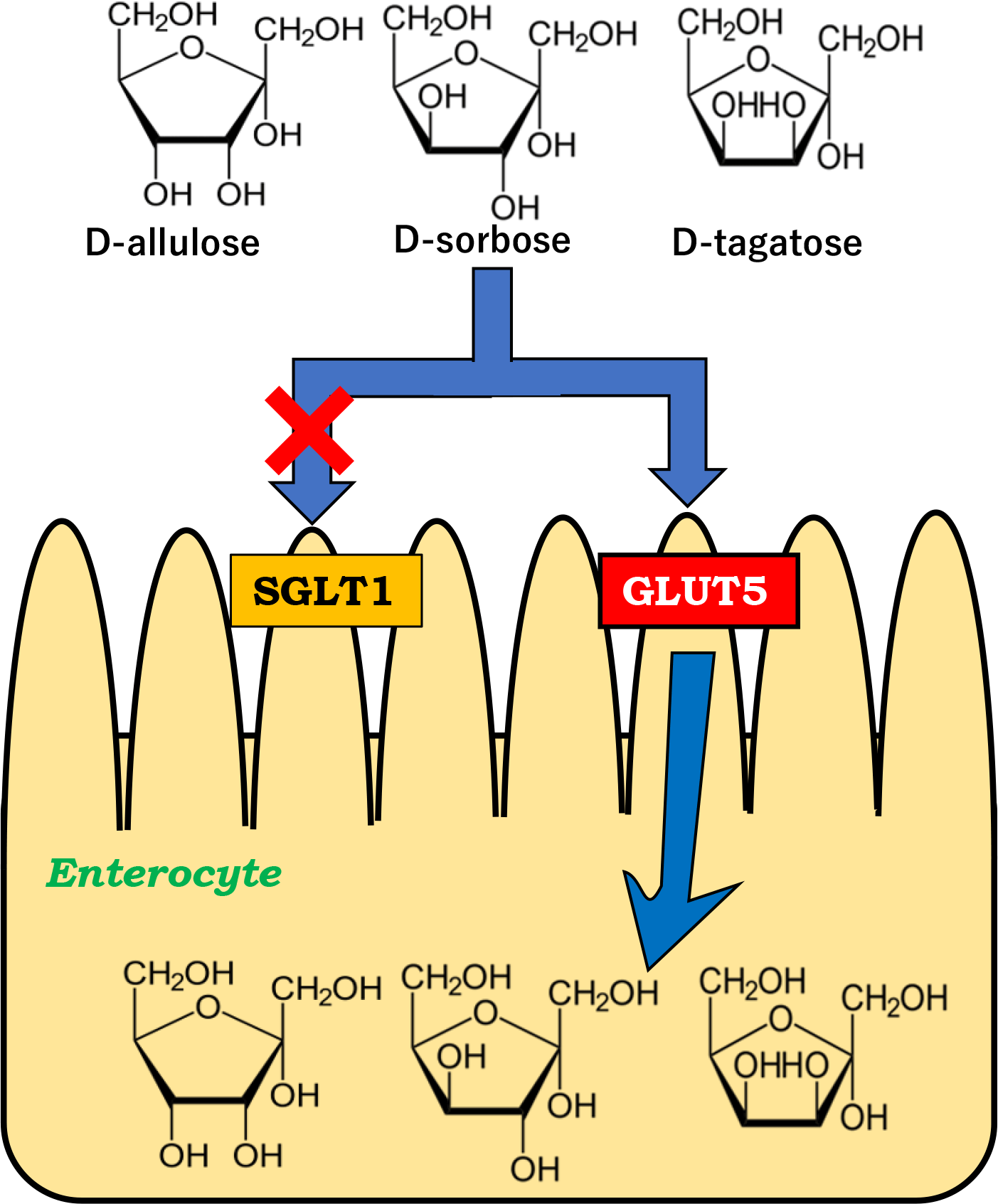
D-allulose, D-sorbose and D-tagatose are D-fructose isomers that are called rare sugars. These rare sugars have been studied intensively in terms of biological production and food application as well as physiological effects. There are limited papers with regard to the transporters mediating the intestinal absorption of these rare sugars. We examined whether these rare sugars are absorbed via sodium-dependent glucose cotransporter 1 (SGLT1) as well as via GLUT type 5 (GLUT5) using rats. High-fructose diet fed rats, which express more intestinal GLUT5, exhibited significantly higher peripheral concentrations, Cmax and AUC0–180 min when D-allulose, D-sorbose and D-tagatose were orally administrated. KGA-2727, a selective SGLT1 inhibitor, did not affect the peripheral and portal vein concentrations and pharmacokinetic parameters of these rare sugars. The results suggest that D-allulose, D-sorbose and D-tagatose are likely transported via GLUT5 but not SGLT1 in rat small intestine.