To save content items to your account,
please confirm that you agree to abide by our usage policies.
If this is the first time you use this feature, you will be asked to authorise Cambridge Core to connect with your account.
Find out more about saving content to .
To save content items to your Kindle, first ensure no-reply@cambridge.org
is added to your Approved Personal Document E-mail List under your Personal Document Settings
on the Manage Your Content and Devices page of your Amazon account. Then enter the ‘name’ part
of your Kindle email address below.
Find out more about saving to your Kindle.
Note you can select to save to either the @free.kindle.com or @kindle.com variations.
‘@free.kindle.com’ emails are free but can only be saved to your device when it is connected to wi-fi.
‘@kindle.com’ emails can be delivered even when you are not connected to wi-fi, but note that service fees apply.
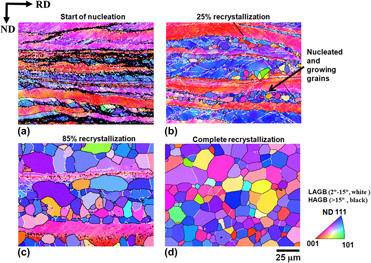
In the present work, a β-Ti alloy (Ti–15V–3Sn–3Cr–3Al) was unidirectionally cold rolled to 80% thickness reduction, followed by recrystallization at two temperatures: (i) 1013 K and (ii) 1053 K. The microstructural developments were studied using light optical microscopy, scanning electron microscopy X-ray peak profile analysis, and electron backscattered diffraction. The bulk texture of deformed and fully recrystallized samples was studied using X-ray diffraction. The deformed microstructures showed the presence of high fraction of shear bands, and these bands were preferentially formed in γ-fiber grains than in the grains with other orientations. Cold rolled β-Ti alloy samples were fully recrystallized in 10 min at 1053 K and in 90 min at 1013 K. Strong α- and γ-fibers were formed after 80% cold rolling, while strong discontinuous γ-fiber (with very strong {111}〈112〉 component) was formed after complete recrystallization. Oriented nucleation was found to be the dominant mechanism for the development of recrystallization texture.
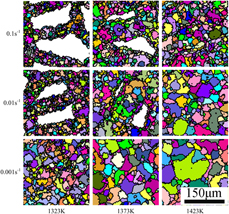
To simulate the effects of hot working parameters on microstructure and flow resistance during dynamic recrystallization (DRX) of a Ni–Cr–Mo-based C276 superalloy, a 2D mesoscopic model has been established using cellular automaton (CA) method. The isothermal hot compression tests were performed on a Gleeble 1500 thermal-mechanical simulator at the temperature range of 1273–1473 K and strain rate range of 0.001–5 s−1. The flow stress behaviors were then obtained and the microstructures of quenching specimen were observed after compression. Then the dislocation density evolution, nucleation and grain growth during hot compression were determined from experiments and integrated to the CA model. The topology of microstructure evolution and deformation resistance were calculated using the developed CA model and compared with the experimental ones. The CA simulation results show reasonable agreements with the experiments, implying the developed CA can capture the effects of processing parameters on the DRX behavior of C276 superalloy.
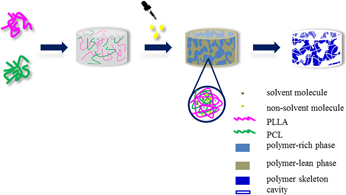
Hierarchically porous poly(L-lactic acid) (PLLA)/poly(ε-caprolactone) (PCL) monolithic composites were fabricated by nonsolvent-induced phase separation (NIPS) method without any template for the first time. A homogeneous hierarchical porous structure with relatively large specific surface area containing both mesopores and macropores was confirmed by pore size distribution plots and scanning electron microscopy images, respectively. Fourier transform infrared analysis (FTIR) revealed that PLLA and PCL were physically blended. Differential scanning calorimeter (DSC) analysis further showed that the two components were physically blended but had a slight thermal compatibility. Meanwhile, X-ray diffraction (XRD) tests indicated that the addition of PCL hindered the crystallization of PLLA. Herein, the formation of the mesopores and macropores during the phase separation process was explained from the microscopic point of view according to the results of XRD and DSC. The present monolithic composites with hierarchically porous structures had promising prospect for applications of tissue engineering.
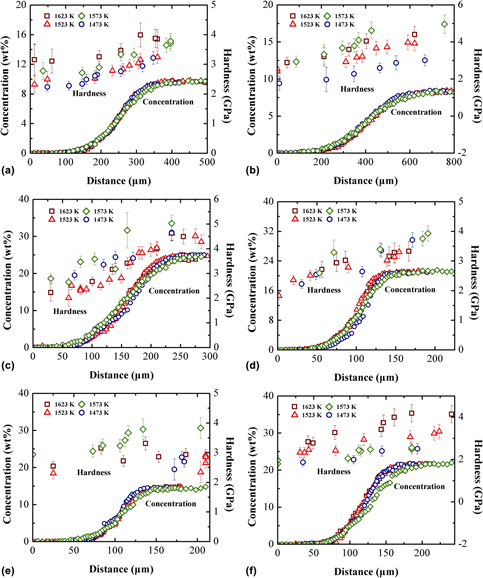
In this paper, the hardness and Young’s moduli along the diffusion paths in fcc Ni–X (X = Rh, Ta, W, Re, Os, and Ir) binary diffusion couples were measured by using the nanoindentation technique. Hardness increases gradually from the pure Ni to the fcc Ni–X alloys, except for the Ni–Os system. While the Young’ moduli in fcc Ni–X alloys scatter much larger and do not show noticeable variation with the addition of element X. After that, the CALPHAD models for description of the composition-dependent hardness and Young’s modulus were proposed, and an in-house code was developed. Based on the present experimental data, the CALPHAD-type descriptions for hardness and Young’s modulus in fcc Ni–X (X = Rh, Ta, W, Re, Os, and Ir) systems were obtained. The model-predicted hardness and Young’s moduli of composition dependence agree with the experimental data in general. It is anticipated that the presently obtained CALPHAD-type hardness and Young’s modulus descriptions, together with the previous thermodynamic and atomic mobility databases, can be used for the future alloy design of novel Ni-based superalloys.
We use density functional theory meta-generalized gradient approximation TPSS + D3(BJ) + U + J calculations to investigate the energetics and geometry of water molecules in the flexible metal-organic framework material Materials of Institut Lavoisier (MIL)-53(Cr) as a function of cell volume. The critical concentration of water to cause the transition from the large pore (lp) to the narrow pore (np) structure is estimated to be about 0.13 water molecule per Cr. At a concentration x = 1 water molecule per Cr, the zero-temperature np and lp configurations each have a hydrogen bond between the H of each framework hydroxyl group and water oxygen (OW). At intermediate volumes, water dimer-like configurations are observed. A concentration x = 1.25 leads to hydrogen bonding between water molecules in the np phase that is absent for x = 1. Our results suggest possible mechanisms for pore closing in hydrated MIL-53(Cr).
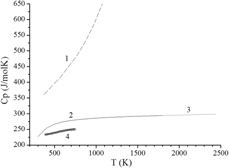
Using the data obtained by Knudsen effusion mass spectrometry, the standard formation thermodynamic properties of La2Hf2O7, Nd2Hf2O7, and Gd2Hf2O7 were calculated in the present study at high temperatures. Based on the results obtained, it was shown that the standard formation Gibbs energies of La2Hf2O7, Nd2Hf2O7, and Gd2Hf2O7 from the elements at the temperature 2445 K were consistent with the empirical rule concerning decrease of stability of pyrochlore hafnate phase with decrease in lanthanoid ionic radius. The La2Hf2O7 and Gd2Hf2O7 heat capacities were obtained in the present study by differential scanning calorimetry. These data were used along with those found earlier to evaluate the standard formation Gibbs energies of La2Hf2O7 and Gd2Hf2O7 from the elements at the temperature 298 K, which equal (−3937 ± 10) kJ/mol and (−3895 ± 10) kJ/mol, respectively. The thermodynamic properties of La2Hf2O7, Nd2Hf2O7, and Gd2Hf2O7 estimated in a wide temperature range allowed consideration of reliability of data available in the literature.
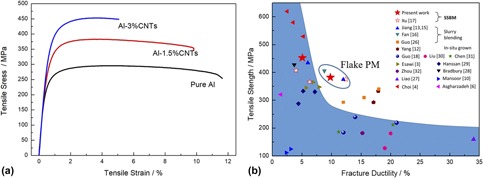
Flat products of carbon nanotubes (CNTs) reinforced Al matrix composites were fabricated using flake powder metallurgy via shift-speed ball milling and hot-rolling. The evolution of CNTs during preparation and the final distribution in the Al matrix were investigated, and the effect of CNT content on mechanical properties were discussed. Due to the combined effect of uniform dispersion of CNTs, structural integrity, interfacial bonding and directional alignment, the balance between high strength and ductility was successfully achieved in the annealed rolled composites with 1.5 wt% CNT addition, with the value of 382.6 MPa in tensile strength and 9.8% in fracture ductility. The load transfer strengthening was the main mechanism of the strength enhancement with CNTs addition. In addition, a strong rotated cube {001}〈110〉 texture was found in the final flat product of rolled composites. This study provides an effective route to produce and improve the mechanical properties of CNT/Al flat products.
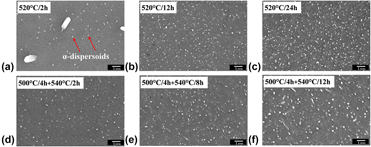
In the present work, Mo was added to an Al–Si–Mg foundry alloy to study its influence on the evolution of dispersoids during various heat treatments. The microhardness and the elevated-temperature tensile properties and creep resistance were measured to evaluate the contribution of dispersoids. Results showed that the addition of Mo greatly promoted the formation of α-dispersoids. During solution treatment, the formation of α-dispersoids started after 8 h at 500 °C. At high temperature (540 °C), the coarsening of dispersoids with increasing time became predominant. The optimum condition of dispersoids can be reached by 520 °C/12 h or 500 °C/4 h + 540 °C/2 h, leading to the highest differences in microhardness between the Mo-containing alloy and base alloy. The tensile strengths were improved at both room temperature and elevated temperatures, while the elongation at elevated temperature was greatly increased. The creep resistance at elevated temperature is further enhanced due to the Mo addition.
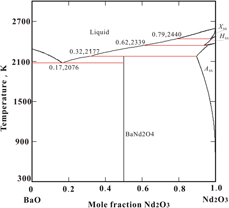
The BaNd2O4 compound and the BaO–Nd2O3 system are of interest for electroceramics. In this work, we synthesized BaNd2O4 by solid-state reaction, measured its heat capacity from 573 to 1273 K by differential scanning calorimetry, and determined its enthalpy of formation from component oxides at 298 K by high-temperature oxide melt solution calorimetry to be −43.75 ± 4.68 kJ/mol. Our newly determined values and available literature data were employed to assess the phase equilibria in the BaO–Nd2O3 system using CALPHAD methodology. A self-consistent thermodynamic database and the calculated phase diagram of the BaO–Nd2O3 system are provided. The optimized thermodynamic parameters are in good agreement with available experimental data. BaNd2O4 is calculated to melt incongruently at 2177 K. This thermodynamic analysis is essential for the optimization of synthesis conditions for materials and for the evaluation of their stability under appropriate technological operating conditions.
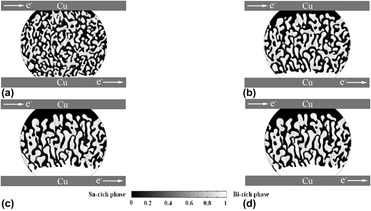
Severe phase coarsening and separation in Sn–Bi alloys have brought increasing reliability concern in microelectronic packages. In this study, a phase field model is developed to simulate the microstructural evolution and evaluate the change in macroscopic physical properties of the flip chip Cu/Sn58Bi/Cu joint under the conditions of isothermal aging, as well as the coupled loads of elastic stress and electric current stressing. Results show that large-sized Bi-rich phase particles grow up at the expense of small-sized ones. Under the coupled loads, Bi atoms migrate along the electron flow direction, consequently Bi-rich phase segregates to form a Bi-rich phase layer at the anode. The current crowding ratio in the solder decreases rapidly first and then fluctuates slightly with time. Current density and von Mises stress exhibit inhomogeneous distribution, and both of them are higher in the Sn-rich phase than in the Bi-rich phase. Electric current transfers through the Sn-rich phase and detours the Bi-rich phase. As time proceeds, the resistance of the solder joint increases, and the average von Mises stress of the solder joint decreases. The Bi-rich phase coarsens much faster under the coupled loads than under the conditions of isothermal aging.
X-ray powder diffraction data, unit-cell parameters, and space group for 17- hydroxy-16-methyl-9,11-epoxypregna-1,4,6-triene-3,20-dione, C22H26O4, are reported [ a = 18.435(1) Å, b = 12.269(3) Å, c = 8.251(5) Å, α = 90°, β = 90°, γ = 90°, unit-cell volume V = 1866.43 Å3, Z = 4, ρcal = 1.261 g cm−3 and space group P212121]. All measured lines were indexed and are consistent with the P212121 space group. No detectable impurities were observed.
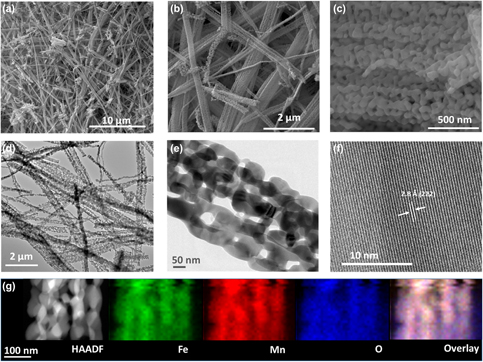
The development of stable and effective earth-abundant metal oxide electrocatalysts is very crucial to improve competence of water electrolysis. In this study, iron manganite (FeMnO3) nanomaterials were synthesized as an affordable electrocatalyst for water oxidation reactions. The structural and chemical properties of FeMnO3 nanomaterials were studied by transmission electron microscopy, scanning electron microscopy, energy-dispersive X-ray, X-ray diffraction, X-ray photoelectron spectroscopy, inductively coupled plasma-optical emission spectrometry, and Brunauer–Emmett–Teller analyses. The microscopy analyses show that the synthesized material has wire morphology, and assembly of approximately 70 nm nanocrystallites forms the wires. XRD patterns confirmed the bixbyite structure of FeMnO3. The potential utility of the synthesized FeMnO3 nanowires (NWs) as an electrocatalyst for oxygen evolution reaction (OER) was investigated in alkaline medium. The FeMnO3 NW modified fluorinated tin oxide (FTO) electrodes demonstrated promising OER activity with onset potential of 1.60 V versus reversible hydrogen electrode and overpotential of 600 mV at 10 mA/cm2 catalytic current density. FeMnO3 NW modified FTO electrode was also observed to be stable during long-term constant potential electrolysis. Therefore, this new material can be considered as a cost-effective alternative to noble metal electrocatalysts for water oxidation and other possible catalytic reactions.
Heterogeneous photocatalytic oxidation technology is currently a technology with the potential to solve environmental pollution and energy shortages. The key to this technology is to find and design efficient photocatalysts. Here, a series of inorganic coordination polymer quantum sheets (ICPQS)@graphene oxide (GO) composite photocatalysts are synthesized by adding GO to the synthesis process of ICPQS: {[CuII(H2O)4][CuI4(CN)6]}n. These composite photocatalysts were characterized by X-ray diffraction, X-ray photoelectron spectroscopy, cyclic voltammetry, scanning electron microscopy, transmission electron microscopy, Zeta potential, and N2 adsorption/desorption isotherms. The photocatalytic degradation of methylene blue showed that the activity of ICPQS@GO composite photocatalysts is better than that of ICPQS. Among ICPQS@GO composite photocatalysts, the 10.6% ICPQS@GO composite photocatalyst has the best activity, which can reach 3.3 mg/(L min) at pH 3. This method of loading low–specific surface area photocatalysts onto GO to improve photocatalytic performance indicates the direction for the synthesis of highly efficient photocatalysts.
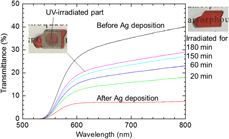
Glasses were prepared in systems based on two stoichiometric sulfides that were selected from Ga2S3, GeS2, and Sb2S3, with the incorporation of excess sulfur and CsCl. We investigated the fundamental properties, including glass transition, density, and optical absorption, and their variations with the incorporation of excess sulfur and CsCl into the pseudo two-component sulfide glasses. The incorporation of CsCl into the GeS2–Sb2S3 glasses shifted the absorption edge at the short-wavelength side to the long-wavelength direction, particularly for glasses with more amount of GeS2 than SbS3/2. In both cases of CsCl incorporation into the Ga2S3–GeS2 glass and Ga2S3–Sb2S3 glass systems, the absorption edges shifted to the short-wavelength direction regardless of the compositions. Ag photodoping behaviors were investigated for the bulk sulfide glasses with excess sulfur and CsCl. The results are discussed based on the diffusion of silver in the glass network that is modified by the incorporation.
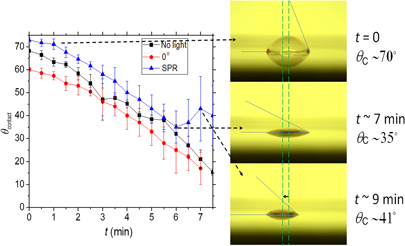
Excitation of surface waves on conducting materials provides a near resistance-free interface capable of a material glissade either by plasmon forces or by optical beam tractors. Analogous to an ice hockey rink, as proof-of-principle plasmon-assisted optical traction, or hoovering, of water drops on a gold surface is demonstrated. Changes in the contact angle provide a novel, low-cost nanoscale method of quantifying observable and potentially tunable changes. Variability in thresholds and movement, including jumps, is observed and can be explained by the presence of significant roughness, measured by scanning electron microscopy, with water tension. The demonstration opens a path to directly integrate various optical and plasmonic traction technologies. Implications of the phenomena and ways of improving transport and potential applications spanning configurable microfluidics, antennas, tunable lenses, diagnostics, sensing, and active Kerr and other devices are discussed.
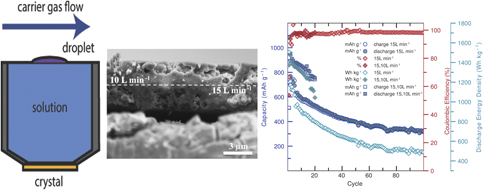
Porosity-graded, conductor- and binder-free porous FeS2 films through the entire thickness were deposited by spray pyrolysis. The film layers deposited at 15 versus 10 L/min are grown in different modes. The film layer deposited at 15 L/min showed Frank–van der Merwe layer-like growth mode whereas the one deposited at 10 L/min showed island growth mode. These growth modes lead to the formation of large pores on the electrolyte side and small ones on the substrate side of the film deposited using 15 and 10 L/min, sequentially. The porosity-graded films showed discharge capacities at C/10 of 879 mA h/g and 754 mA h/g for the 5th and 20th cycles, respectively. Such capacity values are superior to the literature findings for FeS2 powders and nongraded films mixed with conductor and binder additions.
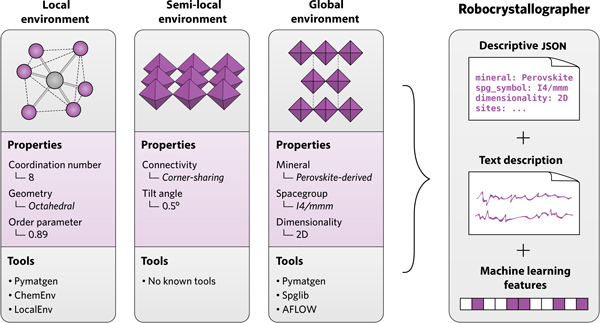
Our ability to describe crystal structure features is of crucial importance when attempting to understand structure–property relationships in the solid state. In this paper, the authors introduce robocrystallographer, an open-source toolkit for analyzing crystal structures. This package combines new and existing open-source analysis tools to provide structural information, including the local coordination and polyhedral type, polyhedral connectivity, octahedral tilt angles, component-dimensionality, and molecule-within-crystal and fuzzy prototype identification. Using this information, robocrystallographer can generate text-based descriptions of crystal structures that resemble descriptions written by human crystallographers. The authors use robocrystallographer to investigate the dimensionalities of all compounds in the Materials Project database and highlight its potential in machine learning studies.