To save content items to your account,
please confirm that you agree to abide by our usage policies.
If this is the first time you use this feature, you will be asked to authorise Cambridge Core to connect with your account.
Find out more about saving content to .
To save content items to your Kindle, first ensure no-reply@cambridge.org
is added to your Approved Personal Document E-mail List under your Personal Document Settings
on the Manage Your Content and Devices page of your Amazon account. Then enter the ‘name’ part
of your Kindle email address below.
Find out more about saving to your Kindle.
Note you can select to save to either the @free.kindle.com or @kindle.com variations.
‘@free.kindle.com’ emails are free but can only be saved to your device when it is connected to wi-fi.
‘@kindle.com’ emails can be delivered even when you are not connected to wi-fi, but note that service fees apply.
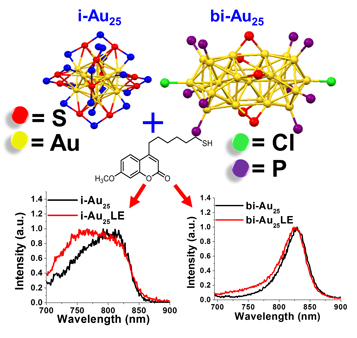
${\rm Au}_{25}\lpar {{\rm C}_6{\rm H}_{14}{\rm S}} \rpar_{18}{}^-$ icosahedron and [Au25(PPh)10(C6H14S)5Cl2]2+ bi-icosahedron clusters were synthesized. Ligand exchange reactions were carried out with a new coumarin-derived fluorophore (Cou-SH) to label both clusters. Labeled and unlabeled Au25 were compared and the changes in the electronic structure were determined. The labeled clusters showed marked changes in electronic states, as evidenced by the quenching in the UV region and enhancement in the near infrared. The quantum yield from Cou-SH decreased and the quantum yield from the labeled Au25 increased. Second, the authors observed changes in the electrochemical band gap.

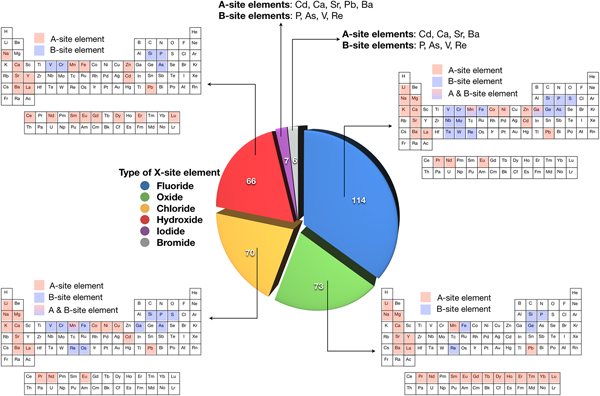
The authors develop a computational approach that integrates machine learning (ML) and density functional theory (DFT) with experimental data to predict formable and thermodynamically stable iodine-containing apatites. This is an important problem because radioactive iodine is toxic and capturing it in solid waste forms have implications in remediation treatments. The authors train ML models using 336 compositions and screen 54 iodine-containing compounds in apatite stoichiometry. ML models predict 18 as formable and 24 as nonformable in the apatite structure; 12 compounds were identified to be uncertain. DFT convex hull predicted two to be thermodynamically stable, one as metastable, and nine as unstable.
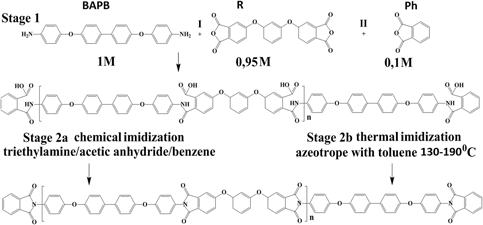
A comparative study of properties of the films based on polyimide powders synthesized by chemical or thermal imidization is presented. It is shown that the imidization method affects the shape, size, bulk density, and size distribution of the synthesized polyimide powder particles, which influences the properties of the films obtained. The method of chemical modification allows to obtain denser powders comparing to the thermally imidized powder. The films were obtained with the help of selective laser sintering (SLS) for the first time. It is shown that the films produced by SLS from chemically imidized polyimide powder are more dense and monolithic as compared to those made from thermally imidized polyimide, which provides, obviously, higher mechanical characteristics of the former. They have the strength higher in 2.5 times and the elastic modulus twice as high than latter one. The optimal laser power is 65 W.
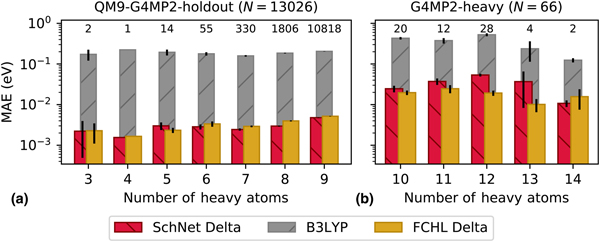
Recent studies illustrate how machine learning (ML) can be used to bypass a core challenge of molecular modeling: the trade-off between accuracy and computational cost. Here, we assess multiple ML approaches for predicting the atomization energy of organic molecules. Our resulting models learn the difference between low-fidelity, B3LYP, and high-accuracy, G4MP2, atomization energies and predict the G4MP2 atomization energy to 0.005 eV (mean absolute error) for molecules with less than nine heavy atoms (training set of 117,232 entries, test set 13,026) and 0.012 eV for a small set of 66 molecules with between 10 and 14 heavy atoms. Our two best models, which have different accuracy/speed trade-offs, enable the efficient prediction of G4MP2-level energies for large molecules and are available through a simple web interface.
Composition-dependent microstructure and mechanical properties of ultrafine-grained Al and Al–Mg films fabricated by DC magnetron sputtering with the novel micro-combinatorial technique were studied by transmission electron microscopy, atomic force microscopy, and nanoindentation. It was revealed that these films have extremely high strength, enabling their potential application as protecting layers. Besides the possible practical applications, the results of the present work also confirm the validity of the modified Hall–Petch relationship for the uniform description of the strength of face-centered cubic metals and solid solution having ultrafine-grain size.
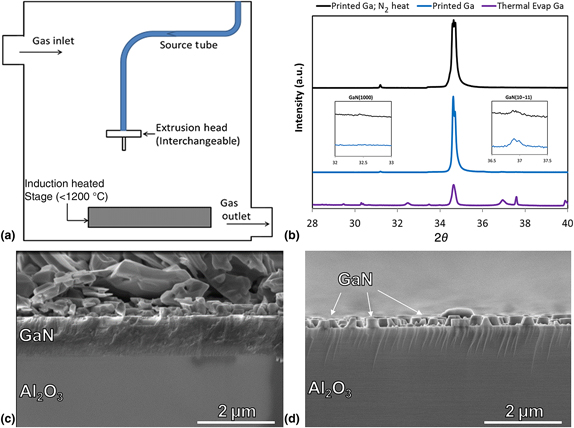
The rise of additive manufacturing (AM) has enabled the rapid production of complex part geometries across multiple material domains. To date, however, AM of inorganic semiconductor materials has not been fully realized due to the difficulty of forming single-crystal materials with traditional AM processes. Here, we demonstrate a novel semiconductor synthesis method using a combination of liquid and gas precursors to additively print gallium nitride. Growth rates of 1–2 µm/min are demonstrated in printed regions while maintaining epitaxial alignment with the substrate. We also outline critical variables for the future development, improvement, and implementation of the proposed process.
Using ethanol adsorption calorimetry, the surface energetics of two carbon substrates and two products in microwave-assisted carbon nanotube (CNT) growth was studied. In this study, the ethanol adsorption enthalpies of the two graphene-based samples at 25 °C were measured successfully. Specifically, the near-zero differential enthalpies of ethanol adsorption are −75.7 kJ/mol for graphene and −63.4 kJ/mol for CNT-grafted graphene. Subsequently, the differential enthalpy curve of each sample becomes less exothermic until reaching a plateau, −55.8 kJ/mol for graphene and −49.7 kJ/mol for CNT-grafted graphene, suggesting favorable adsorbate–adsorbent binding. Moreover, the authors interpreted and discussed the partial molar entropy and chemical potential of adsorption as the ethanol surface coverage (loading) increases. Due to the low surface areas of carbon black–based samples, adsorption calorimetry could not be performed. This model study demonstrates that using adsorption calorimetry as a fundamental tool and ethanol as the molecular probe, the overall surface energetics of high–surface area carbon materials can be estimated.
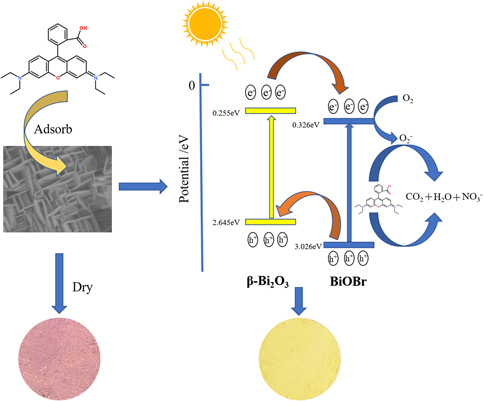
Bismuth (Bi)-based photocatalytic materials are widely used in the field of photocatalytic degradation of wastewater. In this study, β-Bi2O3/BiOBr heterojunction photocatalysts were prepared by an in situ chemical transformation method. BiOBr molecules are arrayed to cross each other to form a pore around β-Bi2O3. The prepared photocatalyst had a large specific surface area and excellent adsorption and photocatalytic properties. The β-Bi2O3/BiOBr with a molecular ratio of 11.1% had the highest catalytic activity. The result of a degradation experiment, performed with Rhodamine B (RhB) as the target pollutant, revealed that the degradation rate reached 99.85% after 25 min under visible light irradiation. The pore structure can adsorb contaminants and the heterojunction facilitates the separation of photogenerated electron–hole pairs to enhance the photocatalytic properties. The high adsorption performance and heterojunction achieved higher photocatalytic efficiency. This semiconductor photocatalyst with high adsorption performance provides a new approach to control water pollution.
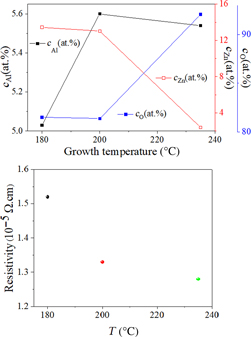
Aluminum-doped zinc oxide films were prepared by atomic layer deposition using diethylzinc, trimethylaluminum, and water. High-purity water was used with low vacuum. The effect of growth temperature on characteristics of the films was investigated. The crystallinity was improved as growth temperature was increased from 180 to 235 °C, with the grain sizes increasing from 32.830 to 47.020 nm. The films possessed high transparency with a 95% transmission window blue shifted with growth temperature. This shift was seen in the energy-band gaps which changed from 3.46 to 3.68 eV, leading to a decreased resistivity from 1.52 × 10⁻⁵ to 1.28 × 10⁻⁵ Ω cm.
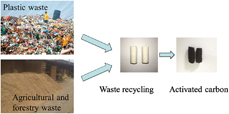
Polypropylene plastic (PP) was chosen as additives for the preparation of activated carbon (AC), considering that PP promotes pore formation during the preparation of AC. When the addition ratio of PP was 20%, AC having a maximum specific surface area of 1916.1 m2/g was prepared. Fourier transform–infrared spectroscopy (FT-IR) analysis exhibited the types of functional groups on the surface of AC, such as–OH, C=O, C–C, and –CH. The SEM analysis revealed the formation of disordered pores over the AC. Furthermore, iodine value of the AC is 1460 mg/g. Additionally, adsorption test revealed the AC is suitable for adsorbing methylene blue (MB). The adsorption equilibrium data of MB onto AC were most suitable for Redlich–Peterson model. The maximum adsorption capacity of the single layer was 476.88 mg/g, indicating that AC has high adsorption capacity. The kinetic data fitted well with the pseudo-second-order model.
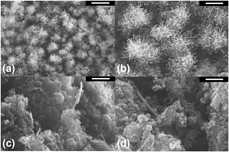
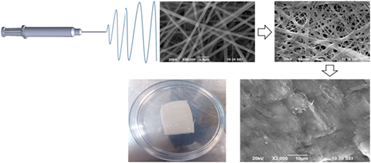
In recent years, tissue engineering has helped to reduce hospital stays and deaths caused by skin wounds. Scaffolds are one of the main factors that influence the success of any tissue graft. Collagen is one of the main components of the extracellular matrix, and there has been much interest in new sources for application as a biomaterial. In this work, a tissue engineering scaffold was developed using the electrospinning technique. The chicken skin was used as an alternative source to obtain collagen. The combination of this collagen with elastin was successfully electrospun, and a distribution of diameters was obtained, less than 100 nm. In vitro tests showed the adhesion and proliferation of the cells, as well as an absence of cytotoxicity from non–cross-linked scaffolds and scaffolds that were cross-linked with carbonyldiimidazole. The structure and composition of the developed scaffolding provide a favorable environment for cell growth and generating a skin substitute.
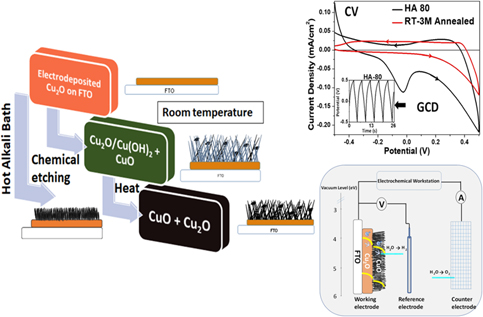
Nano-forms of copper oxides (CuO and Cu2O) are potential candidates in the field of energy conversion and storage. Low temperature and controlled growth of three-dimensional nanostructured hierarchical assembly of CuO over Cu2O is reported here with demonstrated advantage in energy conversion and storage applications. Electrodeposited Cu2O is partially oxidized in an alkali bath to two different forms of hierarchical nanostructures (HNS): CuO/Cu2O and CuO:Cu(OH)2/Cu2O. Randomly oriented nanorods and nanoflakes with high surface area tussock-like nanostructure are formed during oxidation at room and at elevated temperatures, respectively. The nanoflake morphology exhibits a high surface area of 85.82 m2/g and sufficient ion percolation pathways, leading to an efficient electrode–electrolyte interface for electrochemical energy devices. A favorable conduction and valence band alignment in the HNS with respect to water redox level along with fast electron diffusion time of 0.8 μs make it an ideal photocathode.
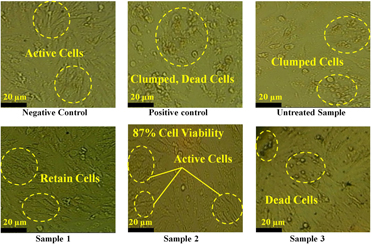
In the current research, the application and capability of electric discharge treatment (EDT) for enhancing the cytocompatibility and tribological properties of medical-grade Co–Cr alloy were investigated. The Co–Cr specimens were treated by copper tungsten (Cu–W) electrode in a deionized water tank (dielectric medium) at different spark energy levels. To examine the cytocompatibility of substrates, the MTT [3-(4,5-dimethylthiazol-2-yl)-2,5-diphenyltetrazolium bromide] assay was performed to evaluate the substrate cell viability. Furthermore, the wear rate and coefficient of friction of the substrates were examined on a pin-on-disc tribometer. In vitro cytocompatibility results revealed that the % viability of the MG-63 cells on EDT sample was approximately two times improved compared with that on the untreated surface. The tribological results showed that the treated samples have better friction reducing properties and four times higher wear resistance compared with unmachined Co–Cr samples. The surface modification at 10 A current and 60 µs pulse on-time and 150 µs off-time were found as significant parameters in both assessments.
A supercapacitor electrode featured with a voltage self-stabilizing capability is demonstrated by growing indium tin oxide (ITO) nanowires on Ni foam. The ITO nanowires with a single crystal structure are prepared by using magnetron sputtering technique, and they can act as an active electrode material. Charging–discharging experiments are performed under different current densities, demonstrating a good rate capability. Using properly designing top and bottom double connection circuits, part of the electrode can be used as a resistance switch. An electrode that can function as a supercapacitor and a resistance switch is fabricated. Detailed characteristics confirm that the device not only exhibits high performance as a supercapacitor but also has good characteristics of resistance switching (RS). The specific capacitance is 956 F/g at the scanning rate of 10 mV/s, and the switching ratio as a bipolar resistance switch is as high as 102. The stabilization time of discharging voltage is nearly doubled longer than that without any RS function, revealing the potential application of our devices, which can be used as a supercapacitor with voltage self-stabilizing.
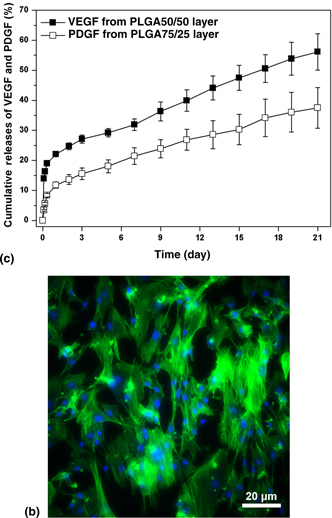
The regeneration of human tissues with complex anatomy such as gastrointestinal (GI) tract remains greatly challenging since it requires appropriate cell microenvironments with well-defined structural and biochemical cues. In this investigation, bilayer scaffolds consisting of different polymer nanofibers with orthogonal fiber orientations were prepared, in which vascular endothelial growth factor (VEGF) and platelet-derived growth factor (PDGF) were encapsulated separately. The bilayer scaffolds have similar architecture to the anatomy of the GI tract and can achieve dual releases of VEGF and PDGF in sequential and sustained manners, which hold promise as appropriate cell microenvironments for promoting the regeneration of the GI tract.
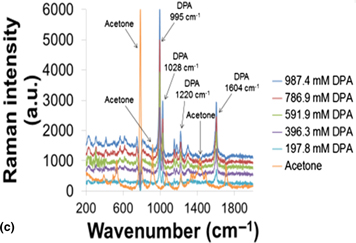
Signal detection limit (SDL), limit of detection (LOD), and limit of quantitation of a portable Raman spectrometer were measured for smokeless gunpowder stabilizers, diphenylamine (DPA) and ethyl centralite (EC), in acetone, acetonitrile, ethanol, and methanol. Acetone yielded the lowest LOD for three of four DPA peaks, and acetonitrile yielded the lowest LOD for two of three EC peaks and the remaining DPA peak. When gold nanoparticles were added to the DPA solutions in acetone and acetonitrile, statistically significant changes were observed (DPA peak position, full width at half maximum, and/or total area) and SDL was improved for the majority of all peaks in both solvents.
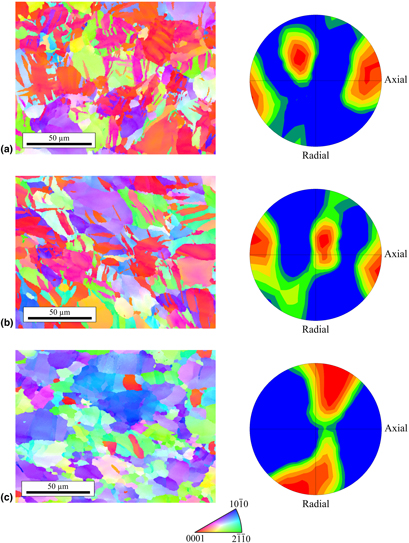
In this work, the effect of temperature, in the range of 25 to 250 °C, on deformation twinning in textured polycrystalline pure magnesium (Mg) was investigated. Compression loading was applied perpendicular to the c-axis texture direction. The yield strength and strain hardening rate are shown to drastically decrease with increasing temperature with total suppression of twinning at 200 °C. This behavior is attributed to the decrease in the critical resolved shear stress for prismatic slip and temperature insensitivity of tensile twinning. These results provide a first step in fundamentally understanding the deformation of Mg at elevated temperatures and quantify the mechanisms that lead to their improved formability at elevated temperatures.
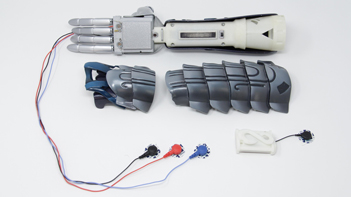
Additive manufacturing used with custom electromyographic sensors has been demonstrated for neuroprosthetic limb manufacturing and is now translating to the clinical environment. These manufacturing methods have dramatically reduced device weight while increasing the capability for multi-finger dexterity. Using wearable electromyography sensors standalone from the prosthetic limb, a new virtual training method has been designed and tested to improve human–machine interaction. This type of training leverages real-time visual feedback to user inputs, supporting improved timing and magnitudes of muscle contractions. The combination of these technologies may provide a stronger affinity between the pediatric patient group and the device.