To save content items to your account,
please confirm that you agree to abide by our usage policies.
If this is the first time you use this feature, you will be asked to authorise Cambridge Core to connect with your account.
Find out more about saving content to .
To save content items to your Kindle, first ensure no-reply@cambridge.org
is added to your Approved Personal Document E-mail List under your Personal Document Settings
on the Manage Your Content and Devices page of your Amazon account. Then enter the ‘name’ part
of your Kindle email address below.
Find out more about saving to your Kindle.
Note you can select to save to either the @free.kindle.com or @kindle.com variations.
‘@free.kindle.com’ emails are free but can only be saved to your device when it is connected to wi-fi.
‘@kindle.com’ emails can be delivered even when you are not connected to wi-fi, but note that service fees apply.
Conventional silicon-based electronics have faced challenges in the realization of soft bioelectronics, such as wearable and implantable integrated devices, which necessitate electrically and mechanically interactive biotic–abiotic interfacing without disturbing the daily life of the user or posing biocompatibility issues. Recently, much effort has been directed at overcoming the mechanical limitations of conventional rigid electronics by replacement of bulky, thick, and rigid electronic materials with biocompatible, soft, and nanoscale electronic materials, which exhibit intrinsic mechanical deformability as well as superior electrical properties. Recent advances in the synthesis of unconventional nanomaterials, surface functionalization methods, and integrated device fabrication techniques have resulted in further improvements in the performance of nanomaterials-based soft bioelectronics. Numerous studies have focused on the biological, electrical, and mechanical analyses of heterogeneous nanomaterial–biosystem interfaces as well as the development of efficient integration processes of soft nanomaterials into devices. In this article, we summarize the latest advances and future prospects in nanomaterials synthesis, processing, and integration strategies for flexible and stretchable bioelectronics, and their application to wearable and implantable devices.
The crystal structures of cefdinir and cefdinir sesquihydrate have been solved and refined using synchrotron X-ray powder diffraction data, and optimized using density functional techniques. Cefdinir crystallizes in space group P21 (#4) with a = 5.35652(4), b = 19.85676(10), c = 7.57928(5) Å, β = 97.050(1) °, V = 800.061(6) Å3, and Z = 2. Cefdinir sesquihydrate crystallizes in space group C2 (#5) with a = 23.98775(20), b = 5.01646(3), c = 15.92016(12) Å, β = 109.4470(8) °, V = 1806.438(16) Å3, and Z = 4. The cefdinir molecules in the anhydrous crystal structure and sesquihydrate have very different conformations. The two conformations are similar in energy. The hydrogen bonding patterns are very different in the two structures, and the sesquihydrate is more stable than expected from the sum of the energies of cefdinir and cefdinir sesquihydrate, the result of additional hydrogen bonding. The powder patterns are included in the Powder Diffraction File™ as entries 00-066-1604 (cefdinir) and 00-066-1605 (cefdinir sesquihydrate).
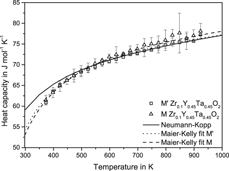
Enthalpies of formation and heat capacities are key parameters for thermodynamic assessments using the CALPHAD method and were determined in this work in the ZrO2–Y0.5Ta0.5O2 quasibinary system. ZrxY0.5−x/2Ta0.5−x/2O2 samples with compositions in the monoclinic and tetragonal ZrO2-based solid solutions (0.65 ≤ x ≤ 1) as well as the two monoclinic (M′ and M) polymorphs of the Y0.5Ta0.5O2-based solid solutions (0 ≤ x ≤ 0.2) were investigated. The enthalpies of the two monoclinic polymorphs M′ and M are essentially the same within experimental uncertainty and have significant energetic stability (enthalpies of formation near −45 kJ/mol) relative to their component oxides. The monoclinic and tetragonal zirconia-rich solid solutions have little energetic stability with respect to ZrO2, Ta2O5, and Y2O3 and presumably owe their existence to the configurational entropy. The heat capacities of M′ and M phase are similar and can be estimated from their constituent oxides using the Neumann–Kopp rule.
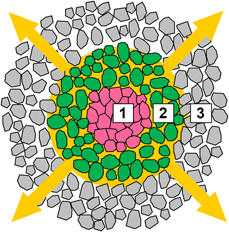
Ultra-rapid microwave sintering of ceramics has been recently demonstrated by the authors. In the experiments with oxide ceramic samples carried out in a 24 GHz gyrotron system for microwave processing of materials, full density was achieved in the sintering processes with a duration of the high-temperature stage of one to several minutes and zero hold at the maximum temperature. The implementation of the ultra-rapid microwave sintering processes was made possible due to fast and efficient control over the temperature of the materials and the supplied microwave power. The absorbed microwave power density was typically in the range of 10–100 W/cm3, which is within the same order of magnitude as the power of Joule heat in the DC electric field–assisted flash sintering processes. At this power level, a thermal instability is triggered by the volumetric heating, which results in a drastic enhancement of mass transport. In addition, possibility of ultra-rapid microwave sintering of powder metals has been demonstrated within a model accounting for the effective electromagnetic properties and resonant absorption effects.
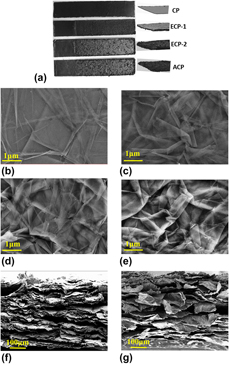
The activated carbon paper (ACP) has been designed as the active electrode material of supercapacitor to improve its capacitive performance. ACP is prepared by electrochemical nitrate ion–assisted exfoliation, sulfate ion–assisted exfoliation, and subsequent hydrothermal reduction processes. The as-prepared ACP shows obviously rougher surface along with the expanded layer distance. ACP exhibits higher specific capacitance of 380 mF/cm2 at 1 mA/cm2 than that of 21 mF/cm2 for carbon paper. ACP electrode shows the cycling capacitance retention of 98% after 5000 cycles at 10 mA/cm2. The symmetric ACP supercapacitor is constructed using ACP electrode and H2SO4 involved polyvinyl alcohol gel electrolyte. ACP supercapacitor presents the specific capacitance of 97 mF/cm2, the energy density of 0.343 mW h/cm3, and the output voltage of 1.6 V at 1 mA/cm2. ACP with high capacitance performance presents the promising supercapacitor application for the electrochemical energy storage.
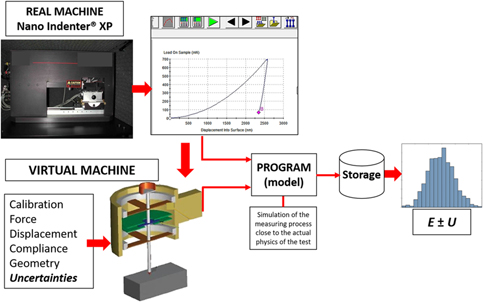
The basis of the virtual machine concept, which is commonly used in coordinate measuring machines, was implemented to determine more realistic uncertainties on the estimation of the elastic modulus obtained from nanoindentation tests. The methodology is based on a mathematical model applied to simulate the testing process and to evaluate the uncertainties through Monte Carlo simulations whose application depends on the studied system (instrument, material, scale, etc.). The methodology was applied to the study of fused silica (FQ) and steel samples tested in a nanoindentation system. The results revealed that the most relevant sources of uncertainty are related to the calibration procedure, particularly to the elastic modulus of the calibration material, and to the contact depth estimation; however, the relevance of the uncertainties is system dependent. This work represents a first insight for a deeper consideration of the uncertainties in instrumented indentation testing.
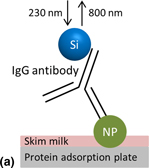
A process for bioconjugation of an IgG antibody and silicon quantum dots (Si-QDs) having the luminescence in the near-infrared (NIR) range was developed. For the bioconjugation, the surface of water-soluble all-inorganic Si-QDs was functionalized by using silane-coupling agents. In amino-functionalized Si-QDs, successful conjugation was achieved without strongly affecting the luminescence property. Detailed analyses revealed that Si-QDs are bound covalently to both the light and heavy chains of an IgG antibody. It was also confirmed that the binding property of an IgG antibody with antigen nucleoprotein was not ruined by the process. The successful conjugation of an IgG antibody and NIR luminescent Si-QDs paves the way for designing environmentally friendly bio-sensing and -imaging processes.
Poly(methyl methacrylate) (PMMA) is one of the most important polymers for application as a dielectric layer in organic electronics, e.g. in organic field-effect transistors. The key to improve the transistor performance is the optimization of the interface between the semiconductor and the dielectric layer. Here, the surface order in thin films of PMMA copolymers with self-organized, semifluorinated (sf) building blocks, and crosslinkable units in single layers and double layers with poly(3-hexylthiophene-2,5-diyl) (P3HT) is investigated. The chemistry of the sf copolymers is systematically varied and the influence on the self-organization in bulk and thin films is examined by a combination of scattering methods. The length of the semifluorinated side chains mainly determines the degree and type of order both in bulk as well as in thin films.
The use of statistical/machine learning (ML) approaches to materials science is experiencing explosive growth. Here, we review recent work focusing on the generation and application of libraries from both experiment and theoretical tools. The library data enables classical correlative ML and also opens the pathway for exploration of underlying causative physical behaviors. We highlight key advances facilitated by this approach and illustrate how modeling, macroscopic experiments, and imaging can be combined to accelerate the understanding and development of new materials systems. These developments point toward a data-driven future wherein knowledge can be aggregated and synthesized, accelerating the advancement of materials science.
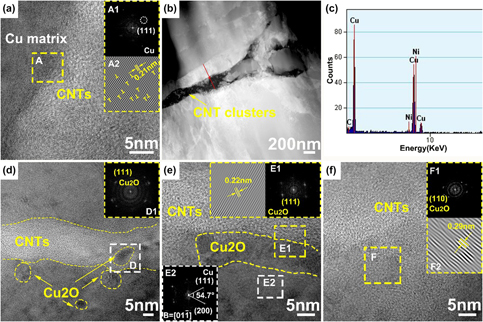
Nonuniform dispersion and weak interfacial bonding between carbon nanotubes (CNTs) and Cu matrix are two critical issues for achieving high strength and good ductility of CNT/Cu composites. Here, acid-treated CNTs precoated with Ni coatings were used to enhance the dispersion uniformity of CNTs and interfacial bonding between CNTs and Cu matrix in the CNT/Cu composites fabricated through spark plasma sintering and subsequently cold rolling. Scanning electron microscopy analysis revealed the homogeneous dispersion of Ni-coated CNTs (Ni-CNTs) in the composite compared with uncoated CNTs. Transmission electron microscope observation indicated that Cu2O nanoparticles were in situ formed at the interface in Ni-CNT/Cu composite, where CNTs were uncovered by Ni coatings. After rolling, the distribution of Ni-CNTs transformed into ribbons aligning along the rolling direction. The ultimate tensile strength (UTS) of 261 MPa was achieved in rolled 1 vol% Ni-CNT/Cu composite, which was 24.3% higher than that before rolling. The UTS of 2 vol% Ni-CNT/Cu composite obviously decreased, which could be attributed to the agglomeration of Ni-CNTs in the Cu matrix due to the increased volume content.
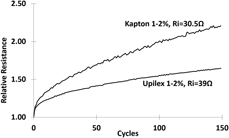
Sintered nanoparticle structures are macroscopically brittle but quite robust if deposited on a flexible substrate. The effects of a polymer substrate on the stretchability of both brittle and ductile coatings and traces are well established. Systematic effects of substrate properties on the fatigue resistance of aerosol printed nano-Ag are slightly more complex. The present work is focused on the early stages of fatigue, where the resistance increases significantly but cracks are not yet visible. Overall, the fatigue behavior is seen to vary with the combination of substrate modulus and viscoelastic deformation properties. Comparing two common polyimides, the rate of damage was seen to increase faster with increasing amplitude on the less compliant one. Consistently with this increasing the minimum strain in the cycle led to a significantly stronger reduction in damage rates. However, the damage rate remained lower on the less compliant substrate at all amplitudes and strain ranges of practical concern.
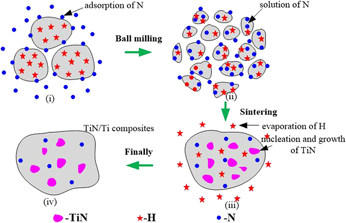
Nano-sized TiN-reinforced Ti metal matrix composites were fabricated by powder metallurgical route, which includes high-energy ball milling pretreatment and subsequent hot-press sintering treatment. The phase composition and microstructure of the sintered samples were characterized by X-ray diffraction, scanning electron microscopy, and transmission electron microscopy. Results showed that N2 was absorbed and solubilized into TiH2 by milling pretreatment, and TiN was formed during sintering process and was fine to a grain size of 20–100 nm. The final phase composition of the composites was αTi, βTi, and TiN with solution N in matrix. Mechanical tests showed that with increasing milling time, the hardness of the composites increased by 31, 58, 93, and 101% compared with pure Ti. The compressive strength initially increased and later decreased to 2440 and 2120 MPa when milled for 1.5 and 2 h, respectively.
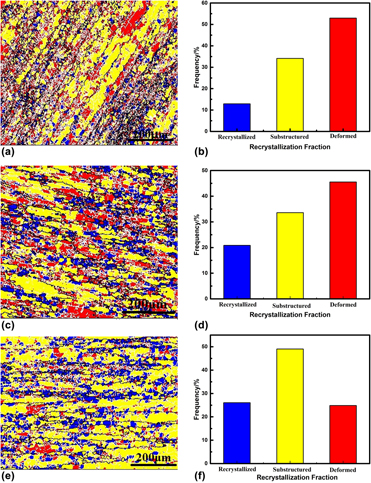
Differences in pipe wall microstructure at various positions throughout the wall thickness of high strength aluminum alloy thick-wall pipes produced by reverse hot extrusion were investigated. The microstructures of the inner wall (IW), outer wall (OW), and half wall (HW) were compared. Further, heterogeneity in the mechanical properties of the pipe throughout the wall thickness was also investigated. Results revealed that the volume fraction of precipitation was highest at the HW position because of the higher Zn and Mg contents. Further, approximately 26% of grains were recrystallized in the OW position due to the greater strain during extrusion, while the recrystallization fractions of the IW and HW positions were 13% and 21%, respectively. The effects of precipitation strengthening and deformation strengthening contribute to the highest ultimate tensile strength and Vickers hardness of the HW position, and to the higher elongation of the IW and OW positions.