To save content items to your account,
please confirm that you agree to abide by our usage policies.
If this is the first time you use this feature, you will be asked to authorise Cambridge Core to connect with your account.
Find out more about saving content to .
To save content items to your Kindle, first ensure no-reply@cambridge.org
is added to your Approved Personal Document E-mail List under your Personal Document Settings
on the Manage Your Content and Devices page of your Amazon account. Then enter the ‘name’ part
of your Kindle email address below.
Find out more about saving to your Kindle.
Note you can select to save to either the @free.kindle.com or @kindle.com variations.
‘@free.kindle.com’ emails are free but can only be saved to your device when it is connected to wi-fi.
‘@kindle.com’ emails can be delivered even when you are not connected to wi-fi, but note that service fees apply.
The coupling of acoustic energy with materials structures and processes is at the core of such current and emerging application areas as ultrasound-enabled materials characterization, structuring, and processing. High concentration of acoustic energy, such as upon the collapse of a cavitation bubble, has been shown to provide conditions for the synthesis of unusual material phases and structures, while intriguing reports on acoustic activation of surface diffusion, desorption, and catalysis hold high promise for applications where heating must be avoided or rapid switching of surface conditions is required. Some of the recent scientific and technical advances in the general area of acoustically enabled materials synthesis, processing, and characterization are reviewed in this issue of MRS Bulletin. Additional discussion of experimental data and computational results providing insights into the fundamental mechanisms and channels of the acoustic energy coupling to atomic-scale surface features and adsorbates is also provided in this article.
Structure–property relationships are the foundation of materials science and are essential for predicting material response to driving forces, managing in-service material degradation, and engineering materials for optimal performance. Elastic, thermal, and acoustic properties provide a convenient gateway to directly or indirectly probe materials structure across multiple length scales. This article will review how using the laser-induced transient grating spectroscopy (TGS) technique, which uses a transient diffraction grating to generate surface acoustic waves and temperature gratings on a material surface, nondestructively reveals the material’s elasticity, thermal diffusivity, and energy dissipation on the sub-microsecond time scale, within a tunable subsurface depth. This technique has already been applied to many challenging problems in materials characterization, from analysis of radiation damage, to colloidal crystals, to phonon-mediated thermal transport in nanostructured systems, to crystal orientation and lattice parameter determination. Examples of these applications, as well as inferring aspects of microstructural evolution, illustrate the wide potential reach of TGS to solve old materials challenges and to uncover new science. We conclude by looking ahead at the tremendous potential of TGS for materials discovery and optimization when applied in situ to dynamically evolving systems.
Laser-induced acoustic desorption (LIAD) enables the desorption of nonvolatile and/or thermally labile neutral compounds, such as asphaltenes, saturated hydrocarbons in base-oil fractions and biomolecules, from a metal surface into a mass spectrometer. This is a “gentle” evaporation technique and causes minimal fragmentation to the desorbed neutral molecules, including oligonucleotides and polypeptides. LIAD can be coupled with a wide range of ionization methods to facilitate analysis of the desorbed analytes by using many different types of mass spectrometers, including Fourier transform ion cyclotron resonance, linear quadrupole ion trap and quadrupole time-of-flight instruments. The development and improvement of LIAD remains an active research area with diverse goals such as better desorption efficiencies, minimized analyte fragmentation and greater versatility. This article details the theory, experimental methods, applications, and future directions of LIAD in combination with mass spectrometry.
Linear elastic moduli of solids with similar chemical compositions usually vary fairly insignificantly. However, for a broad class of apparently similar materials, their higher-order (nonlinear) moduli may differ by many times or even by orders of magnitude. Besides their large magnitude, nonlinear effects often demonstrate qualitative/functional features inconsistent with predictions of the classical theory of nonlinear elasticity based on consideration of weak lattice (atomic) nonlinearity. The latter is mostly applicable to ideal crystals and flawless amorphous solids, whereas the presence of structural heterogeneities can drastically modify the acoustic nonlinearity of materials without appreciable variation in the linear elastic properties. Despite often rather nontrivial/nonstraightforward relationships between microstructural features of the material and the resultant “nonclassical” acoustic nonlinearity, the extremely high structural sensitivity makes utilization of nonlinear acoustic effects attractive for a broad range of diagnostic applications that have been emerging in recent years in various areas—from seismic sounding and nondestructive testing to materials characterization down to the nanoscale.
In this paper, we will report about the implementation of the self-consistent Kröner–Eshelby model for the calculation of X-ray elastic constants for general, triclinic crystal symmetry. With applying appropriate symmetry relations, the point groups of higher crystal symmetries are covered as well. This simplifies the implementation effort to cover the calculations for any crystal symmetry. In the literature, several models can be found to estimate the polycrystalline elastic properties from single crystal elastic constants. In general, this is an intermediate step toward the calculation of the polycrystalline response to different techniques using X-rays, neutrons, or ultrasonic waves. In the case of X-ray residual stress analysis, the final goal is the calculation of X-ray Elastic constants. Contrary to the models of Reuss, Voigt, and Hill, the Kröner–Eshelby model has the benefit that, because of the implementation of the Eshelby inclusion model, it can be expanded to cover more complicated systems that exhibit multiple phases, inclusions or pores and that these can be optionally combined with a polycrystalline matrix that is anisotropic, i.e., contains texture. We will discuss a recent theoretical development where the approaches of calculating bounds of Reuss and Voigt, the tighter bounds of Hashin–Shtrikman and Dederichs–Zeller are brought together in one unifying model that converges to the self-consistent solution of Kröner–Eshelby. For the implementation of the Kröner–Eshelby model the well-known Voigt notation is adopted. The 4-rank tensor operations have been rewritten into 2-rank matrix operations. The practical difficulties of the Voigt notation, as usually concealed in the scientific literature, will be discussed. Last, we will show a practical X-ray example in which the various models are applied and compared.
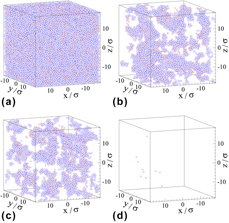
The influence of repeated thermal cycling on mechanical properties, structural relaxation, and evolution of the potential energy in binary glasses is investigated using molecular dynamics simulations. The authors consider a binary mixture annealed with different cooling rates and then exposed to one thousand thermal cycles at constant pressure. It is found that during the first few hundred transient cycles, the potential energy minima after each cycle gradually decrease and the structural relaxation proceeds through collective, irreversible displacements of atoms. With increasing cycle number, the amplitudes of the volume and potential energy oscillations are significantly reduced, and the potential energy minima saturate to a constant value that depends on the thermal cycling amplitude and the initial cooling rate. In the steady state, the glasses thermally expand and contract but most of the atoms return to their cages after each cycle, similar to limit cycles found in periodically driven amorphous materials. The results of tensile tests demonstrate that the elastic modulus and the yielding peak, evaluated after the thermal treatment, acquire maximum values at a particular thermal cycling amplitude, which coincides with the minimum of the potential energy.
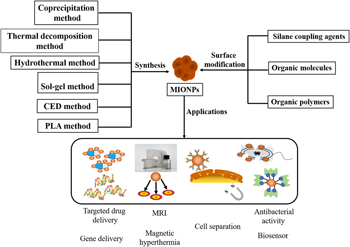
Magnetic iron oxide nanoparticles (MIONPs) are particularly attractive in biosensor, antibacterial activity, targeted drug delivery, cell separation, magnetic resonance imaging tumor magnetic hyperthermia, and so on because of their particular properties including superparamagnetic behavior, low toxicity, biocompatibility, etc. Although many methods had been developed to produce MIONPs, some challenges such as severe agglomeration, serious oxidation, and irregular size are still faced in the synthesis of MIONPs. Thus, various strategies had been developed for the surface modification of MIONPs to improve the characteristics of them and obtain multifunctional MIONPs, which will widen the applicational scopes of them. Therefore, the processes, mechanisms, advances, advantages, and disadvantages of six main approaches for the synthesis of MIONPs; surface modification of MIONPs with inorganic materials, organic molecules, and polymer molecules; applications of MIONPs or modified MIONPs; the technical challenges of synthesizing MIONPs; and their limitations in biomedical applications were described in this review to provide the theoretical and technological guidance for their future applications.
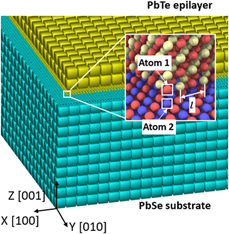
In this work, we investigate misfit dislocations in PbTe/PbSe heteroepitaxial systems using the concurrent atomistic–continuum (CAC) method. A potential model containing the long-range Coulombic interaction and short-range Buckingham potential is developed for the system. By considering the minimum potential energy of relaxed interface structures for various initial conditions and PbTe layer thicknesses, the equilibrium structure of misfit dislocations and the dislocation spacings in PbTe/PbSe(001) heteroepitaxial thin films are obtained as a function of the PbTe layer thicknesses grown on a PbSe substrate. The critical layer thickness above which misfit dislocations inevitably form, the structure of the misfit dislocations at the interfaces, and the dependence of average dislocation spacing on PbTe layer thickness are obtained and discussed. The simulation results provide an explanation for the narrowing of the spread of the distribution of misfit dislocation spacing as layer thickness increases in PbTe/PbSe(001) heteroepitaxy.
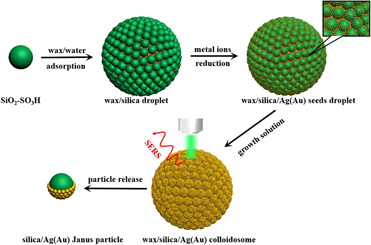
Noble metal (Ag, Au) nanoparticles (NPs) deposited on the surface of three-dimensional (3D) materials are promising 3D surface-enhanced Raman spectroscopy (SERS) substrates. In this work, the authors reported the preparation of 3D wax/silica/Ag(Au) colloidosomes by sulfonic acid group–terminated silica spheres (SiO2–SO3H) combined with a Pickering emulsion technique, as well as seed-mediated growth method of noble metal NPs. The presence of –SO3H group on the silica spheres not only improves significantly the quality of wax/silica colloidosomes (forming perfect silica shell around wax droplet) but also can adsorb metal precursor ions via electrostatic attraction for further growth of metal NPs. The size and coverage of Ag(Au) NPs on wax/silica droplets can be facilely tuned, and relevant wax/silica/Ag(Au) colloidosomes and silica/Ag(Au) Janus particles are obtained via this strategy. The obtained wax/silica/Ag colloidosomes as 3D SERS substrates exhibited excellent SERS enhancement ability and detection limit of 4-aminothiophenol reached 10−9 M.
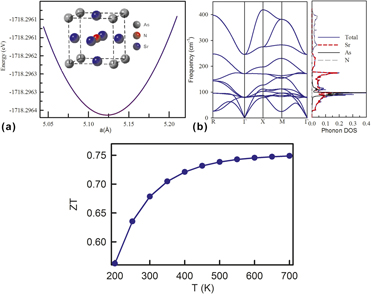
Antiperovskite materials are of high research interest because of their unusual physical properties and technological applications. Here, we report the structural stability and transport properties of Sr3AsN from first-principles study. The calculated equilibrium lattice parameters are in good agreement with the available data. We find that Sr3AsN is mechanically, energetically and dynamically stable at ambient conditions. Our calculated electronic structure indicates that it is a direct band gap semiconductor, with a band gap value ∼1.2 eV. Sr-4d and N-2p orbitals predominantly contribute to the formation of the direct band gap. The calculated Seebeck coefficient of Sr3AsN is high (298 μV/K at 300 K), while the lattice thermal conductivity is comparatively low (1.73 W/m K). The considerable mass difference between Sr, As, and N gives rise to an intense phonon scattering that results in such low lattice thermal conductivity. Our calculated maximum thermoelectric figure of merit (ZT) is 0.75 at 700 K, indicating that it is a potential material for thermoelectric device applications.
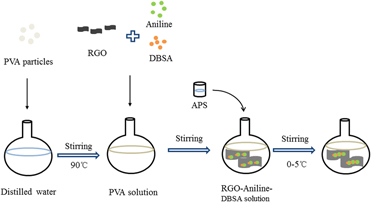
Wearable electrochromic devices are considered as the essential components for the development of smart clothing with the intelligent sensing, actuating, and displaying functions. In this study, the electrochromic composite flexible membranes of polyaniline (PANI) and reduced graphene oxide (RGO) were fabricated by in situ polymerization of aniline monomer in the presence of RGO dispersion. The effects of RGO concentration on the morphology, chemical structure, crystallinity, and electrochromic behavior of the composite membranes were studied. Our experimental results show that the conductivity of PANI/RGO composite membrane increases with the increasing of RGO concentration from 0.1 to 0.25 wt%, and the highest conductivity is 3.57 S/cm. An improved electrochemical performance with good electrochromic cycle characteristic of the PANI/RGO composite can be obtained, which shows a wide color range from green to black compared with the PANI membrane that ranging from green to dark blue. This research provides a systematical investigation of flexible PANI-based electrochromic membrane, which has the potential application in the field of wearable electrochromic devices in the future.
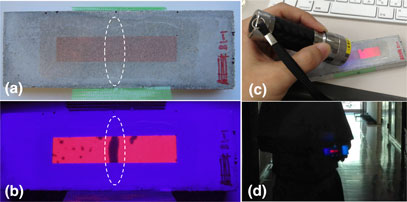
Luminescent oxygen sensor composed of platinum-porphyrin and a gas-permeable polymer binder was applied as an optical crack sensor paint for infrastructure. The sensor paints were designed as a three-layered structure in which the luminescent oxygen sensor layer was sandwiched between oxygen barrier layers. The sensor paints emitted intense luminescence under UV light irradiation, and the luminescence was efficiently quenched when a new crack formed on the concrete surface. Microcracks, which were <0.1 mm width and hardly visible to the naked eye, were clearly visualized under UV light irradiation due to the luminescent quenching caused by oxygen diffusion.
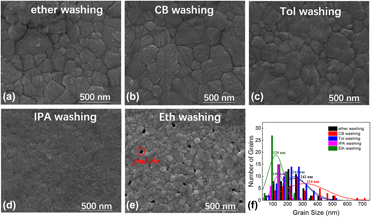
Anti-solvent treatment assisted crystallization is currently one of the most widely used methods to obtain high-quality perovskite films ascribed to its great operability. However, choosing a proper anti-solvent toward high-quality perovskite film for perovskite solar cells (PSCs) remains elusive. In this study, we qualitatively evaluate the impact of anti-solvent treatment on the grain growth and phase composition of perovskite by X-ray diffraction, scanning electron microscope, Fourier transform infrared spectrometer, and UV-vis absorption measurement, etc. The results demonstrate that the chemical groups in anti-solvents also affect the formation of perovskites, and anti-solvents with a low boiling point and good polarity contribute to the superior efficiency and reproducibility of PSCs. The device prepared using ether as an anti-solvent exhibits the best power conversion efficiency of 18.47%. The results indicate a new path toward selecting an ideal anti-solvent to improve the performance of PSCs.
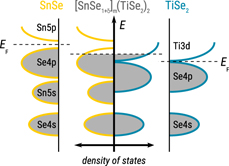
A series of ${\left\hbox[ {{{\left\hbox( {{\rm{SnSe}}} \right\hbox)}_{1 \hbox+ \delta }}} \right\hbox]_m}{\left\hbox[ {{\rm{TiS}}{{\rm{e}}_2}} \right\hbox]_2}$ heterostructure thin films built up from repeating units of m bilayers of SnSe and two layers of TiSe2 were synthesized from designed precursors. The electronic structure of the films was investigated using X-ray photoelectron spectroscopy for samples with m = 1, 2, 3, and 7 and compared to binary samples of TiSe2 and SnSe. The observed binding energies of core levels and valence bands of the heterostructures are largely independent of m. For the SnSe layers, we can observe a rigid band shift in the heterostructures compared to the binary, which can be explained by electron transfer from SnSe to TiSe2. The electronic structure of the TiSe2 layers shows a more complicated behavior, as a small shift can be observed in the valence band and Se3d spectra, but the Ti2p core level remains at a constant energy. Complementary UV photoemission spectroscopy measurements confirm a charge transfer mechanism where the SnSe layers donate electrons into empty Ti3d states at the Fermi energy.

Quantum dots (QDs) are increasingly employed in biologic imaging applications; however, anecdotal reports suggest difficulties in QD bioconjugation. Further, the stability of commercial QDs during bioconjugation has not been systematically evaluated. Thus, we examined fluorescence losses resulting from aggregation and declining photoluminescence quantum yield (QY) for commercial CdSe/ZnS QD products from four different vendors. QDs were most stable in the aqueous media in which they were supplied. The largest QY declines were observed during centrifugal filtration, whereas the largest declines in colloidal stability occurred in 2-(N-morpholino)ethanesulfonic acid (MES) buffer. These results enable optimization of bioconjugation protocols.
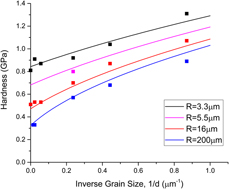
The measured hardness of a metal crystal depends on a variety of length scales. Microstructural features, such as grain size and precipitate spacing, determine the intrinsic material length scale. Extrinsic (test) length scales, such as the indentation depth, lead to the indentation size effect (ISE), whereby it is typically found that smaller is stronger. Nix and Gao [J. Mech. Phys. Solids46, 411 (1998)] developed a widely used model for interpreting the ISE based on forest hardening in single crystalline pure metals. This work extends that model to consider the hardness of polycrystals and alloys, as well as introducing a finite limit to the hardness at very small extrinsic length scales. The resulting expressions are validated against data from the literature. It is shown that a reasonable estimate of the intrinsic material length scale can be extracted from a suite of hardness tests conducted across a range of indentation depths using spherical indenters of various radii.