To save content items to your account,
please confirm that you agree to abide by our usage policies.
If this is the first time you use this feature, you will be asked to authorise Cambridge Core to connect with your account.
Find out more about saving content to .
To save content items to your Kindle, first ensure no-reply@cambridge.org
is added to your Approved Personal Document E-mail List under your Personal Document Settings
on the Manage Your Content and Devices page of your Amazon account. Then enter the ‘name’ part
of your Kindle email address below.
Find out more about saving to your Kindle.
Note you can select to save to either the @free.kindle.com or @kindle.com variations.
‘@free.kindle.com’ emails are free but can only be saved to your device when it is connected to wi-fi.
‘@kindle.com’ emails can be delivered even when you are not connected to wi-fi, but note that service fees apply.
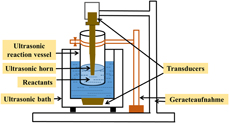
The hydroxyapatite nanoparticles (nHAPs) were synthesized rapidly by the self-assembled dual-frequency ultrasonic method. The ultrasonic time and power effect on the morphology and phase composition of nHAPs were investigated through field-emission scanning electron microscopy (FE-SEM), X-ray diffraction, energy dispersive spectrometer (EDS) spectrometer, and Fourier transform infrared spectroscopy, which showed that the most uniform nanoparticles were obtained when the ultrasonic time was 30 min and the ultrasonic power was 280 W. Cytotoxicity and hemolysis tests showed that an indistinctive cytotoxic effect was within the concentration of 25–400 μg/mL and the hemolytic ratio was below 2.0% at concentration of 25–200 μg/mL, respectively, revealing a good biocompatibility of nHAPs. By loading tetracycline hydrochloride onto nHAPs spheres, the drug release results showed that the drug loading and encapsulation efficiency were (26.34 ± 2.99)% and (52.68 ± 5.98)%, respectively. The drug-loaded sample shows a slow-release property, indicating that nHAPs may be promising as drug carriers.
Structural variation of LiMn1.5Ni0.5O4 spinel cathode during the Li+ extraction/insertion reaction was studied using operando X-ray diffraction. It was found that the reaction in the voltage range from 3.5 to 4.9 V consisted of two consecutive two-phase reactions, where three spinel phases of LiMn1.5Ni0.5O4, Li0.5Mn1.5Ni0.5O4 and Mn1.5Ni0.5O4 were identified and the lattice volume change in the whole reaction was evaluated as 6%. The reactions were symmetric and reversible under low-current conditions, but some asymmetries were detected during high current operation. Furthermore, a two-phase reaction between cubic and tetragonal phases was observed in the low-voltage reaction at 2.1–3.5 V, where the lattice volume change was approximately 4.9%. The rate-determining step was discussed based on these operando results.
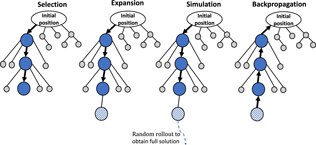
Materials design and discovery can be represented as selecting the optimal structure from a space of candidates that optimizes a target property. Since the number of candidates can be exponentially proportional to the structure determination variables, the optimal structure must be obtained efficiently. Recently, inspired by its success in the Go computer game, several approaches have applied Monte Carlo tree search (MCTS) to solve optimization problems in natural sciences including materials science. In this paper, we briefly reviewed applications of MCTS in materials design and discovery, and analyzed its future potential.
High-temperature X-ray diffraction with concurrent gas chromatography (GC) was employed in the study of iron disulfide (FeS2) cathode pellets disassembled from thermal batteries. When FeS2 cathode materials were analyzed in an air environment, reaction of the KCl and LiCl salt phases led to the formation of Li2(SO4) and KFe2S3 phases beginning at ~230 °C. These phases subsequently reacted to generate various forms of potassium iron sulfates in the 280–500 °C range, with the final products resulting in a β-Fe2O3 phase and K2(SO4). Independent simultaneous thermal analysis coupled with mass spectroscopy (MS) augmented the diffraction results and supported the overall picture of FeS2 decomposition. Both gas analysis measurements (i.e. GC and MS) from the independent experiments confirmed the formation of SO2 off-gas species during the breakdown of the FeS2. In contrast, characterization of the same cathode material under inert conditions showed the persistence of the initial FeS2 phase throughout the entire temperature range of analysis.
X-ray diffraction-X-ray fluorescence (XRD-XRF) data sets obtained from surface scans of synthetic samples have been analysed by means of different data clustering algorithms, with the aim to propose a methodology for automatic crystallographic and chemical classification of surfaces. Three data clustering strategies have been evaluated, namely hierarchical, k-means, and density-based clustering; all of them have been applied to the distance matrix calculated from the single XRD and XRF data sets as well as the combined distance matrix. Classification performance is reported for each strategy both in numerical form as the corrected Rand index and as a visual reconstruction of the surface maps. Hierarchical and k-means clustering offered comparable results, depending on both sample complexity and data quality. When applied to XRF data collected on a two-phases test sample, both algorithms allowed to obtain Rand index values above 0.8, whereas XRD data collected on the same sample gave values around 0.5; application to the combined distance matrix improved the correlation to about 0.9. In the case of a more complex multi-phase sample, it has also been found that classification performance strongly depends on both data quality and signal contrast between different regions; again, the adoption of the combined dissimilarity matrix offered improved classification performance.
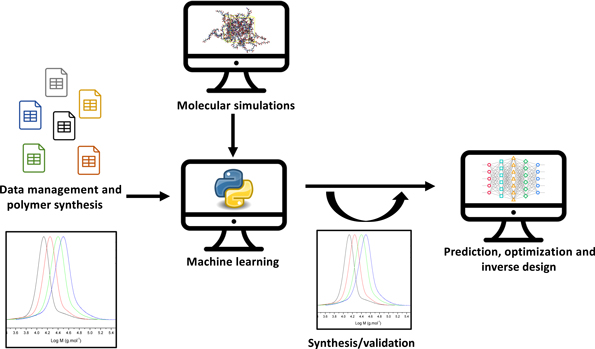
In this perspective, the authors challenge the status quo of polymer innovation. The authors first explore how research in polymer design is conducted today, which is both time consuming and unable to capture the multi-scale complexities of polymers. The authors discuss strategies that could be employed in bringing together machine learning, data curation, high-throughput experimentation, and simulations, to build a system that can accurately predict polymer properties from their descriptors and enable inverse design that is capable of designing polymers based on desired properties.
The novelty of this study was to investigate for the first time in literature the influence of Bombyx mori silkworm cocoon’s age on the properties of silk fibroin-based materials, during all stages of cocoon processing to obtain the fibroin film. The study started with the premise that the cocoon age could cause modifications on fibroin properties during processing and, consequently, a possible interference on the characteristics of the final product. Characterizations were performed using batches of cocoons produced in different years, named C0 (fresh cocoons) and C6 (six-year-old cocoons). The influence of cocoon’s aging was observed on dialyzed dispersion regarding the molecular weight, particle size, and conformation. C6 films showed a more crystalline structure and higher thermal resistance than C0 films. The findings reported in this work are relevant for the reproducibility of fibroin-based materials, and the cocoon age is a key factor that should be considered in the preparation of fibroin-based materials.
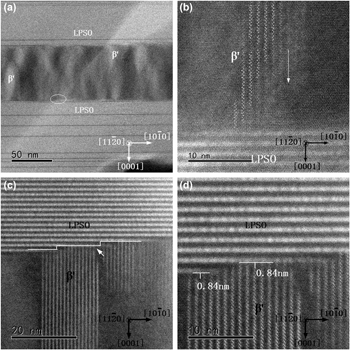
This paper reports on an atomic-scale investigation into the β′ precipitates and the long-period stacking ordered phase (LPSO) in Mg–5Y–2.5Ni–0.5Zr (at.%) alloy, using Cs-corrected high angle annular dark field-scanning transmission electron microscopy (HAADF-STEM). The results displayed that the 18R-type and 14H-type LPSO phases coexisted in the as-cast and the solid solution states, and the 18R-type and 14H-type LPSO structures were thermal stable. After aging treatment, the aging peak hardness reached 138 HV at 225 °C for 48 h. The significant increase in hardness was attributed to the formation of the metastable β′ phase. The lattice parameters of a and b axes for β′ phases are a = 0.65 nm, b = 2.20 nm, and c = 0.52 nm by HAADF-STEM. The interaction between the LPSO phase and the β′ can be found. The atomic-scale interactions between the LPSO and β′ phases are divided into two parts: under-aging and peak-aging conditions between the building blocks.
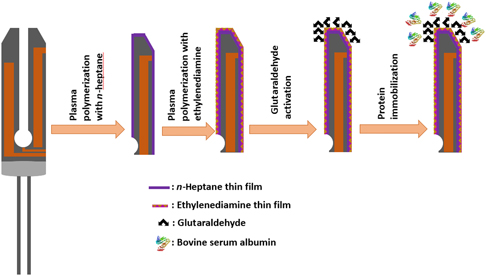
Due to the lack of the stability of amine films, a promising transducer, quartz-tuning fork (QTF) prongs were modified by a bi-layer film of plasma-polymerized n-heptane (hep) and then by ethylenediamine (EDA), respectively. For this purpose, the authors investigate the stability of amine-rich thin films both in air and aqueous medium. EDA films were deposited on QTF substrates by using an RF plasma system. The final amine-rich thin film was used to immobilize biologic recognition element. Model protein studies were showed that selected thin films could be adapted to QTF transducers to be used as a biosensor template.
Ultrasonic sonochemistry and pulsed laser ablation in liquids (LAL) are modern techniques for materials synthesis that are in different ways linked to the formation and collapse of cavitation bubbles. We provide an overview of the physics of laser-induced and acoustically driven bubble oscillations and then describe how the high pressures and temperatures associated with ablation and bubble collapse, as well as emitted shock waves, take part in material synthesis inside and around the bubble. Emphasis is placed on the mechanisms of sonochemical synthesis and modification, and on a step-by-step account of the events from laser ablation through interaction of ablation products with the surrounding liquid up to the modification or aggregation of particles within the bubble. Both sonochemistry and LALs yield nanostructured materials and colloidal nanoparticles with unique properties. The synthesis process has been demonstrated to be scalable.
A quantum computer can outperform classical computers for certain tasks. The general challenge to realize a quantum computer is to solve decoherence, which is due to coupling of a quantum state with the local environment. One possible way to overcome decoherence is to use a topological quantum state. Topologically protected states are expected to have long coherence times. In a topological quantum computer, the information is carried by nonlocal Majorana states. Such states can be engineered in a semiconductor nanowire, which has strong spin–orbit interactions, coupled to a superconductor. The first signatures of Majorana states have been observed recently. In order to substantiate the existence of Majorana states and use them as qubits, an exchange—or braiding—operation of these states has to be performed. The current challenge is to improve the quality of the materials and interfaces. Recent progress toward improved Majorana signals using materials science advances is reviewed in this article.
This article focuses on the acoustic-wave enhancement of chemisorption and surface reactions. Acoustic waves generated by a piezoelectric phenomenon on ferroelectric crystals by the application of radio frequency electric power produce periodic lattice distortions at the surface. The effects of surface acoustic waves (SAWs) and the resonance oscillation (RO) of bulk acoustic waves on thin films of metals or metal oxides are described herein. Both SAWs and RO can modify the work functions of thin Ag, Au, or Pd films, and this effect is highly dependent on the surface structures. These changes in the work function can, in turn, affect the adsorptive characteristics of the metals as well as surface reactions and properties such as catalysis. The importance of periodic lattice displacement vertical to the surface is examined in this article, and the acoustic-wave enhancement of metal and metal oxide surfaces as a means of tuning electronic states and chemical properties is discussed.