To save content items to your account,
please confirm that you agree to abide by our usage policies.
If this is the first time you use this feature, you will be asked to authorise Cambridge Core to connect with your account.
Find out more about saving content to .
To save content items to your Kindle, first ensure no-reply@cambridge.org
is added to your Approved Personal Document E-mail List under your Personal Document Settings
on the Manage Your Content and Devices page of your Amazon account. Then enter the ‘name’ part
of your Kindle email address below.
Find out more about saving to your Kindle.
Note you can select to save to either the @free.kindle.com or @kindle.com variations.
‘@free.kindle.com’ emails are free but can only be saved to your device when it is connected to wi-fi.
‘@kindle.com’ emails can be delivered even when you are not connected to wi-fi, but note that service fees apply.
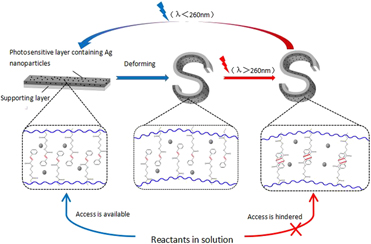
A photoresponsive double-layer hydrogel has been developed, in which light-sensitive cinnamic moieties are grafted onto a polyacrylamide network to produce a photoresponsive layer and pure polyacrylamide formed the supporting layer. Ag nanoparticles were dispersed using in situ reduction on the photoresponsive layer to act as the catalyst. The as-fabricated hydrogel exhibits a shape memory effect and controllable catalytic behavior under an external light stimulus. When exposed to ultraviolet (UV) light at λ > 260 nm, the resulting cycloaddition of cinnamic moieties not only fix the hydrogel’s temporary shape, but also greatly slow down the catalytic reaction rate. After irradiated with UV light at λ < 260 nm, however, the newly formed crosslinking points are reversibly cleaved. This results in the shape recovery of the hydrogel to its permanent shape. At the same time, the catalytic reaction was greatly accelerated because of the facile diffusion of the reactants into the hydrogel.
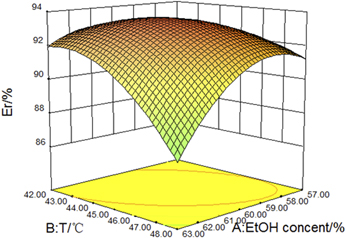
In this work, flavonoids in Polygonum cuspidatum Sieb. et Zucc. were extracted by ultrasound-assisted methodology and determined by ultraviolet–visible spectrophotometry. After that, extraction conditions were optimized by the single fact investigation, the central composite design, and response surface methodology (RSM) in turn. The results showed the optimal values of ethanol concentration, solid–liquid ratio, extraction temperature, extraction time, ultrasonic power, and number of extraction times were 60%, 1:20 (g/mL), 45 °C, 34 min; 80 W, and 5, respectively. The extraction ratio of flavonoids could be as high as 94.50%. The influence order of each factor was ultrasonic power > extraction time > extraction temperature > ethanol concentration. The results also showed that the experimental value was close to the predicted value (94.49%) of the established model by RSM, which proved that the established model was reasonable. The thermodynamic results showed that the extraction process was endothermic and could proceed spontaneously.
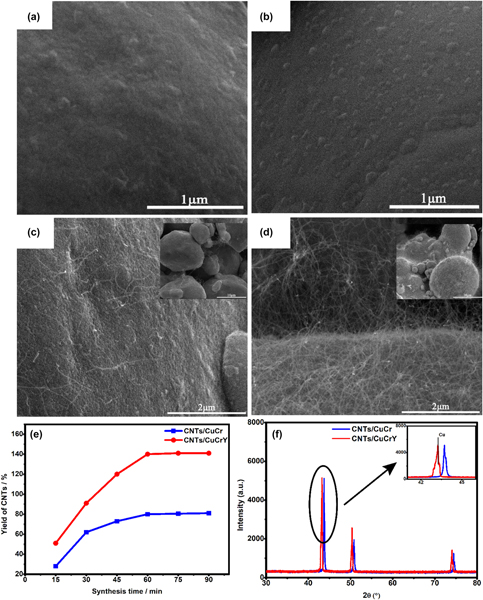
Addition of carbon nanotubes (CNTs) to copper materials significantly enhances their properties. However, the performance of CNTs/Cu composites is often not as good as expected mainly because of difficulties in controlling growth and uniform dispersion of CNTs in the matrix. Our study provides an effective way to prepare CNTs/CuCr and CNTs/CuCrY composites using chemical vapor deposition. The morphology and structure of these composites were characterized by scanning electron microscope, X-ray diffraction, X-ray photoelectron spectroscopy, and Raman spectroscopy to understand how Y incorporation affects properties of these composites. Our results showed that addition of 0.1 wt% Y enhances the catalytic properties of Cr and helps to obtain purer and pristine Cu substrate. We also studied tensile strength, electric conductivity, corrosion, and wear resistance of these composites. When Y was added, composite properties improved significantly. Tensile strength and corrosion resistance increased by 35.21 and 53.28%, respectively. Electric conductivity increased to 90.9% International Annealed Copper Standard and the coefficient of friction reduced to 0.3.
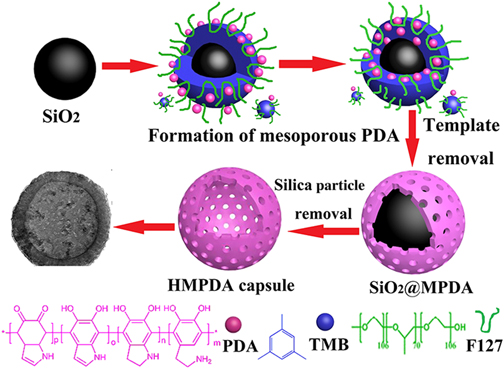
Hollow mesoporous polydopamine (HMPDA) microcapsules were prepared by a template method using silica nanoparticles as the templates. The template method was also used for the formation of mesoporous polydopamine (PDA), which is driven by π–π interactions of trimethylbenzene and PDA, in which the PDA wall with mesoporous structure can be obtained after template removal by extraction. Because of its surface mesoporous structure and large central cavity structure, HMPDA microcapsules have unique adsorption properties. Compared with other porous materials, PDA has better biosafety because dopamine itself is a bionic material. The above properties are of great significance for the application of HMPDA microcapsules in the field of biologic medicine, especially in drug carriers.
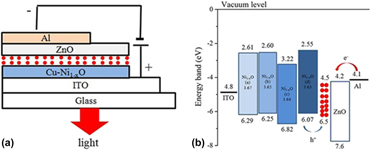
Fabrication and characterization of solution-processed, all-inorganic quantum dots (QDs) light-emitting diodes (QLEDs) incorporating colloidal CdSe/ZnS QDs are presented. Using a simple solvothermal process, Cu-doped NiO nanocrystals were fabricated and applied as a hole transport layer in all inorganic QLEDs. Cu-doped NiO nanocrystals are ascribed to bunsenite cubic structure. The transmittance of the film is more than 81%. The hole-only devices of Au/QDs/Cu–NiO/ITO structures showed that 5% mol Cu doped NiO film obtained the largest hole current. The resulting devices show pure QD electroluminescent emissions with a maximum electroluminescence brightness of 2258 cd/m2 after doping 5% mol Cu in NiO, which is almost 4-fold compared with that of intrinsic NiO due to the enhanced carrier concentration and conductivity. The current efficiency and EQE of the assembled all-inorganic QLED exhibited the maximum values of 1.18 cd/A and 1.223%, respectively.
The General Structure Analysis System (GSAS)-II software package is a fully developed, open source, crystallographic data analysis system written almost entirely in Python. For powder diffraction, it encompasses the entire data analysis process beginning with 2-dimensonal image integration, peak selection, fitting and indexing, followed by intensity extraction, structure solution and ultimately Rietveld refinement, all driven by an intuitive graphical interface. Significant functionality of GSAS-II also can be scripted to allow it to be integrated into workflows or other software. For protein studies, it includes restraints on bond distances, angles, torsions, chiral volumes and coupled torsions (e.g. Ramachandran Φ/Ψ angles) each with graphical displays allowing visual validation. Each amino acid residue (and any ligands) can be represented by flexible rigid bodies with refinable internal torsions and optionally fully described TLS thermal motion. The least-squares algorithm invokes a Levenberg-Marquart minimization of a normalized double precision full matrix via Singular Value Decomposition providing fast convergence and high stability even for a large number of parameters. This paper will focus on the description of the flexible rigid body model of the protein and the details of the refinement algorithm.
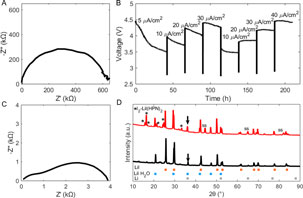
Solid state batteries are an emerging alternative to traditional liquid electrolyte cells that provide potential for safe and high-energy density power sources. This report describes a self-forming, solid state battery based on the Li/I2 couple using an LiI-rich LiI(3-hydroxypropionitrile)2 electrolyte (LiI–LiI(HPN)2). As the negative and positive active materials are generated in situ, the solid electrolyte–current collector interfaces play a critical role in determining the electrochemical response of the battery. Herein, we report the investigation of solid electrolyte–current collector interfaces with a self-forming LiI–LiI(HPN)2 solid electrolyte and the role of varying interface design in reducing resistance during cycling.
One of the critical components of energy savings in buildings is thermal insulation, especially for windows in cold climates. The conventional approach mainly relies on a double-pane design. In this study, a new concept of “Green Window” has been designed for single-pane applications that lower the U-factor. The “Green Window” is structurally and simply composed of a thin film window coating of chlorophyll that exhibits pronounced photothermal effect, while remaining highly transparent. We demonstrate a new concept in “thermal insulation” via optical means instead of solely through thermal insulators or spectral selectivity. This concept lifts the dependence on insulating materials making single-pane window highly possible.
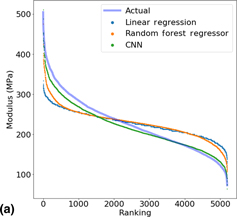
Composites are ubiquitous throughout nature and often display both high strength and toughness, despite the use of simple base constituents. In the hopes of recreating the high-performance of natural composites, numerical methods such as finite element method (FEM) are often used to calculate the mechanical properties of composites. However, the vast design space of composites and computational cost of numerical methods limit the application of high-throughput computing for optimizing composite design, especially when considering the entire failure path. In this work, the authors leverage deep learning (DL) to predict material properties (stiffness, strength, and toughness) calculated by FEM, motivated by DL's significantly faster inference speed. Results of this study demonstrate potential for DL to accelerate composite design optimization.
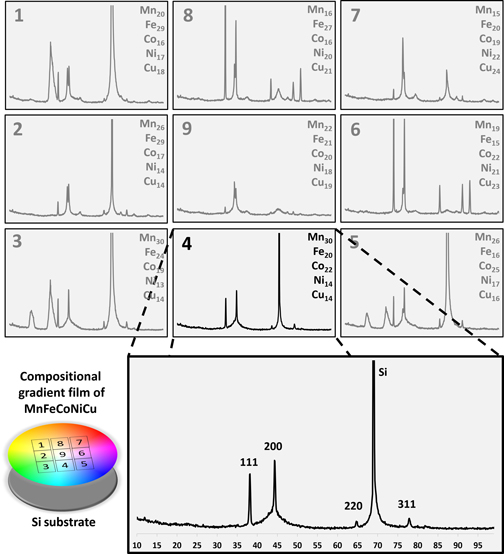
To identify new face centered cubic high entropy alloys (HEAs), MnFeCoNiCu thin film samples were prepared by simultaneous magnetron sputtering of elements onto Si wafers. This sputtering arrangement yielded compositional gradients in the samples. The films exhibited regions with different phases, some of which were single-phase and non-equiatomic. To screen the crystal structure and composition across film samples, multiple characterization techniques were used: scanning electron microscopy, focused ion beam, energy-dispersive x-ray spectroscopy, x-ray diffraction, and electron backscattered diffraction analysis. Using this combinatorial method, candidate single-phase HEAs were identified and then successfully arc-melted in bulk form, followed by thermomechanical processing.
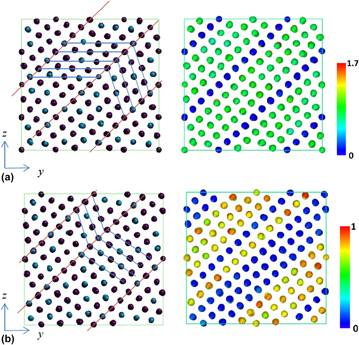
The shape memory properties of Ni–Al alloy are investigated using molecular dynamics simulation. The phase transformation behaviors for various Ni composition ratios are studied under quasistatic cooling and heating process. Various loadings, i.e., uniaxial, shear, and biaxial, are applied on a 68% Ni–Al alloy till plasticity takes place. The atomic configurations are inspected and analyzed using a common neighbor parameter. The shape recovery capability of the plastically deformed alloy is examined after heating above the phase transformation temperature. It is found that there would be shape recovery if the twinning plane reorientation or moving was the major yielding mechanism. For those loadings in which stacking faults or dislocations nucleate, the deformed model would not restore to its original shape after heating and the corresponding maximum shear stress is noticeably higher. There is no direct dependence between the yield strain and the shape recovery capability. Our findings could provide a possible explanation for the functional fatigue of the polycrystalline shape memory alloy.
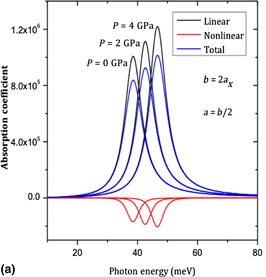
This work is based on a recent theoretical study of how the hydrostatic pressure and core/shell sizes affect the optical properties associated with the transition from the ground state to first excited state (1s–1p), of an exciton confined in spherical core/shell quantum dots (SCSQDs). We have computed under an effective mass framework, linear, third-order nonlinear, and total absorption coefficients (AC) and refractive index (RI) as functions of photon energy for different sizes of SCSQDs with varying hydrostatic pressure. Our results show that the optical absorption is deeply dependent on the incident light intensity. Both AC and RI significantly influenced by the confinement and pressure effects.
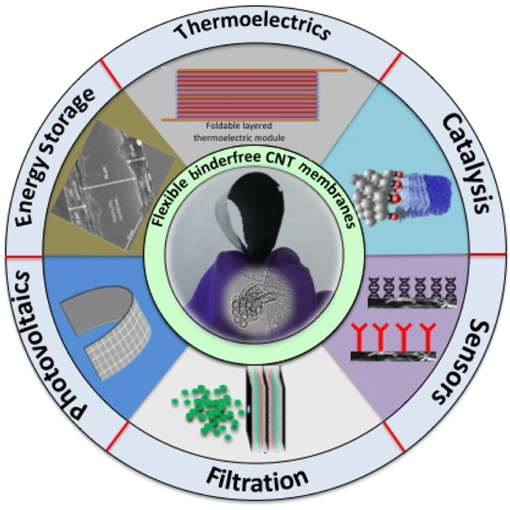
We have successfully employed a charge transfer mechanism to convert carbon nanotube (CNT) powder into CNT flexible membrane with no binder. We have demonstrated the use of the CNT membranes as electrode in a stacked bipolar solid-state capacitor using grafoil as current collector that showed 80% capacitance retention over 10,000 cycles at 70 °C. The CNT membranes could have potential application in catalysis, photovoltaic, thermoelectric, and many others.
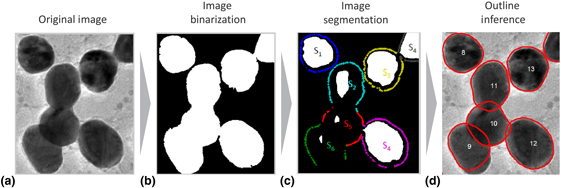
Advancements in temporal and spatial resolutions of microscopes promise to expand the frontiers of understanding in materials science. Imaging techniques produce images at a high-frame rate, streaming out a tremendous amount of data. Analysis of all these images is time-consuming and labor intensive, creating a bottleneck in material discovery that needs to be overcome. This paper summarizes recent progresses in machine learning and data science for expediting and automating material image analysis. The discussion covers both static image and dynamic image analyses, followed by remarks concerning ongoing efforts and future needs in automated image analysis that accelerates material discovery.
The development of more sustainable construction materials is a crucial step toward the reduction of CO2 emissions to mitigate climate change issues and minimize environmental impacts of the associated industries. Therefore, there is a growing demand for bio-based binders which are not only safer toward human and environmental health but also facilitate cleaner disposal of the construction materials and enable their compostability. Here, we summarize the most relevant bio-based polymers and molecules with applications in the construction sector. Due to the biologic nature of these materials, the existing biotechnologic processes, including synthetic biology, for their development and production have been evaluated.
Unlike other data intensive domains, understanding distributions, trends, correlations, and relationships in materials data sets typically involves navigating high-dimensional spaces with only a limited number of observations. Under these conditions extracting structure/property relationships is not straightforward and considerable attention must be given to the reduction of feature space before predictions can be made. Here we have used Kohonen networks (self-organizing maps) to identify hidden structure/property relationships in computational sets of twinned and single-crystal diamond nanoparticles based on structural similarity in multiple dimensions, and confirmed the importance of a limited number of surface chemical features using regression.
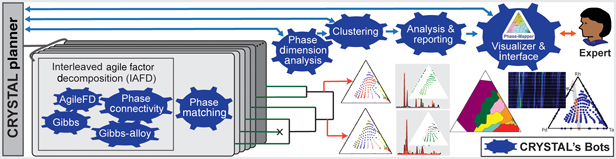
We introduce CRYSTAL, a multi-agent AI system for crystal-structure phase mapping. CRYSTAL is the first system that can automatically generate a portfolio of physically meaningful phase diagrams for expert-user exploration and selection. CRYSTAL outperforms previous methods to solve the example Pd-Rh-Ta phase diagram, enabling the discovery of a mixed-intermetallic methanol oxidation electrocatalyst. The integration of multiple data-knowledge sources and learning and reasoning algorithms, combined with the exploitation of problem decompositions, relaxations, and parallelism, empowers AI to supersede human scientific data interpretation capabilities and enable otherwise inaccessible scientific discovery in materials science and beyond.
Synthetic biology has a huge potential to produce the next generation of advanced materials by accessing previously unreachable (bio)chemical space. In this prospective review, we take a snapshot of current activity in this rapidly developing area, focusing on prominent examples for high-performance applications such as those required for protective materials and the aerospace sector. The continued growth of this emerging field will be facilitated by the convergence of expertise from a range of diverse disciplines, including molecular biology, polymer chemistry, materials science, and process engineering. This review highlights the most significant recent advances and addresses the cross-disciplinary challenges currently being faced.
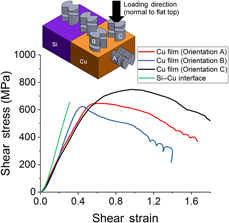
Microscale testing has enjoyed significant developments, with the majority of testing focused on tensile/compression type tests and little focus on shear testing. With the recent advances in macroscale shear testing, we developed a novel shear structure for evaluating shear properties of bulk materials and films at the microscale. The shear response in single-crystal copper oriented along the [111] direction was found to have a yield strength of ∼180 MPa. Nanocrystalline copper specimens with different orientations showed sensitivity to the film texture with a shear yield strength nearly three times that of single-crystal copper. Shear specimens were fabricated with Cu film–Si substrate interface near the middle of the shear region and compressed to fracture. The shear response showed a mixed behavior of the stiff Si substrate and softer nanocrystalline film and failed in a brittle manner, indicating a response unique to the interface.