To save content items to your account,
please confirm that you agree to abide by our usage policies.
If this is the first time you use this feature, you will be asked to authorise Cambridge Core to connect with your account.
Find out more about saving content to .
To save content items to your Kindle, first ensure no-reply@cambridge.org
is added to your Approved Personal Document E-mail List under your Personal Document Settings
on the Manage Your Content and Devices page of your Amazon account. Then enter the ‘name’ part
of your Kindle email address below.
Find out more about saving to your Kindle.
Note you can select to save to either the @free.kindle.com or @kindle.com variations.
‘@free.kindle.com’ emails are free but can only be saved to your device when it is connected to wi-fi.
‘@kindle.com’ emails can be delivered even when you are not connected to wi-fi, but note that service fees apply.
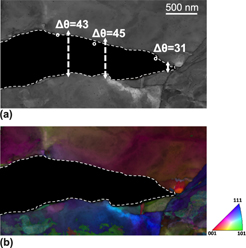
The wettability of the 304L steel is an important parameter in Liquid Metal Embrittlement studies. Empirically, it is found to be greatly enhanced by pre-exposure to oxygenated liquid sodium. The corrosion interface formed during exposure to sodium has been analyzed at the nanoscale by transmission electron microscopy using the focused ion beam sampling. A thin layer of sodium chromite (NaxCrO2 with x ≤ 1) is detected at the interface validating wetting on an oxide mechanism for the enhanced wetting after pre-exposure. Fracture micromechanisms and the crack path of liquid sodium-embrittled austenitic steel 304L at 573 K have been investigated down to the nanoscale. High-resolution orientation mapping analyses immediately below the fracture surface show that abundant martensitic transformations (γ → α) and twinning occur during deformation of austenite. The preferential crack path is intergranular along the newly formed γ/γ interfaces. It is concluded that these transformations play a major role in the fracture process.
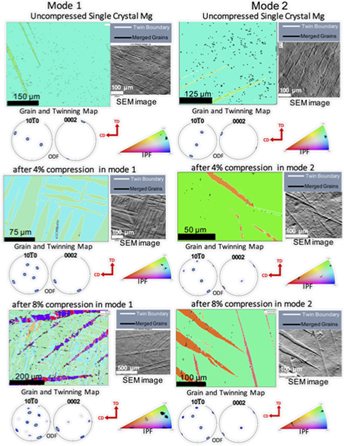
This study describes results from mechanical tests conducted on magnesium single crystals in comparison with polycrystalline magnesium. It was found by impact testing that the magnesium single crystal is highly ductile due to energy absorption by twinning and slip, while the polycrystalline samples fracture easily upon impact. Compressive testing along two orthogonal directions at low plastic strains was also performed. The microstructure studies by electron backscatter diffraction and XRD pole figure analysis revealed profuse ($10\overline12$) twinning when compression is done along the growth plane (72 16 $\overline {88}$ 62). The twinning and interaction between different twin modes resulted in incipient recrystallization at strains as low as 8% at room temperature. Compression along the nearly orthogonal plane (2 2 $\bar{4}$ 15) was marked by a much lower degree of both twinning and recrystallization. The variation in microstructural response with the orientation of loading allows for a wide range for tailoring mechanical properties of pure magnesium single crystals without any need of alloying.
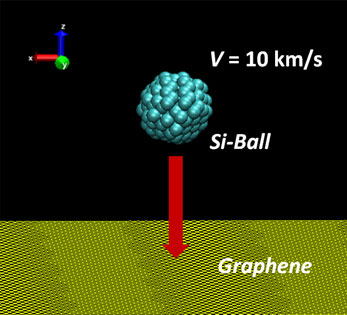
Graphene nanopores are utilized in various notable applications such as water desalination, molecular separation, and DNA sequencing. However, the creation of stable nanopores is still challenging due to the self-healing nature of graphene. In this study, using molecular dynamics simulations we explore the drilling of nanopores through graphene by bombardment with Si-nanoparticles. This enables the Si-passivation along the nanopore rim, which is known as an efficient way to stabilize graphene nanopores. The interplay between graphene and projectile causes the anomalous behaviors such as local maxima depending on particle size. The observations are thoroughly analyzed with interaction energy and shape changes.
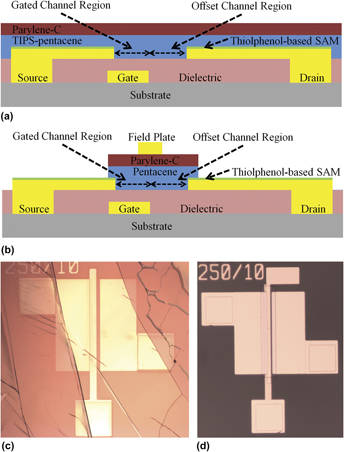
6,13-Bis(triisopropylsilylethynyl)pentacene (TIPS-pentacene) and pentacene-based high-voltage organic thin film transistors (HVOTFTs) have been fabricated on solid and flexible substrates via a low-temperature (<100 °C) solution-processed and vacuum-deposited fabrication method. A high-k dielectric Bi1.5Zn1Nb1.5O7 and an organic dielectric parylene-C have been incorporated into the transistor design. The reliability of the HVOTFTs was analyzed under flexure, where a nonsaturating I–V characteristic behavior was observed. Here, the HVOTFT exhibited a mobility μ of 0.018 cm2/(V s) and a large breakdown voltage of |VDS| > 120 V and >550 V for TIPS-pentacene and pentacene devices, respectively. The large breakdown voltages are attributed to an organic semiconductor channel region which is partially gated, allowing for a large potential drop. Thiolphenol-based SAMs were used to help improve charge injection. Electrical measurements were also performed with samples designed with a top metal field plate to improve control of the charge carrier within the channel.
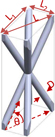
New closed-form analytical equations for volume fractions and surface-area-to-volume ratios for architected lattice cellular materials are derived. Prior approximate equations which erroneously over count overlapping volumes and the associated surface area are commonly used in the literature. These equations are found to have up to 184% error for volume fraction calculations for hollow lattices and 211% error for surface-area-to-volume ratio calculations, thus necessitating computational methods to arrive at accurate geometric properties for cellular lattice materials. This work derives new equations which are accurate to better than 1% for both volume fraction and surface-area-to-volume ratio as compared to the computational models. These new equations for cellular lattice materials are applicable to both pyramidal and tetrahedral unit cells as well as to both hollow and solid lattice members. By eliminating the need for numerical models to compute accurate volume fractions and surface-area-to-volume ratios of architected cellular materials, these new analytical equations will enable accurate yet computationally efficient optimization of the physical properties of architected cellular materials.
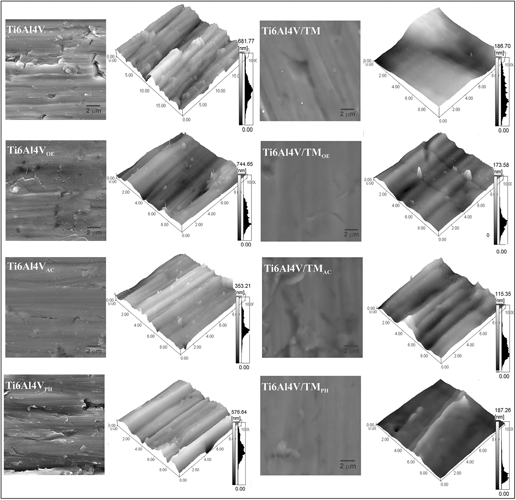
Sterilization is one of the last stages prior to the implantation of a biomaterial. Therefore, the method should be chosen carefully as this is determinant not to compromise the properties of the material. In this context, three sterilization processes were evaluated as to their effect on the properties of a silane hybrid coating: steam autoclave, ethylene oxide, and hydrogen peroxide plasma. The coating was obtained from a sol consisting of alkoxysilane Tetraethoxysilane and organoalcoxysilane Methyltriethoxysilane (MTES), applied to the Ti6Al4V substrate, to increase its corrosion resistance and biocompatibility. After sterilization, the samples were characterized by scanning electron microscopy, atomic force microscopy, profilometry, wetabillity, and Fourier transform infrared spectroscopy. The electrochemical behavior was monitored by open circuit potential and potentiodynamic polarization curves. The cytocompatibility was evaluated by adhesion, viability, and morphological alterations in the MG-63 cells. The results showed that the protective behavior of the hybrid coating was compromised regardless of the sterilization method. However, the steam autoclave caused more morphological changes on the silane hybrid coating as well as on the Ti6Al4V substrate than the other two sterilization methods. Although the sterilized hybrid coating did not show cytotoxicity, the hybrid coating sterilized by hydrogen peroxide plasma showed a higher percentage of viable cells. The ethylene oxide presented the lowest percentage of viability and the highest cell death rate.
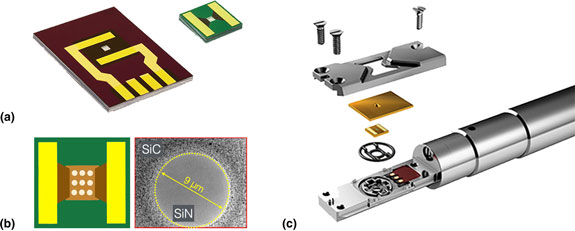
Significant developments in micro-electrical-mechanical systems-based devices for use in transmission electron microscopy (TEM) sample holders have recently led to the commercialization of windowed gas cells that now enable the atomic-resolution visualization of phenomena occurring during gas–solid interactions at atmospheric pressure. In situ TEM study under atmospheric pressures provides unique information that is beneficial to correlating the structure–properties relationship of nanomaterials, particularly under real gaseous environments. We here provide a brief introduction of the advanced instrumentation of windowed gas cells and review recent progress of in situ atomic-resolution TEM study under atmospheric pressures, including some application examples of oxidation and reduction processes, dynamic growth of nanomaterials, catalytic reactions, and “operando” TEM.
The novel visible-light-responsive direct solid-state Z-scheme g-C3N4/BiOI heterojunction has been synthesized successfully by means of a solid phase calcination method and used for the degradation of microcystin-LR (MC-LR). The layered g-C3N4 disperses on the surface of BiOI microspheres. The samples are characterized by FESEM, HRTEM, XRD, FT-IR, UV-vis spectroscopy, XPS, BET, PL, and Mott–Sckottky. The photocatalytic activity and photodegradation mechanism of the as-prepared g-C3N4/BiOI microsphere photocatalysts are conducted under visible light irradiation using MC-LR as the target pollutant. The g-C3N4/BiOI material exhibits superior photocatalytic performance when compared with pure BiOI, the possible reason is the efficient separation of photogenerated carriers at the interface between g-C3N4 and BiOI. The heterostructure is responsible for the improved separation efficiency of photogenerated electron–hole pairs and thus the higher photocatalytic activity. The possible photocatalytic mechanism is proposed based on relative band positions of these two semiconductors.
Pendent-type polymers are attractive materials which allow the flexibility to introduce various redox active moieties that facilitate rapid ion/electron transport and enable charge storage. Here, we demonstrate naphthalene diimide polymers with polynorbornene backbone having N-phenyl, PNAn 5 and N-(4-nitrophenyl), PNNO 6. Small changes in the molecular design have led to a significant difference in bulk material and device properties. PNNO 6 maintained 80% of its capacity at 1C after 10 cycles in a Li-ion coin cell. PNAn 5 displayed exceptionally high charge capacity and rate capability with excellent cyclability, maintaining almost its theoretical capacity at various C-rates throughout 500 cycles.
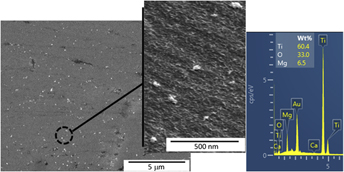
In this present study, different volume percentages of titanium dioxide nanoparticles were added as dispersions in commercially pure magnesium using the blend-press-sinter powder metallurgy process followed by hot extrusion. The physically blended titanium dioxide nanoparticles dispersoid induced a significant grain refinement in the extruded magnesium matrix. Characterization of the mechanical properties revealed that the increasing volume percentage of titanium oxide nanoparticles dispersion was effective in enhancing the ductility of magnesium without disturbing the strength under tensile loading and enhancing the strength of magnesium without disturbing the ductility under compressive loading. The dominating deformation mechanism in pure magnesium was the dislocation slip, which was subdued by the tensile twinning deformation mechanism due to the increasing presence of titanium dioxide dispersion. The effect of shift in the dominating deformation mechanism was displayed by the elimination of tensile-compressive asymmetry in magnesium when dispersed with 1 vol% of titanium dioxide nanoparticles.
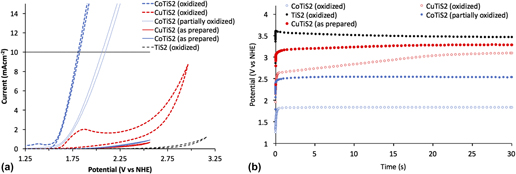
Intercalated and unmodified TiS2 nanomaterials were synthesized and characterized by UV-Visible-NIR spectroscopy, Powder X-Ray Diffraction, and X-Ray Photoelectron and Ultraviolet Photoelectron Spectroscopy. Photoelectron spectroscopy measurements indicated that CoS and Cu2S appeared to be intercalated between sheets of partially or fully oxidized TiS2, which could be solution processed on conductive oxide substrates. The materials were then applied toward water oxidation and evaluated by cyclic voltammetry, chronoamperometry, and impedance measurements. While unmodified TiS2 was not observed to perform well as an electrocatalyst with overpotentials >3 V in 1 M NaOH electrolyte, CoS intercalation was found to lower the overpotential by ∼1.8–1.44 V at 10 mA/cm2. Conversely, Cu2S intercalation resulted in only a modest increase in performance (>2.3 V overpotential). Impedance measurements indicated that intercalation increased the series resistance in the as-prepared samples but decreased the series resistance in oxidized samples.
Characterization and testing during and after manufacture play important roles for ensuring quality and performance [1, 2] of Solar Photovoltaic (SPV) modules. The in-situ characterization during various process steps ensures that good quality modules with acceptable power output are produced. Testing of SPV modules has additional aspects of authenticity and accuracy of the test results. As the output power of the finished modules decides the DC output at system level, some standards and protocols are to be followed during testing to ensure that correct values are measured. Standards are applicable to the tester, which is also known as a ‘Sun simulator’. The protocol demands that the tester is always calibrated against some reference module during testing of finished modules. The reference modules are to be certified by authorized centres such as NREL, Fraunhofer, CIMET, etc. The modules are tested and the electrical parameters, including power are rated under Standard Test Condition (STC), which is 1000 Wm-2 irradiance incident normal to the plane of module face maintained at 25°C. These protocols and standards ensure that the testing of any module produces the same electrical characteristics, within the accuracy band of the tester used, wherever the module is tested. The accuracy required for the Sun simulator is also specified through a standard. These are very important as the accuracy of the rated electrical behaviour, particularly the power output of the modules, ultimately decide how much energy can be extracted from the SPV system using these modules. Inaccurate measurement of power can have serious financial implications for the seller if the measured power is less than the actual value and for the buyer if the measured power is larger than the actual value. It is also important to measure other electrical parameters, such as VOC, ISC, Vm and Im as the string design for SPV system (Chapter 9) requires accurate values of such parameters. It is possible to have the value of the power output very close to the rated value, but other electrical parameters may have large deviations/inaccuracies. The test protocol and standards addresses such issues as well.
Reliability determines the long-term behaviour of any device or product such as a SPV module. This is particularly important as the modules are supposed to produce power for 25 years or more.
Solar Photovoltaic (SPV) modules occupy an important position in the value chain [1–5] (see Figure 9.1). Crystalline silicon (c-Si) is currently the preferred technology with a market share of about 85%. c-Si modules are made using crystalline silicon (Si) solar cells as the starting material. Several such cells are connected to make modules. The manufacturing process for c-Si modules is less complex than that for thin film modules. However, the value chain is quite long (see Figure 9.1) and more process steps in cell manufacture are required prior to module manufacturing. There are also processes, such as single crystal growth in the value chain, which require a substantial amount of electrical energy.
Thin film modules are made with an entirely different approach. These modules are made using a full size substrate (actually superstrate), typically glass with transparent conductive coating and use deposition techniques such as Plasma Enhanced Chemical Vapour Deposition (PECVD). For a-Si cells, layers of p, i and n are deposited sequentially to form the junction for PV conversion. Expensive and energy-intensive crystal growth required in c-Si technology is thus avoided. Historically, CdS/Cu2S were the first thin film cells invented in 1954. But, these were not commercially successful due to low efficiencies and degradation with time. Nowadays semiconductors such as amorphous Si (a-Si), CdTe or CIGS are used in thin film cells. Amorphous-silicon uses PECVD deposited a-Si as the active material. Single, as well as tandem junction a-Si films can be used to form a SPV module. A composite technology using a combination of a-Si and c-Si, called Heterojunction with Intrinsic Thin Layer (HIT) has also been developed. Cadmium Telluride (CdTe) and Copper Indium Gallium Selenide (CIGS) are the other two thin film materials that are being used for commercial SPV technology. Thin film technology has a much shorter value chain with lower electricity consumption than c-Si technology, PECVD being the only complex process. The cost per WP and payback period of thin film technologies is therefore lower than for c-Si technology. Another difference is that the temperature co-efficient of power output is less for thin film cells. This is an advantage in a tropical country such as India. Nevertheless, c-Si is still preferred due to higher efficiency and reliability.