To save content items to your account,
please confirm that you agree to abide by our usage policies.
If this is the first time you use this feature, you will be asked to authorise Cambridge Core to connect with your account.
Find out more about saving content to .
To save content items to your Kindle, first ensure no-reply@cambridge.org
is added to your Approved Personal Document E-mail List under your Personal Document Settings
on the Manage Your Content and Devices page of your Amazon account. Then enter the ‘name’ part
of your Kindle email address below.
Find out more about saving to your Kindle.
Note you can select to save to either the @free.kindle.com or @kindle.com variations.
‘@free.kindle.com’ emails are free but can only be saved to your device when it is connected to wi-fi.
‘@kindle.com’ emails can be delivered even when you are not connected to wi-fi, but note that service fees apply.
An overview of the Solar Photovoltaic (SPV) systems has been presented in Chapter 9. The entire system [1–9] consists of: (a) solar field; (b) structure; (c) Balance of System (BOS) comprising DC-DC converter, Maximum Power Point Tracking (MPPT), inverter/ Power Conditioning Unit (PCU) and other accessories such as LT panel, cables, combiner box, connectors, etc.; (d) storage, if required, comprising battery and charge controller and (e) transformer for on-grid systems. A solar field provides a varying DC output decided primarily by insolation and ambient conditions. The design and implementation of the solar fields consisting of solar modules connected in series and parallel, known as ‘string and array design’, has been discussed in some detail in Chapter 9. Structures are required to mount the modules. The structure for a fixed system is relatively simple. Tracking structures are more complex as these require provision for movement of the modules according to the Sun's position. Motors with movable structures are, therefore, required for such installations. The movement of the motor can be programmed to ensure that the Sun's rays fall perpendicular to the module face whenever possible. Dual axis tracking is even more complex than single axis tracking. It may be noted that the power required for driving the motors are provided from the power generated from the SPV plant.
The DC-DC converter along with MPPT takes the output of the solar field as an input and converts this to a maximum possible stable DC output. In case storage is provided, a battery is required to store some amount of energy for later use. A charge controller is also required to manage the charging and discharging of the battery. The inverter provides the AC output to the corresponding loads. A solar inverter consists of DC-DC with MPPT control and DC-AC converters. A Power Conditioning Unit (PCU) is essentially a solar inverter along with a charge controller. Accessories, such as cables, connectors, combiner box, LT panel, etc., are required to implement the string and array design (DC side) and manage the interface between inverter/PCU output and load (AC side). An on-grid system, which is also known as ‘SPV power plant’, sends the generated power to the electricity grid local substation.
Our conventional energy reserves are limited and have severe environmental impact. There has been all round focus on the development of renewable energy primarily due to these facts, as well as from the perspective of energy security, climate change and energy access. Solar energy has been the Earth's most available energy source, capable of providing many times the total energy demand. Solar Photovoltaic (SPV) deals with conversion of sunlight into electricity. Governments across the world have realized the importance of solar power and over 60 countries have introduced feed-in tariffs, capital subsidies and incentives for productions to promote wider adoption and advancement of SPV. The average growth rate of global SPV capacity has been close to 40%, with the total installed capacity now approaching 350GWP. Renewable energy initiatives, particularly SPV, have picked up pace in India also. The Jawaharlal Nehru National Solar Mission (JNNSM) has been a major initiative of the Government of India to give an impetus to the domestic solar power industry. It sets an ambitious target of 20 GW of solar power capacity by 2022. Several State Governments have announced independent policies in SPV.
Solar PV systems [1–7] occupy a very important place in the SPV value chain (Figure 9.1). As it comes at the end point of the value chain, it decides the amount of power finally supplied. The power generated by a SPV system depends on the previous operations of the value chain as well. In the crystalline silicon (c-Si) technology, the type of wafers (mono or multi) and the efficiency of the solar cells, decided by the cell manufacturing technology, play a very important role. Assembly of the solar cells to make modules has been somewhat straightforward for c-Si technology. Thin film technology (a-Si, CdTe, CIGS, etc.) takes a different route in the value chain diagram (Figure 9.1). The modules are made directly by the Chemical Vapour Deposition (CVD) technique to deposit thin layers of appropriate materials on a conductive glass substrate to form p-n junction solar cell. In this case also the efficiency is decided by several factors such as material (Si, CdTe, CIGS, etc.), structure (amorphous, microcrystalline, etc.) and configuration (single junction, tandem junction, etc.).
There has been rising interest followed by extensive research on organic and polymer solar cells in the last three decades. Organic semiconductors have made great strides since conductivity [1] and electroluminescence [2] in Anthracene were studied in the 1960s by Kallmann and his group. Electronic processes in organic materials have been thoroughly discussed by Pope and Swinberg [3]. Rapid progress in the field of organic materials is exemplified by the commercial success of Organic Light Emitting Diodes (OLEDS) in mobile phones and other applications. This has been possible through the tailor-making of the properties of organic semiconductors to emit light across the visible spectrum from blue to red [4]. Recently Heliatek [5], a German firm, has achieved a record conversion efficiency of 13.2% for an Organic Photovoltaic (OPV) Multi-junction (MJ) cell using small molecules. The cell has three absorber layers for absorbing light from the near infrared, red and green wavelengths, covering the major part of the solar spectrum from 450 nm to 950 nm. Stability of the small molecules is projected for 25 years. This achievement has provided great impetus to commercial development. Thus, there is, in principle, no reason why organic solar cells with their inherent advantages, discussed below, should not usher in the third generation of solar cells [6, 7].
At the outset it is necessary to distinguish between the types of organic and polymer materials for PV applications.
Organic semiconductors can be classified into two broad types [8]:
(a) Small molecules with molecular weight (MW) < 1000; usually deposited by physical vapour deposition
(b) Polymeric films[9] with molecular weight (MW) > 10,000; deposited by casting from solution, spin coating, doctor blading screen, or inkjet printing. Though thin films are reasonably easy to form, their molecular weight and purity are hard to control.
ENERGY LEVELS
Organic solids and polymers are generally considered to be insulators. However, both, the small molecules and polymers (Figure 5.1) used as light-absorbing materials have large conjugated systems in which carbon atoms covalently bond with alternating single and double bonds. These electrons in orbitals delocalize and form a delocalized bonding orbital with a anti-bonding orbital. The delocalized orbital forms the Highest Occupied Molecular Orbital (HOMO) and the orbital forms the Lowest Unoccupied Molecular Orbital (LUMO).
The growth and demand for Solar Photovoltaic (SPV) energy systems has been strong and in line with the increasing importance of renewable energy. Worldwide demand and production of SPV systems has been growing at a compound annual growth rate of more than 30% over the last decade. There have been significant advances in technology, spanning the entire value chain consisting of solar cells, modules and balance-of-system (BOS) components. This has resulted in an increase in efficiency and a significant cost reduction over the years, making SPV systems viable both in small stand-alone and large grid-connected applications.
Solar energy, which is the Earth's most available energy source, can be converted to electricity providing scalable and clean power requiring minimal maintenance. This book deals with the subject of Solar Photovoltaics in some detail covering the basics as well as advanced topics. All the important areas of SPV, covering both science and technology, have been addressed in this book. Commencing with the basic principles, different types of solar cells from bulk silicon (Si) to thin film cells are described comprehensively. Tandem concentrator cells now provide the highest efficiencies of 43%. Newer low cost alternatives, such as organics and perovskites, are also discussed. Manufacturing details have been covered in great detail. The basic cost and investment calculations of SPV manufacturing and systems leading to economic viability have also been included. These aspects are generally not covered in most of the books published in this field. Several practical and state-of-the art manufacturing and system design details have been presented based on the experience of one of the authors (J. N. Roy). This book should be useful for students studying this important subject, who eventually want to pursue careers in this field. The book should be also useful for researchers and industry personnel who want to have a thorough understanding of the subject. Each chapter has illustrations and tables. There are several examples and exercises throughout the book to help consolidate thorough learning of the subject.
Chapter 1 presents a general introduction to the subject of solar energy in the context of global warming. Solar insolation and distribution are presented and some basic terms are defined. This is followed by the principles of operation of SPV devices, device characteristics, criteria for choice of materials, and critical parameters for efficient operation.
Deformation and structural behavior of an experimental γ′-strengthened Co-base alloy during creep at 800 °C and 196 MPa have been investigated. The characteristic features of this alloy are zero γ/γ′-lattice misfit and a fine γ/γ′-microstructure. In the initial condition, the γ′-precipitates in this alloy are small (size of about 100 nm), have polyhedral morphology, and are separated by the very narrow γ-channels (width of about 10 nm). The tests performed up to about 1% creep strain (about 500 h creep time) gave creep curves with a slow constant strain rate and without an apparent transient creep, typical for superalloys with nonzero misfit. In this initial stage of creep, entering of the narrow γ-channels by dislocations is blocked by a strong Orowan force. The micromechanism of creep was identified as an octahedral glide of 〈011〉 superdislocations simultaneously in two phases, γ and γ′. The γ/γ′-microstructure with zero misfit shows no rafting but rapidly coarsens isotropically. It is concluded that zero misfit is beneficial at the initial stages of the creep but is unfavourable for long-term creep because of the continuous microstructural coarsening.
Polyphenylene sulfide (PPS) has good corrosion resistance, chemical stability, and thermal stability, which was widely applied in precipitator field. In this paper, a novel in situ synthesis protocol was selected to fabricate the Mn–CeOx/PPS functional composites with excellent low-temperature denitration activity. Results show that the as-obtained Mn–CeOx/PPS filter possessed of superb denitration activity at 180 °C under a weight hourly space velocity of 210,000 mL/gcat/h, which may be stemmed from the generation of amorphous and well-dispersed mixed metal oxide catalysts.
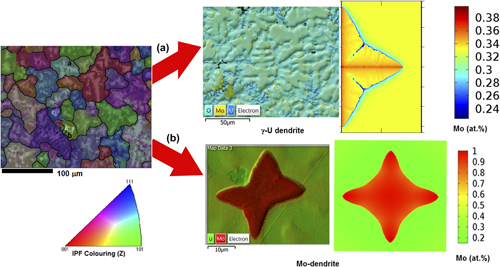
U–Mo metallic alloy is considered as an advanced fast reactor and research reactor fuel material. U–33 at.% Mo has a higher melting point than that of pure uranium metal. This provides a higher safety margin against fuel melting and diminishes fuel and clad interaction. The metallic fuels are fabricated through a melting-casting route, and the cast microstructure of U–33 at.% Mo has been characterized using optical microscope, scanning electron microscopy—energy dispersive spectroscopy, and Electron back scattered diffraction. These microstructures show dendrites of two different morphologies: (i) the γ-(U) dendrite with secondary branches and (ii) the equiaxed (Mo) dendrite without secondary branches and surrounded by a peritectic reaction product. In this article, for the first time, a phase field model has been developed for U–Mo alloys to understand the morphological evolution and the associated microsegregation of γ-(U) dendrites in the U–33 at.% Mo alloy. The evolution of the concentration and temperature field with the time and the effect of undercooling on the growth velocity of γ-(U) and (Mo) dendrites has been studied.
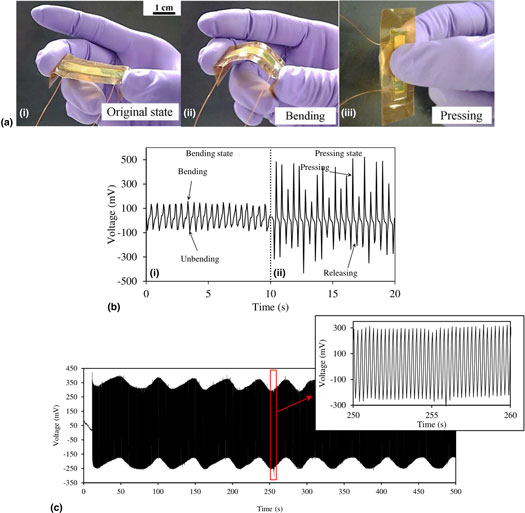
Multiwall carbon nanotubes (MWCNTs) are utilized to resolve low coupling coefficient issue by dispersing MWCNTs in poly(vinylidene fluoride) matrix to create stress reinforcing network, dispersant, and electron conducting functions for barium titanate (BT) nanoparticles. Various BT and MWCNT percentages of nanocomposite film are fabricated by FDM three-dimensional (3D) printing which can simplify the fabrication process as well as lower cost and design flexibility. Increasing MWCNTs and BT particles gradually increase piezoelectric coefficient (d31) by 0.13 pC/N with 0.4 wt%-MWCNTs/18 wt%-BT. These results provide not only a technique to print piezoelectric nanocomposites but also unique materials combination for sensor application.
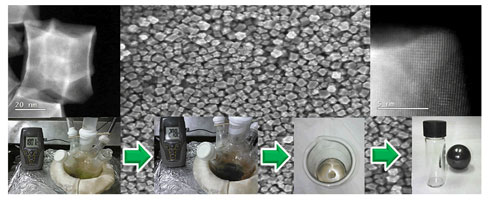
Ni–Pt polyhedral nanoparticles were synthesized through a thermochemical route by the hot-injection method using Oleylamine (Oam) and Oleic acid (Oac) solvents as simultaneous stabilizing and reducing agents. Several syntheses were performed to study the effect of the hot-injection temperature on nanoparticle size distribution. Results revealed that the injection of precursors in a mixture of Oam and Oac at 180 °C produced paramagnetic nanoparticles with an approximate size of 27 nm; these particles have uniformly defined polyhedral structures and show greater Pt accumulation on the edges and corners. Ni–Pt polyhedral nanoparticles with larger sizes and high polydispersity were obtained as the injection temperature was increased closer to the reduction temperature.
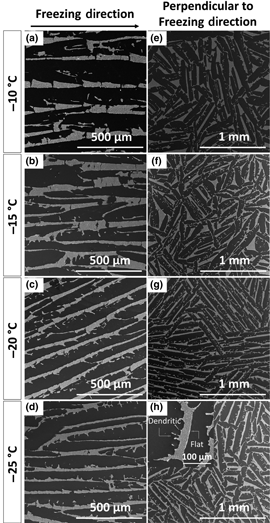
An aqueous suspension of 5 vol% silicon (Si) nanoparticles was directionally solidified at substrate temperatures between −10 and −25 °C, resulting in colonies of aligned pure ice dendrites separated by interdendritic Si particles packed walls. Channels are created by sublimation of the dendrites, and the surrounding Si walls are densified by sintering. The resulting Si foams exhibit a 76 ± 2% macroporosity, with the width of the ice-templated channels and the Si walls decreasing with solidification temperature, from 106 to 60 µm and from 34 to 17 µm, respectively. Si walls show high surface roughness from inverse templating of short secondary ice dendrite arms.