To save content items to your account,
please confirm that you agree to abide by our usage policies.
If this is the first time you use this feature, you will be asked to authorise Cambridge Core to connect with your account.
Find out more about saving content to .
To save content items to your Kindle, first ensure no-reply@cambridge.org
is added to your Approved Personal Document E-mail List under your Personal Document Settings
on the Manage Your Content and Devices page of your Amazon account. Then enter the ‘name’ part
of your Kindle email address below.
Find out more about saving to your Kindle.
Note you can select to save to either the @free.kindle.com or @kindle.com variations.
‘@free.kindle.com’ emails are free but can only be saved to your device when it is connected to wi-fi.
‘@kindle.com’ emails can be delivered even when you are not connected to wi-fi, but note that service fees apply.
Multimaterial bioprinting technologies offer promising avenues to create mini-organ models with enhanced tissue heterogeneity and complexity. This article focuses on the application of three-dimensional bioprinting to fabricate organ-on-a-chip systems for in vitro drug testing and screening. We illustrate the capabilities and limitations of a bioprinting approach compared to microfabrication in constructing an organ-on-a-chip device. Further, we propose strategies in multimaterial integration for printing microphysiological tissue models. With these analyses, key challenges and future directions are highlighted.
Bioprinting, the three-dimensional (3D) printing of cell-laden inks, will be a truly revolutionary technology for the biomaterials community. The number of bioink studies, especially aimed at functional tissues, remains significantly limited, and furthermore, current bioinks are limited by a narrow window of printability. This can be largely attributed to the fact that the preparation of bioinks and their 3D printing is significantly complicated by the presence of cells, which require strict conditions for their viability. This article discusses how cells should be considered during bioink synthesis, 3D printing, and post-printing processing. We also discuss what has been reported thus far with regard to the relationships between bioink material properties and cells. This underlines the need for next-generation bioinks that simultaneously achieve excellent printability, high cell viability, and a wide range of material properties.
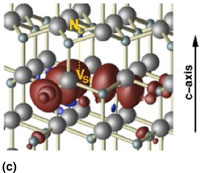
NV centers in silicon carbide have been identified in the three main polytypes 3C, 4H, 6H by magnetic resonance and photoluminescence experiments and related ab initio calculations. Their properties show them to be promising centers for applications in quantum technology, similar to the case of NV in diamond. However, their spectral range is in the near-infrared, which should allow their integration in telecommunication systems.
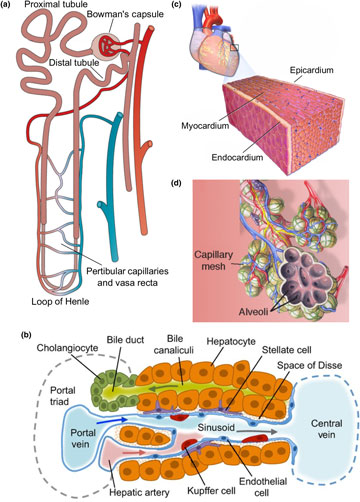
Tissue engineering has been recognized as a translational approach to replace damaged tissue or whole organs. Engineering tissue, however, faces an outstanding knowledge gap in the challenge to fully recapitulate complex organ-specific features. Major components, such as cells, matrix, and architecture, must each be carefully controlled to engineer tissue-specific structure and function that mimics what is found in vivo. Here we review different methods to engineer tissue, and discuss critical challenges in recapitulating the unique features and functional units in four major organs—the kidney, liver, heart, and lung, which are also the top four candidates for organ transplantation in the USA. We highlight advances in tissue engineering approaches to enable the regeneration of complex tissue and organ substitutes, and provide tissue-specific models for drug testing and disease modeling. We discuss the current challenges and future perspectives toward engineering human tissue models.
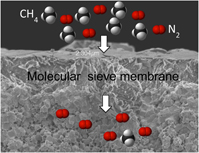
Natural gas consumption has grown from 5.0 trillion cubic feet (TCF) in 1949 to 27.0 TCF in 2014 and is expected to be ∼31.6 TCF in 2040. This large demand requires an effective technology to purify natural gas. Nitrogen is a significant impurity in natural gas and has to be removed since it decreases the natural gas energy content. The benchmark technology to remove nitrogen from natural gas is cryogenic distillation, which is costly and energy intensive. Membrane technology could play a key role in making this separation less energy intensive and therefore economically feasible. Molecular sieve membranes are ideal candidates to remove natural gas impurities because of their exceptional size-exclusion properties, high thermal and chemical resistance. In this review, the state of the art of molecular sieve membranes for N2/CH4 separation, separation mechanisms involved, and future directions of these emerging membranes for natural gas purification are critically discussed.
In pursuit of design and characterisation of Cu adsorbing in thin films, we present data from a large variety of Cu-K edge X-ray Absorption Near Edge Spectroscopy (XANES) spectra obtained from organic and inorganic standards. Additionally, we have explored the impact of beam damage inducing redox alterations. Polymer nanoparticles were tested against films to produce higher concentration samples while maintaining high surface area to bulk effects. Spectra from nanoparticles were highly comparable to thin films of ~8 nm thickness, implying comparable contributions by surface effects on copper association. Finally, we observed no impact on Cu XANES spectra from vitrification with dimethyl sulfoxide to produce amorphous frozen, hydrated samples. The spectra should act as a valuable resource in assisting the design of experiments and identification of copper associations.
A CrMnFeCoNi high-entropy alloy was investigated by nanoindentation from room temperature to 400 °C in the nanocrystalline state and cast plus homogenized coarse-grained state. In the latter case a 〈100〉-orientated grain was selected by electron back scatter diffraction for nanoindentation. It was found that hardness decreases more strongly with increasing temperature than Young’s modulus, especially for the coarse-grained state. The modulus of the nanocrystalline state was slightly higher than that of the coarse-grained one. For the coarse-grained sample a strong thermally activated deformation behavior was found up to 100–150 °C, followed by a diminishing thermally activated contribution at higher testing temperatures. For the nanocrystalline state, different temperature dependent deformation mechanisms are proposed. At low temperatures, the governing processes appear to be similar to those in the coarse-grained sample, but with increasing temperature, dislocation-grain boundary interactions likely become more dominant. Finally, at 400 °C, decomposition of the nanocrystalline alloy causes a further reduction in thermal activation. This is rationalized by a reduction of the deformation controlling internal length scale by precipitate formation in conjunction with a diffusional contribution.
Organometal trihalide perovskite solar cells (PSCs) have sparked a frantic excitement in the scientific community because they can achieve high power conversion efficiencies (PCEs) even when fabricated by low-cost solution-processing technologies. However, the poor stability of PSCs has seriously hindered their commercialization. Among various kinds of PSCs, carbon-based PSCs without hole transport materials (C-PSCs) seem to be the most promising for addressing the stability issue because carbon materials are stable, inert to ion migration, and inherently water-resistant. Concurrent with the steady rise in PCE of C-PSCs, great progresses have also been attained on the device stability and scaling-up fabrication of C-PSCs, which have well signified the possible commercialization of PSCs in the near future. In this review, we will summarize these progresses with a view of exposing the promising prospect. We start by collating recent stability testing results of C-PSCs with reference to those of HTM-PSCs. Then, we update the research status on large-scale C-PSCs and their associated scalable fabrication technologies. Finally, we identify main issues to be addressed alongside future research directions.
The Cu–S compounds have been reported as promising thermoelectric materials with abundant element composition, low price, and low toxicity. In this work, SnxCu1.8−xS samples with different Sn contents (x = 0.005, 0.01, 0.03, and 0.05) were fabricated by mechanical alloying combined with spark plasma sintering. The phase structure and microstructure of all the bulk samples were checked by X-ray diffraction (XRD) and field emission scanning electron microscopy respectively. The thermoelectric transport properties, such as electrical conductivity, Seebeck coefficient, carrier concentration, carrier mobility, and thermal conductivity, were measured. The effect of second phase introduced by Sn addition on the thermoelectric properties of Cu–S system was investigated. The thermoelectric properties of samples were improved by the precipitations of two different second phases (Cu2SnS3 and Cu4SnS4). The second phase species depend on the Sn contents. Finally, the Sn0.01Cu1.79S bulk sample obtained the highest ZT value of 0.81 at 773 K, which is 1.6-fold higher than that of the pristine Cu1.8S sample due to the significantly reduced thermal conductivity by second phase and nanopores scattering.
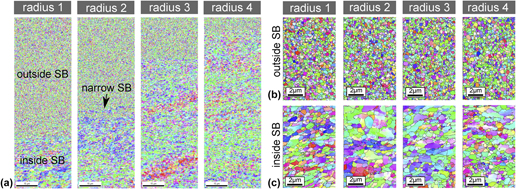
Structural instabilities of nanocrystalline and ultrafine-grained (UFG) materials have been recognized as a major challenge during cyclic loading, especially in the low cycle fatigue regime. Although a severe deterioration of the mechanical properties has been reported during cyclic deformation, quantification of the softening portion solely due to grain coarsening was not possible. It will be demonstrated that cyclic high pressure torsion (CHPT) is a versatile method to enable direct measurement of the impact of grain coarsening on cyclic softening, as failure of the sample is prevented. Here, CHPT experiments have been performed on 99.99% UFG nickel. Grain coarsening similar to conventional uniaxial fatigue experiments was observed and could be studied up to large cyclic accumulated macro strains of 50. The correlation of electron back scatter diffraction images with microhardness measurements facilitated quantification of the cyclic softening as a consequence of grain growth for the very first time. Further, structural investigations revealed distinctly enhanced grain coarsening within shear bands. Thus, the cyclic strain seems to be the most important parameter controlling mechanically driven boundary migration during cyclic loading at low homologous temperatures.
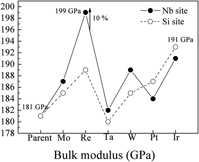
Nb-based silicides are promising ultrahigh-temperature materials. However, the structural stability and mechanical properties of Nb-based silicides are markedly influenced by Nb3Si phase. Therefore, the improvement of the stability and mechanical properties of Nb3Si is a great challenge. To solve these key problems, in this work, we apply the first-principles calculations to investigate the influence of transition metals (TM = Mo, Re, Ta, W, Pt, and Ir) on the structural stability, mechanical, and thermodynamic properties of Nb3Si. Two possible doped sites: Nb site and Si site are considered. We find that these alloying elements not only can stabilize the Nb3Si phase but also effectively improve the mechanical properties of Nb3Si. The calculated electronic structure shows that high elastic modulus is attributed to the formation of the TM–Si bond. Importantly, these alloying elements improve the heat capacity of Nb3Si due to the vibration of TM atoms under high temperature. Therefore, our calculated results predict that alloying elements of Re and Ir are beneficial for improving the overall performances of Nb3Si.
In this work, examination of joint properties of ferritic and dual-phase stainless steel dissimilar welds was carried out by using E2209 duplex and E309LMo austenitic electrodes. The results of E2209 weld showed dual-phase microstructure of ferrite and austenite in the form of grain boundary austenite, Widmanstatten and intragranular austenite, whereas E309LMo weld showed acicular ferrite in the cores of subgrain of austenite. Electron backscatter diffraction was used to study the evolution of the microstructure and micro-texture. The significant variations in the feature of weldments illustrated the presence of a very strong texture. Ferritoscope measurement revealed higher ferrite content in the E2209 weld. Tensile strength, hardness, and absorbed energy of weld metal were dominated by E2209 weld. The modified Strauss test indicated intergranular corrosion attack in the AISI 430 ferritic side heat affected zone. Higher pitting resistance showed by E2209 weld than E309LMo weld. While higher galvanic corrosion observed in the E309LMo weld and AISI 430 ferritic base metal couple.
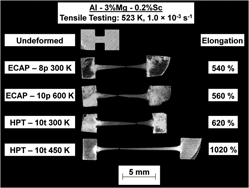
The Al–Mg–Sc alloys have become important materials in research conducted on superplasticity in aluminum-based alloys. Many results are now available and this provides an opportunity to examine the consistency of these data and also to make a direct comparison with the predicted rate of flow in conventional superplasticity. Accordingly, all available data were tabulated with divisions according to whether the samples were prepared without processing using severe plastic deformation (SPD) techniques or they were processed using the SPD procedures of equal-channel angular pressing or high-pressure torsion or they were obtained from friction stir processing. It is shown that all results are mutually consistent, the measured superplastic strain rates have no clear dependence on the precise chemical compositions of the alloys, and there is a general agreement, to within less than one order of magnitude of strain rate, with the theoretical prediction for superplastic flow in conventional materials.
The present investigation aims to explore the evolution of microstructure and mechanical properties in Zn–Cu–Ti alloys during severe hot-rolling deformation. Twin deformation and dynamic recrystallisation are two important deformation modes of Zn–Cu–Ti alloys during hot rolling at 300 °C. Twin deformation and dynamic recrystallisation (DRX) appear one after the other. They not only consume the deformation stored energy but also inhibit initiation and growth of cracks. The elongation rate of Zn–Cu–Ti alloys has a rising trend with the increase in hot-rolling deformation. It is mainly due to grain refinement caused by increasing the ratio of DRX and twin deformation. The tensile strength of Zn–Cu–Ti alloys is found to decrease with the increase in hot-rolling deformation. This is because the solid-solution strengthening effect of copper is weakened by more deformation-induced precipitation of ε phase (CuZn5). The solid-solution strengthening effect of copper plays an important role in the strengthening effect of Zn–Cu–Ti alloys.
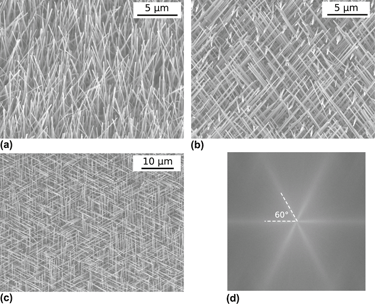
Zinc oxide (ZnO) layers and nanowires were grown by chemical vapor deposition (CVD) using methane (CH4) as reducing agent. Compared to conventional CVD processes, which commonly use graphite powder to reduce the ZnO powder source material, this low-cost method allows an improved controllability of the growth processes. Specifically, the consumption of the source material–a commercially available ZnO powder–can be controlled in a very precise way by varying the flow of the reducing CH4 or the re-oxidizing O2. Using this parameter, the growth can be switched between ZnO layers and nanostructures. High-quality ZnO layers have been grown on gallium nitride (GaN) substrates and on c-plane sapphire with an intermediate aluminum nitride (AlN) nucleation layer. By adjusting the growth conditions accordingly, ZnO nanowires were also grown with this method catalyst-free using a- and c-plane sapphire with ZnO nucleation layer as a substrate. The optical properties of the nanowires were investigated by low-temperature photoluminescence (PL) and compared to samples grown by conventional carbo-thermal CVD.
Nanoscale biosensor technology has attracted considerable attention with its promise of revolutionizing techniques ranging from biological interfaces to rapid pathogen detection to enabling DNA data storage. Many approaches, such as nanopore sequencing, have been explored and are already achieving tremendous success; however, new sensing modalities and architectures are emerging that are envisioned for the next generation of ever more capable biosensors. These novel devices, combined with advances in machine learning, are moving concepts from simulation to experimentation and demonstration. In recent years, rapid advances have been made and many architectures have been put forward for novel approaches to biomolecular sensing using nanoelectronics, including the advent of tunnel junctions as a sensing platform. With high accuracy, sensitivity, and affordability, these sensors are predicted to drive a shift to personalized medicine and rapid diagnostics in real-time anywhere in the world. Here we give an overview of tunneling sequencing and its application in biomolecular sensing and provide a perspective on the use of scalable tunneling sequencing methods utilizing graphene as the active component.