To save content items to your account,
please confirm that you agree to abide by our usage policies.
If this is the first time you use this feature, you will be asked to authorise Cambridge Core to connect with your account.
Find out more about saving content to .
To save content items to your Kindle, first ensure no-reply@cambridge.org
is added to your Approved Personal Document E-mail List under your Personal Document Settings
on the Manage Your Content and Devices page of your Amazon account. Then enter the ‘name’ part
of your Kindle email address below.
Find out more about saving to your Kindle.
Note you can select to save to either the @free.kindle.com or @kindle.com variations.
‘@free.kindle.com’ emails are free but can only be saved to your device when it is connected to wi-fi.
‘@kindle.com’ emails can be delivered even when you are not connected to wi-fi, but note that service fees apply.
Novel compounds Ca8−xPbxZnBi(VO4)7 (0 ≤ x ≤ 1.5) solid solution with the whitlockite-type structure were synthesized by a standard solid-state method. The unit-cell parameters were determined by X-ray powder diffraction and using Le Bail decomposition. The crystal structural of Ca6.5Pb1.5ZnBi(VO4)7 was refined by Rietveld method. It is found that Pb2+ cations occupy a half of the M3 site, whereas the M1 and M2 sites are predominantly occupied by calcium with admixture of Bi3+ cations. The M5 site is fully occupied by Zn2+ cations. The M4 site in the structure of studied sample remains vacant and does not participate in the cations arrangement. Optical second harmonic generation demonstrates high non-linear optical activity. Dielectric investigations confirm polar space group R3c. Changes in the non-linear optical and ferroelectric parameters are matched with lead and zinc cation distribution over the sites of the whitlockite-type structure.
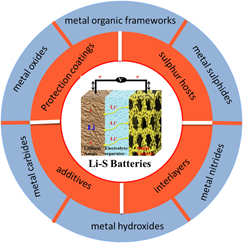
Lithium–sulphur (Li–S) batteries are one of the most promising candidates for the next generation of energy storage systems to alleviate the energy crisis. However, Li–S batteries’ commercialization faces the challenges of low active materials utilization, poor cycling life, and low energy density. Recently, tremendous progress has been achieved in improving the electrode performances and tap density by using the nanostructured metal compounds in Li–S batteries. In this review, we not only present the latest various nanostructured metal compounds applications in Li–S batteries, including metal oxides, metal sulphides, metal carbides, metal nitrides, and metal organic frameworks, but also we focus on the interaction mechanisms between these polar metal compounds with polysulphides. The issues and bottlenecks of these metal compounds are concluded and the corresponding available solutions to address these issues are proposed. This systematic discussion and proposed strategies can offer avenues to the practical application of Li–S batteries in the near future.
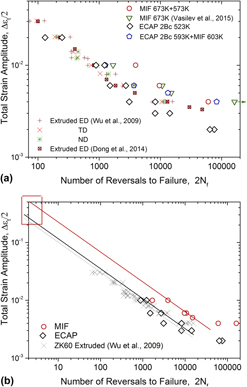
Complex wrought magnesium-based alloys suffer from poor ductility, strong yield asymmetry, and lower than desired fatigue performance. These unfavourable properties are exacerbated by the heterogeneity of the microstructure and strong texture forming in Mg alloys during conventional thermo-mechanical processing. For the user, severe plastic deformation (SPD) increases flexibility in tailoring the microstructures and selecting the properties to be emphasized in wrought Mg alloys. The effect of SPD by hot multiaxial forging and equal channel angular pressing on the formation of fine grain microstructure and on resultant mechanical properties is discussed. It is demonstrated that SPD is capable of substantial enhancement in ductility and tensile strength which gives rise to concurrent improvement of both low- and high-cycle fatigue properties. The main message of this overview is that the full potential for improving fatigue performance of Mg alloys can be taken advantage of by way of comprehensive understanding the role of the individual effects associated with the SPD-induced microstructures and textures.
Cellulose nanocrystal (CNC) enhances mechanical performance of cement composites via short-circuit diffusion (SCD). CNCs transport water along their hydrophilic surface into the unhydrated cement cores to induce extra hydration. It is important to characterize CNC distribution because it determines the SCD pathways. This study for the first time, employs virtual environment dynamic atomic force microscopy, an atomic force microscopy computational tool to investigate CNC distribution in both fresh and hardened cement pastes. The methods not only provide insights in a static context (hardened sample), but also offer opportunities to evaluate the interaction of CNCs with calcium-silicate-hydrate growth during the kinetic early ages of hydration.
Self-assembled oxide-based vertically aligned nanocomposite (VAN) thin films have aroused tremendous research interest in the past decade. The interest arises from the range of unique nanostructured films which can form and the multifunctionality arising from these forms. Hence, a large number of oxide VAN systems have been demonstrated and explored for enhancing specific physical properties, such as strain-enhanced ferroelectricity, tunable magnetotransport, and novel electrical/ionic transport properties. The epitaxial growth of the nanocomposite thin films and the coupling at the heterogeneous interfaces are critical considerations for future device applications. In this review, the advantages of strain coupling along vertical interfaces and film-substrate interfaces in nanocomposite films over conventional single phase films are discussed. Specifically, a unique strain compensation model enabling the epitaxial growth of two-phase nanocomposites having large lattice mismatch with substrates is proposed. Out-of-plane strain coupling between the two phases is also discussed in terms of designing strain states for desired functionalities.
Magnetism in carbon nanostructures is a rapidly expanding field of current materials science. Its progress is driven by the wide range of applications for magnetic carbon nanosystems, including transmission elements in spintronics, building blocks of cutting-edge nanobiotechnology, and qubits in quantum computing. These systems also provide novel paradigms for basic phenomena of quantum physics, and are thus of great interest for fundamental research. This comprehensive survey emphasizes both the fundamental nature of the field, and its groundbreaking nanotechnological applications, providing a one-stop reference for both the principles and the practice of this emerging area. With equal relevance to physics, chemistry, engineering and materials science, senior undergraduate and graduate students in any of these subjects, as well as all those interested in novel nanomaterials, will gain an in-depth understanding of the field from this concise and self-contained volume.
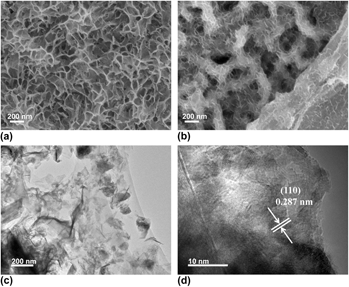
Three-dimensional Ni3S2-reduced graphene oxide (rGO) nanosheets composite is directly grown on nickel foam (Ni3S2-rGO@NF) by a one-step hydrothermal process involving in situ sulfurization of NF and reduction of GO. The introduction of GO is found not only to control the aggregation and the growth of Ni3S2 nanosheets, but also to increase the number of active sites and improve conductivity of composite. The heterogeneous Ni3S2-rGO@NF electrode as electrocatalysts for hydrogen evolution reaction (HER) exhibits significantly enhanced catalytic activity in alkaline media. The onset potential of Ni3S2-rGO@NF can be as low as ∼0 mV, which is comparable to platinum, and only a small overpotential of ∼44 mV is needed to reach a benchmark current density of 10 mA/cm2. Moreover, it demonstrates a good stability. All evidences suggest that the in situ surfurization can be considered as an effective way to prepare metal sulfides as electrocatalysts for hydrogen generation.
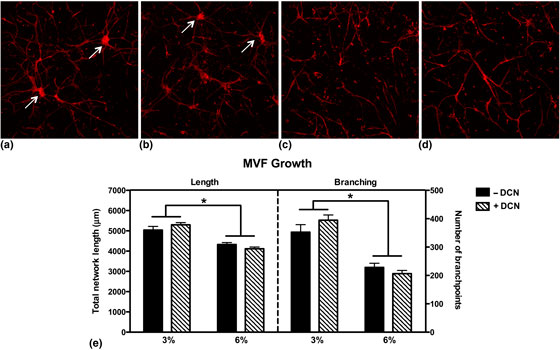
Angiogenesis is a critical component during wound healing, and the process is sensitive to mechanical stimuli. Current in vitro culture environments used to investigate three-dimensional microvascular growth often lack dimensional stability and the ability to withstand compression. We investigated the ability of decorin (DCN), a proteoglycan known to modulate collagen fibrillogenesis, incorporated into a collagen hydrogel to increase construct dimensional stability while maintaining vascular growth. DCN did not affect microvascular growth parameters, while increasing the compressive modulus of collagen gels and significantly reducing the contraction of 3% collagen gels after 16 days in culture.
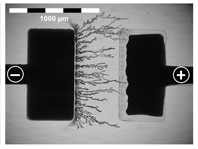
Operational lifetime is a critical performance parameter of organic electronic devices and can be cut short by multiple degradation mechanisms. One supposed cause is metal migration between the electrodes, which, however, is difficult to study independently of other failure modes. We present a setup, which excludes such competing processes and demonstrates that silver (Ag) electrochemical migration through organic optoelectronic materials occurs predominantly by cation transport. Metal dendrites form at the cathode, eventually causing short circuits between the electrodes. Lifetime studies with organic light-emitting diodes containing Ag electrodes suggest that results obtained with our setup can provide relevant information about degradation in real devices.
Crystal structure determination on the basis of powder diffraction data frequently involves the question how the given diffraction data with some appreciably hkl-dependent line broadening should be interpreted. In many cases, such line broadening may either: (i) reasonably well be reconciled with a certain high-symmetry structure model or (ii) with a variant of the former with lower symmetry crystal family, which frequently will give a somewhat better fit in Rietveld refinement. In this work, it is shown mathematically that symmetry reduction induced reflection spitting masked by other line broadening contributions, thus leading to some reflection splitting-induced line broadening, shows a similar hkl dependence as typically adopted for anisotropic microstrain broadening with respect to the high-symmetry structure. This implies that Rietveld refinement on the basis of the low-symmetry model (including typically isotropic line broadening) and on the basis of the high-symmetry model with anisotropic microstrain broadening can both lead to similar qualities of the fit. Hence, the refinement results for both possibilities should be carefully considered in combination with possibly available additional information (e.g. results of first-principles calculations) to arrive at adequate conclusions concerning the true symmetry of the material under investigation.
This manuscript describes, defines, and discusses the process of cold sintering, which can consolidate a broad set of inorganic powders between room temperature and 300 °C using a standard uniaxial press and die. This temperature range is well below that needed for appreciable bulk diffusion, indicating immediately the distinction from the well-known and thermally driven analogue, allowing for an unconventional method for densifying these inorganic powders. Sections of this report highlight the general background and history of cold sintering, the current set of known compositions that exhibit compatibility with this process, the basic experimental techniques, the current understanding of physical mechanisms necessary for densification, and finally opportunities and challenges to expand the method more generically to other systems. The newness of this approach and the potential for revolutionary impact on traditional methods of powder-based processing warrants this discussion despite a nascent understanding of the operative mechanisms.
Microstructure and mechanical properties of Mg–0.43Nd–xY–0.08Zn–0.11Zr (x = 0, 0.03, 0.06, and 0.12 at.%) alloys were investigated. The results indicated that Mg24Y5 phase was formed in the as-cast Y-containing alloys, the grains were refined and the amount of needle-like Mg12Nd phase in the α-Mg grain interior was increased with increasing Y addition. After solution treatment, the Mg24Y5 phase and needle-like Mg12Nd phase nearly completely dissolved into the α-Mg matrix and long-rod-like Zn2Zr3 phase occurred. The amount of Zn2Zr3 phase was increased with increasing Y content after age treatment. Mg–0.43Nd–0.12Y–0.08Zn–0.11Zr alloy exhibited the best combination of strength and elongation in all conditions, especially in the temperature range of 200–300 °C, and an Arrhenius model was established to study the plastic flow behavior. The improvement in mechanical properties was attributed to the grain refining, solution strengthening and enhanced precipitation hardening of Zn2Zr3 phase and β-type phase.
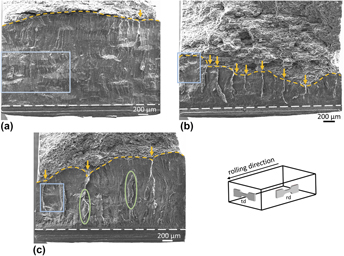
The near-threshold behavior of long cracks is studied in this paper using precracked flat dogbone specimens of a commercial aluminum alloy in peak-aged and overaged conditions. After introducing the initial crack in compression precracking, the crack was propagated approximately with the constant range of the stress intensity factor at values just above or below the corresponding threshold values. It was found that there were two major mechanisms which kept the crack from continuous extension. First, the crack front was pinned by primary precipitates. This effect was rather pronounced and lead to significant kinking in the crack front and ductile ridges on the fracture surface. The second mechanism was shear-controlled crack extension of very long cracks with plastic zones ahead of the crack tip, very similar to stage-I small cracks. Interaction with primary precipitates deflected the shear-controlled cracks but did not change the crack extension mode.
We introduce the idea that the electronic band structure of a charge density wave system may mimic that of graphene. In that case, a class of materials quite different from graphene might be opened up to exploit graphene’s remarkable properties. For such materials, their dynamical rather than static properties are crucial. The charge density wave system requires a wave geometry simply related to graphene and self-consistency among the electrons which requires the net Coulomb and phonon-mediated parts of the electron–electron interactions to be attractive. Our model leads to an analytical expression for the total energy in terms of the effective electron mass µ, the electron density ρ0, and the strength ${\tilde v_K}$ of the net electron–electron interaction. We examine the limitations set upon ${\tilde v_K}$ by self-consistency, stability, and the approximation in the electronic state calculation and find them to be mutually compatible.
Palladium (Pd) nanostructures have been actively adapted for various applications and their properties and applicability closely depend on their shape, size, and density. In this paper, the evolution of self-assembled Pd nanostructures on the hexagonal c-plane GaN is presented by the systematical control of Pd deposition amount (DA) at distinctive temperatures. Pd nanostructures of various configurations, sizes, and densities are demonstrated based on the solid-state dewetting of Pd thin films and a clear distinction in the growth regimes is observed. Three growth regimes are clearly observed depending on the variation of DA, i.e., (i) the agglomeration of Pd nanoparticles, (ii) the coalescence of wiggly Pd nanostructures, and finally (iii) the growth of nanovoids and layers. Owing to the temperature-dependent dewetting process, the growth regimes are markedly shifted, resulting in the distinctive Pd nanostructures within the identical DA range. The results are discussed in conjunction with the surface diffusion, Volmer–Weber and coalescence growth model, and surface/interface energy minimization mechanism. In addition, the evolution of optical properties, emission band, and lattice properties are probed by reflectance, photoluminescence, and Raman spectroscopy, which exhibit varying spectral intensity and peak positions according to the surface morphology of Pd nanostructures.
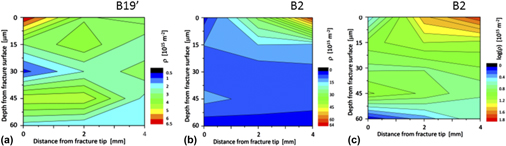
The present work addresses the competition between dislocation plasticity and stress-induced martensitic transformations in crack affected regions of a pseudoelastic NiTi miniature compact tension specimen. For this purpose X-ray line profile analysis was performed after fracture to identify dislocation densities and remnant martensite volume fractions in regions along the crack path. Special emphasis was placed on characterizing sub fracture surface zones to obtain depth profiles. The stress affected zone in front of the crack-tip is interpreted in terms of a true plastic zone associated with dislocation plasticity and a pseudoelastic zone where stress-induced martensite can form. On unloading, most of the stress-induced martensite transforms back to austenite but a fraction of it is stabilized by dislocations in both, the irreversible martensite and the surrounding austenite phase. The largest volume fraction of the irreversible or remnant martensite along with the highest density of dislocations in this phase was found close to the primary crack-tip. With increasing distance from the primary crack-tip both, the dislocation density and the volume fraction of irreversible martensite decrease to lower values.
This research was designed for the first time to investigate the photocatalytic activities of MoO3/g-C3N4 composite in converting CO2 to fuels under simulated sunlight irradiation. The composite was synthesized using a simple impregnation-heating method and MoO3 nanoparticles was in situ decorated on the g-C3N4 sheet. Characterization results indicated that the introduction of MoO3 nanoparticles into g-C3N4 fabricated a direct Z-scheme heterojunction structure. The effective interfacial charge-transfer across the heterojunction significantly promoted the separation efficiency of charge carriers. The optimal CO2 conversion rate of the composite reached 25.6 μmol/(h gcat), which was 2.7 times higher than that of g-C3N4. Additionally, the synthesized MoO3/g-C3N4 also presented excellent photoactivity in RhB degradation under visible-light irradiation.
A wide variety of applications ranging from microelectronics to turbines for propulsion and power generation rely on films, coatings, and multilayers to improve performance. As such, the ability to predict coating failure - such as delamination (debonding), mud-cracking, blistering, crack kinking, and the like - is critical to component design and development. This work compiles and organizes decades of research that established the theoretical foundation for predicting such failure mechanisms, and clearly outlines the methodology needed to predict performance. Detailed coverage of cracking in multilayers is provided, with an emphasis on the role of differences in thermoelastic properties between the layers. The comprehensive theoretical foundation of the book is complemented by easy-to-use analysis codes designed to empower novices with the tools needed to simulate cracking; these codes enable not only precise quantitative reproduction of results presented graphically in the literature, but also the generation of new results for more complex multilayered systems.