To save content items to your account,
please confirm that you agree to abide by our usage policies.
If this is the first time you use this feature, you will be asked to authorise Cambridge Core to connect with your account.
Find out more about saving content to .
To save content items to your Kindle, first ensure no-reply@cambridge.org
is added to your Approved Personal Document E-mail List under your Personal Document Settings
on the Manage Your Content and Devices page of your Amazon account. Then enter the ‘name’ part
of your Kindle email address below.
Find out more about saving to your Kindle.
Note you can select to save to either the @free.kindle.com or @kindle.com variations.
‘@free.kindle.com’ emails are free but can only be saved to your device when it is connected to wi-fi.
‘@kindle.com’ emails can be delivered even when you are not connected to wi-fi, but note that service fees apply.
The presence of interfaces and geometrical confinement can have a strong influence on the structure and morphology of thin films of semicrystalline polymers. Using surface-sensitive grazing incidence wide angle X-ray scattering and atomic force microscopy to investigate the vertical structure of thin films of poly(3-hexylthiophene) crystallized from the melt, we show that highly oriented crystallites are induced at the air/polymer interface and not as sometimes assumed at the interface to the substrate. These crystallites are oriented with their crystallographic a-axis perpendicular to the plane of the film. While the corresponding orientation dominates in thinner films, for sufficiently thick films (>60 nm) a layer containing unoriented crystals is present below the surface layer. Due to the anisotropic charge transport properties, the observed effects are expected to be of special relevance for potential applications of semiconductor polymers in the field of organic photovoltaics for which vertical transport in thicker films plays an important role.
In this work, we developed an X-ray powder diffractometer system equipped with six solid-state detectors and used it to perform ab initio structure determination from the powder diffraction pattern data obtained for a caffeine–oxalic acid co-crystal. The crystal structure obtained from the powder diffraction data was consistent with the previously solved single-crystal structure (Trask reference), although slightly larger (by about 2%). The co-crystallization of pharmaceutically active molecules can modulate their physical properties such as solubility, stability, and bioavailability. For the investigation of pharmaceutical complexes, the ability to visualize molecular interactions such as hydrogen bonding would be very helpful toward understanding their physical properties. Given the rate at which the high-throughput screening of pharmaceutical complexes has grown, an analogous high-volume, high-resolution X-ray powder diffraction technique with high-throughput data collection ability would be useful. We also solved the crystal structures of an inorganic complex and metal organic framework, zinc acetate dihydrate and CPL-1, in order to demonstrate the performance of our new diffractometer system.
The effect of tellurium (Te) doping on the electrocatalytic activity of La1−xTexMnO3 toward the oxygen reduction reaction is investigated for the first time. La1−xTexMnO3 with x-values up 23% were synthesized from a single ionic liquid-based precursor, yielding nanoparticles with mean diameter in the range of 40–68 nm and rhombohedral unit cell. Electrochemical studies were performed on carbon-supported particles in alkaline environment. The composition dependence activity is discussed in terms of surface density of Mn sites and changes in the effective Mn oxidation state.
Recent observations on strength and deformation of small metals containing microstructures, including dislocation patterns, grain boundaries, and second-phase precipitates are reviewed. These microstructures impose an internal length scale that may interplay with the extrinsic length scale due to the specimen size to affect strength and deformation in an intricate manner. For micro-crystals containing pre-existing dislocations, Taylor work-hardening may dictate the dependence of strength on specimen size. The presence of grain boundaries in a small specimen may lead to effects far from the conventional Hall–Petch behavior. Precipitate–dislocation interactions in a small specimen may lead to an interesting weakest-size behavior.
The orientation relationship (OR) between Al matrix and several typical inclusions, Al2O3, MgO, AlN, TiB2, and AlB2, in Al alloy have been studied by edge-to-edge matching model and refined with Δg theory. Based on the calculation of interatomic spacing misfit and interplanar spacing misfit, the number of ORs between Al and Al2O3, MgO, AlN, TiB2, AlB2 were predicted to be 1, 7, 2, 2, and 2, respectively. The result reveals that the wettability of Al to the studied inclusions could rank as MgO, AlB2, TiB2, AlN, Al2O3 in the order of decreasing, and the removability of those particles from aluminum melt rank in an opposite way from the perspectives of crystallography features of interfacial energy. Moreover, Al2O3 have a higher sensitivity to the performance of a processed aluminum alloy component than other inclusions, and MgO has the minimal impact, when the studied inclusions were residual in aluminum alloy.
Aluminum matrix composites were prepared by powder processing route containing three different loadings of graphene nanoplatelets, i.e., 1 wt%, 3 wt%, and 5 wt%. Ball milling of composite powders was performed to ensure the uniform dispersion of nanoplatelets in aluminum powder, followed by their consolidation to near theoretical densities. Microstructural evolution after composite preparation was witnessed by X-ray diffraction, optical microscopy, and scanning electron microscopy, while the mechanical property profile was evaluated by hardness, compression, and flexural tests. The mechanical properties of composites containing 5 wt% nanoplatelets were found with maximum improvements in hardness, compression, and flexural strengths of 35%, 433%, and 283%, respectively. This increase in mechanical performance is related to uniform dispersion and microstructural development in composites by incorporating nanoplatelets. Fractographic characterization indicated a change in fracture morphology from matrix-dominant in pure aluminum to nanoplatelet-dominant in composites. In particular, shearing and pull out of nanoplatelets were observed during the fracture of composites with simultaneous restricted plastic deformation of the surrounding aluminum matrix.
Ceramic scaffolds are being developed to control both proliferation and differentiation of hematopoietic stem cells into desired cell products in bioreactors. These scaffolds mimic important aspects of the microenvironment or “niche” inside bone marrow. In particular, hematopoietic stem cell fate is thought to be effected by the architecture of trabecular bone and the presence of calcium. Here we report the effects of ceramics processing on the phase distribution and microstructure of biphasic ceramics used to culture hematopoietic stem cells. Processing of biphasic ceramics by powder mixing resulted in tetracalcium phosphate on the sintered surface. This correlated with observed surface deposits, weight gain, and the release of calcium ions in saline over 28 days. In contrast, impregnation of partially sintered hydroxyapatite with calcium nitrate resulted in calcium carbonate on the sintered surface. Impregnation correlated with the release of calcium ions into the saline, surface pitting, and weight loss.
Partially reduced graphene oxide functionalized with Fe nanoparticles alone or combined with Au and Pt nanoparticles is synthesized and characterized, and their effects on Polymer Electrolyte Membrane Fuel Cell (PEMFC) power output and carbon monoxide resistance are tested. Samples were prepared with various combinations of metal nanoparticles to create a cost-effective catalyst. Transmission and scanning electron microscopy revealed metal nanoparticles embedded on graphene sheets, some with magnetic susceptibility. PEMFC tests exhibited power output that was >180% of the control in a pure H2 gas feed and 250% of the control in a H2 gas feed with 1000 ppm of CO.
Polystyrene spheres were found to be an effective assisted material in the growth of indium-tin-oxide (ITO) nanowire networks, bearing low temperature, high purity, and good control of size. The temperature and time of growth were studied to achieve ITO nanowire networks with high transmission and low resistivity. When prepared by PS spheres of 670 nm dia. for 15 min at 300 °C, the transmittance is above 90% after the wave length of 400 nm, and the sheet resistance is ∼200 Ω/□. Polystyrene-assisted ITO nanowires showed the high degree of crystallinity with lattice fringes, and well coincided cubic phase of In2O3. The density of ITO nanowire networks were controlled by polystyrene spheres and the residual polystyrene was removed by thermal annealing. ITO nanowire networks open new opportunities for optoelectronic devices needing special morphology for the improvement of light extraction efficiency, and as a new type of conductive film, which have an even broad application arena.
Recent advances in alumina ceramics are focused toward innovative processing routes to improve their mechanical reliability while retaining their superior wear resistance, which might be possible if a thin layer of dense alumina can be formed on a metallic substrate such as Ti–6Al–4V with high mechanical strength. For this purpose, we propose a new two-step process in which a dense layer of Al deposited on the Ti alloy by cold metal transfer method, formed a dense Al3Ti gradient reaction layer at their interface to improve adhesion in a single step. Subsequent micro-arc oxidation treatment transformed Al layer to a graded alumina layer in which γ-alumina decreased and α-alumina increased with increasing depth. Abrasion of outer regions revealed underlying pure α-alumina regions with high Vickers hardness matching with that of sintered alumina. The designed alumina/Ti alloy hybrid can be a potential candidate for wear resistance applications.
Al–(12, 20, 35 wt%)Si alloys were fabricated using powder metallurgy process involving hot pressing followed by hot extrusion. The effect of Si content on the microstructure [by scanning electron microscopy], the mechanical properties (hardness and tensile tests), and the thermal expansion behavior were studied in detail, respectively. Due to the friction between the Si phase and the matrix, as well as the diffusion of the Si atoms, the Si phase becomes a particulate shape after hot extrusion, and the size increases with increasing Si content. The mechanical strength increases, whereas, the elongation decreases with increasing the Si content from 12 to 35 wt%, which lead to a variation of the fracture mechanism from ductile to brittle failure. The coefficient of thermal expansion (CTE) decreases with increasing Si content as a result of restriction of Si on the Al matrix, and the measured CTE value is in good agreement with the Turner model below 573 K.
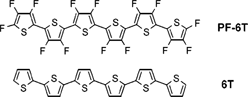
We report on the growth and characterization of molecular mixed thin films of α-sexithiophene (6T), a well-known organic p-type semiconductor with high hole mobility, together with its perfluorinated counterpart, the so far rarely studied tetradecafluoro-α-sexithiophene (PF6T). Pure and blended thin films of these two molecules with different mixing ratios were grown on silicon oxide in ultrahigh vacuum by coevaporation. The effect of perfluorination and mixing on crystal structure, morphology, electronic, and optical properties was examined. The evolution of the PF6T crystal structure was followed in situ in real time by X-ray scattering. We found a new thin film structure different from the reported bulk phase with molecules either standing-up or lying-down depending on the growth temperature. The different morphologies of pure films and blends were investigated with atomic force microscopy. The impact of mixing on the core-levels and on the highest occupied molecular orbitals of 6T and PF6T is discussed.
Single-stranded DNA molecules capable of molecular recognition and catalysis can now be routinely generated via the technique of in vitro selection. When coupled with adequate signal transduction modes, these synthetic functional DNA species represent a potential paradigm shift in the research and development of biosensors to meet the challenges of our rapidly changing world. Coupling functional DNA molecules with graphene materials for the design of optical biosensors has become an exciting research area in recent years, mostly because graphene materials are not only excellent quenchers of fluorescence, but they also display considerably different affinities for free and ligand-bound functional DNA molecules. We will discuss notable progress in this area in this mini-review by highlighting representative studies.
Metal additive manufacturing (AM) processes, such as selective laser melting (SLM), enable powdered metals to be formed into arbitrary three-dimensional shapes. For aluminum alloys, which are desirable in many high-value applications for their low density and good mechanical performance, SLM is regarded as challenging due to the difficulties in laser melting aluminum powders. However, a number of recent studies have demonstrated successful aluminum processing, and have gone on to explore its potential for use in advanced AM componentry. In addition to enabling the fabrication of highly complex structures, SLM produces parts with characteristically fine microstructures that yield distinct mechanical properties. Research is rapidly progressing in this field, with promising results opening up a range of possible applications across scientific and industrial sectors. This article reports on recent developments in this area of research and highlights key topics that require further attention.