To save content items to your account,
please confirm that you agree to abide by our usage policies.
If this is the first time you use this feature, you will be asked to authorise Cambridge Core to connect with your account.
Find out more about saving content to .
To save content items to your Kindle, first ensure no-reply@cambridge.org
is added to your Approved Personal Document E-mail List under your Personal Document Settings
on the Manage Your Content and Devices page of your Amazon account. Then enter the ‘name’ part
of your Kindle email address below.
Find out more about saving to your Kindle.
Note you can select to save to either the @free.kindle.com or @kindle.com variations.
‘@free.kindle.com’ emails are free but can only be saved to your device when it is connected to wi-fi.
‘@kindle.com’ emails can be delivered even when you are not connected to wi-fi, but note that service fees apply.
In this research, Ce3+ and Tb3+ doped alkaline-earth silicate Sr2MgSi2O7 phosphors have been synthesized by solid-state reaction. The results show that the Sr2−xMgSi2O7:xCe3+ phosphors exhibit a violet–blue emission with excitation at 348 nm, whereas the Sr2−yMgSi2O7:yTb3+ phosphor show a green emission with excitation at 243 nm. In addition, the structure of Sr2MgSi2O7 host has been analyzed by Crystalmaker program. Staggered arrangements of [SiO4] and [MgO4] units in the Sr2MgSi2O7 system underlie possible chemical tuning and phase segregation, providing a potential candidate of tunable luminescence. A red shift of wave length is clarified by crystal field theory and Van Uitert expression. The FESEM image of Sr1.99MgSi2O7:0.01Ce3+ phosphors reveal that it has a proper particle size for application in WLEDs. With different Tb3+ doping concentration, the CIE chromaticity coordinates Sr2MgSi2O7:Tb3+ phosphors still remain a steady position. These results indicate that Sr2−xMgSi2O7:xCe3+, Sr2−yMgSi2O7:yTb3+ phosphors are promising phosphors for WLEDs.
The VF3-type compound GaF3 has been studied by high-pressure angle-dispersive X-ray diffraction in the pressure range from 0.0001 to 10 GPa. The compression mechanism was found to be highly anisotropic. The c-axis shows little pressure dependence (≈0.4%), but exhibits negative linear compressibility up to ≈3 GPa where it achieves its maximum length. In contrast, the length of the a-axis is reduced by ≈8.8% at the highest measured pressure and an anomalous reduction in the linear compressibility is observed at 4 GPa. The zero pressure bulk modulus B0 was determined to B0 = 28(1) GPa. The compression mechanism of GaF3 is discussed in terms of deformation of an 8/3/c2 sphere-packing model. The volume reduction of GaF3 is mainly achieved through coupled rotations of the GaF6 octahedra within the entire measured pressure range, which reduces the volume of the cubooctahedral voids. In addition, the volume of the GaF6 octahedra also decreases for p ≲ 4.0 GPa, but remains constant above this pressure. The volume reduction of the GaF6 octahedra is accompanied by an increasing octahedral strain. Isosurfaces of the procrystal electron density are used for visualization of the cubooctahedral voids at different pressures.
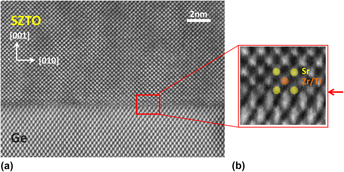
Complex oxides and semiconductors exhibit distinct yet complementary properties owing to their respective ionic and covalent natures. By electrically coupling complex oxides to traditional semiconductors within epitaxial heterostructures, enhanced or novel functionalities beyond those of the constituent materials can potentially be realized. Essential to electrically coupling complex oxides to semiconductors is control of the physical structure of the epitaxially grown oxide, as well as the electronic structure of the interface. Here we discuss how composition of the perovskite A- and B-site cations can be manipulated to control the physical and electronic structure of semiconductor—complex oxide heterostructures. Two prototypical heterostructures, Ba1−xSrxTiO3/Ge and SrZrxTi1−xO3/Ge, will be discussed. In the case of Ba1−xSrxTiO3/Ge, we discuss how strain can be engineered through A-site composition to enable the re-orientable ferroelectric polarization of the former to be coupled to carriers in the semiconductor. In the case of SrZrxTi1−xO3/Ge we discuss how B-site composition can be exploited to control the band offset at the interface. Analogous to heterojunctions between compound semiconducting materials, control of band offsets, i.e., band-gap engineering, provides a pathway to electrically couple complex oxides to semiconductors to realize a host of functionalities.
Mechanical integrity of the interfacial region between ceramic coatings and substrates is critical to high performance coated mechanical components and manufacturing tools. Mechanical failure of the coating/substrate interfacial region often leads to catastrophic failure of the coated system as a whole. Despite extensive research over the past two decades, quantitative assessment of the mechanical response of coating/substrate interfacial regions remains a challenge. The lack of reliable protocols for measuring the mechanical response of coating/substrate interfacial regions quantitatively hampers the understanding of key factors controlling the mechanical integrity of coating/substrate interfaces. In this paper, we describe a new micro-pillar testing protocol for quantitative measurement of critical stresses for inducing shear failure of interfacial regions in ceramic-coating/metal-adhesion-layer/substrate systems. We observe significant differences in the critical stress for shear failure of interfacial regions in CrN/Cu/Si, CrN/Cr/Si, and CrN/Ti/Si systems. The present testing protocol has general applicability to a wide range of coating/interlayer/substrate systems.
The crystal structure of hydrocortisone acetate has been solved and refined using synchrotron X-ray powder diffraction data, and optimized using density functional techniques. Hydrocortisone acetate crystallizes in space group P21 (#4) with a = 8.85173(3) Å, b = 13.53859(3) Å, c = 8.86980(4) Å, β = 101.5438(3)°, V = 1041.455(6) Å3, and Z = 2. Both hydroxyl groups form hydrogen bonds to the ketone oxygen atom on the steroid ring system, resulting in a three-dimensional hydrogen bond network. The powder pattern has been submitted to ICDD for inclusion in the Powder Diffraction File™.
In this paper, some results of neutron diffraction properties of the double-crystal Si(111) + Si(311) setting containing two bent perfect crystals, but with the second one – analyzer in the fully asymmetric diffraction geometry are presented. Both fully asymmetric diffraction geometries, with the output beam compression as well as the output beam expansion, were tested for the sake of possible applications.
Photovoltaics made from organic–inorganic hybrid perovskite semiconductors are attracting significant interest due to their ability to harvest sunlight with remarkable efficiency. The presence of lead in the best performing devices raises concerns regarding their toxicity, a problem that may create barriers to commercialization. Hybrid perovskites with reduced lead content are being investigated to overcome this issue and here we evaluate bismuth as a possible lead substitute. For a series of hybrid perovskite films with the general composition CH3NH3(PbyBi1−y)I3−xClx, we characterize their optical and structural properties using UV–Vis spectroscopy, scanning electron microscopy and grazing incidence wide angle X-ray scattering. We show that they form crystalline structures with an optical band gap, around 2 eV for CH3NH3BiI3. However, preliminary solar cell tests show low power conversion efficiencies (<0.01%) due to both incomplete precursor conversion and material de-wetting from the substrate. The overall outcome is severely limited photocurrent. With current processing methods the general applicability of hybrid bismuth perovskites in photovoltaics may be limited.
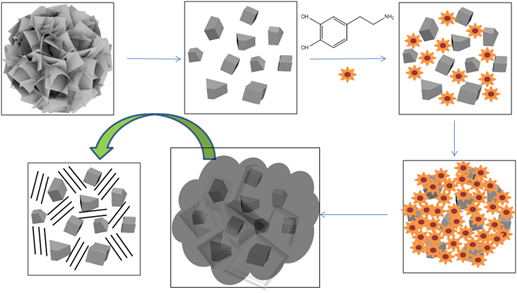
A new lithium ion hybrid supercapacitor is reported, in which the negative electrode was made from ZnO nano-crystals coated with a nitrogen doped carbon, and a positive electrode composed of activated carbon. The ZnO nano-crystals were highly dispersed in a nitrogen doped carbon matrix through a bio-inspired route. Dopamine, used as the nitrogen and carbon source, self-polymerized and deposited onto the surface of ZnO nano-crystal. After pyrolysis, a nitrogen doped amorphous carbon coated ZnO nano-crystal materials were obtained. The characteristics of the synthesized carbon coated ZnO nano-crystal electrode as well as the electrochemical performance of the hybrid device were investigated. The ZnO nano-crystal structure was preserved in the course of the carbon coating. The lithium ion supercapacitor demonstrated a high capacity and good cycling stability. Such good performance can be attributed to improved conductivity, the prevention of ZnO nano particles from pulverization and the high degree of crystallinity of the ZnO material.
This study investigates the synthesis, characterization, and corrosion behavior of AA6063 composites with the inclusion of micron-sized titanium carbide (TiC) particles with different weight percentages. AA6063/TiC particulate composites containing 0, 3, 6, 9, and 12 weight percent of TiC particles were produced by stir casting. The homogeneous dispersion of TiC particles in the AA6063/TiC composites was revealed from the scanning electron microscopy analysis. Energy dispersive X-ray spectroscopy analysis was conducted to ensure the presence of reinforcement particles in the matrix. Mechanical and corrosion properties of the produced composites are evaluated. The addition of TiC particles to the AA6063, the mechanical, electrical, and corrosion properties are initially increased and then decreased. Mechanical and corrosion study shows that the presence of 9 wt% of TiC particles in the matrix improved mechanical properties than other combination of TiC with the matrix material.
As the operating temperature of disk service was elevated from 650 °C to 700 °C, the creep properties urged to be paid attention. To investigate the creep properties of spray-formed low solvus, high refractory (LSHR) superalloy at about 700 °C, creep tests were conducted under seven different stress ranging from 690 MPa to 897 MPa. By means of creep curves and fracture microstructure observation, the creep behaviors and fracture mechanisms of spray-formed LSHR were analyzed. Stress exponent of the alloy was comparable to other disk superalloys such as Waspaloy and Inconel 718. It was interesting to find a transition in the creep behavior in two stress regimes. The contribution of grain boundary sliding in the low stress regime was greater than that in the higher stress. Under higher stress microcracks initiated along the intragranular slip bands because of strain concentration. The spray-forming LSHR exhibited a good creep resistance at low stress compared with other two superalloys by using Larson–Miller parameter, which was consistent with the transition of fracture behaviors.
This study investigated the effects of 1 wt% SiC nanoparticles addition on the microstructures and mechanical properties of Mg9Al–1Si (wt%) alloy subjected to equal channel angular pressing (ECAP). Results showed that addition of SiC nanoparticles could refine matrix grain, Mg17Al12 and Mg2Si phase of as-cast alloy, but the Mg17Al12 phase still exhibited network structure and the morphology of Mg2Si phase was still Chinese-script type. During the ECAP process, network Mg17Al12 and Chinese-script shaped Mg2Si phases were partially broken down into fine particles (∼10 µm) and much finer particles (∼2 µm) respectively. In particular, these Mg17Al12 and Mg2Si particles were uniform distribution in ECAPed Mg9Al–1Si–1SiC composite. The well-distributed particles and the existence of SiC nanoparticles could promote the formation of fine DRXed grains through enhanced grain boundary pinning. During tensile testing at room temperature, ECAPed Mg9Al–1Si–1SiC composite exhibit optimal mechanical properties, the ultimate tensile strength and elongation to failure were reached to 255 MPa and 7.9%, respectively. Furthermore, at elevated temperature of 150 °C, the tensile strength and elongation to failure were considerably increased compared to an ECAPed, SiC-free Mg9Al–1Si alloy.
The object of the present investigations was to evaluate the effect of flash butt welding parameters on microstructures and mechanical properties of HSLA 590CL welded joints in wheel rims by adjusting welding parameters separately. The amount of Widmanstatten ferrites and bainite in the weld metal, and grain size were observed with the adjustment of welding parameters. The tensile strength of welded joints met the strength requirement of wheel rims steels, but the tensile strength and tensile fracture were different in different welding parameters. Micro-hardness distributions of welded joints in different welding parameters were similar, that is the maximum micro-hardness occurred in the weld and micro-hardness decreased from the weld to base metal. A certain degree of softening phenomenon was found in the heat affected zone (HAZ), which should result from the heat input in the flash butt welding. Two failure mechanisms of wheel rims in the expanding process were investigated. The first type fractured at the HAZ and showed ductile fracture characteristics, the crack initiation located at the thinning location. The second type fractured at the weld and showed brittle fracture characteristics.
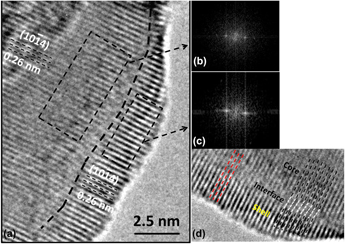
Magnetic core–shell nanoparticles (CSNs) have potential applications in spintronic devices, drug delivery systems, and magnetic random access memory. By use of our hydrothermal nano-phase epitaxy method, we have accomplished synthesis of novel, well-ordered α-Cr2O3@α-Mn0.35Cr1.65O2.94 inverted CSNs. XRD and TEM analyses show a core–shell structure with corundum phase throughout the core and shell with a minimal amount of interface defects. TEM-EDX and XPS data show Mn having the +2 oxidation state in the shell of the CSNs. Magnetization measurements at 5 K show a weak coercivity (HC) value of 8 Oe and an exchange bias field (HE) of 293 Oe. Ab initio calculations show that Mn incorporation in α-Cr2O3 results in narrowing of the energy band gap, substantiated by UV–Vis measurements, and half metallic behavior in case of Mn(III) substitution. Our calculations substantiate that Mn substitution in α-Cr2O3 results in a combination of antiferromagnetic and weak ferrimagnetic character of our CSNs.
Boron carbide (B4C) ceramic particles were used as reinforcement material to produce aluminum (Al) matrix composites by squeeze casting method. Four different B4C contents as 0, 3, 5, and 10 wt%, and three different squeeze pressures as 0, 75, and 150 MPa were used in which the samples consisted of pure Al without B4C and the samples obtained without applying pressure were used as control samples. To determine the effect of squeezing pressure and the amount of B4C added on machinability and mechanical properties, average chip length and surface roughness of the samples were evaluated and hardness measurements were accomplished, yield and ultimate tensile strengths were determined, respectively. Also, the changes in density and microstructure were investigated. B4C reinforcement was found to decrease the average chip length and density of the samples while increasing the hardness and surface roughness. On the other hand, application of squeeze pressure had a positive effect on the densification and mechanical properties of the samples.
In this research, the effect of austenitizing at 900–1100 °C and tempering at 250–650 °C on the microstructure and mechanical properties of 410 and 410 Ni martensitic stainless steels was investigated. The transformation of austenite to ferrite surrounded the austenitizing within the temperature range of 900–1050 °C. The grain size and hardness measurements proved that austenitizing at 1050 °C leads to the partial dissolution of carbides without a considerable growth of austenite grains. The mechanical tests showed two peaks in strength and troughs in ductility by tempering at 450 and 650 °C due to the formation of primary and secondary carbides. The better ductility and fracture toughness in 410 Ni, comparing to 410, were attributed to the effect of Ni on stacking fault energy. Fractured surfaces revealed ductile fracture of the samples tempered at low temperatures, e.g., 250 °C. However, after tempering at 450 and 650 °C, 410 showed a brittle fracture and 410 Ni exhibited a dual intergranular-brittle fracture mechanism.
The high-cycle fatigue (HCF) behavior is significantly affected by surface roughness, especially for high strength metal FV520B-I. However, with surface roughness effect, neither the fatigue property, nor the high-cycle fatigue life model about FV520B-I with surface roughness has been reported. In this paper, designed fatigue experiment using the specimen with different surface roughness is presented to study the effectiveness of the roughness to the fatigue. The observations of the fatigue crack initiation sites and the crack propagation. Then the high cycle fatigue behavior of FV520B-I affected by surface roughness is analyzed. The existing very-high-cycle fatigue life model is not well-fit for high-cycle fatigue model of FV520B-I. A NEW high-cycle fatigue life prediction model of FV520B-I, taking surface roughness as a main effective variable is proposed. The model is built up by a comprehensive use of experimental data and the traditional fatigue modeling theory. The new finding between the fatigue strength coefficient and stress amplitude, with surface roughness, is adopted, leading to a NEW modified life prediction model. Study on fatigue model of FV520B-I with surface roughness is a very beneficial effort in fatigue theory and fatigue engineering development.
A major obstacle in the organic solar cell field is the inability to predict the relevant microstructural length scales that determine charge transport of the interpenetrating polymer/small molecule network based on the component chemical structures. This has led to a trial-and-error approach, which is extremely labor-intensive. This manuscript is our attempt to move toward forming a link between small molecule chemical structure and the morphological hierarchy of the blend. We focus on geometric motifs of small molecule organic semiconductors which have 2D, nonspherical 3D, and quasispherical 3D molecular orbital extent. We find that phase separation in these blends is a function of the molecular structure, and that the small molecule chemical structure is coupled to the crystallite orientation distribution of the polymer matrix. We further find that the ability of a molecule to form a network with a well-defined length scale of phase separation depends on the polymer persistence length.