To save content items to your account,
please confirm that you agree to abide by our usage policies.
If this is the first time you use this feature, you will be asked to authorise Cambridge Core to connect with your account.
Find out more about saving content to .
To save content items to your Kindle, first ensure no-reply@cambridge.org
is added to your Approved Personal Document E-mail List under your Personal Document Settings
on the Manage Your Content and Devices page of your Amazon account. Then enter the ‘name’ part
of your Kindle email address below.
Find out more about saving to your Kindle.
Note you can select to save to either the @free.kindle.com or @kindle.com variations.
‘@free.kindle.com’ emails are free but can only be saved to your device when it is connected to wi-fi.
‘@kindle.com’ emails can be delivered even when you are not connected to wi-fi, but note that service fees apply.
SnSb nanoparticles are dispersed in carbon nanofibers by electrospinning technology and different SnSb precursors, including Sn0.92Sb0.08O2.04 nanoparticles, Sn(CH3COO)2/Sb(CH3COO)3, and SnCl4·5H2O/SbCl3, are used to tune the morphology of the resultant SnSb/C nanofibers. Porous SnSb/C nanofibers are formed during carbonization Sn0.92Sb0.08O2.04 nanoparticles and Sn(CH3COO)2/Sb(CH3COO)3 are used as precursors of SnSb, while solid nanofibers are observed with SnCl4·5H2O/SbCl3 as the precursor indicating the formation mechanism is closely related to the properties of SnSb precursors. Excellent cycling preference (99% capacity retention after 200 cycles) and high coulombic efficiency (above 99% after 10 cycles) are obtained for the SnSb/C nanofibers using Sn0.92Sb0.08O2.04 as precursor, due to its high surface area and stable SnSb/C structure. It is demonstrated that the uniquely designed composite nanofiber structure with excellent lithium storage performance can be realized simply by selecting precursors with appropriate dissolution and decomposition properties.
This work presents the effects of sintering temperature and mechanical milling on the weight loss of the powder metallurgical Fe–28Mn–3Si (wt%) alloy. Mechanically milled (MM) and blended elemental (BE) Fe–28Mn–3Si powder mixtures were prepared. Both the MM and BE compacts were sintered in a vacuum furnace for 3 h at various temperatures. It was found that weight loss occurred among all the sintered compacts. The weight loss of the sintered MM compacts was much lower than their BE counterparts sintered at the same temperature. The weight loss of the compacts was mainly caused by the sublimation of Mn in the Mn depletion region. A single α-Fe phase was observed on the surface of all the sintered samples. Predominant γ-austenite and minor ε-martensite were detected in all the sintered compacts at locations beyond the Mn depletion region. Mn3Si phase was found in BE alloys sintered at 1000 °C.
A chemomechanical coupling model is presented in the temperature range of 1200–1800 °C based on the microstructure during oxidation of ZrB2–SiC. The model includes the interaction of the oxidation rate and the mechanical stress. The stress is generated due to the constraint from the substrate to the lateral growth. The generated stress results in the shrink of the pores in the oxide. At the outer glassy layer surface, the boundary layer evaporation is adopted to describe the evaporation rate. Using the coupling model, the evolutions of the oxide layer thickness, weight gain, pore radius, and stress in both the oxide and substrate are provided, and the theoretical calculated results agree well with the reported experimental results. The results reveal large stress in the oxide layer during the oxidation process. By comparing the results of ZrB2 with different volume fractions of SiC, it is found that ZrB2 with higher volume fraction of SiC has more excellent oxidation resistance and smaller stress.
First-principles calculations are performed to investigate the structural, elastic, and thermodynamic properties of Ni3SnP, Ni2SnP, Ni10SnP3, and Ni2P (here, Ni2P is used for comparison with Ni2SnP). Through calculation, the three ternary Ni–Sn–P intermetallics are all thermodynamic stable but Ni3SnP is elastically unstable. Ni2SnP has the largest degree of elastic anisotropy and is more brittle than Ni2P while Ni10SnP3 is close to be isotropic. The Debye temperature together with the Cahill’s model and Clark’s model are used to investigate the thermal conductivity of the compounds. The Debye temperature follows the sequence of Ni10SnP3 > Ni2SnP > Ni2P. Based on the Clark’s model, the minimum thermal conductivity is ranked as Ni10SnP3 > Ni2P > Ni2SnP which means the heat transfer property of Ni2SnP is lower than Ni2P when the temperature is higher than Debye temperature. The electronic density of states is analyzed. The origin of the elastic anisotropy of Ni2SnP is investigated.
Metallic phase-change materials (PCMs) attract much attention due to their high thermal conductivity in thermal energy storage. Our previous work reported a kind of Cu@Cr@Ni bilayer capsules, which could endure at least 1000 thermal cycles between 1323 and 1423 K without leakage, and might be a potential high-temperature metallic PCM. This study numerically investigates the thermal energy charging performance of Cu@Cr@Ni capsules for recovering high-temperature waste heat at both constant and periodically fluctuant heat transfer fluid temperatures. It was revealed that only a short and slight sloped melting platform existed in the curve of outlet temperature due to the ultrahigh thermal conductivity of copper; with higher inlet velocities, the outlet and mean temperatures of such PCM increased and meanwhile the energy transfer efficiency decreased; the outlet and mean temperatures of the PCM and the liquid fraction in it were rather insensitive to the period of the inlet temperature fluctuation; and the amplitude of inlet temperature fluctuation, ±50 K, was sharply reduced to 5 K due to the thermal damping of the PCM.
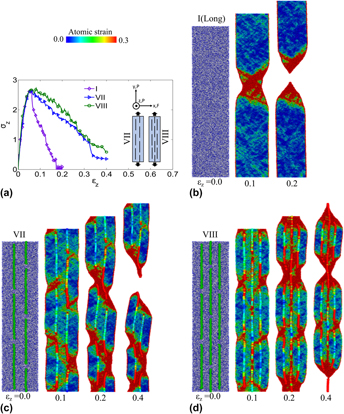
Bulk metallic glasses own unique mechanical properties such as high strength and excellent elastic behavior due to their amorphous atomic structure. Nonetheless, they usually fail catastrophically by shear localization without showing any macroscale plastic deformation under tension and therefore are notoriously brittle. In this study, graphene was proposed as an effective reinforcement to improve the ductility and toughness of metallic glass for possessing a unique combination of strong in-plane strength and weak interbonding with the metal matrix based on molecular dynamics simulations. Both continuous and discontinuous graphene sheets with various configurations and lengths were taken into account. It was found that with proper dispersion of the graphene reinforcements, more than 100% increase in the ductility and more than 150% increase in the toughness can be achieved in the nanocomposites as compared to the monolithic metallic glass of similar size, which was enabled by spreading and delocalizing the plastic shearing deformation in the nanocomposites because of the dual effects of the added graphene.
The dissimilar metal inert-gas arc welding of aluminum alloy and ultrahigh strength steel was studied. The weld appearance was improved when welding wire was directed toward steel groove middle. The Al–steel joints have welding–brazing characteristics and include weld zone (WZ), bond zone (BZ), and interface zone (IZ). The welds with Al–Mg and Al–Cu welding wires consist of α-Al and β-Al3Mg2, and α-Al and Al2Cu, respectively. The IZ contains needle-like Fe4Al13 and lath-shaped Fe2Al5 layers. With increasing welding current, the interface layer thickness and joint cracking sensibility increased due to enhanced heat input and tensile stress in the joints. They were decreased effectively when using Al–Cu welding wire, as the constituent Cu could restrain the growth of interface layer and lower its hardness and brittleness. In particular, Al–Cu welding wire elevated the tensile strength of the Al-steel joints from 65 MPa for Al–Mg wire to 128 MPa.
Polymer nanocomposites are being considered as future materials to effectively attenuate high energy radiations. The present work addresses effects of neutron radiation on the mechanical properties of lightweight multifunctional polymer composite which were fabricated by dispersing nanoparticles with radiation shielding properties in an epoxy polymer. Three different types of nanoparticles including boron nanopowder, gadolinium, and boron carbide, which are known for excellent radiation absorbing characteristics, were dispersed into epoxy resin to form core sheets for final hybrid sandwich structure. The neutron radiation shielding performance of nanocomposites and their mechanical and thermophysical properties were investigated. The study indicates that the neutron shielding efficiency increased significantly by introduction of nanoparticles. Moreover, the mechanical testing and thermophysical analysis showed that the core materials can retain the structural integrity after they are exposed to the highly thermalized neutron radiation in steady-state mode with a flux of 3 × 10¹³ n/cm2/s.
Two- and three-dimensional assemblies of carbon nanomaterials such as carbon nanotubes and graphene are necessary to harness their remarkable physicochemical properties in many clean energy, electronics, and biomedical applications. Herein we report a facile, economical, and versatile method for layer-by-layer fabrication of chemically-crosslinked carbon nanomaterial assemblies by ultrasonic spray coating combined with radical-initiated crosslinking reaction. The chemical, surface, and mechanical properties of the carbon nanomaterial coatings were characterized by Raman spectroscopy, atomic force microscopy, scanning- and transmission-electron microscopy, and nano-dynamic mechanical analysis. Our results indicate that the macroscopic 2D assemblies of crosslinked carbon nanotubes or graphene nanoparticles have surface uniformity, are chemically-crosslinked, and are mechanically robust. We further provide proof-of-concept demonstration of fabricating free-standing, porous, 3D single-walled carbon nanotube structures. Taken together, the results opens avenues toward adapting our method to enable 3D printing or additive manufacturing of all-carbon nanomaterial structures.
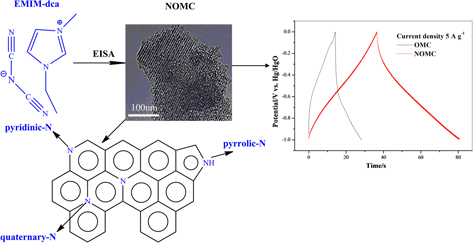
Ordered mesoporous carbons (OMCs) are appealing alternatives to conventional porous activated carbon applied to electronic energy storage and conversion devices. Nitrogen-doped OMC (NOMC) was prepared with a soft-template strategy directly using task-specific ionic liquid with dicyanamide anion as the nitrogen dopant, and utilized as supercapacitors for the first time. Compared with pristine OMC, NOMC showed excellent electrochemical capacitive behavior in 6 M KOH electrolyte. NOMC possessed a high specific capacitance of 427 F/g at a current density of 1 A/g and exhibited a stable cycle life (almost 98% retained at a current density of 5 A/g after 2000 cycles). The outstanding capacitive performance of NOMC was ascribed to the synergetic effects of its bimodal mesoporous structure, large specific surface area (1919 m2/g), and nitrogen doping (3.52 wt%), which help to accelerate the ion diffusion, increase the surface charge storage, and intensify pseudo-capacitive reactions.
TiO2 nanotubes have been demonstrated with promising future in photoelectrocatalytic (PEC)_ applications and deposition of Pt nanoparticles on TiO2 has been widely used to enhance their PEC activities. However, those Pt nanoparticles are normally randomly deposited on the surface of TiO2 nanotubes. Selective deposition of Pt nanoparticles is important to achieve better charge separation. In this study, we reported an electrochemical activation step to prepare TiO2 nanotubes deposited with Pt nanoparticles on their open ends. The “activation step” played a key role in achieving a clean surface of the TiO2 nanotubes, thus ensuring the uniform growth of Pt nanoparticles and efficient photogenerated electrons transportation. The Pt-A-TiO2 films have photocatalytic activities in hydrogen generation and methyl orange degradation with a high hydrogen generation rate of 0.74 mL/h/cm2, three times that of the pure TiO2 nanotubes (0.24 mL/h/cm2). Thus, this study demonstrated an effective method for improving the performance of Pt/TiO2 photocatalyst.
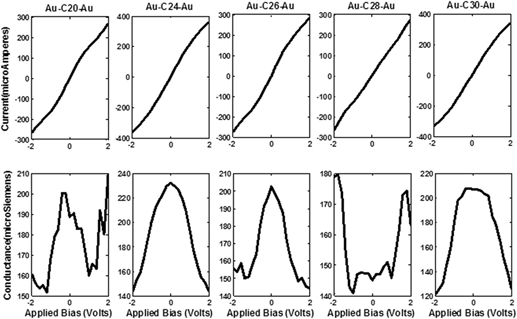
We outline the scrutiny of the two probe devices formed by placing the nonclassical fullerene molecules CM (20 ≤ M ≤ 30) within semi-infinite gold electrodes using density functional theory. The electronic structure and molecular orbitals of isolated fullerene molecules are broadened to form junction devices with charge injection at zero as well as variegated bias respectively. The molecular junctions thus formed are contemplated for two important electrical constitutions, current, and conductance. These parameters are then elaborated and contemplated for their electronic parameters namely, the density of states, transmission coefficient, molecular orbitals, molecular projected self-consistent Hamiltonian states, electron density, and Mulliken population. We conclude that C20 and C24 fullerene molecule exhibits extremely metallic behavior while others fail to demonstrate such behavior. The molecular device, thus formed, strongly supports the superconductive behavior of the C24 molecule with an ability to easily adapt by modulating its active molecular orbitals under applied potential.
Understanding film initiation and growth mechanisms at the atomic level is crucial to obtain high-quality nonpolar ZnO films. Using the advanced reactive force field-based molecular dynamics method, we theoretically studied the effect of substrate temperature (350–950 K) on the quality, layer develop mechanism and defect formation of ZnO films. Investigation of the energy, radial distribution function, layer coverage, sputtering and injecting phenomena indicated that the present films grown at 500–600 K possessed the optimal quality. Further investigation of the growth condition, instant film profiles, interfacial microstructure evolutions and layered snapshots revealed that, addition of atoms on newly formed localized films can induce some partially bonded or extruded atoms out of the film plane. Further adherence of depositing atoms to these unstable or extruded atoms induces the initiation and growth of a new layer.
The metadynamic recrystallization (MDRX) behavior of a Nb–V microalloyed nonquenched and tempered steel was investigated by isothermal hot compression tests on Gleeble-1500 thermal-mechanical simulator. Compression tests were performed using double hit schedules at temperatures of 1273–1423 K, strain rates of 0.01–5 s−1, initial grain sizes of 92–149 μm and an inter-pass time of 0.5–10 s. The experimental results show that MDRX softening fraction increases with the increasing of deformation temperature, strain rate, and inter-pass time, while it decreases with the increasing of initial grain size. Based on the experimental results, the MDRX softening fraction kinetic model and recrystallized grain size model of the tested steel was established. Besides, using the above mathematic models, a finite element model was built to simulate the MDRX process of the tested steel. The simulation results show good agreement with the experimental ones, which indicates that finite element method is an effective approach to analyze the MDRX behavior and the established that mathematic models of the tested steel are reliable and accurate.
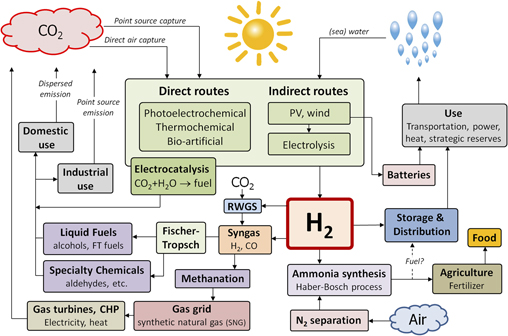
Direct photoelectrochemical water splitting offers several advantages over PV-powered electrolysis and may become the technology of choice in the future. However, significant R&D efforts and breakthroughs are needed to accomplish this goal.
The sustainable production of hydrogen would be an important first step for both powering fuel cells and for enabling large-scale and technologically mature gas phase processes to reduce CO2 and nitrogen to get desired products. Specifically, the central challenge is to produce hydrogen from water using sunlight. Photovoltaics and wind-powered electrolysis are likely to be the technology of choice to produce renewable hydrogen for the next few decades. However, the integration of light absorption and catalysis in ‘direct’ photoelectrolysis routes offers several advantages, such as lower current densities and better heat management, and may become technologically relevant in the second half of this century. This article discusses the research and development efforts and needed breakthroughs to achieve this goal. New chemically stable semiconductors with a band gap between 1.5 and 2.0 eV and long carrier lifetimes are urgently needed to make efficient tandem devices. Scale-up of these research level devices beyond a few cm2 introduces mass transport limitations that require creative electrochemical engineering solutions. Last but not least, standardized methods for measuring efficiencies and stabilities need to be implemented and should lead to official benchmarking and certification laboratories to guide commercial scale up efforts.
The use of in situ formed protective layer on conversion cathodes was introduced as a cheap and simple strategy to shield these materials from undesirable interactions with liquid electrolytes.
Conversion-type cathodes have been viewed as promising candidates to replace Ni- and Co-based intercalation-type cathodes for next-generation lithium (Li) and Li-ion batteries with higher specific energy, lower cost, and potentially longer cycle life. Typically, in conversion reactions two or three Li ions may be stored per just one atom of chalcogen (e.g., S or Se) or transition metal (e.g., Fe or Cu used in halides). Unfortunately, in conversion chemistries the active materials or intermediate charge/discharge products suffer from various unfavorable interactions and dissolution in organic electrolytes. In this mini-review article, we discuss the current interfacial challenges and focus on the protective layers in situ formed on the cathode surface to effectively shield conversion materials from undesirable interactions with liquid electrolytes. We further explore the mechanisms and current progress of forming such protective layers by using various salts, solvents, and additives together with the insight from molecular modeling. Finally, we discuss future opportunities and perspectives of in situ surface protection.
Lessons from the pharmaceutical industry’s commercialization successes can be identified and applied to the U.S. battery industry to potentially improve its discouragingly low startup success rates.
A carbon-neutral and sustainable society of the future necessitates the widespread use of battery technologies that are efficient, effective, and economical. Lower-cost and more energy-dense battery technology can help solve many of our energy challenges, such as balancing the intermittency problems of renewables and making possible electric transportation fleets. New advanced materials are crucial to such battery advances. However, bringing advanced energy materials to market in the United States remains a formidable challenge. Hurdles include high upfront capital requirements, long timelines to success, and few opportunities for technology risk-reduction. Such challenges impede startups from developing financially viable technologies. Consequently, recent advances in battery performance have come from incremental changes implemented by large companies. By contrast, the pharmaceutical industry has many similar technical challenges, yet has an established pipeline of U.S. startup successes. We review and compare the current market structures of battery and pharma innovation. We propose an updated model of U.S. battery commercialization, informed by the pharma model’s successes. The new approach’s benefits and potential pitfalls are discussed. We provide recommendations for entrepreneurs, investors, manufacturers, and policy makers to improve the battery innovation ecosystem. We hope that these ideas spur the battery community to more successfully commercialize and deploy transformative technologies.