To save content items to your account,
please confirm that you agree to abide by our usage policies.
If this is the first time you use this feature, you will be asked to authorise Cambridge Core to connect with your account.
Find out more about saving content to .
To save content items to your Kindle, first ensure no-reply@cambridge.org
is added to your Approved Personal Document E-mail List under your Personal Document Settings
on the Manage Your Content and Devices page of your Amazon account. Then enter the ‘name’ part
of your Kindle email address below.
Find out more about saving to your Kindle.
Note you can select to save to either the @free.kindle.com or @kindle.com variations.
‘@free.kindle.com’ emails are free but can only be saved to your device when it is connected to wi-fi.
‘@kindle.com’ emails can be delivered even when you are not connected to wi-fi, but note that service fees apply.
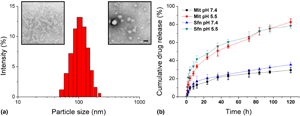
The negative regulation effect of tumor microenvironment (TME) greatly compromised the efficacy of various cancer treatments, especially cancer immunotherapy. As a result, it is generally recognized that remodeling of TME along with the treatment is a promising way to realize satisfactory cancer therapy. Here, in our study, a drug delivery system (DDS) composed cancer cell membrane (CCM) vehicle loaded mitoxantrone (Mit) and sorafenib (Sfn) was proposed with the aim to combine TME regulation and chemotherapy-induced immunotherapy in one platform. Our results confirmed that after treating with this DDS, the Mit induced immunogenic cell death (ICD) could be augmented by Sfn-based TME regulation to realize effective cancer immunotherapy. The Sfn was shown to downregulate of the regulatory T cells (Treg) level while activating the effector T cells of TME. The synergetic TME regulation along with cancer immunotherapy might be a promising way for advanced cancer treatment.
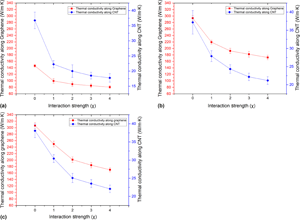
Thermal transport of pillared-graphene structure (PGS) supported on a copper substrate was investigated using equilibrium molecular dynamics. The results show that thermal conductivity along the graphene sheet in Cu-supported PGS ranges between 96.12 and 247.16 W/m K for systems with different dimensions at an interaction strength χ = 1. Thermal conductivity along carbon nanotube was found to range between 22.43 and 30.83 W/m K. The increase of interaction strength between Cu and carbon leads to a general decrease in thermal conductivity of PGS. The simulation results suggest that the thermal conductivity in Cu-supported PGS systems is governed by system geometry and phonon transport.
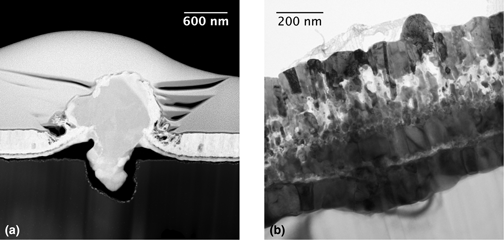
Thin films of platinum deposited by physical vapor deposition (PVD) processes such as evaporation and sputtering are used in many academic and industrial settings, for example to provide metallization when tolerance to corrosive thermal cycling is desired, or in electrocatalysis research. In this review, various practical considerations for platinum (Pt) metallization on both Si and SiO2 are placed in context with a comprehensive data review of diffusion measurements. The relevance of diffusion phenomena to the development of microstructure during deposition as well as the effect of microstructure on the properties of deposited films are discussed with respect to the Pt–Si system. Since Pt and Si readily form silicides, diffusion barriers are essential components of Pt metallization on Si, and various failure modes for diffusion barriers between Pt and Si are clarified with images obtained by electron microscopy. Adhesion layers for Pt films deposited on SiO2 are also considered.
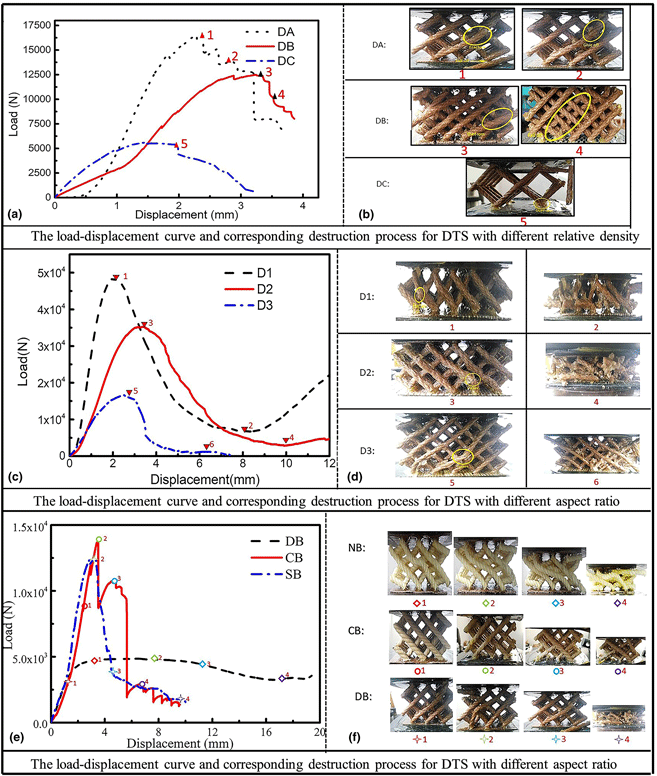
With the aim of optimizing the traditional construction process of a fiber-reinforced lattice structure, the present study modified a previously proposed technique called “truss stacking and node gluing.” To explicitly investigate the structural compressive properties (compressive strength and compressive modulus under the flat pressure), the geometrical parameters, material properties, and topological configuration were examined in detail. Additionally, the present study conducted the relevant theoretical analyses to predict the possible destruction modes and compressive properties. All the samples were tested with a universal testing machine at a rate of 2 mm/min using the ASTM-C365 standard. The results showed that compressive properties are positively related to the relative density and negatively related to the aspect ratio. It was also found that the compressive performance for different materials was in the following order (from good to bad): cotton-fiber reinforced epoxy composite (CREC), jute-fiber reinforced epoxy composite (JREC), and nylon-fiber reinforced epoxy composite (NREC). Furthermore, the mixed topological structure performed as well as the square structure, and they both overmatched the diamond structure. Lastly, the accuracy of the theoretical analysis was evaluated by comparing the theoretical values and the experimental values.
Commercial azelastine hydrochloride crystallizes in the monoclinic space group P21/n (#14) with a = 13.7844(5), b = 16.39920(14), c = 9.41231(22) Å, β = 97.5340(20)°, V = 2109.32(4) Å3, and Z = 4. The lattice parameters differ by −0.02, +0.04, and +0.04% from those in the previous determination (reflecting differences in the temperature and the sample source), and are more precise, from the use of synchrotron radiation. The experimental powder pattern is included in the Powder Diffraction File™ (PDF®) as entry 00-070-1219.
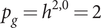
Green–Griffiths–Kerr introduced Hodge representations to classify the Hodge groups of polarized Hodge structures, and the corresponding Mumford–Tate subdomains. We summarize how, given a fixed period domain $ \mathcal{D} $, to enumerate the Hodge representations and corresponding Mumford–Tate subdomains $ D \subset\mathcal{D} $. The procedure is illustrated in two examples: (i) weight two Hodge structures with $ {p}_g={h}^{2,0}=2 $; and (ii) weight three CY-type Hodge structures.
Technical challenges associated with telomere length (TL) measurements have prompted concerns regarding their utility as a biomarker of aging. Several factors influence TL assessment via qPCR, the most common measurement method in epidemiological studies, including storage conditions and DNA extraction method. Here, we tested the impact of power supply during the qPCR assay. Momentary fluctuations in power can affect the functioning of high-performance electronics, including real-time thermocyclers. We investigated if mitigating these fluctuations by using an uninterruptible power supply (UPS) influenced TL assessment via qPCR. Samples run with a UPS had significantly lower standard deviation (p < 0.001) and coefficient of variation (p < 0.001) across technical replicates than those run without a UPS. UPS usage also improved exponential amplification efficiency at the replicate, sample, and plate levels. Together these improvements translated to increased performance across metrics of external validity including correlation with age, within-person correlation across tissues, and correlation between parents and offspring.
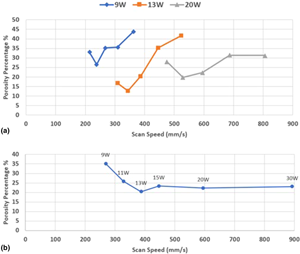
Additive manufacturing (AM) has made long strides in the recent past and rapidly evolved into a promising alternative in specific applications. The aircraft industry is not an exception to this. The true just-intime production possibility is critical for the aircraft maintenance industries, though the lack of material freedom is a major hurdle. Several fire-retardant materials were investigated for AM in the aerospace context, but mainly for fused deposition modeling (FDM). The material consolidation constraints in FDM led to the expansion to the use of selective laser sintering (SLS) to some extent. Nevertheless, the material options are still limited, proprietary, and lack scientific insights into the material consolidation mechanics. Attempts are made in this paper to fill this gap, evaluating a new fire-retardant material for processing by SLS. Experiments conducted to ascertain the material, process, structure, and consolidation relationships indicated energy density levels 0.062–0.070 J/mm2 with laser power 13 W and scan speed varied slightly around 390 mm/s to give the best laser sintering and mechanical property results in polyetherimide powders.
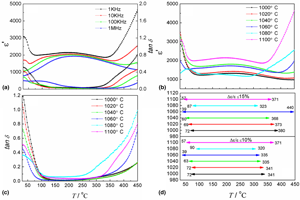
Na0.5Bi0.5TiO3-based ceramics have been paid great attention as Pb-free piezoelectric and electrical energy storage materials. Here, adding 10 mol% BiFeO3 in Na0.5Bi0.5TiO3–SrTiO3 binary system, 0.5Na0.5Bi0.5TiO3–0.4SrTiO3–0.1BiFeO3 ceramics were prepared by a conventional solid-state reaction method. Dielectric measurements reflected a near-plateau dielectric response at high temperature, e.g., the mid-dielectric permittivity of 2052 with the variation within ±10% from 57 to 371 °C and within ±15% from 54 to 371 °C for the ceramic sintered at 1100 °C. At a moderate electric field of 70 kV/cm, a capacitor made by the ceramic has an electrical energy storage density of 0.95 J/cm3, while the polarization has yet saturated at the moderate electric field. These results suggest that 0.5Na0.5Bi0.5TiO3–0.4SrTiO3–0.1BiFeO3 ceramic is a promising novel material with thermally stable dielectric permittivity and high electrical energy storage property for applications in high-temperature electronics.
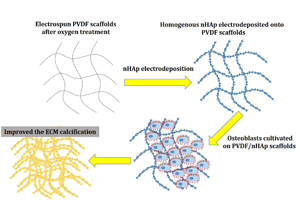
The fibrous scaffolds for bone tissue engineering that mimic the extracellular matrix with bioactive and bactericidal properties could provide adequate conditions for regeneration of damaged bone. Electrospun ultrathin fiber covered with nano-hydroxyapatite is a favorable fibrous scaffold design. We developed a fast and reproducible strategy to produce polyvinylidene fluoride (PVDF)/nano-hydroxyapatite (nHAp) nanofibrous scaffolds with bactericidal and bioactive properties. Fibrous PVDF scaffolds were obtained first by the electrospinning method. Then, their surfaces were modified using oxygen plasma treatment followed by electrodeposition of nHAp. This process formed nanofibrous and superhydrophilic PVDF fibers (133.6 nm, fiber average diameter) covered with homogeneous nHAp (202.6 nm, average particle diameter) crystals. Energy-dispersive X-ray spectrometry demonstrated the presence of calcium phosphate, indicating a Ca/P molar ratio of approximately 1.64. X-ray diffraction, Fourier transform infrared spectroscopy, and Raman spectroscopy spectra identified β-phase of nHAp. Thermal analysis indicated a slight reduction in stability after nHAp electrodeposition. Bactericidal assays showed that nHAp exhibited 99.8% efficiency against Pseudomonas aeruginosa bacteria. The PVDF/Plasma and PVDF/nHAp groups had the highest cell viability, total protein, and alkaline phosphatase activity by 7 days after exposure of the scaffolds to MG63 cell culture. Therefore, the developed scaffolds are an exciting alternative for application in bone regeneration.
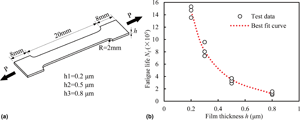
The thickness effect has a significant influence on the fatigue life of micro–nanometer thin films. Due to the increasing application of micro–nanometer thin films in the field of microelectronics, a suitable fatigue prediction model is urgently needed. To reveal the impact of the thickness effect on the fatigue life of a copper wire film, cyclic tension fatigue test of four groups of copper wire films were carried out. Based on the theory of continuous damage mechanics and damage homogenization method, a fatigue damage accumulation model that considered the film thickness was proposed. Based on the proposed fatigue damage prediction model, the damage evolution law and fatigue life of copper wire films with different thickness and strain range were predicted. Furthermore, the size effect of the copper films was analyzed. The results showed that the fatigue life of copper wire films will decrease with the increase of thickness and strain amplitude; the thinner the film, the more significant the thickness effect on the fatigue life is; with the increase of the film thickness, the film thickness effect will gradually decrease.
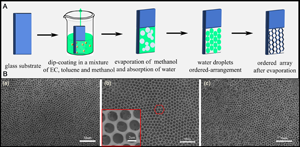
A simple and effective strategy is proposed for fabricating honeycomb-patterned ethyl cellulose (EC) films via a combination of the dip-coating and breath figure methods under a wide humidity range (40–90%). A mixture of toluene and methanol as a volatile solvent/nonsolvent pair was used to effectively control the surface morphology. Additionally, honeycomb patterns were successfully formed via dip-coating under a low humidity (relative humidity less than 40%), when water was directly added into the mixed solution. The important factors that influenced the morphology of EC honeycomb-patterned films were investigated, such as the humidity, solution concentration, and the withdrawal speed during dip-coating. The pore sizes could be controlled by changing the film-formation conditions. Water contact angle enables a transition from hydrophilic to hydrophobic. The possible mechanisms of honeycomb pattern formation are discussed. The fabrication of an ordered honeycomb-patterned film in a cost-effective and convenient manner will have broad application potential in the future.
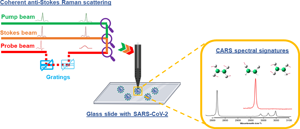
From the 1918 influenza pandemic (H1N1) until the recent 2019 severe acute respiratory syndrome coronavirus 2 (SARS-CoV-2) pandemic, no efficient diagnostic tools have been developed for sensitive identification of viral pathogens. Rigorous, early, and accurate detection of viral pathogens is not only linked to preventing transmission but also to timely treatment and monitoring of drug resistance. Reverse transcription-polymerase chain reaction (RT-PCR), the gold standard method for microbiology and virology testing, suffers from both false-negative and false-positive results arising from the detection limit, contamination of samples/templates, exponential DNA amplification, and variation of viral ribonucleic acid sequences within a single individual during the course of the infection. Rapid, sensitive, and label-free detection of SARS-CoV-2 can provide a first line of defense against the current pandemic. A promising technique is non-linear coherent anti-Stokes Raman scattering (CARS) microscopy, which has the ability to capture rich spatiotemporal structural and functional information at a high acquisition speed in a label-free manner from a biological system. Raman scattering is a process in which the distinctive spectral signatures associated with light-sample interaction provide information on the chemical composition of the sample. In this prospective, we briefly discuss the development and future prospects of CARS for real-time multiplexed label-free detection of SARS-CoV-2 pathogens.
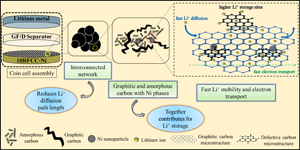
To address the challenges of capacity fading and poor electronic conductivity of hard carbons as anode in Li-ion batteries (LIBs), we report here the catalytic graphitization of resorcinol–formaldehyde xerogel (RFX)-derived hard carbon via a single-step synthesis by incorporating two transition metal catalysts (Co and Ni) with different loadings (5 and 10%) at a modest temperature of 1100 °C. Loading of both the catalysts affects the extent of graphitization and other physiochemical properties that have a direct influence on the anodic performance of as graphitized RFX-derived hard carbon. A 10% Ni catalyst in RFX-derived carbon induces the highest degree of graphitization of 81.4% along with partial amorphous carbon and nickel phases. This improved crystallinity was conducive enough to facilitate rapid electron and Li-ion transfer while the amorphous carbon phase contributed to higher specific capacity, resulting in overall best anodic performance as ever reported for RFX-derived carbon. A specific capacity of 578 mAh/g obtained after 210 cycles at 0.2 C with coulombic efficiency greater than 99% confirms the potential of graphitized RFX-derived carbon as an anode for high-performance LIBs.
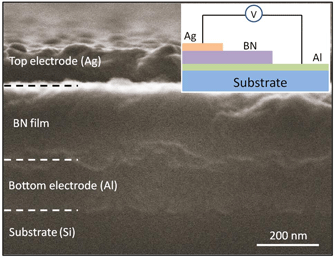
Continuous hBN films have been grown by means of a radio-frequency-sputtering technology, and their material properties have been investigated. The prepared hBN films can achieve good smoothness in a large area. The surface morphologies and compositions of the hBN films on Si substrate and Al film have been characterized, indicating that there is no difference. The 101-phase peak of hBN film is the strongest, and the optical band gap of the fabricated film is 5.84 eV. An attempt on the fabrication of the hBN based resistive switching (RS) device has been made by using an Ag/hBN/Al structure, leading to the observation of a clear and stable RS behavior. The device exhibits a resistance window (high-resistivity state/low-resistivity state) of around 102, and the RS behaviors of hBN film prepared by sputtering were first observed. It has been found that the opening voltage for the device is changed when a different cycle voltage is applied because of the built-in electric field increasing with the increase of applied cycle voltage. The mechanism of the RS behavior has been analyzed, which lay a foundation for the application of hBN as RS material in resistive random access memory to improve the storage density.
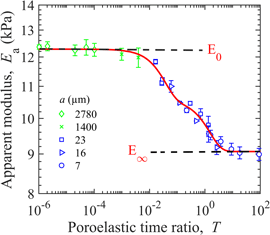
Mechanical properties of hydrogels are of considerable interest for applications including tissue engineering and drug delivery. However, mechanical characterization of hydrogels is inherently challenging due to their multiphasic construction. Under mechanical loading, internal fluid redistribution affects the gel response, leading to a time- and length-scale-dependent material behavior, known as poroelasticity. Traditional mechanical tests are effective for determining instantaneous flow-independent gel response, and they are limited in characterizing poroelastic behavior as a function of loading time- and length-scales. Here, micro- and nanoindentation experiments are combined to characterize the full range of poroelastic behavior of a hydrogel. A master curve is presented to demonstrate that the relative competition of poroelastic relaxation time with ramp loading time determines gel response across different time- and length-scales. The master curve provides a novel mechanism to establish the instantaneous and equilibrium limits on the elastic modulus for a material, useful for designing hydrogel biomaterials.
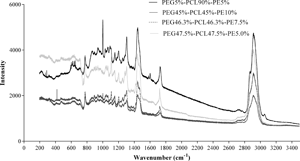
Interactions between smooth muscle cells (SMCs) and biomaterials must not result in phenotype changes as this may generate uncontrolled multiplication processes and occlusions in vascular grafts. The aim of this study was to relate the hydrolytic stability and biocompatibility of polyurethanes (PUs) on SMCs. A higher polycaprolactone (PCL) concentration was found to improve the hydrolytic stability of the material and the adhesion of SMCs. A material with 5% polyethylene glycol, 90% PCL, and 5% pentaerythritol presented high cell viability and adhesion, suggesting a contractile phenotype in SMCs depending on the morphology. Nevertheless, all PUs retained their elastic modulus over 120 days, similar to the collagen of native arteries (~10 MPa). Furthermore, aortic SMCs did not present toxicity (viability over 80%) and demonstrated adherence without any abnormal cell multiplication processes, which is ideal for the function to be fulfiled in situ in the vascular grafts.
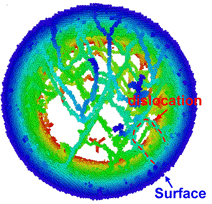
The orientation between twin boundary (TB) and loading direction may play an intriguing role in the deformation behaviors of twinned metallic materials. In this aspect, its essential effect on the high-entropy alloy (HEA) nanocrystals is elusive. Attention herein is focused on the atomic-scaled deformation mechanisms and fracture behaviors of HEA nanocrystals containing twins of even smaller spacings via a combined approach of in situ tensile tests inside a high-resolution transmission electron microscope and molecular dynamics simulations. The results indicate that the deformation mechanisms (especially dislocation activities) of HEA nanocrystals depend on the load orientation with respect to TBs. Because of the low activation energy and uneven local composition of HEA, the surface acts as an effective dislocation source and, together with Schmid factor, dominate the activated dislocation slip system. The load orientation-dependent TB-dislocation interactions may transform the type of fracture from semi-brittle to ductile. Our results indicate that the deformation mechanisms and the types of fracture in HEA nanocrystals can be controlled by changing the orientation.