To save content items to your account,
please confirm that you agree to abide by our usage policies.
If this is the first time you use this feature, you will be asked to authorise Cambridge Core to connect with your account.
Find out more about saving content to .
To save content items to your Kindle, first ensure no-reply@cambridge.org
is added to your Approved Personal Document E-mail List under your Personal Document Settings
on the Manage Your Content and Devices page of your Amazon account. Then enter the ‘name’ part
of your Kindle email address below.
Find out more about saving to your Kindle.
Note you can select to save to either the @free.kindle.com or @kindle.com variations.
‘@free.kindle.com’ emails are free but can only be saved to your device when it is connected to wi-fi.
‘@kindle.com’ emails can be delivered even when you are not connected to wi-fi, but note that service fees apply.
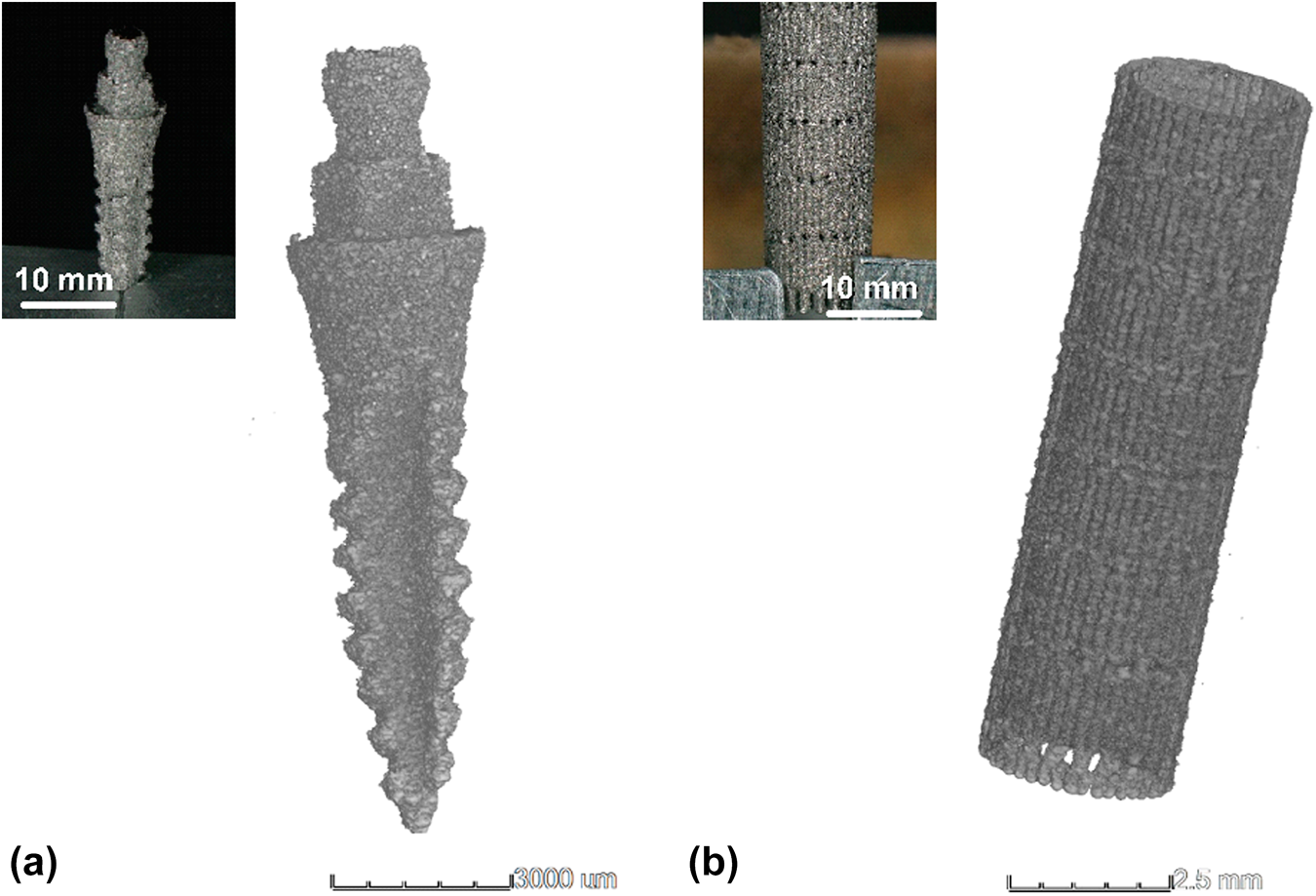
The Ti–35Nb–7Zr–5Ta (TNZT) alloy is a promising alloy because of its biocompatibility, high specific strength, and low Young's modulus. This work aimed at investigating the viability to process the TNZT alloy by selective laser melting (SLM) and at optimizing the processing parameters to obtain densified bulk samples. The single-track approach was first used, and the optimized laser parameters were determined to produce bulk samples with a relative density of 99.0% when an energy input of 58.3 J/mm3 was used. The effect of porosity on mechanical properties was studied, and the as-built SLM samples presented slightly lower compressive strength than samples produced by Cu-mould suction casting, as a result of a columnar grain structure in the SLMed samples. Prototypes were manufactured, proving the feasibility of manufacturing parts of the TNZT alloy with complex geometry by SLM.
Stable superhydrophobic coatings were produced from aqueous suspensions of epoxy nanoparticles. The superhydrophobic coatings demonstrated excellent mechanical robustness and chemical resistance. Aqueous solutions of ionic surfactants, nonionic surfactants, and small organic molecules on superhydrophobic coatings could wet the superhydrophobic coatings. However, the superhydrophobicity can be recovered by rinsing the wet surface with water. It was also discovered that, although seemed wetted, the superhydrophobic surface was separated from the solution of ionic surfactant by a layer of ionic surfactant molecules. In contrast, nonionic and small organic molecules could not aggregate on the superhydrophobic surfaces; the coatings were exposed to the solutions.
Telomeres are repeating DNA sequences found on the ends of chromosomes, which shorten with age and are implicated in senescence. Cross-species analyses of telomere shortening rates (TSR) and telomere lengths are important for understanding mechanisms underlying senescence, lifespan and life-history strategies of different species. Whittemore et al. (2019) generated a new dataset on variation in TSR, lifespan and body mass. In phylogenetically uncorrected analyses they found that TSR negatively correlates with lifespan. We re-ran analyses of their dataset using appropriate phylogenetic corrections. We found a strong phylogenetic signal in the association between TSR and body mass. We were able to corroborate Whittemore et al.’s major findings, including while correcting for body mass in a multivariate analysis. Since laboratory mice have different telomere lengths and potentially different telomere dynamics than wild mice, we removed mice from the analysis, which attenuates most associations.
Dynamic nuclear polarization (DNP) is a technique in magic-angle spinning (MAS) nuclear magnetic resonance (NMR) which leads to sensitivity enhancement and helps to overcome the issue of low polarization in detected nuclei. Recent research showed, that methyl groups, which show active reorientation dynamics and cause heteronuclear cross relaxation at typical DNP temperatures around 100 K, may be used as a pinpoint source of polarization for selective and site-specific probing. In this study, we investigated the cross-relaxation behavior of methyl groups in nicotine and caffeine under DNP. These effects could be useful for investigating receptor/ligand binding.
Electrospun membranes have potential applications in the field of waterproof and breathable textile products. However, challenges still exist to improve the breathability, and waterproof and mechanical properties of these microporous membranes. In this paper, a novel hydrophobic microporous nanofiber membrane was prepared via side-by-side electrospinning of fluorosilane-modified silica nanoparticles (F–SiO2) blended with synthesized polyurethane (PU) solution and composited with the polyacrylonitrile (PAN) solution. To prepare F–SiO2, SiO2 nanoparticles were hydrophobically modified by fluorosilane. Composite nanofiber membranes with different blending ratios of PU(F–SiO2)/PAN were fabricated via side-by-side electrospinning by controlling the extruding speed of two spinnerets. Experimental results indicated that regarding F–SiO2 as hydrophobic inorganic particle can improve the hydrophobic properties of PU nanofiber membrane. The prepared PAN/(F–SiO2/PU) nanofiber microporous membranes exhibit relatively excellent waterproof and mechanical properties as that robust tensile strength (19.5 MPa), preferable water vapor permeability [10.3 kg/(m2 d)], favorable water contact angle (137.2°), and superior mechanical properties. It was believed that the reinforced PAN/(F–SiO2/PU) nanofibrous composite membranes have potential applications in chemical protective clothing, army combat uniforms, self-cleaning materials, and other medical products.
In this study, the glass forming ability, thermal stability, and room-temperature mechanical behavior of a high Zr-containing Zr71Cu11Ni10.5Al7Ti0.5 bulk glassy alloy were investigated. The glassy alloy exhibits a high glass-forming ability with a critical casting diameter of 5 mm using copper mold injection casting, and its critical cooling rate is estimated to be smaller than 40 K/s. A small kinetic fragility index m of 32 indicates its good thermodynamic stability and glass-forming ability. Compressive tests indicate that the glassy alloy displays a significant average plastic strain of 12.3%, a high fracture strength of 1592 MPa, and Young's modulus of 74.5 GPa. The good ductility is attributed to the introduction of more free volume and local compositional inhomogeneity with increasing Zr addition. This finding may provide useful guidelines for the development of novel high Zr-containing glassy alloys.
As electrode materials, metal-organic frameworks always have low electrical conductivity and poor structural stability, which limits its applications in electrochemical fields. Here, Ni-BPDC/GO composites are synthesized using graphene oxide (GO) as a substrate and 4,4′-biphenyldicarboxylic acid (BPDC) as an organic ligand via a hydrothermal approach. The growth mechanism of the Ni-BPDC and Ni-BPDC/GO composites is proposed. In the composites, highly dispersed Ni-BPDC macro-nanostrips are supported on the GO surface in parallel. The presence of GO does not affect the growth and crystalline structure of Ni-BPDC. Compared with the Ni-BPDC, Ni-BPDC/GO composites exhibit higher specific capacitance, rate capability, and operating current density through lowering intrinsic resistance, charge-transfer resistance, and ion diffusion impedance. Moreover, the assembled Ni-BPDC/GO-3//reduced graphene oxide (rGO) asymmetric supercapacitor has large specific capacitance, good cycling stability, and high energy density (16.5 W h/kg at 250 W/kg). Hence, Ni-BPDC/GO composites are a potential electrode material for supercapacitors.
In probing quantum materials, thermal transport is less appreciated than electrical transport. This article aims to show the pivotal role that thermal transport may play in understanding quantum materials—longitudinal thermal transport reflects itinerant quasiparticles, even in an electrical insulating phase, while transverse thermal transport such as the thermal Hall and Nernst effects is tightly linked to nontrivial topology. We discuss three examples—quantum spin liquids wherein thermal transport identifies its existence, superconductors wherein thermal transport reveals the superconducting gap structure, and topological Weyl semimetals where the anomalous Nernst effect is a consequence of nontrivial Berry curvature. We conclude with an outlook on the unique insights thermal transport may offer to probe a much broader category of quantum phenomena.
Gold nanoparticles (AuNPs) are one of the most versatile and accessible classes of nanomaterials. Their chemical stability, ease of colloidal synthesis, surface functionalization, and plasmonic resonance—tunable from the visible through the near-infrared—have made AuNPs the metal nanoparticle of choice for many applications. This article summarizes the chemical synthesis of AuNPs, particularly gold nanorods, with a focus on recent developments in shape control and surface modifications. Current applications using the photothermal properties of AuNPs, as well as AuNP connections to biology and the environmental sciences, will be discussed.
Topological quantum materials are a class of compounds featuring electronic band structures, which are topologically distinct from common metals and insulators. These materials have emerged as exceptionally fertile ground for materials science research. The topologically nontrivial electronic structures of these materials support many interesting properties, ranging from the topologically protected states, manifesting as high mobility and spin-momentum locking, to various quantum Hall effects, axionic physics, and Majorana modes. In this article, we describe different topological matters, including topological insulators, Weyl semimetals, twisted graphene, and related two-dimensional Chern magnetic insulators, as well as their heterostructures. We focus on recent materials discoveries and experimental advancements of topological materials, and their heterostructures. Finally, we conclude with prospects for the discovery of additional topological materials for studying quantum processes, quasiparticles and their composites, as well as exploiting potential applications of these materials.
Two-dimensional (2D) quantum materials offer a unique platform to explore mesoscopic phenomena driven by interfacial and topological effects. Their tunable electric properties and bidimensional nature enable their integration into sophisticated heterostructures with engineered properties, resulting in the emergence of new exotic phenomena not accessible in other platforms. This has fostered many studies on 2D ferromagnetism, proximity-induced effects, and quantum transport, demonstrating their relevance for fundamental research and future device applications. Here, we review ongoing progress in this lively research field with special emphasis on spin-related phenomena.
Low-dimensional superconductors have been at the forefront of physics research due to their rich physical properties such as high-temperature (Tc) superconductivity. In this article, we review the field of emergent high-Tc superconductivity at interfaces of heterostructures, focusing on the experimental advances and its physical mechanism. Charge transfer between constituent materials leads to two-dimensional carrier confinement that facilitates occurrence of superconductivity at the interface. We discuss the similarities between bulk high-Tc superconductors and interface systems, as well as implications from a survey of interface superconductors. We expect that the hybrid heterostructures and the ability to manipulate them on an atomic scale could be an enormously fertile ground to explore superconductivity with higher critical temperature Tc.