To save content items to your account,
please confirm that you agree to abide by our usage policies.
If this is the first time you use this feature, you will be asked to authorise Cambridge Core to connect with your account.
Find out more about saving content to .
To save content items to your Kindle, first ensure no-reply@cambridge.org
is added to your Approved Personal Document E-mail List under your Personal Document Settings
on the Manage Your Content and Devices page of your Amazon account. Then enter the ‘name’ part
of your Kindle email address below.
Find out more about saving to your Kindle.
Note you can select to save to either the @free.kindle.com or @kindle.com variations.
‘@free.kindle.com’ emails are free but can only be saved to your device when it is connected to wi-fi.
‘@kindle.com’ emails can be delivered even when you are not connected to wi-fi, but note that service fees apply.
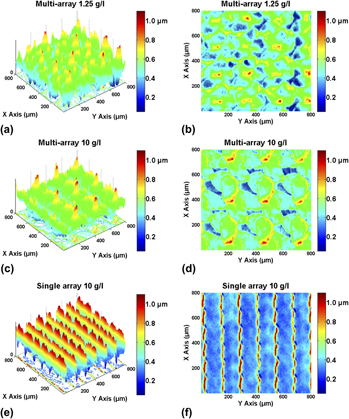
In this paper, ink-jet printing was used to deposit poly(3-hexylthiophene):phenyl-C61-butyric acid methyl ester blend as active layer and a comparison study of three printing methods [multiarray (MA), single layer array, and multilayer array] was performed. For organic photovoltaics (OPVs) fabricated using MA or multilayer arrays, the efficiency was less than 1% independent of printing parameters. When single layer print pattern was used, the device performance improved significantly and an efficiency of 1.29% was obtained, indicating that the thin films fabricated using a single layer are more suitable for OPVs than films obtained by overlapping of multiple layers. The influence of annealing parameters on electrical and optical thin film properties was also investigated. The study found that the optimum annealing condition for the printed OPVs is solvent annealing at 60 °C, yielding an efficiency of 1.99%.
Highly efficient polytype 4H silicon carbide (4H-SiC) p–n diodes for ultraviolet (UV) light detection have been fabricated, characterized, and exposed to high-intensity mercury lamp irradiation (up to 17 mW/cm2). The behavior of the photocurrent response under UV light irradiation using a low-pressure mercury UV-C lamp (4 mW/cm²) and a medium-pressure mercury discharge lamp (17 mW/cm²) has been studied. We report on long-term UV photoaging tests performed for up to 22 mo. Results demonstrate the robustness of SiC photodiodes against UV radiation. The devices under test showed an initial burn-in effect, i.e., the photocurrent response dropped by less than 5% within the first 40 h of artificial UV aging. Such burn-in effect under UV stress was also observed for previously available polytype 6H silicon carbide (6H–SiC) p–n photodetectors. After burn-in, no measurable degradation has been detected, which makes the devices excellent candidates for high irradiance UV detector applications.
In situ small-angle x-ray scattering (SAXS) is used to investigate the electrochemical durability of Pt-Metal (Pt-M) catalysts sputtered onto nitrogen-modified high surface area carbon powder. The results demonstrate that nitrogen modification promotes catalyst durability through reduction of nanoparticle dissolution and coarsening. Although particle sizes of Pt-M on high surface area carbon supports can be difficult to determine with transmission electron microscopy (TEM), a novel SAXS method has been employed to calculate particle size. SAXS analysis shows that the Pt-M nanoparticle size distribution remained stable for 3000 electrochemical cycles after nitrogen modification, whereas the unmodified support material leads to Pt-M nanoparticle instabilities. These results for industrial-relevant catalyst/support architectures underscore the potential of nitrogen-modified carbon support structures for enhanced Pt-M catalyst durability.
Structure and phase transitions of (1 − y)((1 − x)Bi1/2Na1/2TiO3–xBi1/2K1/2TiO3)–yK0.5Na0.5NbO3 (x; y) piezoceramics (0.1 ≤ x ≤ 0.4; 0 ≤ y ≤ 0.05) were investigated by transmission electron microscopy, neutron diffraction, temperature-dependent x-ray diffraction, and Raman spectroscopy. The local crystallographic structure at room temperature (RT) does not change by adding K0.5Na0.5NbO3 to Bi1/2Na1/2TiO3–xBi1/2K1/2TiO3 for x = 0.2 and 0.4. The average crystal structure and microstructure on the other hand develop from mainly long-range polar order with ferroelectric domains to short-range order with polar nanoregions displaying a more pronounced relaxor character. The (0.1; 0) and (0.1; 0.02) compositions exhibit monoclinic Cc space group symmetry, which transform into Cc + P4bm at 185 and 130 °C, respectively. This high temperature phase is stable at RT for the morphotropic phase boundary compositions of (0.1; 0.05) and all compositions with x = 0.2. For the compositions of (0.1; 0) and (0.1; 0.02), local structural changes on heating are evidenced by Raman; for all other compositions, changes in the long-range average crystal structure were observed.
We propose a new method of synthesis of crystalline yttrium and lutetium orthoborates in thin (2.5–20.0 μm thick) layers of molten borate oxide glasses. The method is based on interaction of nanosized lutetium and yttrium oxide powders with boron anhydride in the melt. X-ray diffractometry and electron microscopy investigations have revealed that in the case of lead-content glasses, the method shows a very strong orienting effect in the texture of the resulting orthoborate particles. This highly oriented texture results in good transparency of the obtained glass–ceramic films. Studies of the luminescence and scintillation spectra of the glass–ceramic composites show that they can be used as highly effective phosphors with a light yield comparable to that of single crystalline scintillators.
We report the results of the systematic investigation into correlations between energetics and hexagonal stacking configurations for carbon, silicon, SiC, BN, AlN, GaN, and InN polytypes with sp3-bonded networks. The atomistic geometry, energetics, and electronic structure for these compounds with up to the periodic stacking length of L = 8 have been carefully calculated based on the density functional theory within the generalized gradient approximation (GGA). Using the Axial Next-Nearest-Neighbor Ising model extracted from the GGA calculations, we have also studied the energetics for more than 6 million kinds of nonequivalent stacking polytypes with up to L = 30, whose configurations have been deduced by the efficient polytype generation algorithm [E. Estevez-Rams and J. Martinez-Mojicar, Acta Crystallogr., Sect. A: Found. Crystallogr. 64, 529 (2008)], and illustrated some trends of structural and energetic properties for these compounds.
In the previous chapter, we saw how the long-range order of particle positions in a crystal could be described in a rather elegant manner using a space lattice that extends indefinitely. In this chapter, we examine instead disordered matter such as liquids or glasses in which a long-range repeated pattern is absent. These amorphous materials might not seem as glamorous as their crystalline counterparts, but they are increasingly prevalent in our world as they comprise the windows, computer screens and vast array of plastic components that surround us on a daily basis. In comparison with crystalline structures, these amorphous materials pose a challenge to describe, and their structure can only be defined in a statistical sense by introducing an ensemble-averaged, pair distribution function. In spite of their disordered nature, a robust pattern of particle positions emerges over short distances. This short-range order reflects the local coordination of particles and we briefly review the random close pack and the continuous random network systems as common examples of amorphous structure.
A statistical structure
Disordered or amorphous condensed matter has a clear disadvantage in that particle positions lack any long-range repeating pattern akin to that found in crystals. This is evident in Fig. 2.1, which illustrates the typical particle positions of either a glass or a liquid captured at a particular instant in time.
Picture with me an old cottage nestled in the woods. There is a small house builtof clay bricks that were thoughtfully stacked and interlaced by a masterbricklayer so as to produce a repeated interlocking pattern. The house has athatched roof consisting of bundles of straw. The straws in each bundle areoriented in a common direction to direct rainwater off the roof, and are lashedtogether with twine. Around the house is a garden enclosed by a stone wall. Likethe brick walls of the house, the stones in the wall are bonded together withmortar. But unlike the bricks, the stones lack any sense of a repeatingpattern.
In this part of the textbook, we examine the basic structures that are found incondensed matter as well as the forces (the mortar and twine) that maintainthese structures over long time periods. For our purposes, structures aredivided into two main categories: ordered (like the bricks and the straw of thehouse) and disordered (like the stones in the garden wall).
In Chapter 5 we introduced the structure factor, S(q), as the Fourier representation of the positions of a collection of fixed, elastically scattering, particles. In reality, these particles are rarely fixed. In a solid (crystal or glass), the particles are bound together by bonds and, while unable to wander about, are able to oscillate or vibrate about a fixed center of motion. In a liquid, the particles are even less constrained and are free to wander around over considerable distances. In this chapter we develop the dynamic structure factor as a straightforward extension of the static structure factor introduced previously, and apply it to examine the dynamics of liquid-like systems. In one instance, we consider the Brownian diffusion of macromolecules in a solvent, where the motion mimics that of the random walk we discussed in the previous chapter. In another instance, we show how thermodynamically driven density fluctuations present in a simple liquid are responsible for the characteristic Rayleigh–Brillouin spectrum of light scattering. We also take this opportunity to consider the special case of slow dynamics in polymer liquids and to briefly consider the nature of the liquid-to-glass transition that separates amorphous solids from their liquid counterparts.
Dynamic structure factor
We can think of a liquid as a time-dependent amorphous structure. In many ways, the structure of a liquid resembles the structure of a glass in that, at any instant in time, a “snapshot” of its S(q) resembles that of the glass. Indeed, the only real difference between a liquid and a glass is the presence or absence, respectively, of long-range translational motion. In the liquid, the translational motion results from the incessant jostling of the particles allowing them to wander about. By virtue of this motion, particles of the liquid are able to rearrange on some characteristic time scale (related to the viscosity of the liquid) into different, but thermodynamically equivalent, amorphous configurations whose instantaneous structure resembles that of a glass. For certain glass forming liquids near their glass transition point, the characteristic time scale for these rearrangements can become exceedingly long with some unusual consequences, as we will discuss later.
In the last two chapters we explored the behavior of phonons in a crystal. There we saw how these discrete, quantized pieces of propagating energy contributed to both the specific heat and thermal conductivity of the solid. Here we turn our attention to crystalline metals whose metallic bonding results in the formation of a sea of mobile electrons present within the crystal. Like phonons, these mobile electrons carry around energy and consequently contribute to the specific heat. But they also carry around charge and so contribute also to the electrical conductivity of the metal.
In this chapter, we begin with a simplistic model of the mobile electrons as quantum mechanical waves trapped within an infinite square well potential. This model is known as the free electron model because the interaction of the electron with the ion cores of the metal lattice is disregarded. The electron is only trapped by the confines of the crystal itself. Although this simple model is unable to capture all the experimental features of conduction in metals, it readily accounts for the smallness of the electron contribution to the specific heat and does provide a simple interpretation of such electron emission phenomena as the photoelectric effect.
In this final chapter on the subject of structures, we turn our attention to magnetic materials. Why? Because magnetic materials are illustrative of yet another level of structure that often arises in condensed matter, beyond that of particle arrangements. As we will see, magnetic particles have a property of net spin and a magnetic moment whose orientation in space is largely unrestricted. Regardless of whether a large system of magnetic particles is positioned in an ordered or disordered manner, their spins represent an additional layer of ordering. The moments could be randomly oriented or aligned in a common direction. In ferromagnetic systems, these moments interact with one another to promote a local alignment of the moments which can eventually spread over the entire system. This is reminiscent of how pairwise bonding between particles eventually leads to crystallization of a liquid, and it is the archetype for a wide variety of phase transitions in which order appears in the form of correlated regions emerging from a disordered host.
The ordering process
So far, our discussion of structure has focused entirely on particles: their relative positions and the forces that hold them together. We have seen that arrangements of particles fall into either an ordered or disordered pattern which can be characterized by the level of symmetry present. By virtue of its disorder, the liquid has rotational invariance and an infinite symmetry (on average). The crystal, however, conforms to a space lattice and possesses only a discrete set of symmetry operations. In the process of forming a crystal from the liquid, the symmetry is often said to be “broken”.
Yb3+:Sr3Y2(BO3)4 crystals have been grown successfully by Czochralski method. The compound crystallizes in orthorhombic system, space group Pnma, with a = 7.4062(3) Å, b = 16.0030(7) Å, c = 8.7130(4) Å, α = β = γ = 90°, and Z = 4. Yb3+:Sr3Y2(BO3)4 has three cationic sites and two kinds of boron sites. The crystalline quality of the Yb3+:Sr3Y2(BO3)4 single crystal was verified by the width of the x-ray diffraction peak in the x-ray rocking curves measurement. The absorption spectrum, emission spectrum, and fluorescence lifetime of the Yb3+:Sr3Y2(BO3)4 crystal were detected at room temperature. The laser performance parameters βmin, Ipsat, and Imin were calculated.
In this chapter, we develop some fundamental understanding of the nature ofphase transitions by examining two well-studied examples: thevapor-to-liquid transition of fluids and the paramagnetic-to-ferromagnetictransition in magnetic materials. Here, our focus is on the experimentallyobserved features of these two transitions and how to interpret and navigatethe many phase diagrams that describe them. The theoretical interpretationwill be tackled later in Chapter 17. We will find that, in general, a phasetransition is accompanied by some change in the amount of order as when, forexample, liquid water freezes into crystalline ice. Moreover, we candescribe this amount of ordering quantitatively by introducing anappropriate order parameter, whose value changessignificantly only during the transition. Based upon the manner in which theorder parameter changes, we can distinguish two different types of phasetransitions: those of first order for which the order parameter changesdiscontinuously and those of second order for which it changes continuously.Second-order transitions are possible for both the vapor-to-liquidtransition and the paramagnetic-to-ferromagnetic transition and are ofinterest due to the way in which many properties diverge near the transitionin a similar, power law manner.
A steaming cup of coffee is sitting on my desk. Aside from the steam, there islittle else that would suggest any other activity is present. The cup and itcontents appear to be “at rest”. But a little closer examinationreveals a small ripple of waves on the surface of the liquid caused by amechanical pump in the room next door. Indeed, if I rest my finger gently on thelip of the cup, I can feel the vibration. I can also feel the heat that hasdeveloped in the cup, now several minutes since I poured the coffee from the potand added some creamer.
If I could examine this evenmore closely Iwould actually see that nothing istruly “at rest”. The particles of the liquid are jostling aboutincessantly. The particles of the creamer that I added have clearly taken flightand diffused rapidly out into all regions of the coffee. The cup itself is alsoin motion. Its particles are undergoing incessant vibrations that are ultimatelyresponsible for the heat I feel when I hold it.
Perhaps most interesting is that all this microscopic motion appears to be drivenentirely by thermodynamics. The coffee and cup are sitting in aclimatecontrolled office and there is a constant flux of thermal energy (heat)entering and exiting both the coffee and the cup to keep things moving.
Vanadium (V)–aluminum (Al)–carbon (C) thin films were deposited on Al2O3$(11\mathop 2\limits^ - 0)$ substrates at 500 °C by direct current magnetron sputtering using a powder metallurgical composite target with 2:1:1 MAX phase stoichiometry. Transmission electron microscopy (TEM) and x-ray diffraction results suggest that a hexagonal Al-containing vanadium carbide solid solution (V,Al)2Cx was formed. The films exhibited a strong basal plane texture. The lattice parameter of the hexagonal solid solution was dependent on the annealing temperature: the c lattice parameter decreased by 3.45% after annealing for 1 h at 750 °C compared to the as-deposited film. Based on the comparison between experimental and theoretical lattice parameter data, it is reasonable to assume that this annealing-induced change in lattice parameter is a consequence of atomic ordering. Meanwhile, the formation of V2AlC MAX phase was observed at 650 °C and phase-pure V2AlC was obtained at 850 °C. TEM images support the notion that V2AlC forms by nucleation and growth.
What makes condensed matter “condensed”? The answer is stickiness (i.e. an attractive interaction) that exists between the particles that make up a liquid or solid. In the last two chapters we have looked at two extremes of particle arrangements in matter: ordered (crystalline) and disordered (amorphous). In this chapter, we now examine the nature of the forces that form between particles and which promote the formation of a condensed phase of matter. We begin by reviewing the five major bonds (van der Waals, covalent, ionic, metallic and hydrogen bonds) and conclude by considering the overall cohesive energy in a crystal. As thermodynamics generally favors the system with lowest energy, this cohesive energy is part of what determines why a particular crystal structure is adopted in Nature, rather than another structure.
Survey of bond types
In order for matter to condense, there must be an attractive force between the particles to promote their mutual gathering together. Of the four fundamental forces in Nature, the two nuclear forces (strong and weak) play no role in the condensation process and the gravitational force is far too weak to drive the process at ordinary terrestrial temperatures and pressures. Instead, the fundamental force that binds particles together in condensed matter arises from electrostatic interactions.