To save content items to your account,
please confirm that you agree to abide by our usage policies.
If this is the first time you use this feature, you will be asked to authorise Cambridge Core to connect with your account.
Find out more about saving content to .
To save content items to your Kindle, first ensure no-reply@cambridge.org
is added to your Approved Personal Document E-mail List under your Personal Document Settings
on the Manage Your Content and Devices page of your Amazon account. Then enter the ‘name’ part
of your Kindle email address below.
Find out more about saving to your Kindle.
Note you can select to save to either the @free.kindle.com or @kindle.com variations.
‘@free.kindle.com’ emails are free but can only be saved to your device when it is connected to wi-fi.
‘@kindle.com’ emails can be delivered even when you are not connected to wi-fi, but note that service fees apply.
In the last chapter, we investigated the dynamics of liquids whose particles are free to wander about due to the reasonably weak level of inter-particle bonding. In a solid (crystal or glass), bonding between particles is stronger and the translational motion of the particles is arrested. Nevertheless, these “solid” particles continue to move and execute small, localized vibrations about a fixed point in space. In this chapter and the next, we investigate the nature of this vibrational motion and its impact on the thermal properties of a solid. Here we begin by considering a simple model of masses connected by ideal springs to demonstrate how vibrations of individual atoms are, in reality, a consequence of propagating waves traveling through the crystal lattice. In order to connect these waves with the quantum mechanical perspective of each atom behaving as a quantized harmonic oscillator, we find ourselves introducing the concept of a quantum of elastic wave, known as a phonon.
An important outcome of our development of quantized elastic waves is a growing appreciation for a special region of reciprocal space known as the Brillouin zone, which is populated by all the wave vectors, K, corresponding to allowed phonon waves in the crystal. For phonons whose K matches the edge of this zone, significant Bragg scattering results, to produce two equivalent standing wave patterns separated by an energy gap. We will revisit the Brillouin zone often in the chapters to come, and we will begin to appreciate the significance of this boundary for the motion of all waves that attempt to travel within a crystal.
We have now witnessed the similar patterns associated with second-order phase transitions in both fluid and magnetic systems. These patterns include laws of corresponding states and similarity in critical exponents, that govern how properties evolve near the transition point. Furthermore, the Landau theory provides a framework for understanding the commonality of these second-order phase transitions, in terms of similarity in the functional dependence of the free energy on an appropriately chosen order parameter, and a simple expansion that can be performed near the critical point. In this chapter, we examine yet another significant phase transition found in condensed matter: the transition of a material to a state of virtually infinite conductivity or superconductivity. Here the transition involves the sticking together of two electrons into a boson-like, superconducting charge carrier known as a Cooper pair, and we again find evidence of a second-order transition consistent with mean field theory.
Superconducting phenomena
Discovery
In 1908, H. K. Onnes perfected the technique for cooling helium gas to its condensation point and soon after began using this new technology to investigate the properties of various elements at ultra low temperatures. In one instance, Onnes was curious about the ultimate demise of the resistivity of an electronic conductor. As we saw in Chapter 12, the resistivity of most conductors decreases linearly with temperature at high temperatures, due to the scattering of electrons by lattice phonons, but approaches a limiting value at low temperatures, associated with a mean free path determined by macroscopic imperfections of the crystal lattice. In a series of studies, Onnes measured the resistance of gold and platinum and observed an approach to a limiting resistance at low temperatures. In an effort to eliminate the effects of imperfections, he extended the study in 1911 to include mercury, which at that time could be refined to a highly pure form. The results of this study, shown in Fig. 18.1, are quite dramatic. A roughly linear temperature dependence was observed above about 4.2 K, which decreased abruptly to an immeasurably small resistance at lower temperatures. On reheating, the resistance was identically retraced, and Onnes concluded that mercury had undergone a unique phase transition to a new state characterized by virtually zero resistance – a “superconducting” phase.
A technique of controlling growth gas flow rate for adjusting crystal resistivity is presented in this paper. The experimental results showed that high growth gas flow rate could affect SiC crystal resistivity remarkably. The SiC crystal resistivity would get higher and higher with increasing growth gas flow rate. The purifying effect of gas flow rate was contributing to resistivity increase at a relatively low flow rate range. As for the high gas flow rate, increase of resistivity might be explained by the well-known site competition effect. Then, one explanation for reducing nitrogen content in the crystal via increasing gas flow rate was put forward. Namely, the Si component in the gas species may more easily go through the graphite crucible at the initial stage to make the growth ambient C-rich when the gas flow rate is ∼800 sccm or more and hence suppress nitrogen incorporation into carbon site to increase crystal resistivity. This result is very helpful to grow high purity high resistivity SiC ingots.
In this study, we have developed and characterized two previously unstudied alkoxysilane surface chemistries for use with superparamagnetic iron oxide (SPIO) nanoparticles as a magnetic resonance imaging contrast agent. We modified superparamagnetic iron oxide nanoparticles (SPIO) using aminopropyl triethoxysilane and two analogous alkoxysilanes, aminopropyl dimethylethoxysilane and aminopropyl methyldiethoxysilane, to compare a mono- and dialkoxysilane, respectively, to a more commonly used trialkoxysilane as two new SPIO surface chemistries capable of forming ultrathin functional surface coatings. The ligand densities of the mono- and dialkoxysilane-modified SPIO produced in this study are consistent with near monolayers of ligands on the SPIO surface. We studied the chemical stability of the mono-, di-, and trialkoxysilane-modified SPIO in neutral and acidic media to evaluate the viability of these surface chemistries for use in long-term intracellular applications. The mono- and dialkoxysilane-modified SPIO demonstrate comparable chemical stability to the trialkoxysilane-modified SPIO, indicating that the mono- and dialkoxysilane are both viable new SPIO surface chemistries for future applications requiring minimally thick alkoxysilane surface coatings.
Low temperature solid oxide fuel cells (SOFCs) are a promising solution to revolutionize stationary, transportation, and personal power energy conversion efficiency. Through investigation of fundamental conduction mechanisms, we have developed the highest conductivity solid electrolyte, stabilized bismuth oxide (Dy0.08W0.04Bi0.88O0.36). To overcome its inherent thermodynamic instability in the anode environment, we invented a functionally graded bismuth oxide/ceria bilayered electrolyte. For compatibility with this bilayared electrolyte, we developed high performance bismuth ruthenate–bismuth oxide composite cathodes. Finally, these components were integrated into an anode-supported cell with an anode functional layer, resulting in an exceptionally high power density of ∼2 W/cm2 at moderate temperatures (650 °C) and sufficient power down to 300–400 °C for most applications. Moreover, because SOFCs can operate on conventional fuels, these low temperature SOFCs provide one of the most efficient energy conversion technologies available without relying on a hydrogen infrastructure.
We have created hybrids of functionalized single wall carbon nanotubes (fSWCNTs) and also multiwall CNTs (fMWCNTs) with PBT/PTMO, a block copolymer of semicrystalline poly(butyl terephthalate) (PBT) with amorphous oxytetramethylene (PTMO). For both single wall (SW) and multiwall (MW) carbon nanotubes (CNTs) tensile modulus and strain at break as a function of CNTs’ concentration (cCNT) show maxima. Elongation at break is enhanced by the nanotubes, a plasticizing effect—much stronger for SWCNTs because they have less contact points per unit area with the matrix and also are more flexible. Repetitive tensile tests were also performed; each loading cycle resulted in lowering the tensile modulus. Brittleness B(cCNT) diagrams show minima. New results for CNT hybrids fit an earlier general diagram for determination of viscoelastic recovery in sliding wear (f) as a function of brittleness (B); the original equation with unchanged parameters covers also these results. Volumetric wear was determined after abrasion on a pin-on-disk tribometer. Minima are seen on the volumetric wear versus cCNT diagrams, similar to those on the B(cCNT) diagrams.
Amorphous oxide semiconductors based on indium oxide [e.g., In–Zn–O (IZO) and In–Ga–Zn–O (IGZO)] are of interest for use in thin-film transistor (TFT) applications. We report that the stability of amorphous In–Zn–O (a-IZO) used in TFT applications depends, in part, on the metallization materials used to form the source and drain contacts. A thermodynamics-based approach to the selection of IZO metallization materials is presented along with a study of the microstructural stability of a-IZO metallized with Mo and Ti. In situ transmission electron microscopy (TEM), x-ray diffraction, and atomic force microscopy studies are presented that show that the crystallization temperature of a-IZO metallized with Ti is sharply reduced (to 200 °C), while a-IZO metallized with Mo remains amorphous. The effects of the unstable Ti/IZO interface are shown to include: vacancy injection, enhanced amorphous-to-crystal transformation kinetics, interfacial oxide formation, and the lateral growth on adjacent IZO of rutile TiO2 needles.
The effects of hydrogen on the structure of Zr-based bulk metallic glasses were investigated by positron annihilation lifetime spectroscopy. Three lifetime components are identified, indicating the presence of three distinct size ranges for open volume defects in the glass. The concentration of the smallest sites identified as tetrahedral interstitial holes in the densely packed and the intermediate sites identified as flow defects, changes with hydrogen addition. The concentration of tetrahedral interstitial holes in Zr55Cu30Ni5Al10 alloys initially increases with the increase of hydrogen content. When Zr55Cu30Ni5Al10 alloys were prepared in Ar + 10%H2 atmospheres, the concentration of tetrahedral interstitial holes reaches a maximum, which may provide a more dense random-packed structure. For Zr57Al10Cu15.4Ni12.6Nb5alloys, the increase of hydrogen content causes a decrease in the concentration of tetrahedral interstitial holes and an increase in the concentration of flow defects.
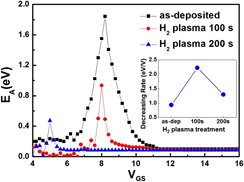
We report the effect of H2 plasma treatment on amorphous indium–gallium–zinc–oxide (a-IGZO) thin-film transistor (TFT). The changes in electrical characteristics and stability of the a-IGZO TFT treated by H2 plasma were evaluated under thermal stress. Each device exhibited a change in the subthreshold swing, turn on voltage shift, and hysteresis depending on the amount of hydrogen atom. It was found that there occurred a decrease of oxygen deficiency and an increase of hydrogen content in channel layer and channel/dielectric interface with increasing treatment time. The proper hydrogen dose well passivated the oxygen vacancies; however, more hydrogen dose acted as excessive donors. The change of oxygen vacancy and total trap charge were explained by the activation energy from Arrhenius plot. Through this study, we found that the optimized H2 plasma treatment brings device stability by affecting oxygen vacancy and trap content in channel bulk and channel/dielectric interface.
Amorphous titania thin films with increasing Fe content have been prepared by RF magnetron sputtering. X-ray absorption spectroscopy revealed modifications of both local structures/environment of the Ti and Fe atoms, with formation of phases containing amorphous material and a magnetite-like phase. The temperature dependence of the electrical conductivity of the films was investigated for temperatures higher than half of the Debye temperature (T > 391 K). It was found that the electrical conductivity in the amorphous Fe/TiO2 films obeys the Meyer–Neldel rule. The origin of this behavior is explained on the basis of the multiphonon-assisted hopping model.
High-density cobalt (Co) nanowires (NWs) were fabricated using porous anodized aluminum oxide as a template. Measurement results show a high magnetic performance for NWs with a coercivity of about 1750 Oe and strong magnetic anisotropy with an easy axis parallel to the NW direction. We have investigated the effect of alternating current (AC) electrodeposition frequency on the magnetic properties of NW samples. We show that understanding the effect of barrier layer is critical for controlling the rate of NW electrodeposition. A circuit model is proposed that accurately describes the role of the barrier and interfacial layers during deposition. Results obtained by simulation of the circuit show an excellent agreement with experimental results for different frequencies and voltages. It is shown that the amount of electrodeposited material can be estimated based on the difference between the anodic and cathodic half cycles in the electrodeposited current. Use of higher frequency leads to more symmetrical half cycles and smaller electrodeposited material.
The doping properties and stability of hydrogen in zinc oxide (ZnO) crystals have been investigated by cathodoluminescence (CL) spectroscopy. Hydrogen incorporation was achieved by hydrogen plasma at 200 °C. The ZnO near-band-edge (NBE) peak is dramatically enhanced, while the green emission at 2.4 eV is quenched with increasing hydrogen incorporation. These effects are attributed to hydrogen passivating green luminescence centers, which are most likely negatively charged zinc vacancy defects. E-beam irradiation of H-doped ZnO crystals by an intense electron beam with μW power reverses the hydrogen doping process. This effect is ascribed to the dissociation of H-related defects, formation of “hidden” H2, and electromigration of H+ under the influence of the local trapped charge-induced electric field. These results highlight the potential to modify the local luminescent properties of ZnO by e-beam irradiation.
A systematic evaluation of the electrical conductivity of Sr-substituted YAlO3 system has been performed. A comparison between the Ca- and Sr-doped YAlO3 systems is reported. The samples have been synthesized by citrate gel route, and the electrical conductivity measurements have been conducted in air in the 300–800 °C temperature range. The influence of phase development of the compositions on the total conductivity has been investigated using the x-ray diffraction technique. Also, the effect of microstructure and composition of the phases evolved on the electrical conductivity has been analyzed using scanning electron microscopy and energy dispersive spectrum techniques.
Copper–tin (CuxSn1−x) nanocluster is a promising system for gas sensing applications, mainly because of its sensitivity and selectivity for H2S. In this work, pure Sn and Cu as well as composite CuxSn1−x nanoclusters were synthesized using the dc magnetron sputtering gas condensation technique. Nanoclusters with different Sn to Cu ratios were produced by changing the ratio of Sn and Cu in the target. The dependence of Sn, Cu, and CuxSn1−x nanoclusters’ size distribution on various source parameters, such as the inert gas flow rate and aggregation length, has been investigated in detail. The results show that as the inert gas flow rate increases, the mean nanocluster size increases for Sn, decreases for Cu, while increases and then decreases for CuxSn1−x. The results could be understood in terms of the contribution percentage of the nanocluster formation mechanism. Furthermore, this work demonstrates the ability of tuning the CuxSn1−x nanoclusters’ size and composition by a proper optimization of the source operation conditions.
Chemical degradation of the side-chain of perfluorosulfonic acid (PFSA) membranes by hydroxyl radicals (•OH) is examined with electronic structure calculations. The energetics associated with homolytic bond cleavage and for the sequence of reactions involved in the degradation was determined. Results show that the degradation of side-chain begins with the cleavage of the C–S bond. The sequence of reactions of the side-chain with •OH indicates scission of the backbone yielding reactive end-groups. The kinetics of the C–S bond cleavage was studied via: (i) reaction of anionic fragment with a •OH; and (ii) decomposition of fragment radical. The activation energy for the second pathway was calculated to be ∼11 kcal/mol lower requiring a change in symmetry of the molecular geometry of the sulfonate group from trigonal pyramidal to trigonal planar. This suggests that although the C–S bond may be the weakest in the side chain of a PFSA ionomer, its cleavage is kinetically hindered.
The compilation of measured effective rate constants for oxygen surface exchange on mixed conducting perovskites, which covers a great variety of compositions ranging from (La,Sr)MnO3−δ to (La,Sr)(Co,Fe)O3−δ and (Ba,Sr)(Co,Fe)O3−δ, demonstrates the importance of ionic conductivity—i.e., high oxygen vacancy concentration as well as vacancy mobility—as a key factor for the surface oxygen exchange rate. This interpretation is corroborated by ab initio calculations, which indicate that the approach of an oxygen vacancy to oxygen intermediates adsorbed on the surface is the rate determining step for a number of perovskites.
Effects of Ti and Si particle sizes on phase transformations of Ti–Si–Cu system were explored through differential thermal analysis (DTA), x-ray diffraction (XRD), and field emission scanning electron microscope (FESEM). For Ti[15]Si[15]Cu[45] system, fine Ti easily dissolves into Si–Cu liquid to form Ti–Si–Cu liquid at ∼795 °C, which further participates into the reaction of β-Ti and Si to yield abundant quantity of Ti5Si3 at ∼917 °C. For Ti[150]Si[15]Cu[45] system, nonetheless, the reaction of coarse Ti with Si–Cu liquid involves more difficulty in forming the ternary liquid , which is the causal factor for the delay in the formation of Ti5Si3 to ∼948 °C. For Ti[15]Si[150]Cu[45] system, coarse Si results in the formation of insufficient Si–Cu liquid initially, whereas Ti–Cu liquid forms at ∼960 °C instead, which further reacts with coarse Si to form Ti–Si–Cu liquid, and then Ti5Si3is precipitated from the liquid.