Refine search
Actions for selected content:
106129 results in Materials Science

Confined crystallization in polymer nanolayered films: A review
-
- Journal:
- Journal of Materials Research / Volume 27 / Issue 10 / 28 May 2012
- Published online by Cambridge University Press:
- 17 February 2012, pp. 1326-1350
- Print publication:
- 28 May 2012
-
- Article
- Export citation
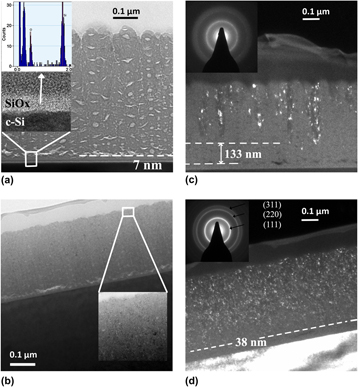
Effect of substrate bias on the promotion of nanocrystalline silicon growth from He-diluted SiH4 plasma at low temperature
-
- Journal:
- Journal of Materials Research / Volume 27 / Issue 9 / 14 May 2012
- Published online by Cambridge University Press:
- 16 February 2012, pp. 1303-1313
- Print publication:
- 14 May 2012
-
- Article
- Export citation

Oscillatory thickness dependences of the Seebeck coefficient in nanostructures based on compounds IV–VI
-
- Journal:
- Journal of Materials Research / Volume 27 / Issue 8 / 28 April 2012
- Published online by Cambridge University Press:
- 16 February 2012, pp. 1157-1163
- Print publication:
- 28 April 2012
-
- Article
- Export citation

Effects of geometric and crystal structures on the photoelectrical properties of highly ordered TiO2 nanotube arrays
-
- Journal:
- Journal of Materials Research / Volume 27 / Issue 7 / 14 April 2012
- Published online by Cambridge University Press:
- 16 February 2012, pp. 1029-1036
- Print publication:
- 14 April 2012
-
- Article
- Export citation
JMR volume 27 issue 4 Cover and Back matter
-
- Journal:
- Journal of Materials Research / Volume 27 / Issue 4 / 28 February 2012
- Published online by Cambridge University Press:
- 13 February 2012, pp. b1-b3
- Print publication:
- 28 February 2012
-
- Article
-
- You have access
- Export citation
Standing porous ZnO nanoplate-built hollow microspheres and kinetically controlled dissolution/crystal growth mechanism
-
- Journal:
- Journal of Materials Research / Volume 27 / Issue 6 / 28 March 2012
- Published online by Cambridge University Press:
- 13 February 2012, pp. 951-958
- Print publication:
- 28 March 2012
-
- Article
- Export citation
-
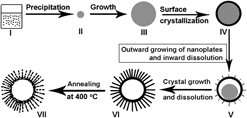
The standing porous nanoplate-built ZnO hollow microspheres with micro/nanostructure are fabricated based on a modified hydrothermal strategy, using citrate as structural director, and subsequent annealing treatment. The hollow spheres are composed of the vertically standing and cross-linked single crystalline porous nanoplates with the exposed surface of nonpolar (10
 0) planes. Experiments have revealed the structural evolution: the formation of amorphous spheres in the initial reaction stage, followed by surface crystallization and nanoplate outward growth accompanied by inward dissolution of the amorphous spheres. Citrate in the precursor solution plays a dominant role in the formation of such porous ZnO hollow spheres. A model is presented, based on citrate-induced amorphous sphere formation and kinetically controlled dissolution and crystal growth. The model describes the formation of the hollow spheres, thermodynamically and kinetically.
 0) planes. Experiments have revealed the structural evolution: the formation of amorphous spheres in the initial reaction stage, followed by surface crystallization and nanoplate outward growth accompanied by inward dissolution of the amorphous spheres. Citrate in the precursor solution plays a dominant role in the formation of such porous ZnO hollow spheres. A model is presented, based on citrate-induced amorphous sphere formation and kinetically controlled dissolution and crystal growth. The model describes the formation of the hollow spheres, thermodynamically and kinetically.
JMR volume 27 issue 4 Cover and Front matter
-
- Journal:
- Journal of Materials Research / Volume 27 / Issue 4 / 28 February 2012
- Published online by Cambridge University Press:
- 13 February 2012, pp. f1-f4
- Print publication:
- 28 February 2012
-
- Article
-
- You have access
- Export citation

Development of a Bi2Te3-based thermoelectric generator with high-aspect ratio, free-standing legs
-
- Journal:
- Journal of Materials Research / Volume 27 / Issue 8 / 28 April 2012
- Published online by Cambridge University Press:
- 13 February 2012, pp. 1149-1156
- Print publication:
- 28 April 2012
-
- Article
- Export citation

Effects of Mg substitution on microstructure and electrical properties of NiMn2−xMgxO4 NTC ceramics
-
- Journal:
- Journal of Materials Research / Volume 27 / Issue 6 / 28 March 2012
- Published online by Cambridge University Press:
- 10 February 2012, pp. 928-931
- Print publication:
- 28 March 2012
-
- Article
- Export citation

Activation of plasmons and polarons in solar control cesium tungsten bronze and reduced tungsten oxide nanoparticles
-
- Journal:
- Journal of Materials Research / Volume 27 / Issue 6 / 28 March 2012
- Published online by Cambridge University Press:
- 10 February 2012, pp. 965-970
- Print publication:
- 28 March 2012
-
- Article
- Export citation
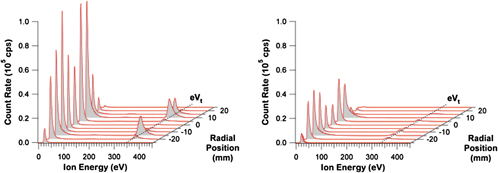
Reactive magnetron sputtering of transparent conductive oxide thin films: Role of energetic particle (ion) bombardment
-
- Journal:
- Journal of Materials Research / Volume 27 / Issue 5 / 14 March 2012
- Published online by Cambridge University Press:
- 08 February 2012, pp. 765-779
- Print publication:
- 14 March 2012
-
- Article
- Export citation
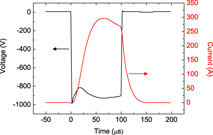
An introduction to thin film processing using high-power impulse magnetron sputtering
-
- Journal:
- Journal of Materials Research / Volume 27 / Issue 5 / 14 March 2012
- Published online by Cambridge University Press:
- 08 February 2012, pp. 780-792
- Print publication:
- 14 March 2012
-
- Article
- Export citation

Influence of laser interference patterning on microstructure and friction behavior of gold/yttria-stabilized zirconia nanocomposite thin films
-
- Journal:
- Journal of Materials Research / Volume 27 / Issue 6 / 28 March 2012
- Published online by Cambridge University Press:
- 07 February 2012, pp. 879-885
- Print publication:
- 28 March 2012
-
- Article
- Export citation

Monte Carlo simulations of crystallization in heterogeneous copolymers: The role of copolymer fractions with intermediate comonomer content
-
- Journal:
- Journal of Materials Research / Volume 27 / Issue 10 / 28 May 2012
- Published online by Cambridge University Press:
- 07 February 2012, pp. 1383-1388
- Print publication:
- 28 May 2012
-
- Article
- Export citation

Investigation on the atomic structural evolution of as-prepared and annealed ZrCuAl metallic glasses
-
- Journal:
- Journal of Materials Research / Volume 27 / Issue 8 / 28 April 2012
- Published online by Cambridge University Press:
- 07 February 2012, pp. 1164-1168
- Print publication:
- 28 April 2012
-
- Article
- Export citation
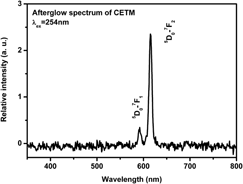
Enhancement on afterglow properties of Eu3+ by Ti4+, Mg2+ incorporation in CaWO4 matrix
-
- Journal:
- Journal of Materials Research / Volume 27 / Issue 6 / 28 March 2012
- Published online by Cambridge University Press:
- 07 February 2012, pp. 959-964
- Print publication:
- 28 March 2012
-
- Article
- Export citation

Characterization study of GaN-based epitaxial layer and light-emitting diode on nature-patterned sapphire substrate
-
- Journal:
- Journal of Materials Research / Volume 27 / Issue 6 / 28 March 2012
- Published online by Cambridge University Press:
- 06 February 2012, pp. 971-977
- Print publication:
- 28 March 2012
-
- Article
- Export citation
Crystal structure and microwave dielectric properties of low temperature sintered MgO ceramic with LiF addition
-
- Journal:
- Journal of Materials Research / Volume 27 / Issue 6 / 28 March 2012
- Published online by Cambridge University Press:
- 06 February 2012, pp. 915-921
- Print publication:
- 28 March 2012
-
- Article
- Export citation
-
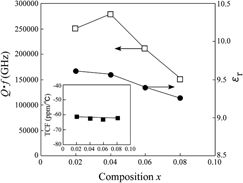
The (1−x)MgO–xLiF ceramics (x = 0.02–0.08) were successfully sintered when the ceramics were sintered at 950 °C for 4 h in covered crucible. From the crystal structure analysis, it was found that a small amount of Li+ cation occupied Mg2+ site in MgO ceramic; the formation of oxygen vacancy induced by Li substitution for Mg was suggested by the evaluation of the bulk conductivity and the calculation of density of state (DOS) for the (Mg13O43)−60 and (Mg11Li2O42)−58 cluster models. As for the microwave dielectric properties of the (1−x)MgO–xLiF ceramics, the dielectric constant εr and the temperature coefficient of resonant frequency values of the ceramic were independent of the lithium fluoride (LiF) content, and these values were approximately 9.5 and −62 ppm/°C. On the other hand, the quality factor
 values strongly depended on the LiF content. As a result, the highest
  value of 282,230 GHz was obtained at x = 0.04. From these results, it is determined that the LiF addition is effective in reducing the sintering temperature of MgO without any detrimental effect on the microwave dielectric properties of MgO ceramics.
 values strongly depended on the LiF content. As a result, the highest
  value of 282,230 GHz was obtained at x = 0.04. From these results, it is determined that the LiF addition is effective in reducing the sintering temperature of MgO without any detrimental effect on the microwave dielectric properties of MgO ceramics.
Control of the morphology and chemical properties of carbon spheres prepared from glucose by a hydrothermal method
-
- Journal:
- Journal of Materials Research / Volume 27 / Issue 8 / 28 April 2012
- Published online by Cambridge University Press:
- 02 February 2012, pp. 1117-1123
- Print publication:
- 28 April 2012
-
- Article
- Export citation
NSF announces new workplace flexibility policies: http://www.nsf.gov/career-life-balance
-
- Journal:
- MRS Bulletin / Volume 37 / Issue 2 / February 2012
- Published online by Cambridge University Press:
- 17 February 2012, p. 107
- Print publication:
- February 2012
-
- Article
-
- You have access
- HTML
- Export citation
