To save content items to your account,
please confirm that you agree to abide by our usage policies.
If this is the first time you use this feature, you will be asked to authorise Cambridge Core to connect with your account.
Find out more about saving content to .
To save content items to your Kindle, first ensure no-reply@cambridge.org
is added to your Approved Personal Document E-mail List under your Personal Document Settings
on the Manage Your Content and Devices page of your Amazon account. Then enter the ‘name’ part
of your Kindle email address below.
Find out more about saving to your Kindle.
Note you can select to save to either the @free.kindle.com or @kindle.com variations.
‘@free.kindle.com’ emails are free but can only be saved to your device when it is connected to wi-fi.
‘@kindle.com’ emails can be delivered even when you are not connected to wi-fi, but note that service fees apply.
In situ transmission electron microscopy (TEM) was carried out to investigate the dynamics of resistance switching in a solid electrolyte, Cu-Ge-S. By applying voltage to Pt-Ir/Cu-Ge-S/Pt-Ir, where Pt-Ir constituted the electrodes, a deposit containing conductive filaments composed mainly of Cu was formed around the cathode. As voltage continued to be applied, the deposit grew and finally narrow conductive filaments made contact with the anode. This corresponded to resistance switching from high- to low-resistance states (HRS and LRS). By alternating the voltage, the deposit contracted toward the cathode and detached from the anode. The resistance immediately changed from LRS to HRS. By applying voltage, the deposit containing Cu-based filaments grew and shrank, and resistance switching occurred at the electrolyte-anode interface. This conductive filament-formation model, which was recently reported, was experimentally confirmed with TEM through dynamic observations of the deposit-containing filaments.
Novel fluorine-doped zinc tin oxide (ZTO:F) thin-film transistors (TFTs) have been fabricated using an aqueous solution process. Exploiting hydrolysis and condensation reactions in an aqueous solution process, organic-free ZTO:F thin films were fabricated at a low temperature of 250 °C. The fabricated TFT device shows a field-effect mobility of 2.85 cm2/V s, on-to-off current ratios exceeding 107, and sub-threshold swings of 0.83 V/dec. The ZTO:F TFT also displays high operational stability of ΔVth = 1.73 V despite incorporation of a large amount of fluorine and use of a low-temperature annealing process. This is attributed to effective passivation of oxygen vacancy diffusion by metal fluoride bonds at the ZTO:F channel/gate dielectric interface.
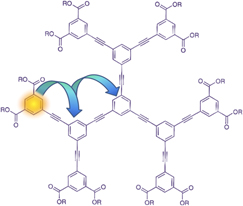
Multichromophoric dendrimers are increasingly being considered for solar energy systems. To design materials with suitably efficient photon collection demands a thorough understanding of crucial photophysical conditions and electrodynamic mechanisms, many of which prove to emulate photosynthetic systems. Key parameters include the chromophore absorption properties, the generation, branching and folding of the dendrimer, and the presence of a spectroscopic gradient. Driving excitation towards a trap, resonance energy transfer favors migration between nearest neighbor chromophores. In modeling the progress of excitation from antenna chromophores towards the trap, a propensity matrix method has broad applicability, giving physical insights of generic validity. Calculations on specific dendrimers are best served by quantum chemistry models; again, links with photobiological systems can be discerned. Two important optically nonlinear features are cooperative energy pooling, and two-photon energy transfer. Branch multiplicity and the polar or polarizable nature of the chromophores also play important roles in determining energy harvesting characteristics.
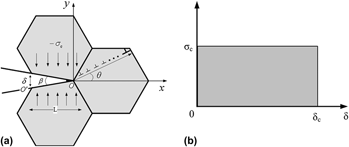
A combined dislocation–cohesive zone model was proposed to describe the fracture toughness of nanocrystalline (nc) materials. In the framework of the model, cohesive stress near crack tip initiates edge dislocations, which move to the opposite grain boundaries. The emitted dislocations provide a shielding effect of the crack. The dependence of both the maximum number of dislocations, emitted by a crack, and the critical stress intensity factor on grain size d (ranging from 20 to100 nm) for Cu was calculated. The calculated results show that (i) nc materials have low fracture toughness, (ii) the critical stress intensity factor decreases with decreased grain size, and (iii) the grain size effect is not high; for instance, increasing the grain size from 20 to 100 nm increases the value of critical stress intensity factor only by 0.035 MPa/m1/2.
Yttria-stabilized zirconia (YSZ)/Al2O3 multilayers deposited on Pt foil were studied by differential scanning calorimetry. Observed thermal effects were interpreted using additional evidence from x-ray diffraction and transmission electron microscopy. The crystallization temperature of YSZ increases from 344 to 404 °C as the layer thickness decreases from 15 to 4 nm. The enthalpy of crystallization becomes more exothermic with decreasing thickness, and it was measured to be −26 kJ/mol YSZ for 4-nm-thick layers and −12 kJ/mol for 15-nm-thick layers. The latter value is consistent with the reported crystallization enthalpy for YSZ powder of the same composition prepared by precipitation from aqueous solution. The more exothermic crystallization enthalpies for thinner films are indicative of a decrease in their degree of crystallinity. The 2–6-nm-thick Al2O3 layers remain amorphous when heated to 1000 °C. The described methodology enables thermal analysis of oxide thin films using commercial instruments.
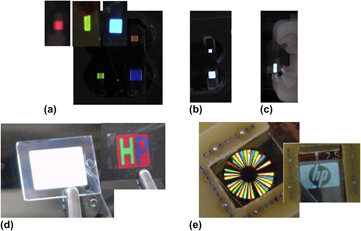
Recently, tremendous progress has been made toward the application of organic light-emitting diodes (OLEDs) in full color flat panel displays and other devices. This article reviews and discusses our recent progress in extended development of emissive semi-interpenetrating polymer networks (E-semi-IPNs) and hybrid quantum dots (QDs)–polymer nanocomposites for use in multicolor and multilayer OLED pixels through low-cost solution processing. Our semi-IPNs with high solvent resistance, containing an inert polymer network and conjugated polymers, served in different layers of OLED devices. These semi-IPNs do not require complicated chemical modification to OLED materials; therefore, many state-of-the-arts conjugated polymers can be utilized to achieve red–green–blue and white OLEDs by tuning formulations. Our research findings on hybrid QD–oligomer nanocomposites lead to the successful design and synthesis of QD–polymer hybrid nanocomposites, which were used to build proof-of-the-concept devices showing good promise in providing excellent color purity and stability from QDs and solution processability from hybrid nanocomposites.
A common fingerprint of the electrically active point defects in semiconductors is the transition among their localized defect states upon excitation, which may result in characteristic absorption- or photoluminescence spectrum. Identification of such point defects by means of density functional theory (DFT) calculations with traditional (semi) local functionals suffers from two problems: the “band gap error” and the many-body nature of the electron-hole interaction of the excited state. We show that non local hybrid density functionals may effectively mimic the quasiparticle correction of the band edges and the defect levels within the band gap in group-IV semiconductors, thus they can effectively heal the “band gap error.” The electron-hole interaction can be calculated by time-dependent DFT (TD-DFT) method. Here, we apply TD-DFT on three topical examples: nitrogen-vacancy defect in diamond, silicon-vacancy and divacancy defects in silicon carbide that are candidates in effective development of solid-state quantum bits.
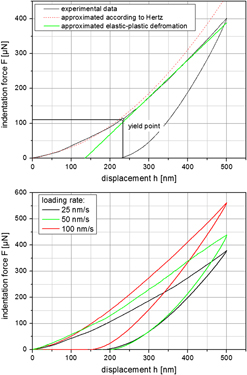
Depending on the application of nanoparticles, certain characteristics of the product quality such as size, morphology, abrasion resistance, specific surface, and tendency to agglomeration are important. These characteristics are a function of the physicochemical properties of the nanostructured material and, thus, of the process parameters of the particle synthesis. Because of econimical reasons in large-scale production such as pyrolysis or precipitation processes, nanosized particles are produced not as single primary particles but rather as aggregates or agglomerates. The application properties of these aggregates are strongly affected by the micromechanical properties, which can be measured via nanoindentation. In this study, a flat punch method was used. For the measurements, model aggregates out of sol–gel produced silica with varying primary particle size and strength of solid bonds were used. Generally, the micromechanical properties can be characterized by measuring the micromechanical properties via nanoindentation and be described by different theoretical models.
Transmission electron microscopy (polycrystalline electron diffraction, nanoelectron diffraction, and energy dispersive x-ray spectroscopy) was used to determine the dispersion of crystal phase and Nb dopants in mixed-phase (anatase and rutile) Ti1−xNbyO2 thin films prepared by reactive sputtering. When co-sputtering mixed-phase TiO2 with a dopant, it is unclear how the crystal phases are distributed within thin film structures, what the dominant interfaces are, and how the dopant is distributed within the crystal phases. In the Ti1−xNbyO2 films, anatase and rutile grains were found to be homogeneously dispersed indicating that anatase/rutile interfaces are the dominant interfaces. Anatase/rutile interfaces are a critical feature of mixed-phase materials which impart high reactivity to the composite. Nb homogeneously dispersed at low concentrations, but at high concentrations, Nb segregated in the rutile phase. There is an apparent threshold beyond which Nb segregates according to its higher solubility in rutile due to a better lattice fit.
Electrophoretic displays (EPDs) are attracting a great deal of academic and commercial interest due to the advantages of both electronic displays and conventional paper. The key materials for EPD application of microcapsules are the electrophoretic particles and the capsule wall enwrapping the electrophoretic suspension inside. Here, black and white electrophoretic particles with low density and good dispersity such as titanium dioxide, carbon black, and Cu2Cr2O3 were prepared by surface modification of the pigments. The preparation and properties of the gelatin-based microcapsules prepared by complex coacervation methods are also summarized. The microcapsules have transparent and elastic walls of compact structure, which endows them with good barrier properties and thermal stability for EPD application. EPD prototype devices based on the obtained microcapsules were prepared and could be driven at 9 V.
Microcompression tests were performed on the Al/Nb multilayers of incoherent interfaces with the layer thicknesses of 5 nm Al/5 nm Nb and 50 nm Al/50 nm Nb. The Al-Nb multilayers showed increase in strength as the layer thickness was reduced; the average flow stresses at 5% plastic strain from the 5 nm Al/5 nm Nb and 50 nm Al/50 nm Nb layer thickness specimens were determined to be 2.1 GPa and 1.4 GPa respectively. The results from this Al-Nb microcompression study were compared with those of the previous report on Cu-Nb multilayer microcompression results that indicated that the flow stresses of the Al-Nb multilayer are lower than those of Cu-Nb with the same bilayer spacing. The observed difference in strength was attributed to a potential difference in the interfacial strength of the two incoherent multilayer systems.
We have demonstrated resistance switching using polycrystalline HfO2 film with a Cu top electrode for nonvolatile memory applications and revealed the Cu diffusion into the HfO2 layer during the filament formation process. Resistive switching was clearly observed in the Cu/HfO2/Pt structure by performing a current–voltage measurement. The current step from a high-resistive state to a low-resistive state was of the order of 103–104 Ω, which provided a sufficient on/off ratio for use as a switching device. The filament formation process was investigated by employing hard x-ray photoelectron spectroscopy under bias operation. The application of a bias to the structure reduced the Cu2O state at the interface and the intensity ratio of Cu 2p3/2/Hf 3d5/2, providing evidence of Cu2O reduction and Cu diffusion into the HfO2 layer. These results also provide evidence that the resistance switching of the Cu/HfO2/Pt structure originates in a solid electrolyte (nanoionics model) containing Cu ions.
The dielectric properties and tunability with external magnetic and electric fields for LuFe2-xMnxO4 (0 ≤ x ≤ 1) are systematically studied. It was found that the dielectric loss, the ferrimagnetic Curie temperature, and the conductivity reduce with increasing Mn doping. One of the most important results is that the room temperature dielectric tunability with low magnetic and electric fields can be achieved in these samples. The analysis demonstrates that the electron transfer between Fe2+ and Fe3+ is efficiently suppressed with Mn doping and thus results in the decreases of the leaky conductivity and the dielectric loss. Furthermore, from the studies on the combination of impedance and modulus complex planes for the samples with different electrodes, the tunability is found to be more closely related to the extrinsic effect than the intrinsic bulk effect.