Refine search
Actions for selected content:
26076 results in Abstract analysis
Closed geodesies on compact Lorentzian manifolds of splitting type
-
- Journal:
- Proceedings of the Royal Society of Edinburgh. Section A: Mathematics / Volume 128 / Issue 3 / 1998
- Published online by Cambridge University Press:
- 14 November 2011, pp. 447-462
- Print publication:
- 1998
-
- Article
- Export citation
-
In this paper, we consider the problem of the existence of a spacelike closed geodesic on compact Lorentzian manifolds. Tipler and Galloway proved that, under suitable topological properties of the manifold, there exists a closed timelike geodesic. In their proofs, they use the hypothesis that the time coordinate of one timelike geodesic has derivative always different from zero. This clearly fails for spacelike geodesies. Using variational methods and applying the relative category theory, we prove the existence of a closed spacelike geodesic on a compact manifold
 of splitting type. Observe that, thanks to the previous results, the existence of at least two geometrically distinct closed geodesies on follows.
 of splitting type. Observe that, thanks to the previous results, the existence of at least two geometrically distinct closed geodesies on
 The critical exponents of parabolic equations and blow-up in Rn
-
- Journal:
- Proceedings of the Royal Society of Edinburgh. Section A: Mathematics / Volume 128 / Issue 1 / 1998
- Published online by Cambridge University Press:
- 14 November 2011, pp. 123-136
- Print publication:
- 1998
-
- Article
- Export citation
Rank one plus a null-Lagrangian is an inherited property of two-dimensional compliance tensors under homogenisation
-
- Journal:
- Proceedings of the Royal Society of Edinburgh. Section A: Mathematics / Volume 128 / Issue 2 / 1998
- Published online by Cambridge University Press:
- 14 November 2011, pp. 283-299
- Print publication:
- 1998
-
- Article
- Export citation
Multibump periodic travelling waves in suspension bridges
-
- Journal:
- Proceedings of the Royal Society of Edinburgh. Section A: Mathematics / Volume 128 / Issue 3 / 1998
- Published online by Cambridge University Press:
- 14 November 2011, pp. 631-659
- Print publication:
- 1998
-
- Article
- Export citation
Focusing blow-up for quasilinear parabolic equations
-
- Journal:
- Proceedings of the Royal Society of Edinburgh. Section A: Mathematics / Volume 128 / Issue 5 / 1998
- Published online by Cambridge University Press:
- 14 November 2011, pp. 965-992
- Print publication:
- 1998
-
- Article
- Export citation
-
We study the behaviour of the non-negative blowing up solutions to the quasilinear parabolic equation with a typical reaction–diffusion right-hand side and with a singularity in the space variable which takes the form

where m ≧ 1, p > 1 are arbitrary constants, in the critical exponent case q = (p–1)/m > 0. We impose zero Dirichlet boundary conditions at the singular point x = 0 and at x = 1, and take large initial data. For a class of ‘concave’ initial functions, we prove focusing at the origin of the solutions as t approaches the blow-up time T in the sense that x = 0 belongs to the blow-up set. The proof is based on an application of the intersection comparison method with an explicit ‘separable’ solution which has the same blow-up time as u. The method has a natural generalisation to the case of more general nonlinearities in the equation. A description of different fine structures of blow-up patterns in the semilinear case m = 1 and in the quasilinear one m > 1 is also presented. A numerical study of the semilinear equation is also made using an adaptive collocation method. This is shown to give very close agreement with the fine structure predicted and allows us to make some conjectures about the general behaviour.
Liouville theorems for elliptic inequalities and applications
-
- Journal:
- Proceedings of the Royal Society of Edinburgh. Section A: Mathematics / Volume 128 / Issue 6 / 1998
- Published online by Cambridge University Press:
- 14 November 2011, pp. 1217-1247
- Print publication:
- 1998
-
- Article
- Export citation
PRM volume 128 issue 2 Cover and Back matter
-
- Journal:
- Proceedings of the Royal Society of Edinburgh. Section A: Mathematics / Volume 128 / Issue 2 / 1998
- Published online by Cambridge University Press:
- 14 November 2011, pp. b1-b2
- Print publication:
- 1998
-
- Article
-
- You have access
- Export citation
Weighted Lorentz norm inequalities for general maximal operators associated with certain families of Borel measures
-
- Journal:
- Proceedings of the Royal Society of Edinburgh. Section A: Mathematics / Volume 128 / Issue 2 / 1998
- Published online by Cambridge University Press:
- 14 November 2011, pp. 403-424
- Print publication:
- 1998
-
- Article
- Export citation
-
Given a certain family ℱ of positive Borel measures and γ ∈ [0, 1), we define a general onesided maximal operator
 and we study weighted inequalities in Lp,q spaces for these operators. Our results contain, as particular cases, the characterisation of weighted Lorentz norm inequalities for some well-known one-sided maximal operators such as the one-sided Hardy–Littlewood maximal operator associated with a general measure
  , the one-sided fractional maximal operator
  and the maximal operator
  associated with the Cesèro-α averages.
 and we study weighted inequalities in L
 , the one-sided fractional maximal operator
  and the maximal operator
  associated with the Cesèro-α averages.
Generic affine differential geometry of space curves
-
- Journal:
- Proceedings of the Royal Society of Edinburgh. Section A: Mathematics / Volume 128 / Issue 2 / 1998
- Published online by Cambridge University Press:
- 14 November 2011, pp. 301-314
- Print publication:
- 1998
-
- Article
- Export citation
Remarks on the Hardy–Littlewood maximal function
-
- Journal:
- Proceedings of the Royal Society of Edinburgh. Section A: Mathematics / Volume 128 / Issue 1 / 1998
- Published online by Cambridge University Press:
- 14 November 2011, pp. 1-9
- Print publication:
- 1998
-
- Article
- Export citation
On a problem of Hartman and Wintner
-
- Journal:
- Proceedings of the Royal Society of Edinburgh. Section A: Mathematics / Volume 128 / Issue 5 / 1998
- Published online by Cambridge University Press:
- 14 November 2011, pp. 1007-1022
- Print publication:
- 1998
-
- Article
- Export citation
A multi-phase Mullins–Sekerka system: matched asymptotic expansions and an implicit time discretisation for the geometric evolution problem
-
- Journal:
- Proceedings of the Royal Society of Edinburgh. Section A: Mathematics / Volume 128 / Issue 3 / 1998
- Published online by Cambridge University Press:
- 14 November 2011, pp. 481-506
- Print publication:
- 1998
-
- Article
- Export citation
Spectral asymptotics with a remainder estimate of the Neumann Laplacian on horns: the case of the rapidly growing counting function
-
- Journal:
- Proceedings of the Royal Society of Edinburgh. Section A: Mathematics / Volume 128 / Issue 1 / 1998
- Published online by Cambridge University Press:
- 14 November 2011, pp. 11-22
- Print publication:
- 1998
-
- Article
- Export citation
-
We study the Neumann Laplacian
 in unbounded regions of the form Ω = {(t, x) | t >O,f(t)−1x ∊ Ω′}, where Ω′ ⊂ ℝn−1 is a bounded open set with the Lipschitz boundary and f decays in such a way that the spectrum of is discrete but the counting function N(λ, ) of the spectrum grows faster than a power of λ, a typical example being f(t) = exp (– t In … In t), for t ≧ t0. We compute the principal term of the asymptotics of N(λ, ), with a remainder estimate.
 in unbounded regions of the form Ω = {(t, x) | t >O,f(t)
Convergence rates to travelling waves for a nonconvex relaxation model
-
- Journal:
- Proceedings of the Royal Society of Edinburgh. Section A: Mathematics / Volume 128 / Issue 5 / 1998
- Published online by Cambridge University Press:
- 14 November 2011, pp. 1053-1068
- Print publication:
- 1998
-
- Article
- Export citation
A Ginzburg–Landau problem with weight having minima on the boundary
-
- Journal:
- Proceedings of the Royal Society of Edinburgh. Section A: Mathematics / Volume 128 / Issue 6 / 1998
- Published online by Cambridge University Press:
- 14 November 2011, pp. 1181-1215
- Print publication:
- 1998
-
- Article
- Export citation
-
In this paper, we study the following Ginzburg–Landau functional:

where
 (G, C), and p is a smooth bounded and non-negative map, having minima on the boundary of Ḡ. We give the location of the singularities in the case where the degree around each singularity is equal to 1.
 (G, C), and p is a smooth bounded and non-negative map, having minima on the boundary of Ḡ. We give the location of the singularities in the case where the degree around each singularity is equal to 1.
Convergence of regular approximations to the spectra of singular fourth-order Sturm–Liouville problems
-
- Journal:
- Proceedings of the Royal Society of Edinburgh. Section A: Mathematics / Volume 128 / Issue 5 / 1998
- Published online by Cambridge University Press:
- 14 November 2011, pp. 907-944
- Print publication:
- 1998
-
- Article
- Export citation
PRM volume 128 issue 4 Cover and Front matter
-
- Journal:
- Proceedings of the Royal Society of Edinburgh. Section A: Mathematics / Volume 128 / Issue 4 / 1998
- Published online by Cambridge University Press:
- 14 November 2011, pp. f1-f2
- Print publication:
- 1998
-
- Article
-
- You have access
- Export citation
PRM volume 128 issue 4 Cover and Back matter
-
- Journal:
- Proceedings of the Royal Society of Edinburgh. Section A: Mathematics / Volume 128 / Issue 4 / 1998
- Published online by Cambridge University Press:
- 14 November 2011, pp. b1-b2
- Print publication:
- 1998
-
- Article
-
- You have access
- Export citation
Shape optimisation problems governed by nonlinear state equations
-
- Journal:
- Proceedings of the Royal Society of Edinburgh. Section A: Mathematics / Volume 128 / Issue 5 / 1998
- Published online by Cambridge University Press:
- 14 November 2011, pp. 945-963
- Print publication:
- 1998
-
- Article
- Export citation
Uniqueness of positive solutions of a quasilinear Dirichlet problem with exponential nonlinearity
-
- Journal:
- Proceedings of the Royal Society of Edinburgh. Section A: Mathematics / Volume 128 / Issue 5 / 1998
- Published online by Cambridge University Press:
- 14 November 2011, pp. 895-906
- Print publication:
- 1998
-
- Article
- Export citation
-
Uniqueness of positive solutions of the following equation:
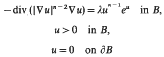
has been obtained, where B ⊂ ℝn is the ball of unit radius and λ > 0. Moreover, if n = 2, then the solutions are nondegenerate.
