Refine search
Actions for selected content:
26076 results in Abstract analysis
The effective bulk energy of the relaxed energy of multiple integrals below the growth exponent
-
- Journal:
- Proceedings of the Royal Society of Edinburgh. Section A: Mathematics / Volume 128 / Issue 3 / 1998
- Published online by Cambridge University Press:
- 14 November 2011, pp. 463-479
- Print publication:
- 1998
-
- Article
- Export citation
-
The characterisation of the bulk energy density of the relaxation in W1, P(Ω; ℝd) of a functional
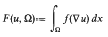
is obtained for p > q – q/N, where u ∈ W1, P(Ω; ℝd), and f is a continuous function on the set of d × N matrices verifying
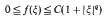
for some constant C > 0 and 1 ≦ q < + ∞. Typical examples may be found in cavitation and related theories. Standard techniques cannot be used due to the gap between the exponent q of the growth condition and the exponent p of the integrability of the macroscopic strain ∇u. A recently introduced global method for relaxation and fine Sobolev trace and extension theorems are applied.
Sharp inequalities for maximal functions associated with general measures
-
- Journal:
- Proceedings of the Royal Society of Edinburgh. Section A: Mathematics / Volume 128 / Issue 4 / 1998
- Published online by Cambridge University Press:
- 14 November 2011, pp. 717-723
- Print publication:
- 1998
-
- Article
- Export citation
A semilinear heat equation with singular initial data
-
- Journal:
- Proceedings of the Royal Society of Edinburgh. Section A: Mathematics / Volume 128 / Issue 4 / 1998
- Published online by Cambridge University Press:
- 14 November 2011, pp. 745-758
- Print publication:
- 1998
-
- Article
- Export citation
-
We first prove existence and uniqueness of non-negative solutions of the equation
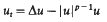
in
 in the range 1 < p < 1 + 2/N, when initial data u(x, 0) = a|x|−2(p−1), x ≠ 0, for a > 0. It is proved that the maximal and minimal solutions are self-similar with the form
where g = ga satisfies

After uniqueness is proved, the asymptotic behaviour of solutions of

is studied. In particular, we show that

The case for a = 0 is also considered and a sharp decay rate of the above equation is derived. In the final, we reveal existence of solutions of the first and third equations above, which change sign.
 in the range 1 < p < 1 + 2/N, when initial data u(x, 0) = a|x|
Extension of a Theorem of Zygmund*
-
- Journal:
- Proceedings of the Royal Society of Edinburgh. Section A: Mathematics / Volume 128 / Issue 2 / 1998
- Published online by Cambridge University Press:
- 14 November 2011, pp. 425-432
- Print publication:
- 1998
-
- Article
- Export citation
PRM volume 128 issue 5 Cover and Front matter
-
- Journal:
- Proceedings of the Royal Society of Edinburgh. Section A: Mathematics / Volume 128 / Issue 5 / 1998
- Published online by Cambridge University Press:
- 14 November 2011, pp. f1-f2
- Print publication:
- 1998
-
- Article
-
- You have access
- Export citation
Variational perturbative methods and bifurcation of bound states from the essential spectrum*
-
- Journal:
- Proceedings of the Royal Society of Edinburgh. Section A: Mathematics / Volume 128 / Issue 6 / 1998
- Published online by Cambridge University Press:
- 14 November 2011, pp. 1131-1161
- Print publication:
- 1998
-
- Article
- Export citation
Fragmentation–diffusion model. Existence of solutions and their asymptotic behaviour*
-
- Journal:
- Proceedings of the Royal Society of Edinburgh. Section A: Mathematics / Volume 128 / Issue 4 / 1998
- Published online by Cambridge University Press:
- 14 November 2011, pp. 759-774
- Print publication:
- 1998
-
- Article
- Export citation
Maximum and anti-maximum principles for singular Sturm–Liouville problems*
-
- Journal:
- Proceedings of the Royal Society of Edinburgh. Section A: Mathematics / Volume 128 / Issue 3 / 1998
- Published online by Cambridge University Press:
- 14 November 2011, pp. 525-547
- Print publication:
- 1998
-
- Article
- Export citation
-
The maximum and anti-maximum principles are extended to the case of eigenvalue Sturm–Liouville problems

with boundary conditions of Dirichlet type (if possible) on a bounded interval [a, b]. The function r is assumed to be continuous and > 0 on ]a, b[, but the function 1/r is not necessarily integrable on [a, b]. The conditions on the functions p, m and h depend on the integrability or nonintegrability of 1/r on [a, c] and/or [c, b], for some c ∈ ]a, b[. The weight function m is not necessarily of constant sign.
On invariant subspaces for nonlinear finite-difference operators
-
- Journal:
- Proceedings of the Royal Society of Edinburgh. Section A: Mathematics / Volume 128 / Issue 6 / 1998
- Published online by Cambridge University Press:
- 14 November 2011, pp. 1293-1308
- Print publication:
- 1998
-
- Article
- Export citation
On the essential self-adjointness of Schrödinger operators with locally integrable potentials
-
- Journal:
- Proceedings of the Royal Society of Edinburgh. Section A: Mathematics / Volume 128 / Issue 1 / 1998
- Published online by Cambridge University Press:
- 14 November 2011, pp. 95-106
- Print publication:
- 1998
-
- Article
- Export citation
Gradient-like parabolic semiflows on BUC(ℝN)
-
- Journal:
- Proceedings of the Royal Society of Edinburgh. Section A: Mathematics / Volume 128 / Issue 6 / 1998
- Published online by Cambridge University Press:
- 14 November 2011, pp. 1281-1291
- Print publication:
- 1998
-
- Article
- Export citation
The Number of m-ary Search Trees on n Keys
-
- Journal:
- Combinatorics, Probability and Computing / Volume 6 / Issue 4 / December 1997
- Published online by Cambridge University Press:
- 01 December 1997, pp. 435-453
-
- Article
- Export citation
Constructive Upper Bounds for the Turán Number
-
- Journal:
- Combinatorics, Probability and Computing / Volume 6 / Issue 4 / December 1997
- Published online by Cambridge University Press:
- 01 December 1997, pp. 475-479
-
- Article
- Export citation
On the asymptotic expansion of certain functions defined by infinite series
- Part of
-
- Journal:
- Mathematika / Volume 44 / Issue 2 / December 1997
- Published online by Cambridge University Press:
- 26 February 2010, pp. 401-418
- Print publication:
- December 1997
-
- Article
- Export citation
There are 913 regular ternary forms
-
- Journal:
- Mathematika / Volume 44 / Issue 2 / December 1997
- Published online by Cambridge University Press:
- 26 February 2010, pp. 332-341
- Print publication:
- December 1997
-
- Article
- Export citation
Non-isothermal flows in porous media with curing
-
- Journal:
- European Journal of Applied Mathematics / Volume 8 / Issue 6 / December 1997
- Published online by Cambridge University Press:
- 01 December 1997, pp. 623-637
-
- Article
- Export citation
The Zero-Free Intervals for Chromatic Polynomials of Graphs
-
- Journal:
- Combinatorics, Probability and Computing / Volume 6 / Issue 4 / December 1997
- Published online by Cambridge University Press:
- 01 December 1997, pp. 497-506
-
- Article
- Export citation
Triangle-Free Graphs with Large Degree
-
- Journal:
- Combinatorics, Probability and Computing / Volume 6 / Issue 4 / December 1997
- Published online by Cambridge University Press:
- 01 December 1997, pp. 381-396
-
- Article
- Export citation
The structure of Rabinowitz' global bifurcating continua for problems with weak nonlinearities
- Part of
-
- Journal:
- Mathematika / Volume 44 / Issue 2 / December 1997
- Published online by Cambridge University Press:
- 26 February 2010, pp. 419-433
- Print publication:
- December 1997
-
- Article
- Export citation
Free boundary value problems associated with the growth and development of multicellular spheroids
-
- Journal:
- European Journal of Applied Mathematics / Volume 8 / Issue 6 / December 1997
- Published online by Cambridge University Press:
- 01 December 1997, pp. 639-658
-
- Article
- Export citation
