Refine search
Actions for selected content:
26076 results in Abstract analysis
A note on the separation of slow viscous flow near a sharp edge
- Part of
-
- Journal:
- Mathematika / Volume 44 / Issue 2 / December 1997
- Published online by Cambridge University Press:
- 26 February 2010, pp. 239-244
- Print publication:
- December 1997
-
- Article
- Export citation
Recovering Set Systems and Graph Entropy
-
- Journal:
- Combinatorics, Probability and Computing / Volume 6 / Issue 4 / December 1997
- Published online by Cambridge University Press:
- 01 December 1997, pp. 481-491
-
- Article
- Export citation
The stability of the Strokes layer in periodic orbital flow around a circular cylinder
- Part of
-
- Journal:
- Mathematika / Volume 44 / Issue 2 / December 1997
- Published online by Cambridge University Press:
- 26 February 2010, pp. 225-238
- Print publication:
- December 1997
-
- Article
- Export citation
Strong shift equivalence of 2 by 2 non-negative integral matrices
- Part of
-
- Journal:
- Mathematika / Volume 44 / Issue 2 / December 1997
- Published online by Cambridge University Press:
- 26 February 2010, pp. 302-312
- Print publication:
- December 1997
-
- Article
- Export citation
Maximal Spacing Configurations in Graphs
-
- Journal:
- Combinatorics, Probability and Computing / Volume 6 / Issue 4 / December 1997
- Published online by Cambridge University Press:
- 01 December 1997, pp. 455-463
-
- Article
- Export citation
Radial variation of functions in Dirichlet-type spaces
- Part of
-
- Journal:
- Mathematika / Volume 44 / Issue 2 / December 1997
- Published online by Cambridge University Press:
- 26 February 2010, pp. 267-277
- Print publication:
- December 1997
-
- Article
- Export citation
-
Let W denote a positive, increasing and continuous function on [1, ∞]. We write
 to denote the Dirichlettype space of functions f that are holomorphic in the unit disc
  and for which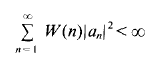
Where
 If W(x) = x for all x, then is the classicial Dirichlet space for which
  Note also that
  for every
  so, by Fatu's theoreum, every function in . ha finite radial(and angular) limits a.e. on the boundary of U. The question of the existence a.e. on ∂U of certain tangential limits for functions in has been considered in [6,11], but we shall be concerned here with the radial variation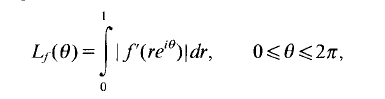
i.e., the length of the image of the ray from 0 to eiθ under the mapping w = f(z), and, in particular, with the size of the set of values of θ for which Lf(θ) can be infinite when

 to denote the Dirichlettype space of functions f that are holomorphic in the unit disc
  and for which
 If W(x) = x for all x, then
  Note also that
  for every
  so, by Fatu's theoreum, every function in

The light fluid loading limit for fluid/solid interactions
-
- Journal:
- European Journal of Applied Mathematics / Volume 8 / Issue 5 / October 1997
- Published online by Cambridge University Press:
- 01 October 1997, pp. 485-505
-
- Article
- Export citation
Analysis of thermostat models
-
- Journal:
- European Journal of Applied Mathematics / Volume 8 / Issue 5 / October 1997
- Published online by Cambridge University Press:
- 01 October 1997, pp. 437-455
-
- Article
- Export citation
Source-type solutions to thin-film equations in higher dimensions
-
- Journal:
- European Journal of Applied Mathematics / Volume 8 / Issue 5 / October 1997
- Published online by Cambridge University Press:
- 01 October 1997, pp. 507-524
-
- Article
- Export citation
Critical exponent in a Stefan problem with kinetic condition
-
- Journal:
- European Journal of Applied Mathematics / Volume 8 / Issue 5 / October 1997
- Published online by Cambridge University Press:
- 01 October 1997, pp. 525-532
-
- Article
- Export citation
The influence of material non-uniformity preceding shear-band formation in a model for granular flow
-
- Journal:
- European Journal of Applied Mathematics / Volume 8 / Issue 5 / October 1997
- Published online by Cambridge University Press:
- 01 October 1997, pp. 457-483
-
- Article
- Export citation
Bipartite Coverings of Graphs
-
- Journal:
- Combinatorics, Probability and Computing / Volume 6 / Issue 3 / September 1997
- Published online by Cambridge University Press:
- 01 September 1997, pp. 349-352
-
- Article
- Export citation
Dependent Sets of Constant Weight Binary Vectors
-
- Journal:
- Combinatorics, Probability and Computing / Volume 6 / Issue 3 / September 1997
- Published online by Cambridge University Press:
- 01 September 1997, pp. 263-271
-
- Article
- Export citation
Crossing Numbers and Hard Erdős Problems in Discrete Geometry
-
- Journal:
- Combinatorics, Probability and Computing / Volume 6 / Issue 3 / September 1997
- Published online by Cambridge University Press:
- 01 September 1997, pp. 353-358
-
- Article
- Export citation
Limit Laws for the Optimal Directed Tree with Random Costs
-
- Journal:
- Combinatorics, Probability and Computing / Volume 6 / Issue 3 / September 1997
- Published online by Cambridge University Press:
- 01 September 1997, pp. 315-335
-
- Article
- Export citation
Triangle Factors in Random Graphs
-
- Journal:
- Combinatorics, Probability and Computing / Volume 6 / Issue 3 / September 1997
- Published online by Cambridge University Press:
- 01 September 1997, pp. 337-347
-
- Article
- Export citation
Log-Concavity and the Spectral Gap of Stochastic Matrices
-
- Journal:
- Combinatorics, Probability and Computing / Volume 6 / Issue 3 / September 1997
- Published online by Cambridge University Press:
- 01 September 1997, pp. 371-379
-
- Article
- Export citation
Hamiltonian Cycles Avoiding Prescribed Arcs in Tournaments
-
- Journal:
- Combinatorics, Probability and Computing / Volume 6 / Issue 3 / September 1997
- Published online by Cambridge University Press:
- 01 September 1997, pp. 255-261
-
- Article
- Export citation
On Medians of Lattice Distributions and a Game with Two Dice
-
- Journal:
- Combinatorics, Probability and Computing / Volume 6 / Issue 3 / September 1997
- Published online by Cambridge University Press:
- 01 September 1997, pp. 273-294
-
- Article
- Export citation
Tied Favourite Edges for Simple Random Walk
-
- Journal:
- Combinatorics, Probability and Computing / Volume 6 / Issue 3 / September 1997
- Published online by Cambridge University Press:
- 01 September 1997, pp. 359-369
-
- Article
- Export citation
