Refine search
Actions for selected content:
26076 results in Abstract analysis
PRM volume 128 issue 6 Cover and Front matter
-
- Journal:
- Proceedings of the Royal Society of Edinburgh. Section A: Mathematics / Volume 128 / Issue 6 / 1998
- Published online by Cambridge University Press:
- 14 November 2011, pp. f1-f2
- Print publication:
- 1998
-
- Article
-
- You have access
- Export citation
BV solutions and relaxation limit for a model in viscoelasticity
-
- Journal:
- Proceedings of the Royal Society of Edinburgh. Section A: Mathematics / Volume 128 / Issue 4 / 1998
- Published online by Cambridge University Press:
- 14 November 2011, pp. 775-795
- Print publication:
- 1998
-
- Article
- Export citation
On the evaluation of the norm of an integral operator associated with the stability of one-electron atoms
-
- Journal:
- Proceedings of the Royal Society of Edinburgh. Section A: Mathematics / Volume 128 / Issue 5 / 1998
- Published online by Cambridge University Press:
- 14 November 2011, pp. 993-1005
- Print publication:
- 1998
-
- Article
- Export citation
Index to Volume 128
-
- Journal:
- Proceedings of the Royal Society of Edinburgh. Section A: Mathematics / Volume 128 / Issue 6 / 1998
- Published online by Cambridge University Press:
- 14 November 2011, pp. 1417-1421
- Print publication:
- 1998
-
- Article
- Export citation
P-th moment growth bounds of infinite-dimensional stochastic evolution equations
-
- Journal:
- Proceedings of the Royal Society of Edinburgh. Section A: Mathematics / Volume 128 / Issue 1 / 1998
- Published online by Cambridge University Press:
- 14 November 2011, pp. 107-121
- Print publication:
- 1998
-
- Article
- Export citation
The finite basis problem for pseudovariety

-
- Journal:
- Proceedings of the Royal Society of Edinburgh. Section A: Mathematics / Volume 128 / Issue 3 / 1998
- Published online by Cambridge University Press:
- 14 November 2011, pp. 661-669
- Print publication:
- 1998
-
- Article
- Export citation
-
We show that the pseudovariety
generated by all semigroups of order-preserving transformations of a finitechain has no finite pseudoidentity basis.

PRM volume 128 issue 3 Cover and Front matter
-
- Journal:
- Proceedings of the Royal Society of Edinburgh. Section A: Mathematics / Volume 128 / Issue 3 / 1998
- Published online by Cambridge University Press:
- 14 November 2011, pp. f1-f2
- Print publication:
- 1998
-
- Article
-
- You have access
- Export citation
PRM volume 128 issue 6 Cover and Back matter
-
- Journal:
- Proceedings of the Royal Society of Edinburgh. Section A: Mathematics / Volume 128 / Issue 6 / 1998
- Published online by Cambridge University Press:
- 14 November 2011, pp. b1-b3
- Print publication:
- 1998
-
- Article
-
- You have access
- Export citation
Estimates on the Green's function of second-order elliptic operators in ℝN
-
- Journal:
- Proceedings of the Royal Society of Edinburgh. Section A: Mathematics / Volume 128 / Issue 5 / 1998
- Published online by Cambridge University Press:
- 14 November 2011, pp. 1033-1051
- Print publication:
- 1998
-
- Article
- Export citation
-
Sharp upper and lower pointwise bounds are obtained for the Green's function of the equation

for λ> 0. Initially, in a Cartesian frame, it is assumed that
 . Pointwise estimates for the heat kernel of ut + Lu = 0, recently obtained under this assumption, are Laplace-transformed to yield corresponding elliptic results. In a second approach, the coordinate-free constraint
  is imposed. Within this class of operators, the equations defining the maximal and minimal Green's functions are found to be simple ODEs when written in polar coordinates, and these are soluble in terms of the singular Kummer confluent hypergeometric function. For both approaches, bounds on
 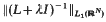 are derived as a consequence.
 . Pointwise estimates for the heat kernel of u
 is imposed. Within this class of operators, the equations defining the maximal and minimal Green's functions are found to be simple ODEs when written in polar coordinates, and these are soluble in terms of the singular Kummer confluent hypergeometric function. For both approaches, bounds on
  are derived as a consequence.
On the l1-algebra of certain monoids
-
- Journal:
- Proceedings of the Royal Society of Edinburgh. Section A: Mathematics / Volume 128 / Issue 5 / 1998
- Published online by Cambridge University Press:
- 14 November 2011, pp. 1023-1031
- Print publication:
- 1998
-
- Article
- Export citation
Minimal group actions on Λ-trees
-
- Journal:
- Proceedings of the Royal Society of Edinburgh. Section A: Mathematics / Volume 128 / Issue 1 / 1998
- Published online by Cambridge University Press:
- 14 November 2011, pp. 23-36
- Print publication:
- 1998
-
- Article
- Export citation
Permanence and asymptotic stability in diagonally convex reaction–diffusion systems
-
- Journal:
- Proceedings of the Royal Society of Edinburgh. Section A: Mathematics / Volume 128 / Issue 1 / 1998
- Published online by Cambridge University Press:
- 14 November 2011, pp. 147-172
- Print publication:
- 1998
-
- Article
- Export citation
Maximal operators associated to Fourier multipliers with an arbitrary set of parameters
-
- Journal:
- Proceedings of the Royal Society of Edinburgh. Section A: Mathematics / Volume 128 / Issue 4 / 1998
- Published online by Cambridge University Press:
- 14 November 2011, pp. 683-696
- Print publication:
- 1998
-
- Article
- Export citation
-
We present here some general results of boundedness on LP for maximal operators of the form
 , where E is a subset of the positive real numbers and Tt is a dilation of a fixed multiplier operator. The range of values of p depends only on the decay at infinity of the multiplier and the Minkowski dimension of E. For the case
  being the maximal operator associated to a convex body, we prove that the norm of the operator is independent of the body.
 , where E is a subset of the positive real numbers and T
 being the maximal operator associated to a convex body, we prove that the norm of the operator is independent of the body.
Multi-peak periodic semiclassical states for a class of nonlinear Schrödinger equations*
-
- Journal:
- Proceedings of the Royal Society of Edinburgh. Section A: Mathematics / Volume 128 / Issue 6 / 1998
- Published online by Cambridge University Press:
- 14 November 2011, pp. 1249-1260
- Print publication:
- 1998
-
- Article
- Export citation
PRM volume 128 issue 3 Cover and Back matter
-
- Journal:
- Proceedings of the Royal Society of Edinburgh. Section A: Mathematics / Volume 128 / Issue 3 / 1998
- Published online by Cambridge University Press:
- 14 November 2011, pp. b1-b2
- Print publication:
- 1998
-
- Article
-
- You have access
- Export citation
PRM volume 128 issue 1 Cover and Front matter
-
- Journal:
- Proceedings of the Royal Society of Edinburgh. Section A: Mathematics / Volume 128 / Issue 1 / 1998
- Published online by Cambridge University Press:
- 14 November 2011, pp. f1-f2
- Print publication:
- 1998
-
- Article
-
- You have access
- Export citation
Smooth solutions of a nonhomogeneous iterative functional differential equation
-
- Journal:
- Proceedings of the Royal Society of Edinburgh. Section A: Mathematics / Volume 128 / Issue 4 / 1998
- Published online by Cambridge University Press:
- 14 November 2011, pp. 821-831
- Print publication:
- 1998
-
- Article
- Export citation
PRM volume 128 issue 2 Cover and Front matter
-
- Journal:
- Proceedings of the Royal Society of Edinburgh. Section A: Mathematics / Volume 128 / Issue 2 / 1998
- Published online by Cambridge University Press:
- 14 November 2011, pp. f1-f2
- Print publication:
- 1998
-
- Article
-
- You have access
- Export citation
Integral representation of functionals defined on curves of W1,p
-
- Journal:
- Proceedings of the Royal Society of Edinburgh. Section A: Mathematics / Volume 128 / Issue 2 / 1998
- Published online by Cambridge University Press:
- 14 November 2011, pp. 193-217
- Print publication:
- 1998
-
- Article
- Export citation
-
Let I ⊂ ℝ be a bounded open interval,
 (I) be the family of all open subintervals of I and let p > 1. The aim of this paper is to give an integral representation result for abstract functionals F: W1,p(I;ℝn) × (I) → [0, + ∞) which are lower semicontinuous and satisfy suitable properties. In particular, we prove an integral representation theorem for the Г-limit of a sequence {Fh}h, of functionals of the form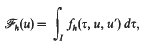
where each fh is a Borel function satisfying proper growth conditions.
 (I) be the family of all open subintervals of I and let p > 1. The aim of this paper is to give an integral representation result for abstract functionals F: W
Effective moduli of plane polycrystals with a rank-one local compliance tensor
-
- Journal:
- Proceedings of the Royal Society of Edinburgh. Section A: Mathematics / Volume 128 / Issue 6 / 1998
- Published online by Cambridge University Press:
- 14 November 2011, pp. 1325-1354
- Print publication:
- 1998
-
- Article
- Export citation
