Refine search
Actions for selected content:
26076 results in Abstract analysis
Singular systems analysis as a moving-window spectral method
-
- Journal:
- European Journal of Applied Mathematics / Volume 9 / Issue 1 / February 1998
- Published online by Cambridge University Press:
- 01 February 1998, pp. 55-79
-
- Article
- Export citation
Asymptotic solution of the conserved phase field system in the fast relaxation case
-
- Journal:
- European Journal of Applied Mathematics / Volume 9 / Issue 1 / February 1998
- Published online by Cambridge University Press:
- 01 February 1998, pp. 1-21
-
- Article
- Export citation
A new free boundary problem for unsteady flows in porous media
-
- Journal:
- European Journal of Applied Mathematics / Volume 9 / Issue 1 / February 1998
- Published online by Cambridge University Press:
- 01 February 1998, pp. 37-54
-
- Article
- Export citation
Radiation condition and limiting amplitude principle for acoustic propagators with two unbounded media
-
- Journal:
- Proceedings of the Royal Society of Edinburgh. Section A: Mathematics / Volume 128 / Issue 1 / 1998
- Published online by Cambridge University Press:
- 14 November 2011, pp. 173-192
- Print publication:
- 1998
-
- Article
- Export citation
A relationship between the periodic and the Dirichlet BVPs of singular differential equations*
-
- Journal:
- Proceedings of the Royal Society of Edinburgh. Section A: Mathematics / Volume 128 / Issue 5 / 1998
- Published online by Cambridge University Press:
- 14 November 2011, pp. 1099-1114
- Print publication:
- 1998
-
- Article
- Export citation
A difference scheme for a stiff system of conservation laws
-
- Journal:
- Proceedings of the Royal Society of Edinburgh. Section A: Mathematics / Volume 128 / Issue 6 / 1998
- Published online by Cambridge University Press:
- 14 November 2011, pp. 1403-1414
- Print publication:
- 1998
-
- Article
- Export citation
The Riemann problem for a resonant nonlinear system of conservation laws with Dirac-measure solutions*
-
- Journal:
- Proceedings of the Royal Society of Edinburgh. Section A: Mathematics / Volume 128 / Issue 1 / 1998
- Published online by Cambridge University Press:
- 14 November 2011, pp. 81-94
- Print publication:
- 1998
-
- Article
- Export citation
Eigenvalue ratios and eigenvalue gaps of Sturm–Liouville operators
-
- Journal:
- Proceedings of the Royal Society of Edinburgh. Section A: Mathematics / Volume 128 / Issue 2 / 1998
- Published online by Cambridge University Press:
- 14 November 2011, pp. 337-347
- Print publication:
- 1998
-
- Article
- Export citation
On equations of KP-type
-
- Journal:
- Proceedings of the Royal Society of Edinburgh. Section A: Mathematics / Volume 128 / Issue 4 / 1998
- Published online by Cambridge University Press:
- 14 November 2011, pp. 725-743
- Print publication:
- 1998
-
- Article
- Export citation
-
We discuss the local Cauchy problem for the generalised Kadomtsev–Petviashvili equation, namely
 , in the periodic and nonperiodic settings.
 , in the periodic and nonperiodic settings.
Construction of an infinitely generated group that is not a free product of surface groups and abelian groups, but which acts freely on an ℝ-tree
-
- Journal:
- Proceedings of the Royal Society of Edinburgh. Section A: Mathematics / Volume 128 / Issue 2 / 1998
- Published online by Cambridge University Press:
- 14 November 2011, pp. 433-445
- Print publication:
- 1998
-
- Article
- Export citation
Heat flow with tangent penalisation converging to mean curvature motion
-
- Journal:
- Proceedings of the Royal Society of Edinburgh. Section A: Mathematics / Volume 128 / Issue 4 / 1998
- Published online by Cambridge University Press:
- 14 November 2011, pp. 875-894
- Print publication:
- 1998
-
- Article
- Export citation
-
In this paper, we prove that mean curvature motion can be regarded as the singular limit of the following model:
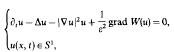
where ε > 0 is a small parameter and
 . This model is related to the Landau–Lifshitz equation of ferromagnetism. Local existence of classical solutions of the Dirichlet problem and global existence of the travelling wave solutions are also obtained.
 . This model is related to the Landau–Lifshitz equation of ferromagnetism. Local existence of classical solutions of the Dirichlet problem and global existence of the travelling wave solutions are also obtained.
Internal layers in high-dimensional domains
-
- Journal:
- Proceedings of the Royal Society of Edinburgh. Section A: Mathematics / Volume 128 / Issue 2 / 1998
- Published online by Cambridge University Press:
- 14 November 2011, pp. 359-401
- Print publication:
- 1998
-
- Article
- Export citation
Asymptotic behaviour, nonoscillation and stability in periodic first-order linear delay differential equations
-
- Journal:
- Proceedings of the Royal Society of Edinburgh. Section A: Mathematics / Volume 128 / Issue 6 / 1998
- Published online by Cambridge University Press:
- 14 November 2011, pp. 1371-1387
- Print publication:
- 1998
-
- Article
- Export citation
A singularly perturbed elliptic problem involving supercritical Sobolev exponent*
-
- Journal:
- Proceedings of the Royal Society of Edinburgh. Section A: Mathematics / Volume 128 / Issue 4 / 1998
- Published online by Cambridge University Press:
- 14 November 2011, pp. 809-819
- Print publication:
- 1998
-
- Article
- Export citation
-
This paper deals with −Δu + εuq−1 = u2*−1,
 , where q > 2*, ε > 0. We first show that the minimiser of the associated minimisation problem blows up at the global minimum point of H(x, x), where H(y, x) is the regular part of the Green's function. We then prove that for each strictly local minimum point x0 of H(x, x), this problem has a solution concentrating at x0 as ε→0.
 , where q > 2*, ε > 0. We first show that the minimiser of the associated minimisation problem blows up at the global minimum point of H(x, x), where H(y, x) is the regular part of the Green's function. We then prove that for each strictly local minimum point x
Global unique existence of a positive solution for a system of equations in electrochemistry*
-
- Journal:
- Proceedings of the Royal Society of Edinburgh. Section A: Mathematics / Volume 128 / Issue 3 / 1998
- Published online by Cambridge University Press:
- 14 November 2011, pp. 507-524
- Print publication:
- 1998
-
- Article
- Export citation
Rearrangements and polar factorisation of countably degenerate functions
-
- Journal:
- Proceedings of the Royal Society of Edinburgh. Section A: Mathematics / Volume 128 / Issue 4 / 1998
- Published online by Cambridge University Press:
- 14 November 2011, pp. 671-681
- Print publication:
- 1998
-
- Article
- Export citation
On a singular nonlinear semilinear elliptic problem
-
- Journal:
- Proceedings of the Royal Society of Edinburgh. Section A: Mathematics / Volume 128 / Issue 6 / 1998
- Published online by Cambridge University Press:
- 14 November 2011, pp. 1389-1401
- Print publication:
- 1998
-
- Article
- Export citation
-
We consider the singular boundary value problem

We study the existence, uniqueness, regularity and the dependency on parameters of the positive solutions under various assumptions.
Existence and regularity results for oblique derivative problems for heat equations in an angle
-
- Journal:
- Proceedings of the Royal Society of Edinburgh. Section A: Mathematics / Volume 128 / Issue 1 / 1998
- Published online by Cambridge University Press:
- 14 November 2011, pp. 47-79
- Print publication:
- 1998
-
- Article
- Export citation
-
An initial-boundary-value problem is considered for the heat equation in an infinite angle dθr ⊆ R2 × [0, ∞) with the oblique derivative boundary conditions on the faces λi of the angle:

with either h0 + h1 > 0, or h0 + h1 ≦ 0. The unique solvability of such a problem is proved in appropriate weighted Sobolev spaces according to the sign of h0 + h1. Estimates of the solution are obtained under ‘natural’ restrictions on the opening of the angle.
Stability of a front for a nonlocal conservation law
-
- Journal:
- Proceedings of the Royal Society of Edinburgh. Section A: Mathematics / Volume 128 / Issue 2 / 1998
- Published online by Cambridge University Press:
- 14 November 2011, pp. 219-234
- Print publication:
- 1998
-
- Article
- Export citation
On the different convex hulls of sets involving singular values
-
- Journal:
- Proceedings of the Royal Society of Edinburgh. Section A: Mathematics / Volume 128 / Issue 6 / 1998
- Published online by Cambridge University Press:
- 14 November 2011, pp. 1261-1280
- Print publication:
- 1998
-
- Article
- Export citation
