Refine search
Actions for selected content:
26076 results in Abstract analysis
Frontmatter
-
- Book:
- Wigner-Type Theorems for Hilbert Grassmannians
- Published online:
- 06 January 2020
- Print publication:
- 16 January 2020, pp i-iv
-
- Chapter
- Export citation
Introduction
-
- Book:
- Wigner-Type Theorems for Hilbert Grassmannians
- Published online:
- 06 January 2020
- Print publication:
- 16 January 2020, pp 1-3
-
- Chapter
- Export citation
2 - Geometric Transformations of Grassmannians
-
- Book:
- Wigner-Type Theorems for Hilbert Grassmannians
- Published online:
- 06 January 2020
- Print publication:
- 16 January 2020, pp 22-52
-
- Chapter
- Export citation
Preface
-
- Book:
- Wigner-Type Theorems for Hilbert Grassmannians
- Published online:
- 06 January 2020
- Print publication:
- 16 January 2020, pp vii-viii
-
- Chapter
- Export citation
d-Auslander–Reiten sequences in subcategories
- Part of
-
- Journal:
- Proceedings of the Edinburgh Mathematical Society / Volume 63 / Issue 2 / May 2020
- Published online by Cambridge University Press:
- 15 January 2020, pp. 342-373
-
- Article
- Export citation
-
Let Φ be a finite-dimensional algebra over a field k. Kleiner described the Auslander–Reiten sequences in a precovering extension closed subcategory ${\rm {\cal X}}\subseteq {\rm mod }\,\Phi $. If $X\in \mathcal {X}$ is an indecomposable such that ${\rm Ext}_\Phi ^1 (X,{\rm {\cal X}})\ne 0$ and $\zeta X$ is the unique indecomposable direct summand of the $\mathcal {X}$-cover $g:Y\to D\,{\rm Tr}\,X$ such that ${\rm Ext}_\Phi ^1 (X,\zeta X)\ne 0$, then there is an Auslander–Reiten sequence in $\mathcal {X}$ of the formMoreover, when
 $${\rm \epsilon }:0\to \zeta X\to {X}^{\prime}\to X\to 0.$$ ${\rm En}{\rm d}_\Phi (X)$ modulo the morphisms factoring through a projective is a division ring, Kleiner proved that each non-split short exact sequence of the formis such that η is right almost split in
 $$\delta :0\to Y\to {Y}^{\prime}\buildrel \eta\over \longrightarrow X\to 0$$ $\mathcal {X}$, and the pushout of δ along g gives an Auslander–Reiten sequence in ${\rm mod}\,\Phi $ ending at X.
In this paper, we give higher-dimensional generalizations of this. Let $d\geq 1$ be an integer. A d-cluster tilting subcategory ${\rm {\cal F}}\subseteq {\rm mod}\,\Phi $ plays the role of a higher ${\rm mod}\,\Phi $. Such an $\mathcal {F}$ is a d-abelian category, where kernels and cokernels are replaced by complexes of d objects and short exact sequences by complexes of d + 2 objects. We give higher versions of the above results for an additive ‘d-extension closed’ subcategory $\mathcal {X}$ of $\mathcal {F}$.


Existence, non-existence and blow-up behaviour of minimizers for the mass-critical fractional non-linear Schrödinger equations with periodic potentials
- Part of
-
- Journal:
- Proceedings of the Royal Society of Edinburgh. Section A: Mathematics / Volume 150 / Issue 6 / December 2020
- Published online by Cambridge University Press:
- 13 January 2020, pp. 3252-3292
- Print publication:
- December 2020
-
- Article
- Export citation
Many synchronized vector solutions for a Bose–Einstein system
- Part of
-
- Journal:
- Proceedings of the Royal Society of Edinburgh. Section A: Mathematics / Volume 150 / Issue 6 / December 2020
- Published online by Cambridge University Press:
- 13 January 2020, pp. 3293-3320
- Print publication:
- December 2020
-
- Article
- Export citation
-
This paper is concerned with the following nonlinear Schrödinger system in ${\mathbb R}^3$where
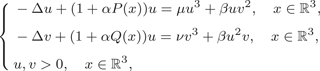 $$\left\{ {\beging{matrix}{ {-\Delta u + (1 + \alpha P(x))u = \mu u^3 + \beta uv^2,} \hfill & {x\in {\open R}^3,} \hfill \cr {-\Delta v + (1 + \alpha Q(x))u = \nu v^3 + \beta u^2v,} \hfill & {x\in {\open R}^3,} \hfill \cr {u,v > 0,} \hfill & {x\in {\open R}^3,} \hfill \cr } } \right.$$ $\beta \in {\mathbb R}$ is a coupling constant, $\mu ,\nu $ are positive constants, P,Q are weight functions decaying exponentially to zero at infinity, α can be regarded as a parameter. This type of system arises, in particular, in models in Bose–Einstein condensates theory and Kerr-like photo refractive media.
We prove that, for any positive integer k > 1, there exists a suitable range of α such that the above problem has a non-radial positive solution with exactly k maximum points which tend to infinity as $\alpha \to +\infty $ (or $0^+$). Moreover, we also construct prescribed number of sign-changing solutions.


A NEW COARSELY RIGID CLASS OF BANACH SPACES
- Part of
-
- Journal:
- Journal of the Institute of Mathematics of Jussieu / Volume 20 / Issue 5 / September 2021
- Published online by Cambridge University Press:
- 13 January 2020, pp. 1729-1747
- Print publication:
- September 2021
-
- Article
- Export citation
-
We prove that the class of reflexive asymptotic- $c_{0}$ Banach spaces is coarsely rigid, meaning that if a Banach space $X$ coarsely embeds into a reflexive asymptotic- $c_{0}$ space $Y$, then $X$ is also reflexive and asymptotic- $c_{0}$. In order to achieve this result, we provide a purely metric characterization of this class of Banach spaces. This metric characterization takes the form of a concentration inequality for Lipschitz maps on the Hamming graphs, which is rigid under coarse embeddings. Using an example of a quasi-reflexive asymptotic- $c_{0}$ space, we show that this concentration inequality is not equivalent to the non-equi-coarse embeddability of the Hamming graphs.


POWERS OF THE MAXIMAL IDEAL AND VANISHING OF (CO)HOMOLOGY
- Part of
-
- Journal:
- Glasgow Mathematical Journal / Volume 63 / Issue 1 / January 2021
- Published online by Cambridge University Press:
- 10 January 2020, pp. 1-5
-
- Article
-
- You have access
- Export citation
On the Poincaré problem and Liouvillian integrability of quadratic Liénard differential equations
- Part of
-
- Journal:
- Proceedings of the Royal Society of Edinburgh. Section A: Mathematics / Volume 150 / Issue 6 / December 2020
- Published online by Cambridge University Press:
- 09 January 2020, pp. 3231-3251
- Print publication:
- December 2020
-
- Article
- Export citation
Wigner-Type Theorems for Hilbert Grassmannians
-
- Published online:
- 06 January 2020
- Print publication:
- 16 January 2020
Spatial dynamics of a nonlocal model with periodic delay and competition
- Part of
-
- Journal:
- European Journal of Applied Mathematics / Volume 31 / Issue 6 / December 2020
- Published online by Cambridge University Press:
- 06 January 2020, pp. 1070-1100
-
- Article
- Export citation
-
Each species is subject to various biotic and abiotic factors during growth. This paper formulates a deterministic model with the consideration of various factors regulating population growth such as age-dependent birth and death rates, spatial movements, seasonal variations, intra-specific competition and time-varying maturation simultaneously. The model takes the form of two coupled reaction–diffusion equations with time-dependent delays, which bring novel challenges to the theoretical analysis. Then, the model is analysed when competition among immatures is neglected, in which situation one equation for the adult population density is decoupled. The basic reproduction number $\mathcal{R}_0$ is defined and shown to determine the global attractivity of either the zero equilibrium (when $\mathcal{R}_0\leq 1$) or a positive periodic solution ( $\mathcal{R}_0\gt1$) by using the dynamical system approach on an appropriate phase space. When the immature intra-specific competition is included and the immature diffusion rate is neglected, the model is neither cooperative nor reducible to a single equation. In this case, the threshold dynamics about the population extinction and uniform persistence are established by using the newly defined basic reproduction number $\widetilde{\mathcal{R}}_0$ as a threshold index. Furthermore, numerical simulations are implemented on the population growth of two different species for two different cases to validate the analytic results.


Backmatter
-
- Book:
- Toeplitz Matrices and Operators
- Published online:
- 06 December 2019
- Print publication:
- 02 January 2020, pp 416-418
-
- Chapter
- Export citation
Appendix A - Key Notions of Banach Spaces
-
- Book:
- Toeplitz Matrices and Operators
- Published online:
- 06 December 2019
- Print publication:
- 02 January 2020, pp 329-332
-
- Chapter
- Export citation
Preface
-
- Book:
- Fourier Restriction, Decoupling, and Applications
- Published online:
- 12 December 2019
- Print publication:
- 02 January 2020, pp ix-xii
-
- Chapter
- Export citation
Appendix B - Key Notions of Hilbert Spaces
-
- Book:
- Toeplitz Matrices and Operators
- Published online:
- 06 December 2019
- Print publication:
- 02 January 2020, pp 333-338
-
- Chapter
- Export citation
Frontmatter
-
- Book:
- Fourier Restriction, Decoupling, and Applications
- Published online:
- 12 December 2019
- Print publication:
- 02 January 2020, pp i-iv
-
- Chapter
- Export citation
13 - Applications of Decoupling
-
- Book:
- Fourier Restriction, Decoupling, and Applications
- Published online:
- 12 December 2019
- Print publication:
- 02 January 2020, pp 284-321
-
- Chapter
- Export citation
Index
-
- Book:
- Fourier Restriction, Decoupling, and Applications
- Published online:
- 12 December 2019
- Print publication:
- 02 January 2020, pp 329-332
-
- Chapter
- Export citation
Acknowledgements
-
- Book:
- Toeplitz Matrices and Operators
- Published online:
- 06 December 2019
- Print publication:
- 02 January 2020, pp xvii-xviii
-
- Chapter
- Export citation
