Refine search
Actions for selected content:
26076 results in Abstract analysis
On stratifications of Mittag-Leffler's transcendents
-
- Journal:
- Proceedings of the Glasgow Mathematical Association / Volume 3 / Issue 4 / July 1958
- Published online by Cambridge University Press:
- 18 May 2009, pp. 170-172
-
- Article
-
- You have access
- Export citation
-
Guided by an observation of Hausdorff ([4]; reproduced by Whittaker and Robinson [6, pp. 177–178]), I pointed out a long time ago [7] that his “Fourier“ treatment of certain products can be systematized so as to apply to an inclusive class of infinite convolutions. Recently I noticed [8] that an appropriate application of this method supplies the following curious result on gamma-quotients:
Corresponding to every index θ on the range 0 < θ < 1, there exists on the line - ∞ < t < ∞ a monotone function μ = μθ = μθ(t) in terms of which the identity

holds on the half-plane Re z > -1 and so, in particular, on the half-line z ≧0.
Projective modular representations of finite groups II
-
- Journal:
- Glasgow Mathematical Journal / Volume 22 / Issue 1 / January 1981
- Published online by Cambridge University Press:
- 18 May 2009, pp. 89-99
-
- Article
-
- You have access
- Export citation
Integrals involving hypergeometric functions and E-functions
-
- Journal:
- Proceedings of the Glasgow Mathematical Association / Volume 3 / Issue 4 / July 1958
- Published online by Cambridge University Press:
- 18 May 2009, pp. 196-198
-
- Article
-
- You have access
- Export citation
-
In § 2 a number of integrals in which the integrand contains a product of a hypergeometric function and an E-function will be evaluated. The following formulae will be employed in the proofs.
If ρ +σ = α + β + γ + 1, and if α, β or γ is zero or a negative integer,

this is Sallschütz's theorem [1].
If R(γ - ½α - ½β)< - ½,

This theorem was given by Wastson [2] for negative integral values of α and later by Whipple [3] for general values α.

R(γ) > 0,

This formula was given by Whipple [3]
l is a positive integer,

Triple orthogonal series
-
- Journal:
- Glasgow Mathematical Journal / Volume 20 / Issue 1 / January 1979
- Published online by Cambridge University Press:
- 18 May 2009, pp. 49-53
-
- Article
-
- You have access
- Export citation
A note on the diophantine equation x2 + 7 = yn
-
- Journal:
- Glasgow Mathematical Journal / Volume 39 / Issue 1 / January 1997
- Published online by Cambridge University Press:
- 18 May 2009, pp. 59-63
-
- Article
-
- You have access
- Export citation
On stationary phase integrals
-
- Journal:
- Glasgow Mathematical Journal / Volume 36 / Issue 3 / September 1994
- Published online by Cambridge University Press:
- 18 May 2009, pp. 355-362
-
- Article
-
- You have access
- Export citation
-
Let f(x) and g(x) be real functions defined on the interval [a, b], with f(x) at least twice continuously differentiable, f′(x) monotone increasing, and f(x) of bounded variation. We consider the exponential integral

where e(t) denotes exp 2πit. The purpose of this note is to prove sharp forms of the well-known estimates:
A: If f′(x) is nonzero on [a, b], then I has order of magnitude

The constant of proportionality depends on the function g(x).
B: If f′(x) changes sign at x = c with a < c < b, then

Corrigendum
-
- Journal:
- Proceedings of the Glasgow Mathematical Association / Volume 6 / Issue 2 / July 1963
- Published online by Cambridge University Press:
- 18 May 2009, p. 116
-
- Article
-
- You have access
- Export citation
The twisted group algebra of a finite nilpotent group over a number field
-
- Journal:
- Glasgow Mathematical Journal / Volume 20 / Issue 1 / January 1979
- Published online by Cambridge University Press:
- 18 May 2009, pp. 55-61
-
- Article
-
- You have access
- Export citation
Semigroups of non-negative integral matrices
-
- Journal:
- Glasgow Mathematical Journal / Volume 15 / Issue 1 / March 1974
- Published online by Cambridge University Press:
- 18 May 2009, pp. 39-42
-
- Article
-
- You have access
- Export citation
-
In [1], Pall proved an interesting result on a certain class of 2 × 2 integral matrices. He showed that the semigroup of 2 × 2 matrices of determinant 1 and non-negative entries contains exactly 2 primes
 , and every other non-unit is expressible uniquely as products of these primes. Before formally stating this result, we need some notation. Let Gn denote the semigroup of n × n matrices with determinant 1 and nonnegative integral entries, In the n × n identity matrix,
  the n × n matrix with a 1 as its (i, j) element and zeros elsewhere, and let
  . When the dimension is clear, we shall drop the superscripts.
 , and every other non-unit is expressible uniquely as products of these primes. Before formally stating this result, we need some notation. Let G
 the n × n matrix with a 1 as its (i, j) element and zeros elsewhere, and let
  . When the dimension is clear, we shall drop the superscripts.
On (V*) sets and Pelczynski's property (V*)
-
- Journal:
- Glasgow Mathematical Journal / Volume 32 / Issue 1 / January 1990
- Published online by Cambridge University Press:
- 18 May 2009, pp. 109-120
-
- Article
-
- You have access
- Export citation
Hilbert modules revisited: orthonormal bases and Hilbert-Schmidt operators
-
- Journal:
- Glasgow Mathematical Journal / Volume 37 / Issue 1 / January 1995
- Published online by Cambridge University Press:
- 18 May 2009, pp. 45-54
-
- Article
-
- You have access
- Export citation
Group Algebras With Central Radicals
-
- Journal:
- Proceedings of the Glasgow Mathematical Association / Volume 5 / Issue 3 / January 1962
- Published online by Cambridge University Press:
- 18 May 2009, pp. 103-108
-
- Article
-
- You have access
- Export citation
On non-zero values of the central homological dimension of C*-algebras
-
- Journal:
- Glasgow Mathematical Journal / Volume 34 / Issue 3 / September 1992
- Published online by Cambridge University Press:
- 18 May 2009, pp. 369-378
-
- Article
-
- You have access
- Export citation
Some Integrals Involving E-Functions
-
- Journal:
- Proceedings of the Glasgow Mathematical Association / Volume 4 / Issue 4 / September 1960
- Published online by Cambridge University Press:
- 18 May 2009, pp. 178-185
-
- Article
-
- You have access
- Export citation
-
In this paper we evaluate some integrals involving U-functions by the methods of the Operational Calculus. The results obtained are quite general and many of them include, as particular cases, some known results.
A function ψ (p) is operationally related with another function f(t), if they satisfy the integral equation


2. Theorem. If

and

As usual, we shall denote (1) by the symbolic expression

provided that the integral is convergent. HereR(α) > 0, R(p) > 0, n = 2,3,4, …, and
 means that in the expression following it, i is to bee replaced by – i and the two expressions are to be added.


 means that in the expression following it, i is to bee replaced by – i and the two expressions are to be added.
On the Radon-Nikodym property in Jordan algebras
-
- Journal:
- Glasgow Mathematical Journal / Volume 24 / Issue 2 / July 1983
- Published online by Cambridge University Press:
- 18 May 2009, pp. 185-189
-
- Article
-
- You have access
- Export citation
The stability of pure weights under conditioning
-
- Journal:
- Glasgow Mathematical Journal / Volume 15 / Issue 1 / March 1974
- Published online by Cambridge University Press:
- 18 May 2009, pp. 5-12
-
- Article
-
- You have access
- Export citation
-
In [1], we showed how a collection of physical operations or experiments could be represented by a nonempty set
 of nonempty sets satisfying certain conditions (irredundancy and coherence) and we called such sets . We also introduced “complete stochastic models” for the empirical universe of discourse represented by such a manual , namely, the so-called weight functions for . These weight functions form a convex set the extreme points of which are called pure weights. We also showed that there is a so-called logic ∏() affiliated with a manual and that each weight function for induces a state on this logic.
 of nonempty sets satisfying certain conditions (irredundancy and coherence) and we called such sets
 A Bessel function inequality connected with stability of least square smoothing, II
-
- Journal:
- Glasgow Mathematical Journal / Volume 9 / Issue 2 / July 1968
- Published online by Cambridge University Press:
- 18 May 2009, pp. 119-122
-
- Article
-
- You have access
- Export citation
-
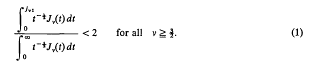
In accordance with customary notation, Jv(t) denotes the Bessel function of the first kind and order v, jvk its kth positive zero and jv, 0 = 0.
The object of this note is to prove that
GMJ volume 40 issue 2 Cover and Front matter
-
- Journal:
- Glasgow Mathematical Journal / Volume 40 / Issue 2 / May 1998
- Published online by Cambridge University Press:
- 18 May 2009, pp. f1-f2
-
- Article
-
- You have access
- Export citation
Uniform distribution of sequences in rings of integral matrices
-
- Journal:
- Glasgow Mathematical Journal / Volume 20 / Issue 2 / July 1979
- Published online by Cambridge University Press:
- 18 May 2009, pp. 169-178
-
- Article
-
- You have access
- Export citation
Levels of division algebras
-
- Journal:
- Glasgow Mathematical Journal / Volume 32 / Issue 3 / September 1990
- Published online by Cambridge University Press:
- 18 May 2009, pp. 365-370
-
- Article
-
- You have access
- Export citation
