Refine search
Actions for selected content:
26076 results in Abstract analysis
On a special class of finite 2-groups
-
- Journal:
- Glasgow Mathematical Journal / Volume 34 / Issue 1 / January 1992
- Published online by Cambridge University Press:
- 18 May 2009, pp. 127-131
-
- Article
-
- You have access
- Export citation
GMJ volume 6 issue 4 Cover and Back matter
-
- Journal:
- Proceedings of the Glasgow Mathematical Association / Volume 6 / Issue 4 / July 1964
- Published online by Cambridge University Press:
- 18 May 2009, pp. b1-b2
-
- Article
-
- You have access
- Export citation
GMJ volume 6 issue 2 Cover and Back matter
-
- Journal:
- Proceedings of the Glasgow Mathematical Association / Volume 6 / Issue 2 / July 1963
- Published online by Cambridge University Press:
- 18 May 2009, pp. b1-b2
-
- Article
-
- You have access
- Export citation
Algebraic points on quartic curves over function fields
-
- Journal:
- Glasgow Mathematical Journal / Volume 26 / Issue 2 / July 1985
- Published online by Cambridge University Press:
- 18 May 2009, pp. 187-190
-
- Article
-
- You have access
- Export citation
Sur la lacunarité des puissances de η
-
- Journal:
- Glasgow Mathematical Journal / Volume 27 / October 1985
- Published online by Cambridge University Press:
- 18 May 2009, pp. 203-221
-
- Article
-
- You have access
- Export citation
-
La fonction η de Dedekind est définie par

où
 , Im(z)>0. C'est une forme modulaire parabolique de poids 1/2. Si r est un entier, la puissance r–ième de η s'écrit;
où les coefficients pr(n) sone définis par l'identité
 .
.
 , Im(z)>0. C'est une forme modulaire parabolique de poids 1/2. Si r est un entier, la puissance r–ième de η s'écrit;
On the vanishing viscosity in the Cauchy problem for the equations of a nonhomogeneous incompressible fluid
-
- Journal:
- Glasgow Mathematical Journal / Volume 36 / Issue 1 / January 1994
- Published online by Cambridge University Press:
- 18 May 2009, pp. 123-129
-
- Article
-
- You have access
- Export citation
-
Let us consider the Cauchy problem
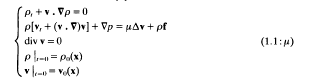
in QT= ℝ3 × [0, T], where f(x, t), ρ0(x) and v0(x) are given, while the density ρ(x, t), the velocity vector v(x, t)= (υ1(x, t), υ2(x, t), υ3(x, t)) and the pressure p(x, t) are unknowns. The viscosity coefficient μ is assumed to be nonnegative. In these equations, the pressure p is automatically determined (up to a function of t) by ρ and v, namely, by solving the equation

Thus we mention (ρ, v) when we talk about the solution of (1.1:μ).
Perfect difference sets
-
- Journal:
- Proceedings of the Glasgow Mathematical Association / Volume 6 / Issue 4 / July 1964
- Published online by Cambridge University Press:
- 18 May 2009, pp. 177-184
-
- Article
-
- You have access
- Export citation
The Jordan-Hölder theorem and prefrattini subgroups of finite groups
-
- Journal:
- Glasgow Mathematical Journal / Volume 37 / Issue 3 / September 1995
- Published online by Cambridge University Press:
- 18 May 2009, pp. 265-277
-
- Article
-
- You have access
- Export citation
The solution of certain triple integral equations involving inverse Mellin transforms†
-
- Journal:
- Glasgow Mathematical Journal / Volume 14 / Issue 1 / February 1973
- Published online by Cambridge University Press:
- 18 May 2009, pp. 65-72
-
- Article
-
- You have access
- Export citation
-
In this paper, we shall be concerned with the solution of triple integral equations of the type

where M−1 is the inverse Mellin transform, nis a positive integer, and — 1 < Res < 0. The use of these equations will be illustrated by their application to two well-known problems in the mathematical theory of elasticity and further applications will be reported later.
Partitioned transversals
-
- Journal:
- Glasgow Mathematical Journal / Volume 15 / Issue 1 / March 1974
- Published online by Cambridge University Press:
- 18 May 2009, pp. 14-16
-
- Article
-
- You have access
- Export citation
-
Let E be a finite set and let
 = (Al, …, A2) be a family of subsets of E. A subset T of E iscalled a transversal of if there exists a bijection Φ: T → {l, …, n} such that x ∈ Aψ(x) for all x ∈ T. If I ⊆ {1, …, n}, we shall, for brevity, write
(and similarly for families denoted by other letters). The cardinal of a set S will be denoted by |S|. If λ is a non-negative integer, we define λS as S or Ø according as λ > 0 or λ = 0.
 = (A
= (A
Toeplitz and Hankel operators on Bargmann spaces
-
- Journal:
- Glasgow Mathematical Journal / Volume 30 / Issue 3 / September 1988
- Published online by Cambridge University Press:
- 18 May 2009, pp. 315-323
-
- Article
-
- You have access
- Export citation
-
Let μ be the Gaussian measure in ℂn given by dμ(z)=(2π)−n exp(−|z|2/2)dV, where dV is the ordinary Lebesgue measure in ℂn. The Segal-Bargmann space H2(μ) is the space of all entire functions on ℂn that belong to L2(μ)-the usual space of Gaussian square-integrable functions. Let P be the orthogonal projection from L2(μ) onto H2(μ). For a measurable function ϕ on ℂn, the multiplication operator Mϕ on L2(μ) is defined by Mϕh =ϕh. The Toeplitz operator Tϕ is defined on H2(μ)by

On 𝓕-subnormal subgroups and Frattini-like subgroups of a finite group
-
- Journal:
- Glasgow Mathematical Journal / Volume 36 / Issue 2 / May 1994
- Published online by Cambridge University Press:
- 18 May 2009, pp. 241-247
-
- Article
-
- You have access
- Export citation
Multiplication of Strongly Summable Series
-
- Journal:
- Proceedings of the Glasgow Mathematical Association / Volume 4 / Issue 1 / December 1958
- Published online by Cambridge University Press:
- 18 May 2009, pp. 29-33
-
- Article
-
- You have access
- Export citation
-
Given a series
 we define
  , by the relations
The series
 is said to be summable (C, k), where k > - 1, to the sum s if
to be summable (C, - 1) to s if it converges to s and nan = o(l); to be absolutely summable (C, k), or summable | C, k, to s if it is summable (C, k) to s and
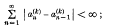
and to be strongly Cesàro summable to s with order k > 0 and index p or summable [C; k, p] to s, if
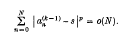
 we define
  , by the relations
 is said to be summable (C, k), where k > - 1, to the sum s if
GMJ volume 39 issue 2 Cover and Front matter
-
- Journal:
- Glasgow Mathematical Journal / Volume 39 / Issue 2 / May 1997
- Published online by Cambridge University Press:
- 18 May 2009, pp. f1-f2
-
- Article
-
- You have access
- Export citation
On the C-Projectivity of ideals in Banach algebras†
-
- Journal:
- Glasgow Mathematical Journal / Volume 40 / Issue 2 / May 1998
- Published online by Cambridge University Press:
- 18 May 2009, pp. 143-145
-
- Article
-
- You have access
- Export citation
On the theorem of Wójcik
-
- Journal:
- Glasgow Mathematical Journal / Volume 38 / Issue 2 / May 1996
- Published online by Cambridge University Press:
- 18 May 2009, pp. 157-162
-
- Article
-
- You have access
- Export citation
-
In the paper [3] the following lemma was proved.
Lemma. Let a, b and c be positive integers such that a and be are relatively prime. Then there are infinitely many primes p in the arithmetic progression ax + b (x = 0,1,2,…) such that


Some characterizations of the hereditary pretorsion class of semigroup automata
-
- Journal:
- Glasgow Mathematical Journal / Volume 35 / Issue 3 / September 1993
- Published online by Cambridge University Press:
- 18 May 2009, pp. 327-337
-
- Article
-
- You have access
- Export citation
Locally convex spaces with fundamental sequences
-
- Journal:
- Glasgow Mathematical Journal / Volume 14 / Issue 1 / February 1973
- Published online by Cambridge University Press:
- 18 May 2009, pp. 96-100
-
- Article
-
- You have access
- Export citation
Small isomorphisms between group algebras
-
- Journal:
- Glasgow Mathematical Journal / Volume 33 / Issue 1 / January 1991
- Published online by Cambridge University Press:
- 18 May 2009, pp. 21-28
-
- Article
-
- You have access
- Export citation
Endomorphism monoids of distributive double p-algebras
-
- Journal:
- Glasgow Mathematical Journal / Volume 20 / Issue 1 / January 1979
- Published online by Cambridge University Press:
- 18 May 2009, pp. 81-86
-
- Article
-
- You have access
- Export citation
