Refine search
Actions for selected content:
26076 results in Abstract analysis
Radicals of semigroup rings†
-
- Journal:
- Glasgow Mathematical Journal / Volume 10 / Issue 2 / July 1969
- Published online by Cambridge University Press:
- 18 May 2009, pp. 85-93
-
- Article
-
- You have access
- Export citation
-
Let
 denote the contracted semigroup ring of the ompletely 0-simple semigroup D over the ring R. The Rees structure theory of completely 0-simple semigroups is used to obtain necessary and sufficient conditions that have zero radical (Theorem 3.8). By using Amitsur's construction of the upper π-radical [1], we are able to treat the Jacobson, Baer (prime), Levitzki (locally nilpotent) and possibly the nil radicals simultaneously. Our results generalize a theorem of Munn [6] on semigroup algebras of finite 0-simple semigroups.
 denote the contracted semigroup ring of the ompletely 0-simple semigroup D over the ring R. The Rees structure theory of completely 0-simple semigroups is used to obtain necessary and sufficient conditions that
 Inequalities for the Maximal Eigenvalue of a Nonnegative Matrix
-
- Journal:
- Glasgow Mathematical Journal / Volume 40 / Issue 2 / May 1998
- Published online by Cambridge University Press:
- 18 May 2009, p. 297
-
- Article
-
- You have access
- Export citation
Residuation theory and Boolean matrices
-
- Journal:
- Proceedings of the Glasgow Mathematical Association / Volume 6 / Issue 4 / July 1964
- Published online by Cambridge University Press:
- 18 May 2009, pp. 185-190
-
- Article
-
- You have access
- Export citation
GMJ volume 21 issue 1 Front matter
-
- Journal:
- Glasgow Mathematical Journal / Volume 21 / Issue 1 / January 1980
- Published online by Cambridge University Press:
- 18 May 2009, pp. f1-f5
-
- Article
-
- You have access
- Export citation
On the prime factors of the number 2p-1 - 1
-
- Journal:
- Glasgow Mathematical Journal / Volume 9 / Issue 2 / July 1968
- Published online by Cambridge University Press:
- 18 May 2009, pp. 83-86
-
- Article
-
- You have access
- Export citation
Congruences on a bisimple ω-semigroup
-
- Journal:
- Proceedings of the Glasgow Mathematical Association / Volume 7 / Issue 4 / July 1966
- Published online by Cambridge University Press:
- 18 May 2009, pp. 184-192
-
- Article
-
- You have access
- Export citation
-
In a semigroup S the set E of idempotents is partially ordered by the rule that e≦ƒ if and only if eƒ=e=ƒe. We say that S is an ω-semigroup if E={ei: i=0, 1, 2, …}, where

Bisimple ω-semigroups have been classified in [10]. From a group G and an endomorphism α of G a bisimple ω-semigroup S(G, α) can be constructed by a process described below in § 1: moreover, any bisimple ω-semigroup is isomorphic to one of this type.

The normal curvature of totally real submanifolds of S6(1)
-
- Journal:
- Glasgow Mathematical Journal / Volume 40 / Issue 2 / May 1998
- Published online by Cambridge University Press:
- 18 May 2009, pp. 199-204
-
- Article
-
- You have access
- Export citation
GMJ volume 36 issue 1 Cover and Back matter
-
- Journal:
- Glasgow Mathematical Journal / Volume 36 / Issue 1 / January 1994
- Published online by Cambridge University Press:
- 18 May 2009, pp. b1-b2
-
- Article
-
- You have access
- Export citation
GMJ volume 5 issue 3 Cover and Front matter
-
- Journal:
- Proceedings of the Glasgow Mathematical Association / Volume 5 / Issue 3 / January 1962
- Published online by Cambridge University Press:
- 18 May 2009, pp. f1-f2
-
- Article
-
- You have access
- Export citation
Cousin complexes and generalized fractions
-
- Journal:
- Glasgow Mathematical Journal / Volume 26 / Issue 1 / January 1985
- Published online by Cambridge University Press:
- 18 May 2009, pp. 51-67
-
- Article
-
- You have access
- Export citation
-
Let A be a commutative Noetherian ring (with non-zero identity). The Cousin complex C(A) for A is described in [6, §2]: it is a complex of A-modules and A-homomorphisms

with the property that, for each n≥0,
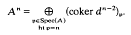
Cohen-Macaulay rings may be characterized in terms of the Cousin complex: A is a Cohen-Macaulay ring if and only if C(A) is exact [6, (4.7)]. Also the Cousin complex provides a natural minimal injective resolution for a Gorenstein ring: see [6, (5.4)].
Automorphisms fixing every subnormal subgroup of a finite group
-
- Journal:
- Glasgow Mathematical Journal / Volume 39 / Issue 1 / January 1997
- Published online by Cambridge University Press:
- 18 May 2009, pp. 111-114
-
- Article
-
- You have access
- Export citation
GMJ volume 21 issue 2 Cover and Front matter
-
- Journal:
- Glasgow Mathematical Journal / Volume 21 / Issue 2 / July 1980
- Published online by Cambridge University Press:
- 18 May 2009, pp. f1-f2
-
- Article
-
- You have access
- Export citation
Some expansions of hypergeometric functions in series of hypergeometric functions†
-
- Journal:
- Glasgow Mathematical Journal / Volume 17 / Issue 1 / January 1976
- Published online by Cambridge University Press:
- 18 May 2009, pp. 17-21
-
- Article
-
- You have access
- Export citation
-
Throughout the present note we abbreviate the set of p parameters a1,…,ap by (ap), with similar interpretations for (bq), etc. Also, by [(ap)]m we mean the product
 , where [λ]m = Г(λ + m)/ Г(λ), and so on. One of the main results we give here is the expansion formula
(1)
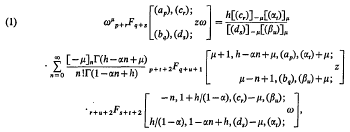
which is valid, by analytic continuation, when, p,q,r,s,t and u are nonnegative integers such that p+r < q+s+l (or p+r = q+s+l and |zω| <1), p+t < q+u (or p + t = q + u and |z| < 1), and the various parameters including μ are so restricted that each side of equation (1) has a meaning.
 , where [λ]
Bending in the space of quasi-Fuchsian structures
-
- Journal:
- Glasgow Mathematical Journal / Volume 33 / Issue 1 / January 1991
- Published online by Cambridge University Press:
- 18 May 2009, pp. 41-49
-
- Article
-
- You have access
- Export citation
A presentation for a group of automorphisms of a simplicial complex
-
- Journal:
- Glasgow Mathematical Journal / Volume 30 / Issue 3 / September 1988
- Published online by Cambridge University Press:
- 18 May 2009, pp. 331-337
-
- Article
-
- You have access
- Export citation
A note on semi-special permutations
-
- Journal:
- Proceedings of the Glasgow Mathematical Association / Volume 3 / Issue 4 / July 1958
- Published online by Cambridge University Press:
- 18 May 2009, pp. 164-169
-
- Article
-
- You have access
- Export citation
On projective characters of prime degree
-
- Journal:
- Glasgow Mathematical Journal / Volume 33 / Issue 3 / September 1991
- Published online by Cambridge University Press:
- 18 May 2009, pp. 311-321
-
- Article
-
- You have access
- Export citation
An alternative proof of Diestel's theorem
-
- Journal:
- Glasgow Mathematical Journal / Volume 25 / Issue 1 / January 1984
- Published online by Cambridge University Press:
- 18 May 2009, pp. 45-46
-
- Article
-
- You have access
- Export citation
GMJ volume 1 issue 3 Cover and Back matter
-
- Journal:
- Proceedings of the Glasgow Mathematical Association / Volume 1 / Issue 3 / September 1953
- Published online by Cambridge University Press:
- 18 May 2009, pp. b1-b2
-
- Article
-
- You have access
- Export citation
GMJ volume 18 issue 2 Cover and Front matter
-
- Journal:
- Glasgow Mathematical Journal / Volume 18 / Issue 2 / July 1977
- Published online by Cambridge University Press:
- 18 May 2009, pp. f1-f2
-
- Article
-
- You have access
- Export citation
