Refine search
Actions for selected content:
26076 results in Abstract analysis
Commutators and normal operators
-
- Journal:
- Glasgow Mathematical Journal / Volume 18 / Issue 2 / July 1977
- Published online by Cambridge University Press:
- 18 May 2009, pp. 197-198
-
- Article
-
- You have access
- Export citation
Compactifications of totally bounded quasi-uniform spaces
-
- Journal:
- Glasgow Mathematical Journal / Volume 28 / Issue 1 / January 1986
- Published online by Cambridge University Press:
- 18 May 2009, pp. 31-36
-
- Article
-
- You have access
- Export citation
-
The notation and terminology of this paper coincide with that of reference [4], except that here the term, compactification, refers to a T1-space. It is known that a completely regular totally bounded Hausdorff quasi-uniform space (X,
 ) has a Hausdorff compactification if and only if
  contains a uniformity compatible with ℱ(
 ) [4, Theorem 3.47]. The use of regular filters by E. M. Alfsen and J. E. Fenstad [1] and O. Njåstad [5], suggests a construction of a compactification, which differs markedly from the construction obtained in [4]. We use this construction to show that a totally bounded T1 quasi-uniform space has a compactification if and only if it is point symmetric. While it is pleasant to have a characterization that obtains for all T1-spaces, the present construction has several further attributes. Unlike the compactification obtained in [4], the compactification given here preserves both total boundedness and uniform weight, and coincides with the uniform completion when the quasi-uniformity under consideration is a uniformity. Moreover, any quasi-uniformly continuous map from the underlying quasi-uniform space of the compactification onto any totally bounded compact T1-space has a quasi-uniformly continuous extension to the compactification. If
  is the Pervin quasi-uniformity of a T1-space X, the compactification
  we obtain is the Wallman compactification of (X, ℱ (
 )). It follows that our construction need not provide a Hausdorff compactification, even when such a compactification exists; but we obtain a sufficient condition in order that our compactification be a Hausdorff space and note that this condition is satisfied by all uniform spaces and all normal equinormal quasi-uniform spaces. Finally, we note that our construction is reminiscent of the completion obtained by Á. Császár for an arbitrary quasi-uniform space [2, Section 3]; in particular our Theorem 3.7 is comparable with the result of [2, Theorem 3.5].
 ) has a Hausdorff compactification if and only if
  contains a uniformity compatible with ℱ(
 ) [4, Theorem 3.47]. The use of regular filters by E. M. Alfsen and J. E. Fenstad [1] and O. Njåstad [5], suggests a construction of a compactification, which differs markedly from the construction obtained in [4]. We use this construction to show that a totally bounded T
 is the Pervin quasi-uniformity of a T
 we obtain is the Wallman compactification of (X, ℱ (
 )). It follows that our construction need not provide a Hausdorff compactification, even when such a compactification exists; but we obtain a sufficient condition in order that our compactification be a Hausdorff space and note that this condition is satisfied by all uniform spaces and all normal equinormal quasi-uniform spaces. Finally, we note that our construction is reminiscent of the completion obtained by Á. Császár for an arbitrary quasi-uniform space [2, Section 3]; in particular our Theorem 3.7 is comparable with the result of [2, Theorem 3.5].
On the tensor product of quaternion algebras of characteristic two
-
- Journal:
- Glasgow Mathematical Journal / Volume 30 / Issue 1 / January 1988
- Published online by Cambridge University Press:
- 18 May 2009, pp. 111-113
-
- Article
-
- You have access
- Export citation
Matrices Associated with Fractional Hankel and Fourier Transformations
-
- Journal:
- Proceedings of the Glasgow Mathematical Association / Volume 2 / Issue 4 / February 1956
- Published online by Cambridge University Press:
- 18 May 2009, pp. 185-192
-
- Article
-
- You have access
- Export citation
On residually transcendental valued function fields of conics
-
- Journal:
- Glasgow Mathematical Journal / Volume 38 / Issue 2 / May 1996
- Published online by Cambridge University Press:
- 18 May 2009, pp. 137-145
-
- Article
-
- You have access
- Export citation
-
Let K/Kobe a finitely generated field extension of transcendence degree 1. Let u0 be a valuation of Koand v a valuation of Kextending v0such that the residue field of vis a transcendental extension ofthe residue field k0of vo/such a prolongation vwill be called a residually transcendental prolongation of v0. Byan element with the uniqueness propertyfor (K, v)/(K0, v0) (or more briefly for v/v0)we mean an element / of Khaving u-valuation 0 which satisfies (i) the image of tunder the canonicalhomomorphism from the valuation ring of vonto the residue field of v(henceforth referred to as the v-residue ot t) is transcendental over ko; that is vcoincides with the Gaussian valuation
 on the subfield K0(t) defined by
 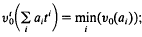 (ii) vis the only valuation of K (up to equivalence) extending the valuation .
 on the subfield K
 (ii) vis the only valuation of K (up to equivalence) extending the valuation
 Union results for thin sets
-
- Journal:
- Glasgow Mathematical Journal / Volume 32 / Issue 2 / May 1990
- Published online by Cambridge University Press:
- 18 May 2009, pp. 241-254
-
- Article
-
- You have access
- Export citation
-
Let G be a compact abelian group and let Γ be its (discrete) dual group. Denote by M(G) the space of complex regular Borel measures on G.
Let E be a subset of Γ. Then:
(i) E is called a Rajchman set if, for all μ ∈M(G)
 implies
(ii) E is called a set of continuity if given ε > 0 there exists δ > 0 such that if
 and
and(iii) E is called a parallelepiped of dimension N if |E| = 2N and there are two-element sets
 . (The multiplication indicated here is the group operation.)
 implies
 and
and . (The multiplication indicated here is the group operation.)
GMJ volume 19 issue 1 Cover and Back matter
-
- Journal:
- Glasgow Mathematical Journal / Volume 19 / Issue 1 / January 1978
- Published online by Cambridge University Press:
- 18 May 2009, p. b1
-
- Article
-
- You have access
- Export citation
Homology operations and power series
-
- Journal:
- Glasgow Mathematical Journal / Volume 24 / Issue 2 / July 1983
- Published online by Cambridge University Press:
- 18 May 2009, pp. 161-168
-
- Article
-
- You have access
- Export citation
GMJ volume 34 issue 3 Cover and Back matter
-
- Journal:
- Glasgow Mathematical Journal / Volume 34 / Issue 3 / September 1992
- Published online by Cambridge University Press:
- 18 May 2009, pp. b1-b2
-
- Article
-
- You have access
- Export citation
Remarks on the asymptotic behaviour of perturbed linear systems†
-
- Journal:
- Glasgow Mathematical Journal / Volume 10 / Issue 2 / July 1969
- Published online by Cambridge University Press:
- 18 May 2009, pp. 116-120
-
- Article
-
- You have access
- Export citation
-
We are here concerned with following result of Trench:
Theorem. (Trench [5]). Let v1 and v2 be two linearly independent solutions of the differential equation

where a(t) is continuous on [0, ∞), and let b(t) be a continuous function of t for t ≧ 0 satisfying
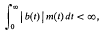
where m(t) = max {|v1(t)|2, |v2(t)|2}. Then, if α1and α2are two arbitrary constants, there exists a solution u of

which can be written in the form
 ,
,with

fori = 1, 2.


Characterization of certain differential operators in the solution of linear partial differential equations†
-
- Journal:
- Glasgow Mathematical Journal / Volume 17 / Issue 2 / July 1976
- Published online by Cambridge University Press:
- 18 May 2009, pp. 83-88
-
- Article
-
- You have access
- Export citation
-
In this paper we consider differential equations of the form

where the coefficients Ai are holomorphic functions in a domain G1 × G2 ⊂ C × C. We restrict our attention to those equations for which it is possible to represent the solutions in the form

where g1(z1) and g2(z2) are arbitrary holomorphic functions in G1 and G2 respectively. The coefficients a1, k and a2, k depend on the given differential equation. Within the last ten years a number of publications have been devoted to this kind of representation of solutions.
Congruences induced by transitive representations of inverse semigroups
-
- Journal:
- Glasgow Mathematical Journal / Volume 29 / Issue 1 / January 1987
- Published online by Cambridge University Press:
- 18 May 2009, pp. 21-40
-
- Article
-
- You have access
- Export citation
Some results on stable p-harmonic maps
-
- Journal:
- Glasgow Mathematical Journal / Volume 36 / Issue 1 / January 1994
- Published online by Cambridge University Press:
- 18 May 2009, pp. 77-80
-
- Article
-
- You have access
- Export citation
-
For each p ∈ [2, ∞)a p-harmonic map f:Mm→Nn is a critical point of the p-energy functional
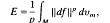
where Mm is a compact and Nn a complete Riemannian manifold of dimensions m and n respectively. In a recent paper [3], Takeuchi has proved that for a certain class of simply-connected δ-pinched Nn and certain type of hypersurface Nn in ℝn+1, the only stable p-harmonic maps for any compact Mm are the constant maps. Our purpose in this note is to establish the following theorem which complements Takeuchi's results.
Quadruple integral equations and operators of fractional integration
-
- Journal:
- Glasgow Mathematical Journal / Volume 12 / Issue 1 / April 1971
- Published online by Cambridge University Press:
- 18 May 2009, pp. 60-64
-
- Article
-
- You have access
- Export citation
-
Cooke [1] modified a technique used by Erdelyi and Sneddon [2] to solve triple integral equations of a certain type. In this paper, we extend this method to solve the quadruple integral equations
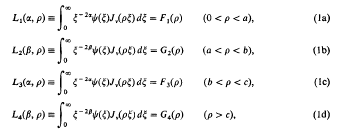
where F1, G2, F3 and G4 are prescribed functions of p and ψ(ξ) is to be determined. With no loss of generality we shall assume that G2(p)≡0, G4(p)≡0.
Pythagorean ratios in arithmetic progression, part i. three Pythagorean ratios
-
- Journal:
- Glasgow Mathematical Journal / Volume 35 / Issue 3 / September 1993
- Published online by Cambridge University Press:
- 18 May 2009, pp. 395-407
-
- Article
-
- You have access
- Export citation
GMJ volume 18 issue 1 Cover and Front matter
-
- Journal:
- Glasgow Mathematical Journal / Volume 18 / Issue 1 / January 1977
- Published online by Cambridge University Press:
- 18 May 2009, pp. f1-f7
-
- Article
-
- You have access
- Export citation
GMJ volume 20 issue 1 Cover and Back matter
-
- Journal:
- Glasgow Mathematical Journal / Volume 20 / Issue 1 / January 1979
- Published online by Cambridge University Press:
- 18 May 2009, p. b1
-
- Article
-
- You have access
- Export citation
On E-groups in the sense of Peng
-
- Journal:
- Glasgow Mathematical Journal / Volume 31 / Issue 2 / May 1989
- Published online by Cambridge University Press:
- 18 May 2009, pp. 231-242
-
- Article
-
- You have access
- Export citation
The efficiency of PSL(2, p)3 and other direct products of groups
-
- Journal:
- Glasgow Mathematical Journal / Volume 39 / Issue 3 / September 1997
- Published online by Cambridge University Press:
- 18 May 2009, pp. 259-268
-
- Article
-
- You have access
- Export citation
GMJ volume 31 issue 1 Cover and Back matter
-
- Journal:
- Glasgow Mathematical Journal / Volume 31 / Issue 1 / January 1989
- Published online by Cambridge University Press:
- 18 May 2009, p. b1
-
- Article
-
- You have access
- Export citation
