Refine search
Actions for selected content:
26076 results in Abstract analysis
Normal radicals and normal classes of modules
-
- Journal:
- Glasgow Mathematical Journal / Volume 30 / Issue 1 / January 1988
- Published online by Cambridge University Press:
- 18 May 2009, pp. 97-100
-
- Article
-
- You have access
- Export citation
-
The study of special radicals was begun by Andrunakievič [1]. A class
 of prime rings is called special if it is hereditary and closed under prime extensions. The upper radicals determined by special classes are called special. In later works Andrunakievič and Rjabuhin [2] and [3] defined the concept of a special class of modules.
 of prime rings is called special if it is hereditary and closed under prime extensions. The upper radicals determined by special classes are called special. In later works Andrunakievič and Rjabuhin [2] and [3] defined the concept of a special class of modules.
Normal structure and fixed point property
-
- Journal:
- Glasgow Mathematical Journal / Volume 38 / Issue 1 / January 1996
- Published online by Cambridge University Press:
- 18 May 2009, pp. 29-37
-
- Article
-
- You have access
- Export citation
on l-adic representations attached to modular forms II
-
- Journal:
- Glasgow Mathematical Journal / Volume 27 / October 1985
- Published online by Cambridge University Press:
- 18 May 2009, pp. 185-194
-
- Article
-
- You have access
- Export citation
-
Suppose that
 is a newform of weight k on Г1(N). Thus f is in particular a cusp form on Г1(N), satisfying
for all n≥1. Associated with f is a Dirichlet character

such that
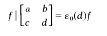
for all,
 .
.
 is a newform of weight k on Г

 .
.GMJ volume 32 issue 2 Cover and Front matter
-
- Journal:
- Glasgow Mathematical Journal / Volume 32 / Issue 2 / May 1990
- Published online by Cambridge University Press:
- 18 May 2009, pp. f1-f2
-
- Article
-
- You have access
- Export citation
A non-abelian tensor product of Lie algebras
-
- Journal:
- Glasgow Mathematical Journal / Volume 33 / Issue 1 / January 1991
- Published online by Cambridge University Press:
- 18 May 2009, pp. 101-120
-
- Article
-
- You have access
- Export citation
Infinite dimensional representations of

-
- Journal:
- Glasgow Mathematical Journal / Volume 32 / Issue 1 / January 1990
- Published online by Cambridge University Press:
- 18 May 2009, pp. 25-33
-
- Article
-
- You have access
- Export citation
-
By a representation of the extended Dynkin diagram
we shall mean a list of 5 vector spaces P, E1, E2, E3, E4 over an algebraically closed field K, and 4 linear maps a1, a2, a3, a4 as shown.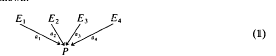
The spaces need not be of finite dimension.
In their solution of the 4-subspace problem [6], Gelfand and Ponomarev have classified such representations when the spaces are finite dimensional. A representation like (1) can also be viewed as a module over the K-algebra R4 consisting of all 5 × 5 matrices having zeros off the first row and off the main diagonal.

GMJ volume 19 issue 2 Cover and Front matter
-
- Journal:
- Glasgow Mathematical Journal / Volume 19 / Issue 2 / July 1978
- Published online by Cambridge University Press:
- 18 May 2009, pp. f1-f2
-
- Article
-
- You have access
- Export citation
On Banach spaces with Mazur's property
-
- Journal:
- Glasgow Mathematical Journal / Volume 33 / Issue 1 / January 1991
- Published online by Cambridge University Press:
- 18 May 2009, pp. 51-54
-
- Article
-
- You have access
- Export citation
GMJ volume 23 issue 1 Cover and Back matter
-
- Journal:
- Glasgow Mathematical Journal / Volume 23 / Issue 1 / January 1982
- Published online by Cambridge University Press:
- 18 May 2009, p. b1
-
- Article
-
- You have access
- Export citation
GMJ volume 3 issue 3 Cover and Back matter
-
- Journal:
- Proceedings of the Glasgow Mathematical Association / Volume 3 / Issue 3 / December 1957
- Published online by Cambridge University Press:
- 18 May 2009, pp. b1-b2
-
- Article
-
- You have access
- Export citation
The Divisibility of Divisor Functions
-
- Journal:
- Proceedings of the Glasgow Mathematical Association / Volume 5 / Issue 1 / January 1961
- Published online by Cambridge University Press:
- 18 May 2009, pp. 35-40
-
- Article
-
- You have access
- Export citation
-
For any positive integers n and v let

where d runs through all the positive divisors of n. For each positive integer k and real x > 1, denote by N(v, k; x) the number of positive integers n ≦ x for which σv(n) is not divisible by k. Then Watson [6] has shown that, when v is odd,

as x → ∞; it is assumed here and throughout that v and k are fixed and independent of x. It follows, in particular, that σ (n) is almost always divisible by k. A brief account of the ideas used by Watson will be found in § 10.6 of Hardy's book on Ramanujan [2].

Immersed surfaces and pencils of planes in 3-space
-
- Journal:
- Glasgow Mathematical Journal / Volume 22 / Issue 2 / July 1981
- Published online by Cambridge University Press:
- 18 May 2009, pp. 133-136
-
- Article
-
- You have access
- Export citation
-
Let M be a compact connected boundaryless surface and f: M → ℝ3 a smooth immersion transverse to a straight line L. Thus there is an even number p of points xεM such that f(x)εL. Under further transversality assumptions on f (see §3) there is a finite number q of points x of M such that the plane containing f(x) and L touches f(M) at f(x). These assumptions are mild in the sense that they hold for any f in an open dense subset of the space of smooth immersions under consideration. Suppose that the Gaussian curvature of f(M) is positive at q+ of these points and negative at q−, with q = q++ q−. Then

where e(M) denotes the Euler number of M.
On the approximation of π by special algebraic numbers
-
- Journal:
- Glasgow Mathematical Journal / Volume 21 / Issue 1 / January 1980
- Published online by Cambridge University Press:
- 18 May 2009, pp. 51-56
-
- Article
-
- You have access
- Export citation
-
Suppose that m0 is an integer, m0≥3, ρ = exp(2πi/m0), K = ℚ(ρ, i), v denotes the degree of K, ξ∈K has degree N over ℚ. The length,
 where
where  is the (irreducible) minimal polynomial for with ξ relatively prime integer coefficients. Feldman [2, p. 49] proved that there is an absolute constant c0>0 such that
From [2, p. 49, Notes 1 and 2] we know that v = φ(m0) or v = 2φ(m0), and φ(m0)≥ c1m0(log log m0)−1 (c1 > an absolute constant), where φ(m0) denotes Euler's function.
 where
where  is the (irreducible) minimal polynomial for with ξ relatively prime integer coefficients. Feldman [2, p. 49] proved that there is an absolute constant c
The Asymptotic Distributions of Statistics arising in Certain Non-Parametric Tests
-
- Journal:
- Proceedings of the Glasgow Mathematical Association / Volume 2 / Issue 1 / April 1954
- Published online by Cambridge University Press:
- 18 May 2009, pp. 47-51
-
- Article
-
- You have access
- Export citation
On the fractional parts of αn2 and βn
-
- Journal:
- Glasgow Mathematical Journal / Volume 22 / Issue 2 / July 1981
- Published online by Cambridge University Press:
- 18 May 2009, pp. 181-183
-
- Article
-
- You have access
- Export citation
-
We denote by ‖…‖ the distance to the nearest integer. Let α and β be real. W. M. Schmidt [5] proved that for ε > 0 and N>c1(ε) there is a natural number n such that

This extends a theorem of H. Heilbronn [4] and also sharpens a theorem of H. Davenport [3].
GMJ volume 35 issue 2 Cover and Back matter
-
- Journal:
- Glasgow Mathematical Journal / Volume 35 / Issue 2 / May 1993
- Published online by Cambridge University Press:
- 18 May 2009, pp. b1-b2
-
- Article
-
- You have access
- Export citation
GMJ volume 40 issue 1 Cover and Front matter
-
- Journal:
- Glasgow Mathematical Journal / Volume 40 / Issue 1 / March 1998
- Published online by Cambridge University Press:
- 18 May 2009, pp. f1-f2
-
- Article
-
- You have access
- Export citation
Group theoretic properties inherited by lower central factors
-
- Journal:
- Glasgow Mathematical Journal / Volume 29 / Issue 1 / January 1987
- Published online by Cambridge University Press:
- 18 May 2009, pp. 89-91
-
- Article
-
- You have access
- Export citation
-
Several properties are known to be inherited from the derived factor group of a group G by other factors Γi = γi(G)/γi + 1(G) of the lower central series. Derek Robinson proved [1] that the denning property of any class
 of groups which is closed under the forming of homomorphic images of tensor products is so inherited. Possibilities for here include the following classes.
 of groups which is closed under the forming of homomorphic images of tensor products is so inherited. Possibilities for
 On unramified Am-extensions of quadratic number fields
-
- Journal:
- Glasgow Mathematical Journal / Volume 27 / October 1985
- Published online by Cambridge University Press:
- 18 May 2009, pp. 31-37
-
- Article
-
- You have access
- Export citation
An Expression for Bernoulli Numbers
-
- Journal:
- Proceedings of the Glasgow Mathematical Association / Volume 1 / Issue 3 / September 1953
- Published online by Cambridge University Press:
- 18 May 2009, pp. 126-128
-
- Article
-
- You have access
- Export citation
