Refine search
Actions for selected content:
26076 results in Abstract analysis
Partial regularity of strong local minimizers of quasiconvex integrals with (p, q)-growth
-
- Journal:
- Proceedings of the Royal Society of Edinburgh. Section A: Mathematics / Volume 139 / Issue 3 / June 2009
- Published online by Cambridge University Press:
- 26 May 2009, pp. 595-621
- Print publication:
- June 2009
-
- Article
- Export citation
-
We consider strictly quasiconvex integrals

in the multi-dimensional calculus of variations. For the C2-integrand f : ℝNn → ℝ we impose (p, q)-growth conditions

with γ, Γ > 0 and 1 < p ≤ q < min {p + 1/n, p(2n − 1)/(2n − 2)}. Under these assumptions we prove partial C1, αloc-regularity for strong local minimizers of F and the associated relaxed functional
 .
.
 .
.Differential modules on p-adic polyannuli
- Part of
-
- Journal:
- Journal of the Institute of Mathematics of Jussieu / Volume 9 / Issue 1 / January 2010
- Published online by Cambridge University Press:
- 19 May 2009, pp. 155-201
- Print publication:
- January 2010
-
- Article
- Export citation
A lemma about the Epstein zeta-function
-
- Journal:
- Proceedings of the Glasgow Mathematical Association / Volume 6 / Issue 4 / July 1964
- Published online by Cambridge University Press:
- 18 May 2009, pp. 198-201
-
- Article
-
- You have access
- Export citation
-
Let h (m, n) = αm2 + 2δmn + βn2 be a positive definite quadratic form with determinant αβ–δ2 = 1. It may be put in the shape

with y > 0. We write (for s > 1)

The function Zn(s) may be analytically continued over the whole s-plane. Its only singularity is a simple pole with residue π at s = 1.
Knots, groups, and spinning
-
- Journal:
- Glasgow Mathematical Journal / Volume 33 / Issue 1 / January 1991
- Published online by Cambridge University Press:
- 18 May 2009, pp. 99-100
-
- Article
-
- You have access
- Export citation
Coordinates for analytic operator algebras
-
- Journal:
- Glasgow Mathematical Journal / Volume 31 / Issue 1 / January 1989
- Published online by Cambridge University Press:
- 18 May 2009, pp. 31-47
-
- Article
-
- You have access
- Export citation
-
Let M be a σ-finite von Neumann algebra and α = {αt}t∈A be a representation of a compact abelian group A as *-automorphisms of M. Let Γ be the dual group of A and suppose that Γ is totally ordered with a positive semigroup Σ⊆Γ. The analytic algebra associated with α and Σ is

where spα(a) is Arveson's spectrum. These algebras were studied (also for A not necessarily compact) by several authors starting with Loebl and Muhly [10].
Note on Three-Dimensional Lie Groups
-
- Journal:
- Proceedings of the Glasgow Mathematical Association / Volume 2 / Issue 3 / July 1955
- Published online by Cambridge University Press:
- 18 May 2009, pp. 112-115
-
- Article
-
- You have access
- Export citation
Asymmetric and symmetric graphs
-
- Journal:
- Glasgow Mathematical Journal / Volume 15 / Issue 1 / March 1974
- Published online by Cambridge University Press:
- 18 May 2009, pp. 69-73
-
- Article
-
- You have access
- Export citation
On the distribution of αpk modulo 1
-
- Journal:
- Glasgow Mathematical Journal / Volume 39 / Issue 2 / May 1997
- Published online by Cambridge University Press:
- 18 May 2009, pp. 121-130
-
- Article
-
- You have access
- Export citation
Polycyclic group rings and unique factorisation rings
-
- Journal:
- Glasgow Mathematical Journal / Volume 36 / Issue 2 / May 1994
- Published online by Cambridge University Press:
- 18 May 2009, pp. 135-144
-
- Article
-
- You have access
- Export citation
GMJ volume 11 issue 1 Cover and Back matter
-
- Journal:
- Glasgow Mathematical Journal / Volume 11 / Issue 1 / January 1970
- Published online by Cambridge University Press:
- 18 May 2009, pp. b1-b2
-
- Article
-
- You have access
- Export citation
Radical Q-algebras
-
- Journal:
- Glasgow Mathematical Journal / Volume 17 / Issue 2 / July 1976
- Published online by Cambridge University Press:
- 18 May 2009, pp. 119-126
-
- Article
-
- You have access
- Export citation
On the Diophantine equation z2 = x4 + Dx2y2 + y4
-
- Journal:
- Glasgow Mathematical Journal / Volume 36 / Issue 3 / September 1994
- Published online by Cambridge University Press:
- 18 May 2009, pp. 283-285
-
- Article
-
- You have access
- Export citation
-
The equation of the title in positive integers x, y, z where D is a given integer has been considered for some 300 years [4, pp 634–639]. As observed by V. A. Lebesgue, and probably known to Euler, if x, y, z is one non-trivial solution i.e., one with xy(x2 – y2) ≠0, another is given by
 . It then follows that there are infinitely many such with (x, y) = 1. The question that remains is to determine for which values of D such solutions exist.
 . It then follows that there are infinitely many such with (x, y) = 1. The question that remains is to determine for which values of D such solutions exist.
A note concerning the L1convergence of a class of games which become fairer with time
-
- Journal:
- Glasgow Mathematical Journal / Volume 13 / Issue 1 / March 1972
- Published online by Cambridge University Press:
- 18 May 2009, pp. 39-41
-
- Article
-
- You have access
- Export citation
-
Throughout this note, let
 be a probability space with
  an increasing sequence of sub σ-fields of
  whose union generates . Let
  be a sequence of random variables adapted to (see [3], p. 65) and henceforth be referred to as a game. As in [1], the game
  will be said to become fairer with time if, for every ε > ε,
as n, m → ∞ with n ≧ m
 be a probability space with
  an increasing sequence of sub σ-fields of
  whose union generates
  be a sequence of random variables adapted to
  will be said to become fairer with time if, for every ε > ε,
Weakly stable Banach spaces and the Banach-Saks properties
-
- Journal:
- Glasgow Mathematical Journal / Volume 35 / Issue 1 / January 1993
- Published online by Cambridge University Press:
- 18 May 2009, pp. 79-83
-
- Article
-
- You have access
- Export citation
-
In [9] J. L. Krivine and B. Maurey introduced the class of stable Banach spaces: a separable Banach space is called stable if for every pair of bounded sequences (xn)n, (yn)n and for every pair of ultrafilters
 on the natural numbers we have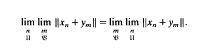
 on the natural numbers we have
Almost-Dedekind rings
-
- Journal:
- Glasgow Mathematical Journal / Volume 36 / Issue 1 / January 1994
- Published online by Cambridge University Press:
- 18 May 2009, pp. 131-134
-
- Article
-
- You have access
- Export citation
Discriminantal divisors and binary quadratic forms
-
- Journal:
- Glasgow Mathematical Journal / Volume 13 / Issue 1 / March 1972
- Published online by Cambridge University Press:
- 18 May 2009, pp. 69-73
-
- Article
-
- You have access
- Export citation
Pure-injective modules
-
- Journal:
- Glasgow Mathematical Journal / Volume 14 / Issue 2 / September 1973
- Published online by Cambridge University Press:
- 18 May 2009, pp. 120-122
-
- Article
-
- You have access
- Export citation
Rings which are nearly principal ideal domains
-
- Journal:
- Glasgow Mathematical Journal / Volume 40 / Issue 3 / September 1998
- Published online by Cambridge University Press:
- 18 May 2009, pp. 343-351
-
- Article
-
- You have access
- Export citation
A Fourier-Neumann series and its application to the reduction of triple cosine series
-
- Journal:
- Glasgow Mathematical Journal / Volume 14 / Issue 2 / September 1973
- Published online by Cambridge University Press:
- 18 May 2009, pp. 198-201
-
- Article
-
- You have access
- Export citation
-
The Jacobi expansion

is well known and easily obtained from the generating function of the Besselcoefficients. The sum of the series on the right of equation (1) when sin (n+½)x is replaced by cos (n+½)x cannot be found in this way but it can be expressed in terms of a definite integral as shown below. The result so obtained is useful in reducing certain triple cosine series to dual series and so simplifying the solution given by one of us for such series in an earlier paper [1].
A Simple proof of the Goldberg–Straus theorem on numerical radii
-
- Journal:
- Glasgow Mathematical Journal / Volume 28 / Issue 2 / July 1986
- Published online by Cambridge University Press:
- 18 May 2009, pp. 139-141
-
- Article
-
- You have access
- Export citation
-
Let Mn(ℂ) be the algebra of n × n complex matrices, and let
 be its unitary group. Given A, B ε Mn(ℂ), the A-numerical radius of B is the nonnegative quantity
In particular, for A = diag(1, 0, …, 0) it reduces to the classical numerical radius r(B) = max||x*Bx|:x*x = 1}. In [1] Goldberg and Straus proved that rA is a generalized matrix norm (i.e. a positive definite seminorm) on Mn(ℂ) if and only if A is nonscalar and tr A ≠ 0. This result agrees with the well-known fact that the classical numerical radius r is a generalized matrix norm. The nontrivial part of the proof is to show that if A is nonscalar and tr A ≠ 0 then rA is positive definite; that is, for any B ε Mn(ℂ), tr(AU*BU) = 0 for all U ε
implies B = 0. The proof given in [1] is computational and involves the use of differentiation on matrices. Later Marcus and Sandy [2] gave three elementary proofs of the result. Their proofs are still computational in nature and two of them need knowledge of multilinear algebra.
 be its unitary group. Given A, B ε M
