Refine search
Actions for selected content:
26076 results in Abstract analysis
Trace rings of generic matrices are unique factorization domains
-
- Journal:
- Glasgow Mathematical Journal / Volume 28 / Issue 1 / January 1986
- Published online by Cambridge University Press:
- 18 May 2009, pp. 11-13
-
- Article
-
- You have access
- Export citation
-
A. W. Chatters and D. A. Jordan defined in [0] a unique factorization ring to be a prime ring in which every height one prime ideal is principal. In this note we will prove that the trace ring of m generic n × n-matrices satisfies this condition.
Throughout this note, k will be a field of characteristic zero. Consider the polynomial ring S = k[
 ;1≤i, j≤n, 1≤l≤m] and the n × n matrices Xl =
  in Mn(S). The k-subalgebra of Mn(S) generated by {Xl; 1≤l≤m} is called the ring of m generic n × n matrices Gm,n. Adjoining to it the traces of all its elements we obtain the trace ring
  of m n × n generic matrices, cfr. e.g. [1].
 ;1≤i, j≤n, 1≤l≤m] and the n × n matrices X
 in M
in M of m n × n generic matrices, cfr. e.g. [1].
On right unipotent semigroups II
-
- Journal:
- Glasgow Mathematical Journal / Volume 19 / Issue 1 / January 1978
- Published online by Cambridge University Press:
- 18 May 2009, pp. 63-68
-
- Article
-
- You have access
- Export citation
Perfect Pell Powers
-
- Journal:
- Glasgow Mathematical Journal / Volume 38 / Issue 1 / January 1996
- Published online by Cambridge University Press:
- 18 May 2009, pp. 19-20
-
- Article
-
- You have access
- Export citation
Class groups and automorphism groups of group rings
-
- Journal:
- Glasgow Mathematical Journal / Volume 28 / Issue 1 / January 1986
- Published online by Cambridge University Press:
- 18 May 2009, pp. 79-86
-
- Article
-
- You have access
- Export citation
Averaging operators in non commutative Lp spaces II
-
- Journal:
- Glasgow Mathematical Journal / Volume 25 / Issue 1 / January 1984
- Published online by Cambridge University Press:
- 18 May 2009, pp. 121-126
-
- Article
-
- You have access
- Export citation
A contribution to the solution of the compact correction problem for operators on a Banach space
-
- Journal:
- Glasgow Mathematical Journal / Volume 31 / Issue 2 / May 1989
- Published online by Cambridge University Press:
- 18 May 2009, pp. 219-229
-
- Article
-
- You have access
- Export citation
Crack-like imperfections in a spherical shell†
-
- Journal:
- Glasgow Mathematical Journal / Volume 12 / Issue 1 / April 1971
- Published online by Cambridge University Press:
- 18 May 2009, pp. 65-88
-
- Article
-
- You have access
- Export citation
Primitive sequences whose elements have no large prime factors
-
- Journal:
- Glasgow Mathematical Journal / Volume 10 / Issue 1 / January 1969
- Published online by Cambridge University Press:
- 18 May 2009, pp. 10-15
-
- Article
-
- You have access
- Export citation
-
A sequence a1 < a2 < … of positive integers is said to be primitive if no element of the sequence divides any other. The study of primitive sequences arose naturally out of investigations into the subject of abundant numbers, where sequences each of whose elements is of the form
 , the pi being fixed primes, are of particular importance. Such a sequence is said to be built up from the primes p1…pr. Thus Dickson [1], in an early paper on abundant numbers, proved that a primitive sequence built up from a fixed set of primes is necessarily finite.
 , the p
E-unitary inverse semigroups over semilattices
-
- Journal:
- Glasgow Mathematical Journal / Volume 19 / Issue 1 / January 1978
- Published online by Cambridge University Press:
- 18 May 2009, pp. 1-12
-
- Article
-
- You have access
- Export citation
-
An inverse semigroup is called E-unitary if the equations ea = e = e2 together imply a2 = a. In a previous paper [4], the author showed that any E-unitary inverse semigroup is isomorphic to a semigroup constructed from a triple (G, ℋ,
 ) consisting of a down-directed partially ordered set ℋ, an ideal and subsemilattice of ℋ and a group G acting on ℋ, on the left, by order automorphisms in such a way that ℋ = G. This semigroup is denoted by P(G, ℋ, ); it consists of all pairs (a, g)∈ × G such that g−1a ∈ , under the multiplication
 ) consisting of a down-directed partially ordered set ℋ, an ideal and subsemilattice
A common generalization of local cohomology theories
-
- Journal:
- Glasgow Mathematical Journal / Volume 21 / Issue 1 / January 1980
- Published online by Cambridge University Press:
- 18 May 2009, pp. 173-181
-
- Article
-
- You have access
- Export citation
-
Throughout this note all rings considered will be commutative and noetherian and will have non-zero identity elements. A will always denote such a ring and the category of all A-modules and all A-homomorphisms will be denoted by
 A.
A.

A continuation theory for weakly inward maps
-
- Journal:
- Glasgow Mathematical Journal / Volume 40 / Issue 3 / September 1998
- Published online by Cambridge University Press:
- 18 May 2009, pp. 311-321
-
- Article
-
- You have access
- Export citation
Semi-normal operators on uniformly smooth Banach spaces
-
- Journal:
- Glasgow Mathematical Journal / Volume 32 / Issue 3 / September 1990
- Published online by Cambridge University Press:
- 18 May 2009, pp. 273-276
-
- Article
-
- You have access
- Export citation
Some finiteness conditions concerning intersections of conjugates of subgroups
-
- Journal:
- Glasgow Mathematical Journal / Volume 37 / Issue 3 / September 1995
- Published online by Cambridge University Press:
- 18 May 2009, pp. 327-335
-
- Article
-
- You have access
- Export citation
On the generalized Josephus problem
-
- Journal:
- Glasgow Mathematical Journal / Volume 14 / Issue 2 / September 1973
- Published online by Cambridge University Press:
- 18 May 2009, pp. 168-173
-
- Article
-
- You have access
- Export citation
-
The problem of Josephus and the forty Jewsis well known [1, 3]. In its most general form, this problem is equivalent to the problem of m-enumeration of a set, as described below.
Define the ordered set
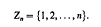
We choose and remove cyclically, from left to right, each with element of Zn until the set is exhausted. The chosen elements are ordered into a new ordered set

which is therefore a permutation of Zn, obtained by what we call m-enumeration of theset Zn.
Quotients of F-spaces
-
- Journal:
- Glasgow Mathematical Journal / Volume 19 / Issue 2 / July 1978
- Published online by Cambridge University Press:
- 18 May 2009, pp. 103-108
-
- Article
-
- You have access
- Export citation
Arithmetics in Cayley's algebra
-
- Journal:
- Proceedings of the Glasgow Mathematical Association / Volume 6 / Issue 2 / July 1963
- Published online by Cambridge University Press:
- 18 May 2009, pp. 99-106
-
- Article
-
- You have access
- Export citation
π-domains, overrings, and divisorial ideals
-
- Journal:
- Glasgow Mathematical Journal / Volume 19 / Issue 2 / July 1978
- Published online by Cambridge University Press:
- 18 May 2009, pp. 199-203
-
- Article
-
- You have access
- Export citation
Normal operators on Banach spaces
-
- Journal:
- Glasgow Mathematical Journal / Volume 20 / Issue 2 / July 1979
- Published online by Cambridge University Press:
- 18 May 2009, pp. 163-168
-
- Article
-
- You have access
- Export citation
-
A (bounded, linear) operator H on a Banach space
 is said to be hermitian if ∥exp(itH)∥ = 1 for all real t. An operator N on is said to be normal if N = H + iK, where H and K are commuting hermitian operators. These definitions generalize those familiar concepts of operators on Hilbert spaces. Also, the normal derivations defined in [1] are normal operators. For more details about hermitian operators and normal operators on general Banach spaces, see [4]. The main result concerning normal operators in the present paper is the following theorem.
 is said to be hermitian if ∥exp(itH)∥ = 1 for all real t. An operator N on
 GMJ volume 29 issue 2 Cover and Front matter
-
- Journal:
- Glasgow Mathematical Journal / Volume 29 / Issue 2 / July 1987
- Published online by Cambridge University Press:
- 18 May 2009, pp. f1-f2
-
- Article
-
- You have access
- Export citation
The convergence of least squares approximations for dual orthogonal series
-
- Journal:
- Glasgow Mathematical Journal / Volume 15 / Issue 1 / March 1974
- Published online by Cambridge University Press:
- 18 May 2009, pp. 82-84
-
- Article
-
- You have access
- Export citation
