Refine search
Actions for selected content:
26076 results in Abstract analysis
An Integral involving a Modified Bessel Function of the Second Kind and an E-function
-
- Journal:
- Proceedings of the Glasgow Mathematical Association / Volume 1 / Issue 3 / September 1953
- Published online by Cambridge University Press:
- 18 May 2009, pp. 119-120
-
- Article
-
- You have access
- Export citation
-
§ 1. Introductory. The formula to be established is

where m is a positive integer,

and the constants are such that the integral converges.
A note on groups with non-central norm
-
- Journal:
- Glasgow Mathematical Journal / Volume 36 / Issue 1 / January 1994
- Published online by Cambridge University Press:
- 18 May 2009, pp. 37-43
-
- Article
-
- You have access
- Export citation
A note on a pair of integral operators involving Whittaker functions
-
- Journal:
- Glasgow Mathematical Journal / Volume 18 / Issue 1 / January 1977
- Published online by Cambridge University Press:
- 18 May 2009, pp. 99-100
-
- Article
-
- You have access
- Export citation
-
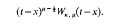
In recent years various authors have studied integral operators involving confluent hypergeometric functions Mκ,μ and Wκ,μ. Using the method devised by Fox [2], Saxena [5] obtained the inverse of an integral operator with kernel (xt) μ− ½e− ½xtWκ,μ (xt). Singh [6] derived the solution of an integral equation of convolution type with kernel
On the derivatives at the origin of entire harmonic functions
-
- Journal:
- Glasgow Mathematical Journal / Volume 20 / Issue 2 / July 1979
- Published online by Cambridge University Press:
- 18 May 2009, pp. 147-154
-
- Article
-
- You have access
- Export citation
-
If f is an entire function in the complex plane such that

where 0 ≤ α < 1, and all the derivatives of f at 0 are integers, then it is easy to show that f is a polynomial (see e.g. Straus [10]). The best possible result of this type was proved by Pólya [9]. The main aim of this paper is to prove two analogous results for harmonic functions defined in the whole of the Euclidean space Rn, where n ≥ 2 (i.e. entire harmonic functions).
On torsion-free hypercentral groups with all subgroups subnormal
-
- Journal:
- Glasgow Mathematical Journal / Volume 31 / Issue 2 / May 1989
- Published online by Cambridge University Press:
- 18 May 2009, pp. 193-194
-
- Article
-
- You have access
- Export citation
On embeddable finite amalgams of groups
-
- Journal:
- Glasgow Mathematical Journal / Volume 13 / Issue 2 / September 1972
- Published online by Cambridge University Press:
- 18 May 2009, pp. 135-141
-
- Article
-
- You have access
- Export citation
Propagation of a Boundary of Fusion
-
- Journal:
- Proceedings of the Glasgow Mathematical Association / Volume 1 / Issue 1 / January 1952
- Published online by Cambridge University Press:
- 18 May 2009, pp. 42-47
-
- Article
-
- You have access
- Export citation
-
We consider a volume of material, divided into two regions 1 and 2. each of density ρ, by a moving surface S. On S a change of phase occurs, at a definite temperature (which we may take to be zero) and with absorption or liberation of a latent heat L per unit mass. If θl, kl, K1 are the temperature, thermal conductivity and diffusivity of phase 1, and θ2, k2, K2 corresponding quantities for phase 2, the surface S is the isothermal

and the boundary condition on this surface is

Subscript letters denote partial differentiation.
GMJ volume 17 issue 1 Cover and Front matter
-
- Journal:
- Glasgow Mathematical Journal / Volume 17 / Issue 1 / January 1976
- Published online by Cambridge University Press:
- 18 May 2009, pp. f1-f7
-
- Article
-
- You have access
- Export citation
On p-injective rings
-
- Journal:
- Glasgow Mathematical Journal / Volume 37 / Issue 3 / September 1995
- Published online by Cambridge University Press:
- 18 May 2009, pp. 373-378
-
- Article
-
- You have access
- Export citation
On a class of QI-rings
-
- Journal:
- Glasgow Mathematical Journal / Volume 34 / Issue 1 / January 1992
- Published online by Cambridge University Press:
- 18 May 2009, pp. 75-81
-
- Article
-
- You have access
- Export citation
A note on the conditional chromatic polynomial
-
- Journal:
- Glasgow Mathematical Journal / Volume 36 / Issue 3 / September 1994
- Published online by Cambridge University Press:
- 18 May 2009, pp. 265-267
-
- Article
-
- You have access
- Export citation
On limit problems associated with some inequalities
-
- Journal:
- Glasgow Mathematical Journal / Volume 14 / Issue 2 / September 1973
- Published online by Cambridge University Press:
- 18 May 2009, pp. 123-127
-
- Article
-
- You have access
- Export citation
-
Let {an} be a sequence of non-negative real numbers. Suppose that
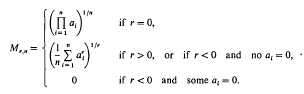
Then M1,n is the arithmetic mean, MO,n the geometric mean, and Mr,n the generalized mean of order r, of a1, a2, …, an. By a result of Everitt [1] and McLaughlin and Metcalf [5], {n(Mr,n–Ms,n)}, where r ≧ l ≧ s, is a monotonic increasing sequence. It follows that this sequence tends to a finite or an infinite limit as n → ∞. Everitt [2, 3] found a necessary and sufficient condition for the finiteness of this limit in the cases r, s = 1, 0 and r ≧ 1 > s > 0. His results are included in the following theorem.
GMJ volume 1 issue 2 Cover and Back matter
-
- Journal:
- Proceedings of the Glasgow Mathematical Association / Volume 1 / Issue 2 / July 1952
- Published online by Cambridge University Press:
- 18 May 2009, pp. b1-b2
-
- Article
-
- You have access
- Export citation
On Dirichlet series attached to cusp forms and the Siegel-zero
-
- Journal:
- Glasgow Mathematical Journal / Volume 25 / Issue 1 / January 1984
- Published online by Cambridge University Press:
- 18 May 2009, pp. 107-119
-
- Article
-
- You have access
- Export citation
-
Let k be an even integer greater than or equal to 12 and f an nonzero cusp form of weight k on SL(2, Z). We assume, further, that f is an eigenfunction for all Hecke-Operators and has the Fourier expansion

For every Dirichlet character xmod Q we define

Solution of the Word Problem for Certain Types of Groups I
-
- Journal:
- Proceedings of the Glasgow Mathematical Association / Volume 3 / Issue 1 / December 1956
- Published online by Cambridge University Press:
- 18 May 2009, pp. 45-54
-
- Article
-
- You have access
- Export citation
Substitutional lemma for G-spaces of 1-dimensional groups
-
- Journal:
- Glasgow Mathematical Journal / Volume 38 / Issue 2 / May 1996
- Published online by Cambridge University Press:
- 18 May 2009, pp. 215-220
-
- Article
-
- You have access
- Export citation
-
Let G be a compact Lie group and X a G-CW complex. We are interested in the calculation of the Borel cohomology of X

where EG is a universal free G-space and we use on the right hand side cellular cohomology. For an introduction to G-CW complexes see Matumoto [4] and for a good exposition on Borel cohomology see for instance torn Dieck [2], We want to replace X with an ordinary CW complex Y in order to find an ordinary CW structure on the Borel construction EG ΧGY so we can use cellular chains to compute the Borel cohomology of X. For every compact Lie group one has an extension

where G0 is the identity component, so for our case G0 is isomorphic to the circle group
 . We are dealing with the case in which π0(G) is isomorphic to C2, the cyclic group of order
 . We are dealing with the case in which π
On the kernels of representations of finite groups
-
- Journal:
- Glasgow Mathematical Journal / Volume 22 / Issue 2 / July 1981
- Published online by Cambridge University Press:
- 18 May 2009, pp. 151-154
-
- Article
-
- You have access
- Export citation
The 3-local cohomology of the Mathieu group M24
-
- Journal:
- Glasgow Mathematical Journal / Volume 38 / Issue 1 / January 1996
- Published online by Cambridge University Press:
- 18 May 2009, pp. 69-75
-
- Article
-
- You have access
- Export citation
-
In this paper we calculate the localisation at the prime 3 of the integral cohomology ring of the Mathieu group M24, together with its mod-3 cohomology ring. The main results are
Theorem 1. The ring H*(M24, Z)(3)is the commutative graded Z(3)-algebra with generators
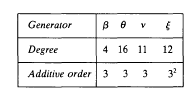
and relations v2 = 0 and βθ = 0. The Chern classes of the Todd representation in GL11F2
On permutation polynomials whose difference is linear
-
- Journal:
- Glasgow Mathematical Journal / Volume 32 / Issue 2 / May 1990
- Published online by Cambridge University Press:
- 18 May 2009, pp. 165-171
-
- Article
-
- You have access
- Export citation
GMJ volume 32 issue 2 Cover and Back matter
-
- Journal:
- Glasgow Mathematical Journal / Volume 32 / Issue 2 / May 1990
- Published online by Cambridge University Press:
- 18 May 2009, pp. b1-b2
-
- Article
-
- You have access
- Export citation
