Refine search
Actions for selected content:
26076 results in Abstract analysis
On some solutions of second order hyperbolic differential equations with constant coefficients
-
- Journal:
- Glasgow Mathematical Journal / Volume 29 / Issue 1 / January 1987
- Published online by Cambridge University Press:
- 18 May 2009, pp. 69-72
-
- Article
-
- You have access
- Export citation
-
If we seek solutions of the hyperbolic differential equation

which depend only on the variables i and
 , we see that these solutions must be even in r and satisfy the differential equation
The object of this paper is to show that some recent results in the fractional calculus can be used to prove the following theorem.
 , we see that these solutions must be even in r and satisfy the differential equation
Dirichlet and Poincaré series
-
- Journal:
- Glasgow Mathematical Journal / Volume 27 / October 1985
- Published online by Cambridge University Press:
- 18 May 2009, pp. 39-56
-
- Article
-
- You have access
- Export citation
-
The study of modular forms has been deeply influenced by famous conjectures and hypotheses concerning
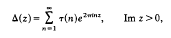
where T(n) denotes Ramanujan's function. The fundamental discriminant Δ is a cusp form of weight 12 with respect to the modular group. Its associated Dirichlet series

defines an entire function of s and satisfies the functional equation

The most penetrating statements that have been made on T(n) and LΔ(s)are:
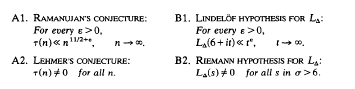
Of these four problems only A1 has been established so far. This was done by Deligne [1] using methods from algebraic geometry and number theory. While B1 trivially holds with ε > 1/2, it was established in [2] for every ε>1/3. Serre [12] proved A2 for a positive proportion of the integers and Hafner [5] showed that LΔ has a positive proportion of its non-trivial zeros on the line σ=6. The proofs of the last three results are largely analytic in nature.
An infinite construction in ring theory
-
- Journal:
- Glasgow Mathematical Journal / Volume 30 / Issue 3 / September 1988
- Published online by Cambridge University Press:
- 18 May 2009, pp. 349-357
-
- Article
-
- You have access
- Export citation
Generalized semigroups of quotients
-
- Journal:
- Glasgow Mathematical Journal / Volume 12 / Issue 2 / September 1971
- Published online by Cambridge University Press:
- 18 May 2009, pp. 150-161
-
- Article
-
- You have access
- Export citation
-
In ([6]; pages 36–41), Lambek constructs the maximal ring of quotients Q(R) of a commutative ring R by denning a multiplication on
 Homr(D, R) where D ranges over all the dense ideals of R, and this generalizes the classical construction of ring of quotients, (cf. [6] for all the references on the subject.)
This programme is carried over, in the first section of this article, to the categoryof commutative reductive semigroups. Examples show that the maximal semigroup of quotients of a commutative monoid can be different from the classical one.
 Hom
HomGMJ volume 12 issue 1 Cover and Back matter
-
- Journal:
- Glasgow Mathematical Journal / Volume 12 / Issue 1 / April 1971
- Published online by Cambridge University Press:
- 18 May 2009, pp. b1-b2
-
- Article
-
- You have access
- Export citation
The semigroup of continuous selfmaps of I has infinitely many ideals
-
- Journal:
- Glasgow Mathematical Journal / Volume 34 / Issue 1 / January 1992
- Published online by Cambridge University Press:
- 18 May 2009, pp. 27-33
-
- Article
-
- You have access
- Export citation
Limits of covering spaces and residual properties of groups
-
- Journal:
- Glasgow Mathematical Journal / Volume 36 / Issue 3 / September 1994
- Published online by Cambridge University Press:
- 18 May 2009, pp. 277-282
-
- Article
-
- You have access
- Export citation
Almost factorisable inverse semigroups
-
- Journal:
- Glasgow Mathematical Journal / Volume 36 / Issue 1 / January 1994
- Published online by Cambridge University Press:
- 18 May 2009, pp. 97-111
-
- Article
-
- You have access
- Export citation
Finite coverings by subgroups with a given property
-
- Journal:
- Glasgow Mathematical Journal / Volume 35 / Issue 2 / May 1993
- Published online by Cambridge University Press:
- 18 May 2009, pp. 179-188
-
- Article
-
- You have access
- Export citation
-
Let
 be a group-theoretic property. We say a group has a finite covering by
  -subgroups if it is the set-theoretic union of finitely many
  -subgroups. The topic of this paper is the investigation of groups having a finite covering by nilpotent subgroups, n-abelian subgroups or 2-central subgroups.
R. Baer [12; 4.16] characterized central-by-finite groups as those groups having a finite covering by abelian subgroups. In [6] it was shown that [G: ZC (G)] finite implies the existence of a finite covering by subgroups of nilpotency class c, i.e. ℜc-groups. However, an example of a group is given there which has a finite covering by ℜ2-groups, but Z2(G) does not have finite index in the group. These results raise two questions, on which we will focus our investigations.
 be a group-theoretic property. We say a group has a finite covering by
  -subgroups if it is the set-theoretic union of finitely many
  -subgroups. The topic of this paper is the investigation of groups having a finite covering by nilpotent subgroups, n-abelian subgroups or 2-central subgroups.
Conjugacy in groups with dihedral 3-normalisers
-
- Journal:
- Glasgow Mathematical Journal / Volume 18 / Issue 2 / July 1977
- Published online by Cambridge University Press:
- 18 May 2009, pp. 167-173
-
- Article
-
- You have access
- Export citation
Minimal line graphs
-
- Journal:
- Glasgow Mathematical Journal / Volume 17 / Issue 1 / January 1976
- Published online by Cambridge University Press:
- 18 May 2009, pp. 12-16
-
- Article
-
- You have access
- Export citation
-
In this paper all graphs will be ordinary graphs, i.e. finite, undirected, and without loops or multiple edges. For points x and y of a graph G, we shall indicate that x is adjacent to y by writing x ⊥ y, and if x is not adjacent to y we shall write x
 y. We shall denote the degree of a point x by δ(x) and the minimal degree of G by δ(G).
By the line graph of a graph G we shall mean the graph L(G) whose points are the edges of G, with two points of L(G) adjacent whenever they are adjacent in G. A graph G is said to be a line graph if there exists a graph H such that G = L(H).
 y. We shall denote the degree of a point x by δ(x) and the minimal degree of G by δ(G).
The Double Six of Lines and a Theorem in Euclidean Plane Geometry
-
- Journal:
- Proceedings of the Glasgow Mathematical Association / Volume 1 / Issue 1 / January 1952
- Published online by Cambridge University Press:
- 18 May 2009, pp. 1-7
-
- Article
-
- You have access
- Export citation
A characterization of the definiteness of a Hermitian matrix
-
- Journal:
- Glasgow Mathematical Journal / Volume 15 / Issue 1 / March 1974
- Published online by Cambridge University Press:
- 18 May 2009, pp. 1-4
-
- Article
-
- You have access
- Export citation
Normal-convex embeddings of inverse semigroups
-
- Journal:
- Glasgow Mathematical Journal / Volume 35 / Issue 1 / January 1993
- Published online by Cambridge University Press:
- 18 May 2009, pp. 115-121
-
- Article
-
- You have access
- Export citation
Solution of Irving's Ramsey problem
-
- Journal:
- Glasgow Mathematical Journal / Volume 21 / Issue 2 / July 1980
- Published online by Cambridge University Press:
- 18 May 2009, pp. 187-197
-
- Article
-
- You have access
- Export citation
Weight functions on extensions of the compound manual
-
- Journal:
- Glasgow Mathematical Journal / Volume 21 / Issue 2 / July 1980
- Published online by Cambridge University Press:
- 18 May 2009, pp. 97-101
-
- Article
-
- You have access
- Export citation
-
It has been shown ([8], [2], [1], [3], [9]) that a collection of physical operations or experiments can be represented by a nonempty set of nonempty sets satisfying certain technical conditions. Such a set
 is called a manual. The operations in are looked at as having no “before” and no “after”, i.e., they are isolated in time. If we wish to look at connected sequences of operations—in particular, if we wish to condition by events in —we must look at the compound manual c whose elements represent compound operations built up from the operations in the base manual .
 is called a manual. The operations in
 Automorphisms of normal partial transformation semigroups
-
- Journal:
- Glasgow Mathematical Journal / Volume 29 / Issue 2 / July 1987
- Published online by Cambridge University Press:
- 18 May 2009, pp. 149-157
-
- Article
-
- You have access
- Export citation
-
We let X be an arbitrary infinite set. A semigroup S of total or partial transformations of X is called
 -normal if hSh-1 = S, for all h in , the symmetric group on X. For example, the full transformation semigroup
  , the semigroup of all partial transformations
  , the semigroup of all 1–1 partial transformations
  and all ideals of
  and are -normal.
 -normal if hSh
 , the semigroup of all partial transformations
  , the semigroup of all 1–1 partial transformations
  and all ideals of
  and
and On the cohomology of loop spaces of compact Lie groups
-
- Journal:
- Glasgow Mathematical Journal / Volume 26 / Issue 1 / January 1985
- Published online by Cambridge University Press:
- 18 May 2009, pp. 91-99
-
- Article
-
- You have access
- Export citation
Idempotents in completely 0-simple semigroups
-
- Journal:
- Glasgow Mathematical Journal / Volume 19 / Issue 2 / July 1978
- Published online by Cambridge University Press:
- 18 May 2009, pp. 109-113
-
- Article
-
- You have access
- Export citation
A note on the joint operator norm of hermitian operators on Banach spaces
-
- Journal:
- Glasgow Mathematical Journal / Volume 34 / Issue 2 / May 1992
- Published online by Cambridge University Press:
- 18 May 2009, pp. 219-220
-
- Article
-
- You have access
- Export citation
-
Let X be a complex Banach space and H be a hermitian operator on X. Then in [7] Sinclair proved that r(H) = ¶H¶, where r(H) and ¶H¶ are the spectral radius and the operator norm of H, respectively.
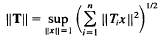
For a commuting n-tuple T = (T1,…, Tn) of operators on X, we denote the (Taylor) joint spectrum of T by σ(T) (see [9]) and define the joint operator norm ¶T¶ and the joint spectral radius r(T) by
and

respectively.
