Refine search
Actions for selected content:
26076 results in Abstract analysis
On the complexity of computing the 2-Selmer group of an elliptic curve
-
- Journal:
- Glasgow Mathematical Journal / Volume 39 / Issue 3 / September 1997
- Published online by Cambridge University Press:
- 18 May 2009, pp. 251-257
-
- Article
-
- You have access
- Export citation
-
In this paper we give an algorithm for computing the 2-Selmer group of an elliptic curve

which has complexity O(LD(0·5),c1)), where D is the absolute discriminant of the curve. Our algorithm is unconditional but the complexity estimate assumes the GRH and a standard conjecture on the distribution of smooth reduced ideals. This improves on the corresponding algorithm of Birch and Swinnerton-Dyer, which has complexity of O(√D).

Totally complex submanifolds of the Cayley projective plane
-
- Journal:
- Glasgow Mathematical Journal / Volume 40 / Issue 2 / May 1998
- Published online by Cambridge University Press:
- 18 May 2009, pp. 161-166
-
- Article
-
- You have access
- Export citation
Generation of the lower central series
-
- Journal:
- Glasgow Mathematical Journal / Volume 23 / Issue 1 / January 1982
- Published online by Cambridge University Press:
- 18 May 2009, pp. 15-20
-
- Article
-
- You have access
- Export citation
-
Let G be a group. The rth term LrG of the lower central series of G is the subgroup generated by the r-fold commutators

where
 , and for r > 1,
 , and for r > 1,
Matrices over orthomodular lattices
-
- Journal:
- Glasgow Mathematical Journal / Volume 10 / Issue 1 / January 1969
- Published online by Cambridge University Press:
- 18 May 2009, pp. 55-59
-
- Article
-
- You have access
- Export citation
On bornological products
-
- Journal:
- Glasgow Mathematical Journal / Volume 11 / Issue 1 / January 1970
- Published online by Cambridge University Press:
- 18 May 2009, pp. 37-40
-
- Article
-
- You have access
- Export citation
-
It is well known that, provided that the indexing set I is not too large, the product

of a family of bornological locally convex topological vector spaces Eαis bornological. Products of bornological spaces were first studied by Mackey [3]. He reduced the problem to the study of R1, showing that this space is bornological if and only if I satisfies a certain condition, related to a problem in measure theory posed by Ulam [5]. We shall therefore call it the Mackey-Ulam condition on I. A similar study of the spaces R1 is to be found in the paper [4] by Simons; see also [1, Ch. IV, §6, exercise 3].

Closable derivations of simple C*-algebras
-
- Journal:
- Glasgow Mathematical Journal / Volume 24 / Issue 2 / July 1983
- Published online by Cambridge University Press:
- 18 May 2009, pp. 181-183
-
- Article
-
- You have access
- Export citation
On Gordon's method of solving dual integral equations
-
- Journal:
- Proceedings of the Glasgow Mathematical Association / Volume 6 / Issue 3 / January 1964
- Published online by Cambridge University Press:
- 18 May 2009, pp. 117-122
-
- Article
-
- You have access
- Export citation
-
1. Dual integral equations of the form
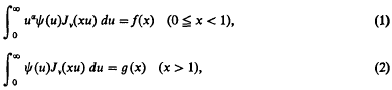
where f(x) and g(x) are given and Ψ(x) is the unknown, have been increasingly studied in recent years; the first solutions were given for the case g(x) ≡ 0 by Titchmarsh [1] (for 0 < α < 2) and Busbridge [2] (for — 2 < α < 0). An interesting and much simpler method of solving the equations in the same case, g ≡ 0, was given by Gordon [3]. He also showed that the problem of solving the general equations (1) and (2) can be reduced to a problem in which g ≡ 0. He did not pursue this idea as far as finding and simplifying the solution of (1) and (2) but this has been done recently (see [4]) and Noble [5] used a similar idea in treating the case f ≡ 0.
On a hyperlogistic delay equation
-
- Journal:
- Glasgow Mathematical Journal / Volume 38 / Issue 2 / May 1996
- Published online by Cambridge University Press:
- 18 May 2009, pp. 255-261
-
- Article
-
- You have access
- Export citation
-
Consider the following hyperlogistic equation

where r, K, τj ∈ (0, ∝), and αj = pj/qj are rational numbers with qj odd, pj and qj, are co-prime, 1 ≤ j ≤ m, and
 .
.
 .
.Addendum
-
- Journal:
- Glasgow Mathematical Journal / Volume 29 / Issue 2 / July 1987
- Published online by Cambridge University Press:
- 18 May 2009, p. 275
-
- Article
-
- You have access
- Export citation
Subnormality and generalized commutation relations of families of operators†
-
- Journal:
- Glasgow Mathematical Journal / Volume 32 / Issue 2 / May 1990
- Published online by Cambridge University Press:
- 18 May 2009, pp. 231-238
-
- Article
-
- You have access
- Export citation
Rings generated by their regular elements
-
- Journal:
- Glasgow Mathematical Journal / Volume 25 / Issue 1 / January 1984
- Published online by Cambridge University Press:
- 18 May 2009, pp. 1-5
-
- Article
-
- You have access
- Export citation
GMJ volume 38 issue 2 Cover and Back matter
-
- Journal:
- Glasgow Mathematical Journal / Volume 38 / Issue 2 / May 1996
- Published online by Cambridge University Press:
- 18 May 2009, pp. b1-b2
-
- Article
-
- You have access
- Export citation
On the generators of elementary subgroups of general linear groups
-
- Journal:
- Glasgow Mathematical Journal / Volume 38 / Issue 1 / January 1996
- Published online by Cambridge University Press:
- 18 May 2009, pp. 1-10
-
- Article
-
- You have access
- Export citation
-
Let R be a ring with identity and let Eij ∈ Mn(R) be the usual n X n matrix units, where n ≥ 2 and 1≤i, j≤N. Let En(R) be the subgroup of GLn(R) generated by all Tij(q where r ∈ R and i ≄ j. For each (two-sided) R-ideal q let En(R, q) be the normal subgroup of En(R) generated by Tij(q), where q ∈ q. The subgroup En(R, q) plays an important role in the theory of GLn(R). For example, Vaserˇstein has proved that, for a larger class of rings
 (which includes all commutative rings), every subgroup S of GLn(R), when R ∈ and n≥3, contains the subgroup En(R, q0), where q0 is the R-ideal generated by αij, rαij-αjjr (i ≄ j, r ∈ R), for all (αij) ∈ S. (See [13, Theorem 1].) In addition Vaseršstein has shown that, for the same class of rings, En(R, q) has a simple set of generators when n ≥ 3. Let Ên(R, q) be the subgroup of En(R, q) generated by Tij(r)Tij(q)Tij(−r), where r ∈ R, q ∈ q. Then Ên(R, q) = En(R, q), for all q, when R ∈ and n ≥ 3.(See [13, Lemma 8].)
 (which includes all commutative rings), every subgroup S of GL
On the order of the Sylow subgroups of the automorphism group of a finite group
-
- Journal:
- Glasgow Mathematical Journal / Volume 11 / Issue 2 / July 1970
- Published online by Cambridge University Press:
- 18 May 2009, pp. 88-96
-
- Article
-
- You have access
- Export citation
Quadratic algebras with few relations
-
- Journal:
- Glasgow Mathematical Journal / Volume 39 / Issue 3 / September 1997
- Published online by Cambridge University Press:
- 18 May 2009, pp. 323-332
-
- Article
-
- You have access
- Export citation
-
Throughout V will be a finite dimensional vector space over a field k and T(V) will denote the tensor algebra over V. For simplicity the symbol ⊗ will be omitted in the writing of the elements of T(V). Let
 be a basis of V ordered by Xi<Xi+1 for all i. Then we order the non-commutative monomials
  and 1 ≤ is ≤ n for s = 1,…, l} lexicographically from the left. D. Anick [1, p. 652] defines the high term of an element b in T(V) to be the highest monomial appearing in b. As a consequence of [1,3.2], if the set of the high terms of homogeneous relations is combinatorically free in the sense of no overlap ambiguities, then the connected algebra has global dimension 2. The purpose of this note is to prove this result and more for quadratic algebras under other hypotheses on the relations.
 be a basis of V ordered by X
 and 1 ≤ i
GMJ volume 14 issue 1 Cover and Front matter
-
- Journal:
- Glasgow Mathematical Journal / Volume 14 / Issue 1 / February 1973
- Published online by Cambridge University Press:
- 18 May 2009, pp. f1-f2
-
- Article
-
- You have access
- Export citation
Weak compactness in locally convex spaces
-
- Journal:
- Glasgow Mathematical Journal / Volume 9 / Issue 2 / July 1968
- Published online by Cambridge University Press:
- 18 May 2009, pp. 123-127
-
- Article
-
- You have access
- Export citation
Primitive Ore extensions
-
- Journal:
- Glasgow Mathematical Journal / Volume 18 / Issue 1 / January 1977
- Published online by Cambridge University Press:
- 18 May 2009, pp. 93-97
-
- Article
-
- You have access
- Export citation
On Tricomi's relation for the Hilbert transformation
-
- Journal:
- Glasgow Mathematical Journal / Volume 16 / Issue 1 / March 1975
- Published online by Cambridge University Press:
- 18 May 2009, pp. 52-56
-
- Article
-
- You have access
- Export citation
-
Tricomi [2] has shown that if φi ∈ Lpi (− ∞, ∞), i = 1, 2, where 1 < pi < ∞, (pi)–l + (P2)–1 < 1, and if H denotes the Hilbert transformation, that is

where the symbol (P) denotes that the integral is taken in the Cauchy principal value sense, then

GMJ volume 4 issue 3 Cover and Back matter
-
- Journal:
- Proceedings of the Glasgow Mathematical Association / Volume 4 / Issue 3 / January 1960
- Published online by Cambridge University Press:
- 18 May 2009, pp. b1-b2
-
- Article
-
- You have access
- Export citation
