Refine search
Actions for selected content:
26076 results in Abstract analysis
The modulus of near smoothness of the lp product of a sequence of Banach spaces
-
- Journal:
- Glasgow Mathematical Journal / Volume 39 / Issue 2 / May 1997
- Published online by Cambridge University Press:
- 18 May 2009, pp. 153-165
-
- Article
-
- You have access
- Export citation
Certain expansions involving E-functions
-
- Journal:
- Proceedings of the Glasgow Mathematical Association / Volume 3 / Issue 3 / December 1957
- Published online by Cambridge University Press:
- 18 May 2009, pp. 119-122
-
- Article
-
- You have access
- Export citation
-
The E-functions were defined by MacRobert [3] in 1937; they are denoted by E (p; αr: q; ps. z).
In § 3 of this paper, I prove a new expansion for E(p; αr: q; ps: z) which is similar to an expansion due to MacRobert [2], viz.,

where

On Hankel convolutors on certain Hankel transformable function spaces
-
- Journal:
- Glasgow Mathematical Journal / Volume 39 / Issue 3 / September 1997
- Published online by Cambridge University Press:
- 18 May 2009, pp. 351-369
-
- Article
-
- You have access
- Export citation
On a result of Johnson about Schur multipliers
-
- Journal:
- Glasgow Mathematical Journal / Volume 34 / Issue 3 / September 1992
- Published online by Cambridge University Press:
- 18 May 2009, p. 347
-
- Article
-
- You have access
- Export citation
The reckoning of certain quartic and octic Gauss sums
-
- Journal:
- Glasgow Mathematical Journal / Volume 18 / Issue 2 / July 1977
- Published online by Cambridge University Press:
- 18 May 2009, pp. 153-155
-
- Article
-
- You have access
- Export citation
On Riesz summability factors
-
- Journal:
- Proceedings of the Glasgow Mathematical Association / Volume 5 / Issue 4 / July 1962
- Published online by Cambridge University Press:
- 18 May 2009, pp. 188-196
-
- Article
-
- You have access
- Export citation
-
1. Suppose throughout that a, k are positive numbers and that p is the integer such that k—l≦p<k. Suppose also that φ(w), ψ(w) are functions with absolutely continuous (p+1)th derivatives in every interval [a, W] and that φ(w) is positive and unboundedly increasing. Let λ ={λn} be an unboundedly increasing sequence with λ1 > 0.
Given a series
 and a number m ≧0, we write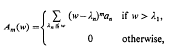
otherwise,
and A(w) = AO(w).
 and a number m ≧0, we write
A problem in lie rings
-
- Journal:
- Glasgow Mathematical Journal / Volume 21 / Issue 1 / January 1980
- Published online by Cambridge University Press:
- 18 May 2009, pp. 139-142
-
- Article
-
- You have access
- Export citation
Solution of the word problem for certain types of groups II
-
- Journal:
- Proceedings of the Glasgow Mathematical Association / Volume 3 / Issue 2 / June 1957
- Published online by Cambridge University Press:
- 18 May 2009, pp. 68-90
-
- Article
-
- You have access
- Export citation
The ideal lattice of an MS-algebra†
-
- Journal:
- Glasgow Mathematical Journal / Volume 30 / Issue 2 / May 1988
- Published online by Cambridge University Press:
- 18 May 2009, pp. 137-143
-
- Article
-
- You have access
- Export citation
On certain decompositional properties of von Neumann algebras
-
- Journal:
- Glasgow Mathematical Journal / Volume 29 / Issue 2 / July 1987
- Published online by Cambridge University Press:
- 18 May 2009, pp. 177-179
-
- Article
-
- You have access
- Export citation
Über Automorphiefaktoren und die Dedekindschen Summen
-
- Journal:
- Glasgow Mathematical Journal / Volume 11 / Issue 1 / January 1970
- Published online by Cambridge University Press:
- 18 May 2009, pp. 41-57
-
- Article
-
- You have access
- Export citation
-
Einleitung. Bei der Betrachtung automorpher Formen zu diskreten Untergruppen Г von SL2(R)mit nicht ganzzahligem Gewicht bzgl. des Automorphiefaktors J(A, z)=
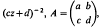 , hat man einen Zweig L(A, z) des Logarithmus von J(A, z)zu fixieren.
 , hat man einen Zweig L(A, z) des Logarithmus von J(A, z)zu fixieren.
A nontrivial T1-space admitting a unique quasi-proximity
-
- Journal:
- Glasgow Mathematical Journal / Volume 38 / Issue 2 / May 1996
- Published online by Cambridge University Press:
- 18 May 2009, pp. 207-213
-
- Article
-
- You have access
- Export citation
GMJ volume 2 issue 3 Cover and Back matter
-
- Journal:
- Proceedings of the Glasgow Mathematical Association / Volume 2 / Issue 3 / July 1955
- Published online by Cambridge University Press:
- 18 May 2009, pp. b1-b2
-
- Article
-
- You have access
- Export citation
A generalization of Clifford algebras
-
- Journal:
- Glasgow Mathematical Journal / Volume 15 / Issue 1 / March 1974
- Published online by Cambridge University Press:
- 18 May 2009, pp. 74-78
-
- Article
-
- You have access
- Export citation
Results on common fixed points on complete metric spaces
-
- Journal:
- Glasgow Mathematical Journal / Volume 21 / Issue 1 / January 1980
- Published online by Cambridge University Press:
- 18 May 2009, pp. 165-167
-
- Article
-
- You have access
- Export citation
-
The following theorem was proved in [1].
Theorem 1. Let S and T be continuous, commuting mappings of a complete, bounded metric space (X, d) into itself satisfying the inequality

for all x, y in X, where 0≤c<1 and p, p′, q, q′≥0 are fixed integers with p+p′, q+q′≥1. Then S and T have a unique common fixed point z. Further, if p′ or q′ = 0, then z is the unique fixed point of S and if p or q = 0, then z is the unique fixed point of T.
A note on the theorem of Jarník-Besicovitch
-
- Journal:
- Glasgow Mathematical Journal / Volume 39 / Issue 2 / May 1997
- Published online by Cambridge University Press:
- 18 May 2009, pp. 233-236
-
- Article
-
- You have access
- Export citation
Some integral equations involving finite parts of divergent integrals
-
- Journal:
- Glasgow Mathematical Journal / Volume 8 / Issue 1 / January 1967
- Published online by Cambridge University Press:
- 18 May 2009, pp. 50-54
-
- Article
-
- You have access
- Export citation
Integrals Involving E-Functions and Associated Legendre Functions
-
- Journal:
- Proceedings of the Glasgow Mathematical Association / Volume 2 / Issue 3 / July 1955
- Published online by Cambridge University Press:
- 18 May 2009, pp. 127-128
-
- Article
-
- You have access
- Export citation
-
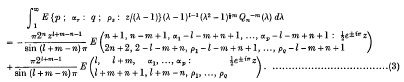
The formulae to be proved are as follows.
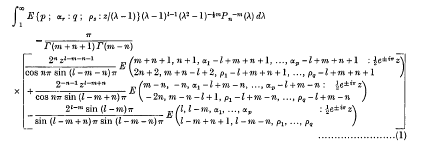
If p ≧ q + 1, R(l + m) > 0, R(αr − l − m + n)> −1, R(αr − l − m − n)> 0, r = 1,2,…p,
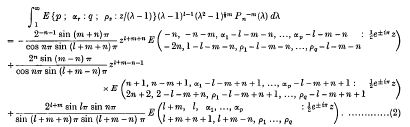
If p ≧ q + 1, R(l >0, R(l+m >0, R(αr − l − m + n)> −1,
Specht modules for finite reflection groups
-
- Journal:
- Glasgow Mathematical Journal / Volume 37 / Issue 3 / September 1995
- Published online by Cambridge University Press:
- 18 May 2009, pp. 279-287
-
- Article
-
- You have access
- Export citation
Integral operators involving Whittaker functions
-
- Journal:
- Glasgow Mathematical Journal / Volume 24 / Issue 2 / July 1983
- Published online by Cambridge University Press:
- 18 May 2009, pp. 139-148
-
- Article
-
- You have access
- Export citation
-
We define the integral operators
 and
and  as
as
and

where
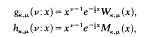
and Wk, u and Mk, u are the Whittaker's confluent hyper-geometric functions. These operators, in their slightly less general form, have been dealt with in [2] and [4]. There the authors have used the fact that these integral operators can be expressed as compositions of the Kober's fractional integral operators and the modified Laplace operator. Then these operators are inverted accordingly. Generally, this type of technique has been very useful for inverting many kinds of integral equations; and a good account of the procedures involved is given [5].
 and
and  as
as
